
QuickEHR • EHR and EMR software

Cloud EHR for US ambulatory clinics

Bring charting, scheduling, patient access, and your billing handoff together with an OpenEMR-based EHR and optional QuickIntell workflow modules.

Evaluate the $0 core EHR offer

QuickEHR advertises $0 core EHR software, migration, training, implementation and customization. Optional AI modules and RCM services are priced separately. Third-party charges, such as clearinghouse, payment-processing and e-prescribing fees, may still apply.Confirm hosting, support, deployment responsibilities, and the included work in your written proposal.

Review pricing and scope

Start with your specialty encounter, staff review requirements, source data, and billing workflow. Confirm integration access and acceptance checks before planning a cutover.

OpenEMR is the underlying software foundation, not evidence of QuickEHR customer deployments. Confirm the deployed version, enabled modules, and integration scope.

Review optional QuickScribe documentation, QuickCode coding, and QuickRCM billing workflows. Request the migration and ROI planning resource.

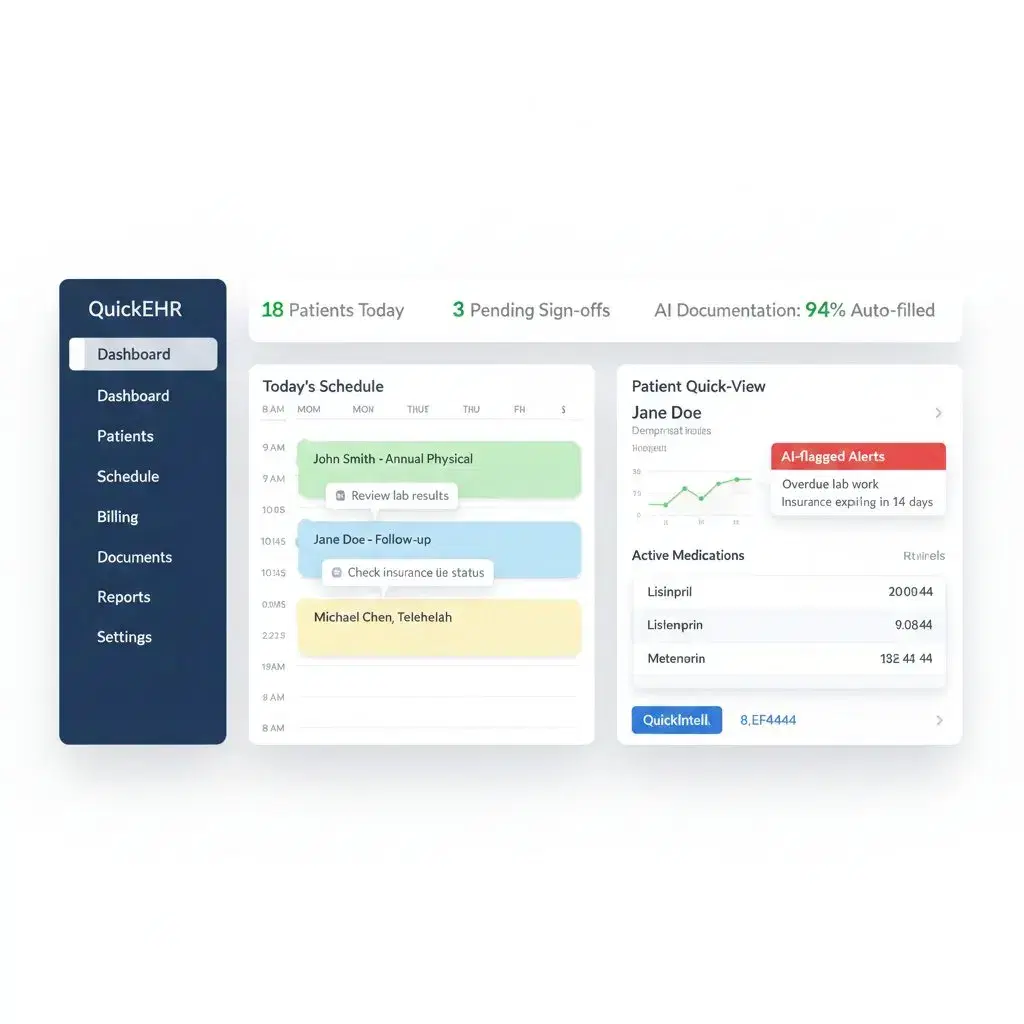
QuickEHR workflow illustration for charting and scheduling
Workflow illustration with sample records and figures. Request a product demo to review the proposed environment and staff approval steps.
Clinician and informatics specialists collaborating at a normal workstation

Two QuickEHR modes

Choose the EHR path that matches your clinic.

Evaluate QuickEHR as a cloud EHR or scope connections from your current EHR to QuickRCM.

Comparing EHR pricing models? Review QuickEHR pricing for the $0 EHR core, optional AI modules, OpenEMR-powered migration scope, RCM attach, and add-on planning.

Comparing EHR, AI, and RCM bundle options? Review QuickEHR bundles for OpenEMR-powered EHR, QuickScribe, QuickCode, QuickAuth, QuickRCM, QuickERA, billing, implementation, and support scoping.

Evaluating the hosted EHR model itself? Review QuickEHR cloud EHR for cloud based EHR software, OpenEMR-powered charting, AI automation, implementation planning, and connected RCM workflows.

Need the certification boundary before procurement review? See QuickEHR certification for the OpenEMR foundation, QuickIntell AI layer, and implementation evidence checklist.

Scoping access controls and MFA? Review QuickEHR security for EHR security, OpenEMR permissions, multi-factor authentication planning, audit trails, AI workflow controls, and Trust Center handoff.

Mapping historical Meaningful Use or current Promoting Interoperability readiness? Review QuickEHR meaningful use for OpenEMR-powered EHR workflows, patient access, documentation, AI automation, and implementation evidence review.

Planning quality reporting and value-based workflows? Review QuickEHR MIPS software for MIPS reporting, quality measure review, OpenEMR chart context, AI documentation, coding, registry handoff planning, and implementation evidence.

Building CQM and eCQM operating workflows? Review QuickEHR clinical quality measures for clinical quality measures software, OpenEMR chart context, AI-prepared documentation, coding review, reporting handoffs, and implementation evidence.

Managing vaccine registry workflows? Review QuickEHR immunization reporting for immunization reporting software, OpenEMR vaccine record context, IIS and state registry handoff planning, AI review queues, coding, RCM, and implementation evidence.

Need a real-time operating view? Review the QuickEHR dashboard for EHR dashboard workflows across schedules, tasks, patient chart context, AI automation, coding, authorization, RCM, and ERA follow-through.

Need healthcare BI and reporting? Review QuickEHR business intelligence for business intelligence software, practice management analytics, medical billing reporting, RCM analytics, OpenEMR-powered data scope, and reviewed AI insights.

Evaluating the provider-facing daily view? Review the QuickEHR physician dashboard for physician dashboard software across schedule triage, OpenEMR chart context, documentation, AI-prepared work, coding, prior authorization, RCM, ERA, and follow-up.

Evaluating provider-facing charting? Review QuickEHR clinical documentation for patient charts, specialty templates, AI note drafting, and downstream coding, prior authorization, RCM, and ERA workflows.

Building specialty note patterns? Review QuickEHR specialty templates for EHR templates, OpenEMR-powered chart context, AI documentation support, coding, authorization, RCM, and ERA handoff.

Organizing reusable template sets? Review the QuickEHR template library for clinical note templates, OpenEMR document-template planning, AI drafting, coding, authorization, RCM, and ERA handoff.

Need scannable patient summaries? See QuickEHR patient cards for OpenEMR-powered patient summary cards, chart context, AI work routing, coding, authorization, RCM, and ERA handoff.

Evaluating provider-facing patient charts? See QuickEHR patient charts for patient chart software, OpenEMR-powered charting, AI-assisted documentation, coding, prior authorization, RCM, and ERA workflow handoff.

Mapping care gaps and follow-up work? See QuickEHR patient health management for patient health management software, OpenEMR chart context, care-management worklists, AI automation, outreach, coding, authorization, RCM, and ERA handoff.

Planning panel-level value-based care workflows? See QuickEHR population health for population health management software, care-gap cohorts, risk stratification, OpenEMR chart context, quality-program handoffs, AI automation, risk adjustment, authorization, RCM, and ERA follow-through.

Evaluating home readings and RPM programs? See QuickEHR remote patient monitoring for remote patient monitoring software workflows, RPM device feeds, OpenEMR chart context, AI review queues, documentation, coding, authorization, RCM, and ERA handoff.

Planning outside-record workflows? See QuickEHR record locator exchange for OpenEMR-powered record locator exchange workflows, outside document review, AI summaries, chart reconciliation, and handoff into documentation, authorization, coding, RCM, and ERA work.

Mapping standards, APIs, and interface feeds? See QuickEHR interoperability for FHIR, HL7, CCD/C-CDA, OpenEMR APIs, QuickIntell adapters, AI automation, and implementation planning across clinical and revenue workflows.

Planning developer access, API scope, or sandbox validation? See QuickEHR open API for EHR API workflows, OpenEMR FHIR and Standard API planning, scoped credentials, sandbox testing, AI automation, and production readiness review.

Need a dedicated validation path before production launch? Review the QuickEHR testing sandbox for EHR testing sandbox workflows, OpenEMR API validation, synthetic chart scenarios, AI review gates, and go-live readiness planning.

Ready to request a specific API connection? Start the QuickEHR API connection request for EHR API integration intake, OpenEMR API integration scope, AI workflow handoff, credentials, testing, and implementation owner review.

Coordinating partner or developer implementation paths? See the QuickIntell EHR marketplace for partners for QuickEHR marketplace workflows, OpenEMR integrations, EHR API integration scoping, AI automation review gates, and Trust Center handoff.

Planning portability, migration, or exit rights? See QuickEHR data export for EHR data export software, OpenEMR export planning, C-CDA, FHIR export, CSV, data ownership review, AI-assisted validation, and implementation handoff.

Moving from a legacy EHR, OpenEMR tenant, or practice management system? See QuickEHR data conversion for EHR data conversion services, OpenEMR migration planning, data mapping, import testing, AI-assisted reconciliation, and billing continuity.

Evaluating mobile EHR software across clinicians and operations? See QuickEHR mobile for mobile EMR workflows around schedules, patient chart access, documentation handoff, AI automation, OpenEMR fit, and revenue follow-through.

Need clinician mobility? See QuickEHR clinical mobile app for mobile EHR workflows around schedules, patient chart context, messages, documentation handoff, AI automation, and connected revenue follow-through.

Planning patient-facing access? See QuickEHR patient portal software for intake forms, messages, selected results, billing questions, OpenEMR data access, and QuickIntell workflow routing.

Need a dedicated message-routing workflow? See QuickEHR patient messaging for patient messaging software, OpenEMR patient messaging context, AI triage, secure routing, audit trail planning, and staff review controls.

Comparing electronic prescribing workflows? See QuickEHR e-prescribing for medication renewals, OpenEMR chart context, EPCS planning, and the QuickIntell handoff into authorization, coding, RCM, and remittance work.

Need controlled-substance prescribing scope? See QuickEHR EPCS software planning for electronic prescribing of controlled substances, OpenEMR chart context, identity proofing review, two-factor workflow review, AI automation, and implementation evidence checks.

Building the front-desk workflow first? Review QuickEHR scheduling for medical scheduling software, patient self-scheduling, appointment reminders, OpenEMR scheduling, and the QuickIntell handoff into intake, authorization, coding, RCM, and ERA work.

Giving patients an online booking path? Review QuickEHR self-scheduling for patient self scheduling software, clinic-controlled visit rules, intake, reminders, OpenEMR chart context, AI automation, authorization, RCM, and ERA follow-through.

Need coverage checks inside the EHR workflow? Review QuickEHR eligibility verification for insurance eligibility verification software, OpenEMR coverage context, real-time checks, batch pre-visit review, AI exception triage, authorization, RCM, and ERA handoff.

Planning the full front-to-back practice workflow? Review QuickEHR practice management for practice management software across scheduling, intake, eligibility, authorization, documentation handoff, billing, claims, payments, denials, OpenEMR fit, and AI automation.

Connecting documentation to code review? Review QuickEHR medical coding for medical coding software workflows, OpenEMR chart context, QuickCode suggestions, claim readiness, AI review queues, QuickRCM denials, and QuickERA remittance feedback.

Mapping electronic claim submission inside the EHR? Review QuickEHR electronic claims for electronic claims software, OpenEMR claim context, claim scrubbing, payer and clearinghouse routing, status repair, denials, RCM, and ERA handoff.

Routing records, referrals, and payer documents by fax? Review QuickEHR electronic faxing for electronic faxing software, OpenEMR chart attachments, AI document classification, referral and records workflows, prior authorization evidence, billing documents, RCM, and ERA handoff.

Planning the clearinghouse layer around claims and remittance? Review QuickEHR clearinghouse for medical billing clearinghouse software workflows, OpenEMR-powered claim readiness, EDI or payer routing, status repair, QuickRCM, QuickERA, and AI exception triage.

Mapping the claim workflow inside the EHR? Review QuickEHR claims management for medical claims management software, claim scrubbing, electronic claims submission, OpenEMR claim context, denials, RCM, and ERA handoff.

Managing aging claims and patient balances from the EHR? Review QuickEHR accounts receivable for accounts receivable software, OpenEMR billing context, AR follow-up, denials, payment posting exceptions, QuickRCM, and QuickERA handoff.

Need electronic remittance inside the EHR workflow? Review QuickEHR ERA posting for ERA posting software, electronic remittance advice, OpenEMR billing context, AI-assisted payment posting, QuickERA EOB-to-ERA conversion, QuickRCM denials, and patient balance handoff.

Need a dedicated pre-submit scrub? Review QuickEHR claims scrubbing for claims scrubbing software, claim scrubber checks, payer-edit routing, AI triage, OpenEMR chart context, and QuickRCM follow-through.

Need the pre-submit review layer? Review QuickEHR claims review for claims review software, claim scrubbing, exception routing, OpenEMR chart context, AI triage, denial feedback, and QuickERA handoff.
QuickEHR Cloud

The $0 EHR for clinics that don't have one.

Replace paper workflows or an aging system with a managed,OpenEMR-based cloud EHR that includes scheduling, clinical documentation, billing workflows, and QuickIntell automation.

See the dedicated cloud based EHR page for deployment fit, security planning, AI workflow boundaries, OpenEMR architecture, and migration questions.

  • Advertised $0 core license; agree on standard migration, training, hosting, and additional charges.
  • Hosted charting, scheduling, billing, and RCM workflows in one cloud platform.
QuickEHR Connect

Connected workflows for clinics keeping their current EHR.

Keep your system of record and assess the data needed by QuickRCM. Confirm source-system permissions, available interfaces, field mapping, write-back scope, and exception ownership with a representative connection test.

Teams comparing EHR replacements can review the QuickEHR vs Athena and QuickEHR vs Kareo migration tradeoffs before planning a switch.

  • Built for clinics that need QuickRCM automation without replacing their EHR.
  • Evaluate available FHIR, HL7, or REST interfaces, approved resources, direction of data flow, and reconciliation requirements for the proposed connection.

What is an AI-powered EHR integration layer?

An EHR integration layer links approved clinical and billing data with revenue cycle workflows. For QuickEHR Connect, evaluate the source EHR version, licensed interface access, supported resources, mapping, sync cadence, and write-back permissions. Test representative demographics, encounters, claim status, and payment information with the proposed connection. Staff need a documented process for conflicts, failed syncs, and records that cannot be transferred. The implementation schedule follows these dependencies and clinic acceptance checks.

Bring your clinical and revenue workflows into scope

For provider organizations evaluating an EHR change, the key questions include charting fit, scheduling, patient access, billing continuity, total cost, and the staff effort needed to handle exceptions.

⚠️

The Problem

  • •License, hosting, add-on, and third-party costs to compare
  • •Migration scope, export access, and staff training needs
  • •Specialty charting and provider review requirements
  • •Manual billing and AR follow-up consuming staff time
  • •Automation output that staff must validate and approve

Document your current workload and unresolved handoffs before evaluating a replacement.

✨

The QuickEHR Solution

Scope the offering around the clinic workflow:

  • ✓$0 EHR Core – Advertised $0 core license; confirm included functions and operating costs
  • ✓AI-First Design – Optional modules with defined staff approvals and exception handling
  • ✓OpenEMR Foundation – Review the deployed version, supported interfaces and configured workflows for your practice
  • ✓Migration & Training – Advertised $0 standard scope; agree on included tasks and exclusions

Evaluate the proposed environment with your clinicians, front-desk staff, billing team, and IT owners.

Questions to compare across EHR proposals

Total operating cost

Compare the core license, selected modules, hosting, implementation, third-party fees, and ongoing staff effort.

Specialty workflow fit

Run the same representative encounter and patient access tasks in each proposed environment. Record missing functions and required configuration.

Automation and review

Identify automation inputs, staff approval steps, exception queues, audit evidence, and connection requirements.

Define the outcomes your pilot will measure

Use your current workflow as the baseline. Measure staff effort, quality, billing exceptions, and total cost before expanding automation.

⏱️

Review documentation effort

Compare chart completion, provider edits, and review time using representative encounters

💰

Measure the billing handoff

Track missing information, claim exceptions, and staff resolution steps against a defined baseline

📅

Evaluate patient access

Test scheduling, reminders, and intake with your appointment rules and patient communication requirements

👥

Map staff responsibilities

Define routine tasks, approvals, and exceptions so your team knows what requires human review

💵

Compare total operating cost

Start with the advertised $0 core license and itemize hosting, migration, training, modules, and third-party charges

🤝

White-Glove Support

Agree on implementation tasks, training, support hours, escalation, and infrastructure responsibilities

Build a practice-specific business case

Financial measures

  • ✓Compare license costs and all proposed fees
  • ✓Measure collections for a defined claim cohort
  • ✓Track aging and follow-up workload
  • ✓Include staff review and exception effort

Workflow measures

  • ✓Measure provider documentation and edit time
  • ✓Compare chart completion and quality
  • ✓Track no-shows and reminder handling
  • ✓Separate claim rejections from payer denials

EHR migration and implementation planning

Agree on source exports, validation, integration access, staff training, and acceptance criteria before setting the go-live date

📞
Step 1

Workflow discovery

We learn about your specialties, volumes, current systems, and biggest pain points.

🎯
Step 2

Tailored Demo

Review your specialty encounter, scheduling, patient access, billing handoff, and staff approvals in the proposed environment.

📋
Step 3

Commercial & Migration Plan

You get a clear proposal for $0 core EHR, optional AI and RCM modules, migration scope, timelines, and milestones.

🧪
Step 4

Sandbox & Pilot

You test workflows in a sandbox or with a limited provider group.

🚀
Step 5

Full Migration, Training & Go-Live

Complete agreed migration and training tasks, resolve exceptions, and obtain clinic acceptance before cutover.

What determines the migration schedule

Solo provider

Export readiness

Confirm record types, available exports, mapping, and the clinic acceptance owner

5–10 providers

Staff validation

Plan role-specific walkthroughs, sample reconciliation, and billing continuity checks

Multi-site group

Site coordination

Agree on location-specific interfaces, access, cutover sequence, and escalation

Define the standard migration and training scope

✓Data discovery + mapping workshops
✓Coordination with your current EHR vendor for data extracts
✓Transformation and validation of patient data, encounters, and documents
✓Environment setup & configuration
✓User provisioning and role setup
✓Test migrations into a sandbox environment
✓Training for providers, front desk, and billing teams
✓Hypercare support during go-live

The advertised offer includes $0 core EHR software, migration, training, implementation and customization. Agree on source inventory, validation, responsibilities, and acceptance criteria in the proposal. Optional AI modules and RCM services are priced separately. Third-party charges, such as clearinghouse, payment-processing and e-prescribing fees, may still apply. Confirm any source-vendor export charges separately.

Evaluate the configuration your clinic will use

Review the actual deployment, data flows and responsibilities before making a decision. These are evaluation inputs, not customer results or verification badges.

Clinician and informatics specialists collaborating at a normal workstation
  • Deployment and version

    Identify the QuickEHR deployment, underlying OpenEMR version and enabled modules. Ask the product owner to demonstrate your required workflow in the proposed configuration; a software foundation does not verify a particular deployment.

  • Interfaces and data direction

    Confirm the source system, supported resources and whether each flow reads data, writes data or does both. Review field mappings and the intended destination. Verify the receiving system's acknowledgement rather than treating a sent request as a completed update.

  • Migration and reconciliation

    Agree which records and date ranges are in scope, who resolves field conflicts and how migrated records will be reconciled. Use approved test data and record unresolved exceptions before deciding whether the configured workflow is ready.

  • Roles and human review

    Define the people responsible for each task, the minimum access they need and the actions requiring approval. Test read, write, approval and export permissions with your administrator; a described role is not proof that the deployed access rules are correct.

  • Security and agreement scope

    Request the applicable security materials and agreements for the actual product, legal entity and deployment. Review coverage, dates, exceptions and responsibilities before sharing restricted records; this checklist is not a control attestation or permission to process PHI.

  • Customer evidence and evaluation

    Ask for relevant, permissioned customer references and the scope and date of any deployment evidence. Define your own workflow baseline, evaluation period and acceptance criteria instead of substituting another product's adoption figures for your results.

Basis: internal QuickIntell training manual sections 23 (EHR integration) and 35 (organization and roles), covering configuration, field mappings, write-back acknowledgement and access review. Internal workflow documentation does not establish current availability for your organization or validate the configuration you will receive.

Customer names, logos, case studies and verification marks need supporting evidence and publication permission. This evaluation guidance does not supply those approvals or replace a customer reference. Use approved channels for restricted records; do not send patient information or access credentials through a public enquiry.

How QuickEHR Compares

Compare QuickEHR with Athena, eClinicalWorks, Kareo / Tebra and DrChrono. A $0 core license, a per-provider bundle and a collections-based service are different offers. Match the modules and implementation scope before comparing total cost.

Sources checked . This is a comparison of published descriptions, not a hands-on product test or an endorsement. Confirm current terms with each vendor.

Scroll sideways to compare all seven criteria. Keyboard: focus the table region and use the left and right arrow keys.

EHR pricing, AI workflows, certification disclosures and FHIR evidence
VendorLicense FeeMigration CostAI ScribeAI CodingVoice AgentsONC-CertifiedFHIR-Native
QuickEHR

$0 core EHR license; optional modules, services and third-party costs scoped separately.

Confirm the included migration, training and source-data scope in your proposal.

QuickScribe is an optional documentation module.

QuickCode is an optional coding-review module.

Optional voice-agent workflows; confirm configuration and usage scope.

OpenEMR foundation: verify the exact version and implementation packet. AI modules are not separate ONC certification claims.

OpenEMR FHIR APIs described; native-core architecture not established by this comparison.

Athena / athenaOne

Collections-aligned pricing; request the applicable rate and package in a proposal.

Implementation and data-mapping services described; migration fee not specified in the reviewed overview.

Ambient Notes described; confirm package and availability.

Express Coding provides AI-assisted coding support; confirm scope.

Patient Conversations text/chat described; virtual-front-desk voice is still marked as forthcoming on the reviewed product page.

Version-specific athenaClinicals certification disclosures published; verify the current product record.

FHIR APIs documented; native-core architecture not established by the reviewed sources.

eClinicalWorks

EHR only $499 or EHR + practice management $599 per provider/month; confirm AI and service scope separately.

Existing-EHR migration advertised as free; check implementation, training and other listed exceptions.

Sunoh.ai medical scribe described; confirm commercial terms.

Agentic AI for RCM analyzes progress notes for E/M and CPT code recommendations.

healow Genie contact center supports voice and other patient communication channels.

Certified EHR versions and additional-cost disclosures published; verify the selected version and criteria.

Certified patient, provider and bulk FHIR APIs described; this is not proof of native-core architecture.

Kareo / Tebra

Standard physician Practice Essentials: $599 per provider/month. Provider type, volume and bundle change the price.

Data-import fees depend on volume and complexity; request an itemized quote.

AI Note Assist drafts notes in the EHR; confirm bundle and note-usage fees.

AI Note Assist suggests diagnoses and ICD-10 codes for provider review.

AI Voice Assistant handles supported administrative calls and transfers exceptions to staff.

Tebra EHR 5.1 certification details published; verify the current product, criteria and required additional software.

FHIR API documentation published; native-core architecture not established by the reviewed sources.

DrChrono

Foundation, Growth and Premium plans are quoted; request the provider and transaction scope.

May be free or carry an additional fee depending on the format of transferred data.

EverHealth Scribe listed as an add-on in Foundation/Growth and included in Premium.

EverHealth Scribe suggests ICD-10 codes; confirm the coding workflow and review requirements.

Phone reminders documented; a conversational front-desk AI agent was not confirmed in the reviewed sources.

EHR 11.0 certification details published; verify the current version and required additional software.

FHIR access through ConnectEHR described; not a verified FHIR-native core claim.

Compare the whole proposal

Use the same provider count, provider type, claim volume and modules. Ask about data export and import, training, interfaces, support, third-party charges and AI usage fees. A quoted price is not zero, and an unconfirmed capability is not a missing feature.

Understand the evidence limits

ONC-Certified refers to version-specific disclosures, not every module or configuration. FHIR-Native asks about architecture: documented FHIR APIs alone do not establish a FHIR-native core for any vendor in this table. AI drafts and coding suggestions require appropriate human review; validate the intended workflow and staff handoffs in a scoped demonstration.

Discuss your QuickEHR evaluation scope · Review QuickEHR pricing details

AI EHR Features: Automation for Front Desk, Providers & RCM

Review the core EHR and selected modules in the proposed environment before deciding on rollout

Core EHR functions to review

Confirm the following functions and their configuration in the advertised $0 core license scope

Core EHR

  • ✓Patient demographics, charts, histories, problems, meds, allergies, immunizations
  • ✓Encounter documentation with specialty-ready templates
  • ✓Multi-provider, multi-location scheduling
  • ✓Basic billing & claims workflows

Patient Portal

  • ✓View results & visit summaries
  • ✓Request appointments and refills
  • ✓Basic secure messaging

Connectivity & Reports

  • ✓Standard lab, imaging, and pharmacy connections (where supported)
  • ✓Standard clinical and financial reports

Hosting, Security & Updates

  • ✓Cloud hosting, backups, patches, and upgrades
  • ✓Role-based access controls and audit logs

Optional AI and connected workflow modules

Demonstrate selected modules, dependencies, staff approvals, and exception handling

Front Desk & Access

  • ✓AI Appointment Scheduling – Handles inbound calls, portal requests, and website chat
  • ✓Automated Reminders & Instructions – SMS/voice/email reminders with pre-visit instructions
  • ✓Self Check-In & Digital Intake – Kiosk, tablet, or mobile check-in with demographics & insurance verification

Clinical Workflows

  • ✓AI Visit Prep – Summarizes key issues, meds, labs, and recent visits before the encounter
  • ✓QuickScribe clinical documentation – Listens and generates structured notes in your template format
  • ✓Smart Order & Problem Suggestions – Suggests likely orders, diagnoses, and care plan elements

Billing, Coding & RCM

  • ✓Automated Coding Suggestions (ICD, CPT, HCPCS, DRG) – QuickCode AI medical coding inside EHR based on documentation
  • ✓Claim Scrubbing & Denial Prediction – Builds claims with payer-specific rules and flags likely denials
  • ✓ERA Posting & AR Worklists – Prioritizes claims for follow-up with AI-suggested appeal strategies

Everything AI Does Is:

📋

Logged & Traceable

Everything AI does is logged with traceable inputs and outputs for compliance and auditing

⚙️

Configurable

Assist-only vs autopilot modes for low-risk workflows, fully customizable to your needs

👤

Fully Overrideable

Your staff always has final review and override authority—AI assists, never replaces judgment

How QuickEHR Makes Money

Optional modules and services are scoped and priced separately:

•AI-Assisted Coding & Charge Capture – Powered by our AI medical coding engine
•AI Voice Agents for scheduling, reminders, and AR calling
•Advanced Analytics & BI

Request the pricing basis, included usage, minimums, and third-party charges for each selected module or service. Compare the proposal with measured staff effort, quality, and business outcomes.

Security, certification, and data ownership review

Evaluate the proposed deployment with your security and privacy team. Review the QuickIntell trust center for the evidence request process. The OpenEMR project publishes its current certification details. Confirm the customer deployment version and scope before procurement sign-off.

🔒

Security and privacy review

  • ✓Review the BAA, hosting scope, and subcontractors
  • ✓Demonstrate role permissions, authentication, and audit access
  • ✓Confirm encryption, backups, retention, and incident responsibilities
📋

OpenEMR certification boundary

  • ✓OpenEMR lists version 8 as certified and version 7 as retired
  • ✓Check the proposed version, current CHPL listing, and certified criteria
  • ✓Review QuickIntell AI modules and third-party dependencies separately
☁️

Security evidence

  • ✓Request current documentation for the proposed environment
  • ✓Confirm the entity, systems, period, and scope of any attestation
  • ✓Agree on evidence access and security review ownership
📤

Governance and recovery

  • ✓Name access, change, and escalation owners
  • ✓Agree on backup testing and recovery objectives
  • ✓Document data rights, export scope, and exit assistance

Plan data access and exit responsibilities

Agree on export scope, formats, timing, fees, and transition support. Test representative clinical records, documents, and financial data before adoption.

📤

Test Export Coverage

Validate covered record types and formats

🔓

Review Exit Terms

Confirm notice, access, and transition obligations

🤝

Migration Support

We can optionally assist with data migration

QuickEHR buyer questions

Get detailed answers to all your questions about QuickEHR

Understanding QuickEHR and its core value proposition

Still have questions? We're here to help you make the right decision for your practice.

QuickEHR Powers the Full QuickIntell Platform

QuickEHR Cloud EHR

Cloud based EHR software for OpenEMR-powered charting, QuickIntell AI automation, implementation planning, security review, and connected RCM workflows.

QuickRCM — End-to-End AI RCM

QuickEHR feeds data directly into QuickRCM for end-to-end revenue cycle automation.

QuickScribe — AI Medical Scribe

AI clinical documentation that syncs notes back to your EHR via QuickEHR integration.

QuickCode — AI Medical Coding

Pull encounter data from your EHR for automated ICD-10 and CPT coding.

QuickAuth — Prior Authorization

EHR-integrated prior auth that gathers clinical data automatically for PA submissions.

QuickEHR Certification

Understand the OpenEMR foundation, AI automation boundary, and implementation evidence.

QuickEHR Security

EHR security workflows for MFA planning, OpenEMR permissions, audit trail readiness, AI controls, and Trust Center review.

QuickEHR Dashboard

EHR dashboard workflows for schedules, patient chart context, tasks, AI automation, coding, prior auth, RCM, and ERA follow-up.

QuickEHR Physician Dashboard

Provider-facing dashboard workflows for schedule triage, patient chart context, documentation, AI worklists, coding, prior auth, RCM, and ERA follow-through.

QuickEHR Meaningful Use

Meaningful use EHR workflows for OpenEMR-powered charting, patient access, AI automation, and implementation evidence review.

QuickEHR MIPS Software

MIPS reporting workflows for quality measures, OpenEMR chart context, AI documentation, coding, registry handoff planning, and implementation evidence.

QuickEHR Clinical Documentation

Provider-facing patient charts, AI note drafting, templates, coding, authorization, and RCM follow-through.

QuickEHR Specialty Templates

EHR templates for specialty documentation, OpenEMR chart context, AI note drafting, coding, prior authorization, RCM, and ERA handoff.

QuickEHR Template Library

Reusable EHR template library workflows for clinical note templates, OpenEMR planning, AI drafting, coding, authorization, RCM, and ERA handoff.

QuickEHR Patient Cards

Digital patient summary cards for OpenEMR chart context, AI work routing, coding, authorization, RCM, and ERA handoff.

QuickEHR Patient Charts

Patient chart software for OpenEMR-powered clinical charting, AI documentation, coding, authorization, RCM, and ERA handoff.

QuickEHR Patient Health Management

Patient health management software for care gaps, follow-up tasks, OpenEMR chart context, AI automation, coding, authorization, RCM, and ERA handoff.

QuickEHR Population Health

Population health management software for cohorts, care gaps, risk stratification, OpenEMR chart context, quality-program handoffs, AI automation, risk adjustment, RCM, and ERA follow-through.

QuickEHR Interoperability

FHIR, HL7, CCD/C-CDA, OpenEMR APIs, QuickIntell adapters, and AI workflow routing for clinical and revenue data exchange.

QuickEHR Open API

EHR API workflows for OpenEMR-powered QuickEHR, scoped API access, sandbox validation, developer planning, and QuickIntell AI automation.

QuickEHR Testing Sandbox

EHR testing sandbox workflows for OpenEMR API validation, chart scenarios, AI review gates, group-practice rollout, and production readiness evidence.

QuickEHR API Connection Request

EHR API integration intake for OpenEMR-powered QuickEHR, request scope, credentials, testing, AI handoffs, and implementation owner review.

QuickEHR Data Export

EHR data export software for OpenEMR-powered portability, C-CDA, FHIR export, CSV, data ownership review, exit rights, and AI-assisted validation.

QuickEHR Data Conversion

EHR data conversion services for OpenEMR, legacy EHR, PM, billing, claims, chart documents, AI-assisted reconciliation, and go-live continuity.

QuickEHR Scheduling

Medical scheduling, patient self-scheduling, appointment reminders, OpenEMR context, and connected revenue workflows.

QuickEHR Self-Scheduling

Patient self scheduling software for online booking, clinic rules, intake, reminders, OpenEMR context, AI automation, authorization, RCM, and ERA handoff.

QuickEHR Eligibility Verification

Insurance eligibility verification software for OpenEMR schedules, real-time checks, batch review, AI exception triage, RCM, and ERA handoff.

QuickEHR Medical Coding

Medical coding software workflows for OpenEMR-powered chart context, QuickCode suggestions, coding review, claim readiness, denials, and ERA feedback.

QuickEHR Electronic Claims

Electronic claims software for OpenEMR-powered claim context, claim scrubbing, submission routing, status repair, denials, RCM, and ERA handoff.

QuickEHR Electronic Faxing

Electronic faxing software for OpenEMR-powered chart attachments, records, referrals, payer letters, authorization evidence, billing documents, RCM, and ERA handoff.

QuickEHR Clearinghouse

Medical billing clearinghouse software workflows for claim readiness, EDI or payer routing, status repair, ERA/EOB handoff, QuickRCM, QuickERA, and OpenEMR-powered context.

QuickEHR Claims Management

Medical claims management software for claim scrubbing, electronic submission, denials, OpenEMR context, RCM, and ERA handoff.

QuickEHR Accounts Receivable

Accounts receivable software for OpenEMR-powered billing, aging claims, AR follow-up, denials, payment posting exceptions, patient balances, QuickRCM, and QuickERA.

QuickEHR ERA Posting

ERA posting software for electronic remittance advice, OpenEMR-powered billing, AI-assisted payment matching, QuickERA, QuickRCM denials, and patient balance handoff.

QuickEHR Claims Scrubbing

Claims scrubbing software for pre-submit claim edits, payer requirements, missing evidence, AI triage, and OpenEMR-powered billing context.

QuickEHR Claims Review

Claims review software for pre-submit claim checks, claim scrubbing, exception routing, AI triage, denial feedback, and OpenEMR-powered chart context.

QuickEHR Clinical Mobile App

EHR mobile app workflows for clinicians reviewing schedules, patient chart context, messages, documentation handoff, and AI automation on the go.

QuickEHR E-Prescribing

OpenEMR-powered medication context, renewals, EPCS planning, and connected authorization, coding, RCM, and ERA workflows.

Ready to See QuickEHR in Action?

If you want an EHR that:

  • Advertises a $0 core software license,
  • Fits your clinical and administrative workflow, and
  • Connects selected automation with staff review,

then it's time to look at QuickEHR.

Clinician and informatics specialists collaborating at a normal workstation
📊

Pilot measures

Agree on baseline effort, quality, and cost

🚀

Migration Plan

Scope exports, validation, and cutover

💡

Module scope

Review dependencies and approval steps

Step 1

Book a product demo

Share your current EHR, pain points, volumes, and goals. We'll show you how QuickEHR fits your practice.

Step 2

See a Tailored Demo

Review a specialty encounter, patient access, and the billing handoff with staff approval steps.

Step 3

Get Your Migration Plan

Clear proposal for $0 core EHR, optional AI modules, migration scope, timelines, and milestones.

Bring your current EHR, specialty workflows, export needs, and billing requirements so the demo and proposal can address your actual implementation.

No credit card required
Deployment-specific security review
Agreed migration and training scope
Milestones after discovery

Evaluate EHR and EMR software for your team

US ambulatory practices evaluating documentation, scheduling, patient records, and the handoff to billing.

What to review in a product demo

Walk through registration, an appointment, documentation review, chart access, and a billing handoff using a representative practice workflow. Ask which features are included in your deployment and how staff review AI-prepared work.

Connections to your current systems

Inventory existing charts, scheduling, laboratory connections, clearinghouse needs, and the practice management system. Confirm supported interfaces and reconcile a migration sample before deciding the cutover scope.

Human review and release controls

Clinicians remain responsible for the accuracy and release of documentation. Staff validate migrated records and administrative changes; credentials and deployment-specific capabilities should be confirmed during evaluation.

Implementation and validation

Agree the migration inventory, sample validation, user roles, training, downtime planning, and support contacts. Stage a representative clinical and billing workflow before the production cutover.

Pricing and quotation

Evaluate the total scope: software access, hosting, migration, implementation, interfaces, training, support, and optional managed billing. Confirm the items included in the written proposal.

EHR and EMR Software for US Practices | QuickEHR