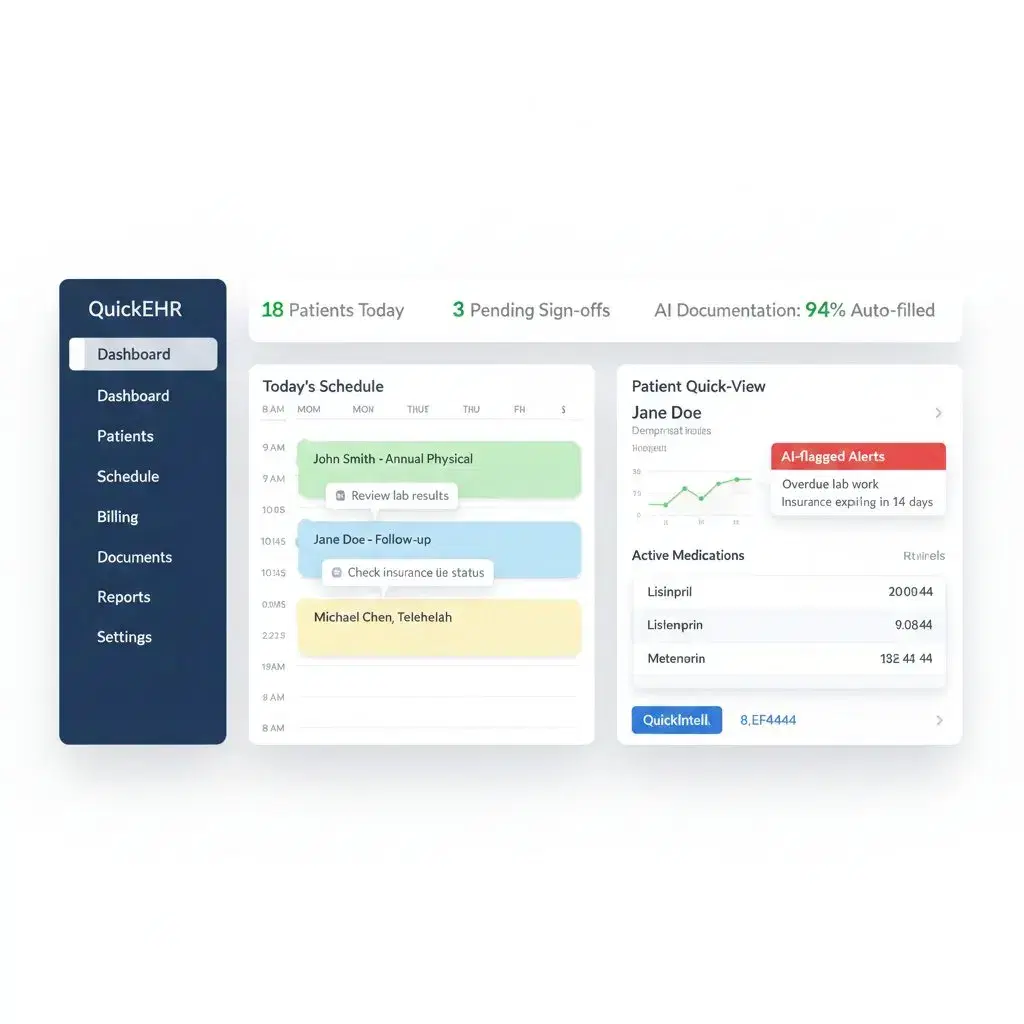
Patient cards for QuickEHR clinical summaries and AI workflows
QuickEHR patient cards give ambulatory clinics a concise, OpenEMR-powered patient summary view that connects chart context, documentation, coding, prior authorization, RCM, ERA, and patient follow-up. Staff can scan the card, open the full chart when needed, and route AI-prepared work for human review.
Summary, chart context, AI worklists, RCM, and ERA
Summary card
Visit, chart, tasks
AI signals
Draft, classify, route
Revenue context
Auth, claims, ERA
Patient card workflow
A patient card should help teams find the next action.
Searchers compare patient cards software because a dense chart can hide the work that matters right now. QuickEHR turns the card into a structured entry point for clinical, documentation, authorization, coding, revenue, and patient follow-up work.
Before the visit
Start from a patient card instead of searching the full chart
QuickEHR patient cards give staff and clinicians a concise view of the patient, encounter, schedule, coverage, recent history, and open work before the rooming workflow begins.
Show the next appointment, visit reason, provider, location, and status signals.
Keep demographic, coverage, portal, and intake gaps visible without turning the card into a full chart replacement.
Route missing information to the right staff queue before the patient is in the room.
During chart review
Use a patient summary card for clinical context and next steps
A digital patient summary card should help a provider scan the essentials, then open the underlying QuickEHR chart when more detail or clinical judgment is required.
Summarize problems, medications, allergies, orders, messages, recent notes, and follow-up tasks when configured.
Keep QuickScribe documentation status and draft-note context close to the patient chart.
Support specialty-specific views for primary care, urgent care, behavioral health, cardiology, orthopedics, pediatrics, and other ambulatory clinics.
After the encounter
Move card signals into coding, authorization, billing, and ERA work
QuickEHR patient cards are most useful when they connect the clinical snapshot to the operational work that follows the visit.
Send documentation-ready context toward QuickCode review without bypassing coder approval.
Flag orders, payer details, and missing clinical evidence that may affect QuickAuth work.
Keep claim, payment, remittance, and patient-balance context available for QuickRCM and QuickERA teams.
Digital card views
Make the patient record card useful without making it the full chart.
QuickEHR patient card software is designed to clarify the moment: who the patient is, why they are here, what is open, and which workflow should handle the next step. The card should point into the full EHR patient dashboard and chart, not hide detail or replace clinical review.
Display patient, provider, location, appointment, intake, portal, and front-desk context so teams know which workflow owns the next step.
Clinical summary card
Organize relevant problems, medications, allergies, recent notes, orders, results, and follow-up work as a patient chart card for review.
Documentation card
Show QuickScribe draft, review, signature, and after-visit handoff status so documentation work stays tied to the patient encounter.
Coding and auth card
Bring diagnosis, procedure, payer, order, and evidence signals together for QuickCode and QuickAuth review before downstream delays start.
Billing context card
Connect claim, denial, balance, remittance, and patient financial questions to QuickRCM and QuickERA workflows with encounter context nearby.
Patient follow-up card
Keep messages, portal activity, reminders, recalls, care instructions, and outreach tasks aligned with the chart and staff queue.
AI patient card automation
AI can prepare and route card context while teams keep the approvals.
For teams evaluating AI EHR patient cards, QuickIntell uses patient, encounter, payer, documentation, claim, and remittance context to draft, classify, summarize, and queue work for review across connected products.
OpenEMR patient cards need implementation context, not generic widgets.
QuickEHR is built on the OpenEMR foundation, then shaped around each clinic's roles, specialties, interfaces, AI review points, and downstream revenue workflows.
QuickEHR-managed OpenEMR patient cards
QuickEHR is built on the OpenEMR foundation and adds managed configuration, implementation planning, integrations, and QuickIntell workflow automation around patient card views.
Existing OpenEMR tenants
Clinics already using OpenEMR can evaluate approved OpenEMR API, FHIR, HL7, or interface-engine paths for patient summary, encounter, task, order, claim, and remittance context.
QuickEHR Connect for another EHR
Practices keeping another system of record can evaluate QuickEHR Connect as a workflow layer that carries patient card context into QuickIntell automation.
Place patient cards inside the EHR workflow, not outside it.
Patient cards should connect to scheduling, charting, portal messages, documentation, e-prescribing, and the OpenEMR integration architecture. These related pages show how the same QuickEHR context moves across the clinic.
Configure card priority by role, queue, and specialty.
A patient summary card for urgent care should not look exactly like one for behavioral health, cardiology, orthopedics, or pediatrics. QuickEHR patient cards should reflect the work each team needs to scan and act on.
QuickEHR patient cards are digital clinical summary cards. They are different from printed appointment reminder cards, greeting cards for hospital patients, patient ID cards, or physical chart labels that often appear in broad search results.
Implementation and trust
Define card scope before go-live.
Patient cards touch clinical context, patient-facing work, and revenue data. QuickIntell implementation planning should make the source systems, card fields, review responsibilities, and AI boundaries explicit before production use.
Procurement and compliance teams can review available security and data-handling materials through the QuickIntell Trust Center. This page does not create certification, security, payer, or regulatory claims for a specific deployment.
Patient card planning checklist
Choose QuickEHR-managed OpenEMR, an existing OpenEMR tenant, or QuickEHR Connect around another EHR.
Define which patient card fields appear for each role, specialty, location, and workflow queue.
Map the source of truth for demographics, insurance, appointments, medications, allergies, problems, orders, notes, results, claims, and remittance context.
Decide where AI may summarize, classify, draft, suggest, or route work before staff, clinician, coder, billing, or compliance review.
Confirm which OpenEMR API, FHIR, HL7, interface-engine, clearinghouse, payer, payment, or communication paths are enabled for the deployment.
Review trust, data handling, access controls, audit expectations, patient-facing language, and support ownership before production use.
FAQs
Patient cards questions for QuickEHR buyers
Answers for teams comparing patient card software, OpenEMR patient cards, and AI EHR patient card workflows.
What are QuickEHR patient cards?
QuickEHR patient cards are digital clinical summary cards for an OpenEMR-powered EHR workflow. They help staff and clinicians scan patient, appointment, chart, documentation, coding, authorization, billing, remittance, and follow-up context before opening the full chart or downstream work queue.
Is this patient cards software or physical patient cards?
This page is about patient cards software for EHR workflows. QuickEHR patient cards are not printed appointment cards, greeting cards, insurance cards, or physical patient identification cards. They are configurable digital patient summary views inside a healthcare workflow.
How do OpenEMR patient cards fit into QuickEHR?
QuickEHR is built on the OpenEMR foundation. QuickIntell adds managed configuration, workflow design, implementation support, integrations, and AI automation around patient cards so clinics can connect OpenEMR chart context to documentation, coding, authorization, RCM, and ERA work.
What can an AI EHR patient card summarize?
An AI EHR patient card can help summarize or route configured context such as visit reason, recent notes, open tasks, message activity, documentation status, coding review signals, authorization-sensitive orders, and billing follow-up. AI suggestions should remain assistive and reviewable.
Can patient cards replace the full EHR chart?
No. Patient cards are meant to make the next action easier to find. Clinicians and staff should open the full QuickEHR chart, underlying OpenEMR records, or connected system when they need complete detail, final review, or clinical decision support.
How do patient cards connect to QuickScribe and QuickCode?
Patient cards can show note status, recent context, and documentation readiness for QuickScribe, then carry signed or reviewable documentation context into QuickCode workflows for coder review of ICD-10, CPT, HCPCS, and HCC suggestions.
How do patient cards support QuickAuth, QuickRCM, and QuickERA?
A patient card can expose payer, order, diagnosis, procedure, claim, balance, denial, payment, and remittance context that helps teams prepare prior authorization packets in QuickAuth, manage revenue work in QuickRCM, and review ERA/EOB details in QuickERA.
Can practices configure patient cards by specialty?
Yes, patient card views should be planned around clinic roles and specialty workflows. Primary care, urgent care, behavioral health, cardiology, orthopedics, pediatrics, and other teams may need different context, field order, and escalation paths.
Can QuickEHR patient cards work with another EHR?
Practices keeping another EHR can evaluate QuickEHR Connect. That path is intended to route approved patient, encounter, documentation, order, claim, remittance, and follow-up context around the existing system of record instead of forcing every clinic to replace its EHR.
What should teams review before launching patient cards?
Teams should review roles, card fields, data sources, enabled interfaces, AI review points, chart-opening workflows, patient-facing language, trust documentation, support ownership, and which QuickIntell modules may use card context for reviewable automation.
Does this page make certification or compliance claims?
No. This page describes QuickEHR patient card workflows and implementation planning. QuickEHR is built on the OpenEMR foundation, and any certification, security, payer, procurement, HIPAA, SOC 2, or regulatory evidence should be verified in the current implementation packet and contract for the specific deployment.
Build patient cards around the work your clinic actually needs to finish.
QuickIntell can help map QuickEHR patient cards across OpenEMR chart context, documentation, coding, authorization, revenue, and patient follow-up workflows.