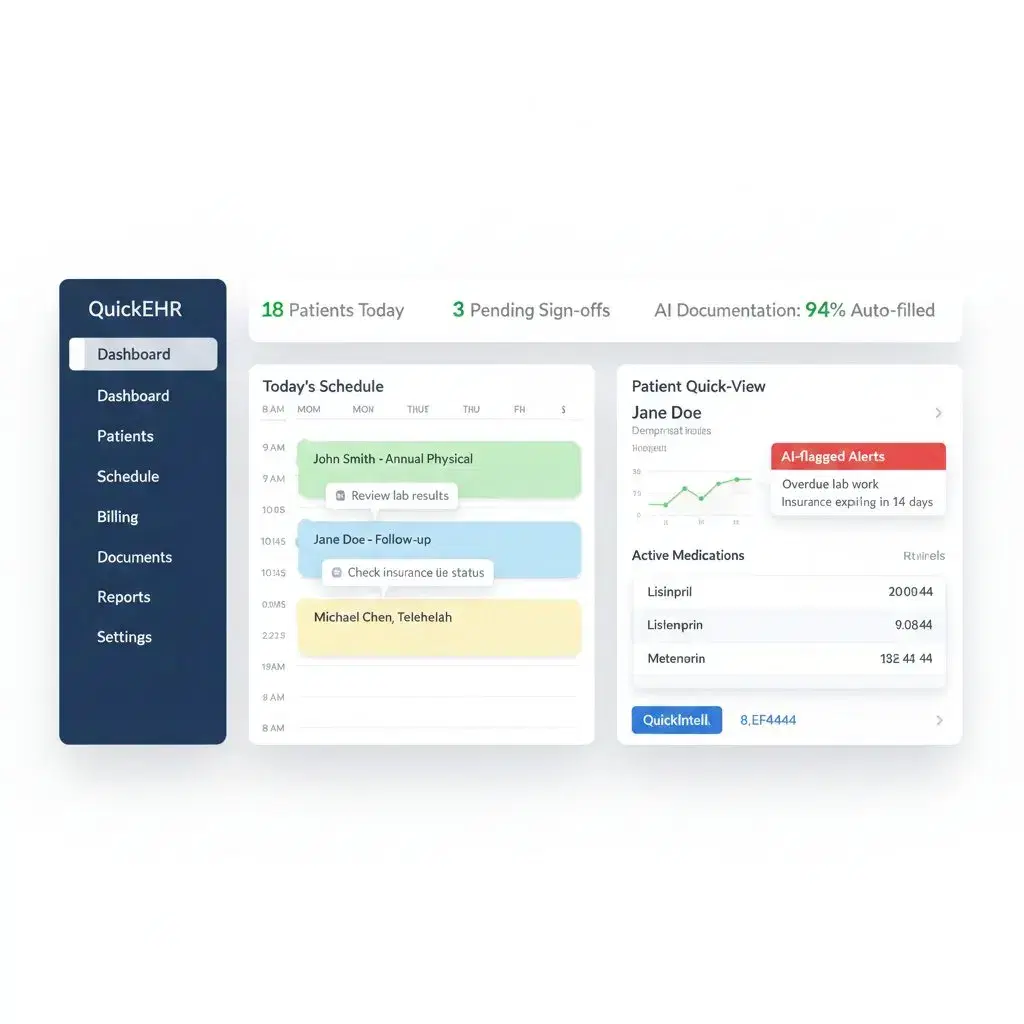
EHR testing sandbox for QuickEHR and OpenEMR workflows
The QuickEHR EHR testing sandbox helps developer teams, enterprise buyers, and group practices validate OpenEMR-powered APIs, sandbox testing workflows, AI automation, and production readiness before live users depend on the connection.
API context, chart scenarios, AI review gates, and readiness
Validate
APIs and payloads
Exercise
Workflow scenarios
Approve
Go-live evidence
Sandbox testing requirements
A testing sandbox should validate the workflow that production users will inherit.
Sandbox evaluators need more than a generic definition. QuickEHR keeps the test plan practical: validate the chart, API, AI, and go-live controls together.
EHR API sandbox
API and integration behavior
Validate the approved API, FHIR, OpenEMR API, HL7, interface-engine, file, or controlled polling paths before production teams rely on them.
Test tenant routing, authentication, patient search, encounter retrieval, document intake, appointment context, and configured write rules.
Confirm how identifiers, locations, providers, departments, and encounter types map across source systems.
Keep failed calls, missing scopes, duplicate records, and unsupported fields visible in exception queues.
Chart workflow testing
Clinical workflow scenarios
Use realistic chart tasks to see whether the sandbox testing environment supports the way clinicians and staff actually work.
Run sample visits from scheduling to chart review, note preparation, coding review, authorization, claim work, and follow-up.
Use synthetic patients or approved test data where possible, with source metadata preserved for review.
Separate read-only context, AI-assisted output, and approved write-back workflows.
AI EHR testing sandbox
AI automation readiness
QuickIntell AI should prepare, summarize, classify, draft, suggest, and route work in a way that keeps human review and source traceability clear.
Check what data each AI workflow can see and what users must review before action.
Validate note drafts, coding suggestions, authorization packets, claim worklists, and remittance exceptions against sample charts.
Route low-confidence outputs, missing evidence, and conflicting source data to the right owner.
Go-live controls
Production readiness
A testing sandbox should show what is ready, what still needs production review, and what support path owns each issue after launch.
Run negative tests for expired tokens, unavailable endpoints, malformed payloads, rate limits, rejected events, and mapping drift.
Document access controls, logs, monitoring, rollback rules, support ownership, and data handling decisions.
Move from sandbox to pilot only when clinical, developer, operational, and revenue-cycle owners agree on the review gates.
Sandbox workflow
Move from endpoint checks to full workflow confidence.
A useful healthcare testing sandbox proves how data moves from a source record into developer integrations, clinical review, AI-assisted worklists, revenue-cycle operations, and production readiness decisions.
Discover
Define what the sandbox must prove
QuickEHR testing starts with the workflow, not just a demo endpoint. QuickIntell maps which systems own the chart, schedule, documents, tasks, claims, and payment context before selecting test cases.
Confirm whether QuickEHR-managed OpenEMR, an existing OpenEMR tenant, or another EHR remains the system of record.
List the patient, provider, location, appointment, encounter, document, coverage, claim, denial, ERA, and task objects required.
Separate developer validation, practice UAT, integration QA, and production readiness review.
Prepare
Seed realistic data without assuming production access
An EHR testing sandbox should use synthetic patients, sample payloads, staging records, approved test data, or controlled pilot charts depending on the implementation scope.
Create encounters with notes, diagnoses, procedures, payer details, orders, attachments, authorizations, claim events, and ERA examples.
Preserve source identifiers and timestamps so test outcomes can be traced back to the record or payload.
Document any test data that cannot be created outside production before relying on the sandbox result.
Exercise
Run the full workflow, not a single happy-path call
The useful test is whether the same encounter context can move through clinical, developer, billing, and remittance work without manual record chasing.
Test chart context, note preparation, coding review, prior authorization packet creation, claim worklists, denial follow-up, and ERA exception handling.
Confirm how QuickScribe, QuickCode, QuickAuth, QuickRCM, QuickERA, and QuickEHR worklists receive context.
Verify role permissions, review responsibilities, notifications, exception queues, and handoff ownership.
Break
Force edge cases before users find them
Sandbox testing should include missing scopes, duplicate patients, bad mappings, inaccessible documents, rejected writes, delayed events, and AI outputs that require review.
Test authentication failures, endpoint downtime, malformed payloads, rate limits, version changes, and unsupported fields.
Check how low-confidence AI results, conflicting evidence, and missing documents appear to reviewers.
Make sure exceptions stay actionable instead of disappearing into logs only developers can read.
Approve
Turn test evidence into a production decision
The sandbox result should become a clear readiness packet for implementation owners, developers, clinical leaders, revenue-cycle teams, and enterprise evaluators.
Summarize what was tested, what passed, what failed, what was deferred, and what must be re-tested in pilot.
Confirm support owners for mapping drift, failed jobs, user issues, API changes, and post-launch monitoring.
Review trust, legal, procurement, security, and data handling requirements for the specific deployed environment.
AI workflow validation
Test AI automation as reviewed workflow, not invisible automation.
The sandbox should prove what QuickIntell AI can prepare, what evidence it uses, what output needs review, and where the next team sees the work.
OpenEMR-powered testing without pretending every tenant behaves the same.
QuickEHR is built on the OpenEMR foundation. Sandbox planning should respect the deployment model, enabled modules, custom forms, API resources, interface options, and support boundaries in front of the actual practice.
QuickEHR-managed OpenEMR
For clinics adopting QuickEHR, the testing sandbox can be scoped around the managed OpenEMR foundation, configured modules, QuickIntell adapters, AI worklists, and production readiness gates.
Existing OpenEMR tenants
For practices already running OpenEMR, QuickIntell can evaluate OpenEMR API access, FHIR resources, custom forms, HL7 or interface paths, hosting constraints, and test-data limits before integration.
OpenEMR and EHR API sandbox planning
Developer evaluators can test the practical behavior of approved endpoints, event feeds, files, documents, and controlled pilot workflows without assuming every production path is enabled.
Give buyers and technical evaluators evidence they can use.
Buyers and technical reviewers need a developer-facing view, not just a definition. QuickEHR testing sandbox planning helps teams evaluate integration behavior, group-practice rollout, and operational fit before go-live.
Validate location, department, provider, role, schedule, payer, and worklist variations before a multi-site practice turns on production automation.
Developer and technical evaluation
Give technical reviewers a structured way to test credentials, API scope, payloads, mappings, event handling, monitoring, and failure behavior.
Clinical and operations UAT
Let clinicians, front desk, auth, coding, billing, posting, and follow-up teams review the exact worklists they will own after launch.
Implementation and trust notes
Keep sandbox boundaries explicit from the first test.
A testing sandbox is useful only if teams understand what it proves and what it does not prove. QuickEHR implementation planning documents data boundaries, role permissions, review gates, logs, support owners, and the move from sandbox to pilot or production.
Use the QuickIntell Trust Center as the starting point for security, data handling, procurement, and implementation evidence review for the specific deployed environment.
Sandbox readiness checklist
Define the sandbox goal: API proof, integration QA, clinical UAT, AI workflow validation, group-practice rollout, or production readiness.
Confirm system-of-record ownership for patient, provider, location, appointment, encounter, document, coverage, claim, payment, and task data.
Choose synthetic patients, sample payloads, staging records, approved test data, or controlled pilot records based on implementation scope.
Document authentication, tenant routing, user roles, least-privilege scopes, environment separation, logs, retention, and support escalation.
Test happy paths and failure paths for APIs, FHIR resources, OpenEMR APIs, HL7 feeds, interface routes, documents, reports, files, and exports.
Set review gates for AI summaries, draft notes, coding suggestions, authorization packets, claim worklists, denials, and ERA exceptions.
Create a readiness summary that separates what passed in the sandbox from what still requires pilot or production validation.
Review trust, legal, procurement, security, and implementation evidence for the specific deployed configuration before go-live.
Related QuickEHR pages
Keep the sandbox connected to architecture and implementation.
These pages help teams move from sandbox validation into API access, interoperability, OpenEMR planning, implementation intake, and the broader QuickEHR product decision.
Specialty workflows can change the test plan. A cardiology authorization packet, behavioral-health note, orthopedic global-period scenario, or urgent-care visit can expose different data, coding, and revenue-cycle needs.
The strongest sandbox plan connects technical proof with staff review, operational ownership, and production readiness. QuickEHR keeps the test plan close to the chart, API, AI, and revenue work it is meant to support.
FAQs
QuickEHR testing sandbox questions
Use these answers to align technical validation, practice UAT, AI review gates, OpenEMR fit, and production readiness planning.
What is an EHR testing sandbox?
An EHR testing sandbox is an isolated validation environment or controlled testing path where developers, implementation teams, and practice stakeholders can test chart workflows, APIs, sample data, AI automation, and failure scenarios without directly affecting the live production environment.
Does QuickEHR provide a testing sandbox?
QuickEHR implementations can include a testing sandbox, staging tenant, synthetic payloads, approved test data, or controlled pilot workflow when available for the project. The exact sandbox model depends on the OpenEMR deployment, approved access, integration scope, hosting model, and production readiness requirements.
How is sandbox testing different from UAT?
Sandbox testing usually proves technical behavior, data mapping, API calls, edge cases, and workflow routing in an isolated environment. UAT asks real users to confirm whether the workflow fits daily operations. A QuickEHR implementation may use both: technical sandbox validation first, then practice UAT or pilot review.
Can developers test OpenEMR APIs or FHIR resources?
OpenEMR API and FHIR testing can be part of the QuickEHR testing sandbox plan when the approved tenant, credentials, endpoint scope, resources, and implementation permissions support it. QuickIntell avoids assuming that every read, write, event, or resource path is enabled for every deployment.
Is this an OpenEMR testing sandbox or a healthcare API sandbox?
It can support OpenEMR testing sandbox and healthcare API sandbox planning when that matches the implementation. For QuickEHR-managed OpenEMR, the sandbox can focus on OpenEMR-powered chart and workflow validation. For connected systems, it can focus on approved APIs, payloads, interface events, files, documents, and AI handoffs.
Does sandbox testing use production PHI?
The preferred path is synthetic patients, sample payloads, staging records, approved test data, or de-identified examples where appropriate for the project. Any production PHI use should follow the implementation agreement, access controls, data handling review, and trust requirements for that deployment.
Can the sandbox validate QuickScribe, QuickCode, and QuickAuth?
Yes, when configured. Sample chart and document context can be routed to QuickScribe note drafting, QuickCode coding review, and QuickAuth prior authorization packet preparation so teams can test review gates, source traceability, and exception handling before production use.
How do QuickRCM and QuickERA fit into the sandbox?
QuickRCM and QuickERA sandbox scenarios can test coverage context, charges, claims, denials, payment data, ERA/EOB exceptions, posting workflows, and follow-up queues. The goal is to keep revenue-cycle work tied to the same patient and encounter context used by the clinical workflow.
What should enterprise buyers test in an EHR sandbox?
Enterprise buyers should test environment separation, role access, multi-location routing, provider and department mapping, API reliability, document handling, AI review gates, exception ownership, monitoring, data retention, support escalation, and the handoff from sandbox evidence to production readiness.
Is QuickEHR the same as OpenEMR?
QuickEHR is built on the OpenEMR foundation and adds QuickIntell workflow design around charting, documentation, coding, prior authorization, RCM, ERA, and related automation. Practices can evaluate QuickEHR-managed OpenEMR or, when appropriate, an integration with an existing OpenEMR tenant.
Does this page make certification or compliance claims?
No. This page describes QuickEHR testing sandbox workflow planning. It does not create new certification, EPCS, ONC, HIPAA, SOC 2, payer, customer, or nationwide exchange claims. Current trust, legal, security, procurement, and implementation evidence should be reviewed for the specific deployed environment.
Scope a QuickEHR testing sandbox before production work depends on it.
Bring the workflow you need to prove: OpenEMR APIs, FHIR resources, chart scenarios, AI review gates, group-practice rollout, RCM handoff, or production readiness. QuickIntell will help map the safest validation path for the implementation.