Call
OpenEMR-powered eRx workflow

E-prescribing software for QuickEHR patient charts

QuickEHR connects e-prescribing software intent to the rest of the clinical workflow: OpenEMR-powered chart context, clinician review, medication renewals, EPCS implementation planning, prior authorization, coding, RCM, and remittance follow-through in one QuickIntell operating model.

Primary intent: e prescribing software
EHR fit: OpenEMR and QuickEHR
AI role: assistive workflow automation

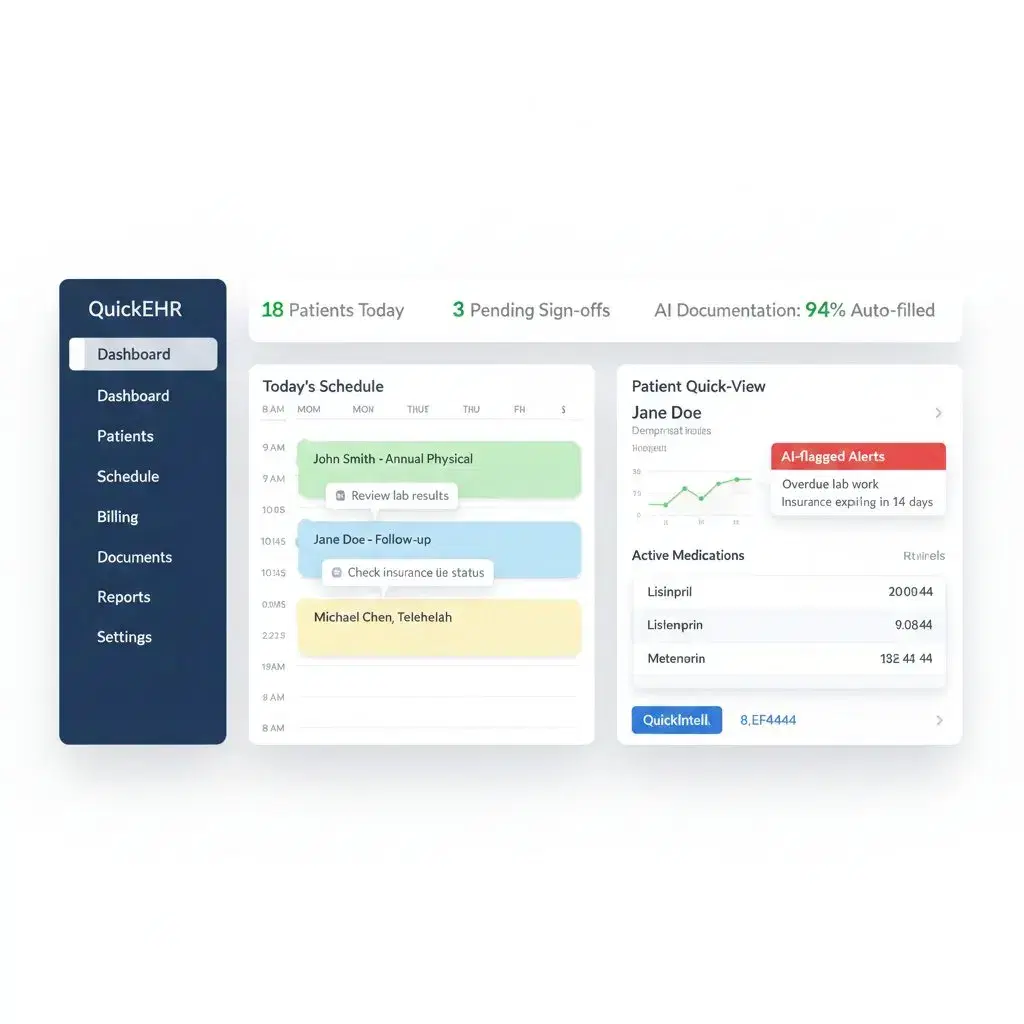
QuickEHR prescribing workspace

Chart context, renewal queue, auth and revenue handoff

QuickEHR dashboard showing patient chart, prescribing task, prior authorization, coding, and revenue workflow context

Chart context

Problems, meds, allergies

Prescribing tasks

New orders and renewals

Follow-through

Auth, coding, RCM, ERA

Prescribing workflow

Electronic prescribing works best when it is connected to the chart.

Searchers comparing electronic prescribing software are not only looking for a send button. They need chart context, review controls, pharmacy routing, renewals, and operational follow-through.

Before prescribing

Start with the active chart

QuickEHR keeps medication work close to the patient chart, visit reason, allergies, diagnoses, prior notes, coverage context, and provider role.

  • Review patient and encounter context before creating a new prescription or renewal.
  • Keep medication history, problem lists, allergies, and payer details in the same workflow review.
  • Use QuickEHR as the clinical source of truth or as the connection layer around an existing EHR.

During the visit

Route the order through the configured eRx path

The prescribing workflow should make review points visible: medication selection, dosing details, pharmacy routing, safety prompts, and the final clinician action.

  • Support electronic prescribing software workflows without hiding who made the final clinical decision.
  • Expose pharmacy, benefit, medication, and alert context when those data sources are enabled for the deployment.
  • Keep AI suggestions assistive so the clinician remains responsible for the prescription.

After prescribing

Connect renewals and follow-up work

E-prescribing should not be an isolated click. QuickIntell connects the chart to renewal queues, prior authorization, coding, claims, ERA, and patient follow-up workflows.

  • Route renewals and missing information back to the right clinical or administrative queue.
  • Use medication and encounter context for QuickAuth, QuickCode, QuickRCM, and QuickERA worklists.
  • Keep audit, review, and implementation responsibilities clear before production use.

What buyers expect

E-prescribing should carry useful clinical and revenue context.

A useful eprescribing workflow keeps the medication task close to the reviewed chart and the teams that act after the visit. QuickEHR is designed to make that handoff visible.

For patient-chart details, review QuickEHR clinical documentation. For the OpenEMR architecture, see the OpenEMR integration.

Medication and allergy context

Bring medications, allergies, problems, visit notes, and relevant orders into the workflow so prescribers are not switching between disconnected screens.

Renewal management

Organize renewal requests, refills, and clinical follow-up tasks with the chart context reviewers need before an approval or denial decision.

Prior authorization handoff

When a medication needs authorization, QuickAuth can help assemble payer packets from chart, order, diagnosis, and coverage context for team review.

Revenue and remittance context

Medication and encounter context can inform coding, claim follow-up, denial work, and ERA posting when the workflow is connected to QuickIntell RCM modules.

OpenEMR and QuickEHR fit

OpenEMR e-prescribing context, managed through QuickEHR.

QuickEHR uses the OpenEMR foundation for the EHR layer and adds QuickIntell configuration, support, integrations, and AI workflow design around the chart. That lets teams evaluate the e-prescribing workflow without blurring the boundary between the EHR foundation, the configured prescribing path, and assistive automation.

QuickEHR-managed OpenEMR

QuickEHR is built on the OpenEMR foundation and adds managed configuration, support, integrations, and AI workflow design around the chart.

Existing OpenEMR tenants

Clinics already running OpenEMR can connect approved OpenEMR API, FHIR, HL7, or interface-engine paths into QuickIntell worklists.

Existing EHR environments

QuickEHR Connect can route chart, coverage, order, prescription, claim, and remittance context around an existing system of record.

EPCS implementation planning

Controlled-substance e-prescribing needs explicit scope review.

Searchers often compare EPCS software and electronic prescribing controlled substances requirements. QuickIntell treats that as an implementation question: confirm the exact configured service, evidence, workflow, state requirements, and responsibilities before production use.

Scope note

This page does not make a blanket EPCS certification, compliance, or production readiness claim. Review the current implementation packet for your tenant.

Confirm whether controlled-substance prescribing is in scope for the deployment.

Identify the configured e-prescribing or EPCS service and its current evidence packet.

Review prescriber enrollment, identity proofing, two-factor workflow, role setup, and audit expectations.

Map DEA, state, payer, and clinic policy requirements with the implementation team before go-live.

Test renewal, cancellation, pharmacy, and exception workflows with sample users and documented approvals.

Avoid treating AI suggestions as clinical authorization to prescribe; final decisions stay with authorized clinicians.

Implementation and trust

Build the prescribing workflow before go-live.

E-prescribing touches clinical decision-making, patient data, pharmacy routing, controlled-substance rules, and downstream operations. QuickIntell helps configure the workflow, but the clinic should still define roles, approvals, policies, and evidence before production rollout.

Choose QuickEHR-managed OpenEMR, an existing OpenEMR tenant, or QuickEHR Connect for another EHR.

Map medications, allergies, preferred pharmacies, providers, locations, visit types, and renewal queues.

Confirm enabled eRx, pharmacy, benefit, formulary, and safety-alert data sources for the specific deployment.

Define review ownership across clinicians, clinical operations, prior authorization, coding, billing, and IT.

Document where QuickScribe, QuickCode, QuickAuth, QuickRCM, and QuickERA may use chart context.

Review trust, data handling, access, audit, and support documentation before production rollout.

FAQs

QuickEHR e-prescribing questions.

These answers are written for practices evaluating e-prescribing software, OpenEMR fit, AI workflow automation, EPCS planning, and connected QuickIntell operations.

What is QuickEHR e-prescribing software?+

QuickEHR e-prescribing software is the prescribing workflow page for QuickEHR. It explains how QuickEHR can keep medication tasks close to OpenEMR-powered patient charts, clinician review, renewals, prior authorization, coding, RCM, ERA, and other QuickIntell automation layers.

For the full platform overview, see QuickEHR.

How does QuickEHR use OpenEMR for e-prescribing workflows?+

QuickEHR is built on the OpenEMR foundation. The configured implementation can use OpenEMR chart context, approved integration paths, and QuickIntell workflow automation so medication tasks are not disconnected from documentation, orders, coverage, coding, authorization, and billing work.

Is QuickEHR a standalone e prescribing software product?+

QuickEHR is primarily an EHR and workflow platform, not only a standalone prescribing app. It can serve clinics that want an OpenEMR-powered EHR and teams that want QuickEHR Connect around an existing system of record. That distinction matters for buyers comparing standalone eRx apps with EHR-integrated workflows.

How does AI help with electronic prescribing software workflows?+

QuickIntell AI can help by surfacing chart context, drafting documentation for clinician review, routing missing information, preparing coding suggestions, assembling prior authorization packets, and organizing follow-up work. It should not be read as autonomous prescribing or a replacement for clinician judgment.

Does QuickEHR support EPCS software or electronic prescribing controlled substances?+

Controlled-substance prescribing and EPCS scope must be confirmed for the specific implementation. A clinic should review the configured prescribing service, identity proofing, two-factor workflow, role setup, audit expectations, DEA and state requirements, and current evidence packet before treating any deployment as ready for EPCS use.

Can QuickEHR connect prescriptions to prior authorization?+

Yes, when the workflow and data sources are configured for the clinic. QuickAuth can help assemble prior authorization packets from chart, diagnosis, medication, order, coverage, and supporting note context so the authorization team has less manual document gathering.

How does e-prescribing affect coding and RCM workflows?+

Medication, diagnosis, order, and encounter context can influence coding review, claims, denials, AR follow-up, and remittance work. QuickCode, QuickRCM, and QuickERA use reviewed chart and claim context to reduce duplicate reconstruction across teams.

What should practices review before going live?+

Practices should review the EHR path, enabled eRx or EPCS services, pharmacy and benefit data, user roles, clinician approvals, audit needs, support ownership, data handling, downstream QuickIntell module use, and any state, payer, or clinic policy requirements that apply to prescribing.

Does this page make certification or compliance claims?+

No. This page describes QuickEHR e-prescribing workflows and implementation planning. Any certification, EPCS, ONC, HIPAA, security, regulatory, payer, or procurement evidence should be verified in the current implementation packet and contract for the specific deployment.
Need e-prescribing connected to QuickEHR workflows?

QuickIntell can walk through OpenEMR-powered chart context, configured eRx paths, EPCS planning, AI documentation, coding, prior authorization, RCM, ERA, and trust documentation for the clinic environment you are evaluating.