Certified EHR core
OpenEMR foundation
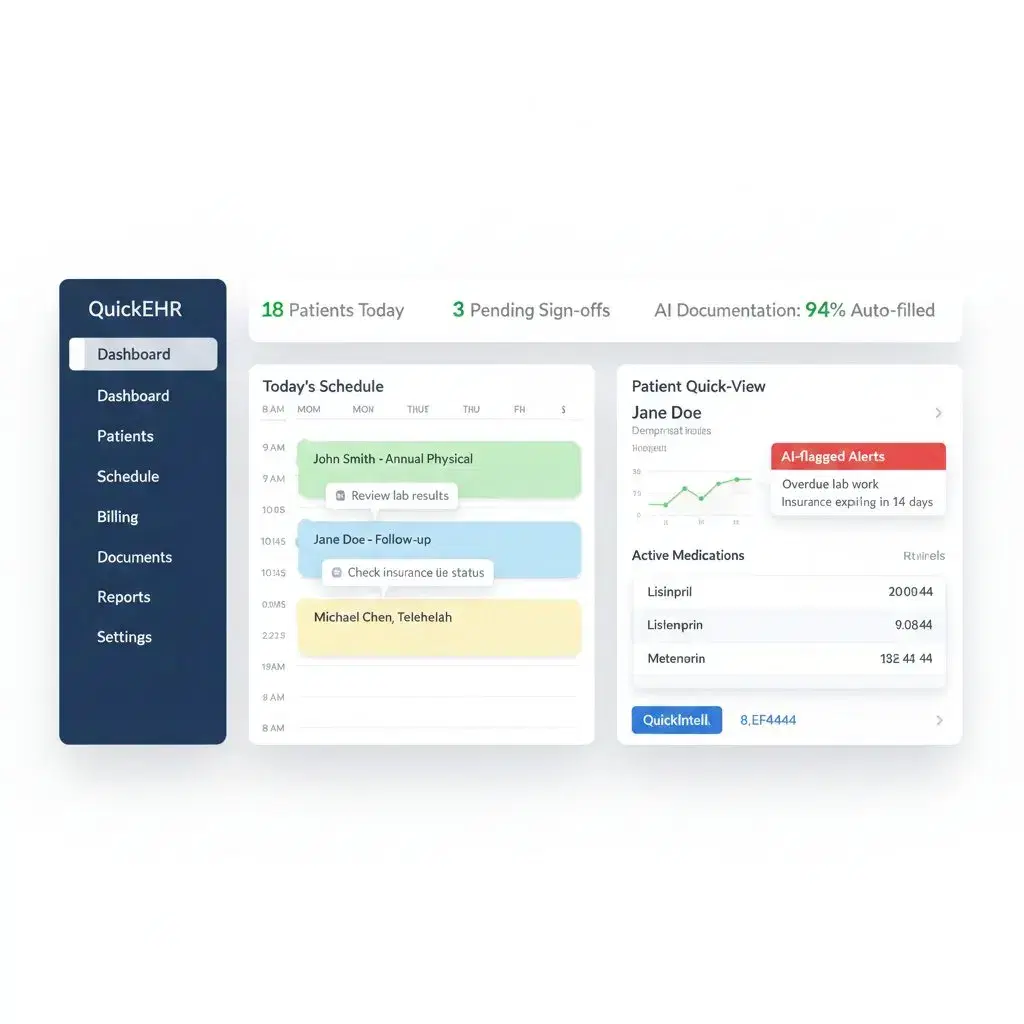
QuickEHR is built on the OpenEMR foundation. Certification evidence should be reviewed against the specific OpenEMR version and implementation packet used for your deployment.
QuickEHR certification questions usually come down to one practical boundary: what belongs to the OpenEMR EHR foundation, what QuickIntell configures around it, and what the clinic should verify before go-live. This page gives buyers a clear way to evaluate ONC certified EHR, OpenEMR certification, and AI EHR certification claims without over-reading the scope.
Certification boundary workspace
Foundation, automation, implementation review
OpenEMR core
Version-specific evidence
QuickEHR layer
Hosting and configuration
AI modules
Reviewable automation
What belongs where
The strongest certification page for QuickEHR is precise. It separates the EHR foundation from QuickIntell's managed layer and from the AI tools that automate work around the chart.
Certified EHR core
QuickEHR is built on the OpenEMR foundation. Certification evidence should be reviewed against the specific OpenEMR version and implementation packet used for your deployment.
Configuration and support
QuickIntell adds managed hosting, migration, configuration, role setup, support, and workflow design around the OpenEMR-based EHR experience.
Assistive workflows
QuickScribe, QuickCode, QuickAuth, QuickRCM, and QuickERA automate work around the chart. They should not be read as separate ONC certification claims.
Buyer review
Procurement, attestation, payer-program, and specialty requirements should be confirmed during implementation before a clinic treats any configuration as ready for production.
Workflow impact
Searchers asking about EHR certification often need a practical answer: which parts help with charting, interoperability, documentation, coding, authorization, and billing work.
The certified EHR software question starts with the core chart: demographics, problems, medications, allergies, notes, orders, results, and interoperability workflows.
QuickIntell automation helps teams move faster without changing who owns final clinical or coding decisions.
QuickEHR can feed revenue-cycle automation while the EHR remains the clinical source of truth.
AI automation fit
The AI layer should be evaluated by workflow, approval point, audit trail, and implementation scope. It should not blur the OpenEMR certification boundary.
Compliance note
If a buyer needs ONC certified EHR list references, CMS EHR certification ID review, EPCS readiness, or payer-program evidence, handle that in the current implementation packet.
Run the OpenEMR-based EHR experience or connect your existing EHR.
Ambient documentation that drafts structured notes for clinician review.
AI coding suggestions for ICD-10, CPT, HCPCS, HCC, and related workflows.
Prior authorization packets assembled from clinical and payer context.
End-to-end RCM automation around eligibility, claims, denials, and AR.
EOB-to-ERA conversion and remittance workflow automation.
OpenEMR and QuickEHR fit
QuickEHR can be deployed as a managed OpenEMR-based EHR experience or used as the QuickIntell integration layer around an existing EHR environment. Either way, the certification discussion should stay specific to the deployed foundation and configured workflow scope.
Review OpenEMR integration detailsFor clinics adopting a managed OpenEMR-based EHR foundation with QuickIntell support, migration, and automation layered in.
For clinics keeping their current system of record while QuickIntell routes data into AI documentation, coding, authorization, and RCM workflows.
Ask for the OpenEMR foundation details, integration scope, configured modules, approval workflows, and support ownership that apply to the deployment being purchased.
Implementation and trust
The safest procurement motion is not to rely on a generic badge. Review the OpenEMR foundation, QuickEHR deployment scope, security documentation, and AI workflow controls in the context of your clinic.
Current OpenEMR version and certification evidence in the implementation packet
Enabled modules, third-party services, and any pass-through vendor requirements
FHIR, API, HL7, or interface-engine scope for the clinic environment
Role-based access, audit logging, approval points, and support ownership
AI workflow boundaries for documentation, coding, prior authorization, and RCM
Any specialty, payer-program, EPCS, or local regulatory requirement that is outside the EHR core
QuickEHR certification and OpenEMR fit questions most often show up in ambulatory settings that want an AI-ready operating model without rebuilding every workflow from scratch.
Once the EHR foundation is clear, most teams evaluate the AI work around it: documentation, coding, prior authorization, claim work, remittance conversion, and RCM operations.
FAQs
These answers are intentionally specific about OpenEMR, QuickEHR, AI automation, and implementation evidence so teams can avoid unsupported assumptions.
For QuickEHR, EHR certification should be read as a foundation-level question. QuickEHR is built on OpenEMR, and certification evidence should be reviewed for the specific OpenEMR version and implementation packet. QuickIntell AI modules add workflow automation around that foundation, but they should not be treated as separate ONC certification claims.
For a broader product overview, see QuickEHR.
No. OpenEMR certification belongs to the OpenEMR core and version-specific evidence. QuickEHR uses that foundation and adds managed deployment, migration, configuration, support, and AI workflows. Buyers should ask QuickIntell for the current implementation packet rather than assuming every layer has the same certification scope.
This page does not make that claim. QuickIntell product modules automate documentation, coding, prior authorization, revenue-cycle, and remittance workflows around the EHR. They remain assistive workflow layers unless the current contract and implementation evidence explicitly state otherwise.
Clinics usually review vendor documentation, implementation evidence, and the official Certified Health IT Product List when ONC certified EHR status matters for procurement or attestation. QuickIntell can help assemble the deployment-specific evidence during implementation.
Review the OpenEMR version, enabled modules, interface scope, third-party services, user roles, audit workflows, approval steps, and any specialty or payer-program requirements. Requirements such as e-prescribing, payer attestation, or local regulations may require separate review.
Searchers often use AI EHR certification to ask whether AI changes certification status. In QuickEHR, the safest framing is that certification evidence starts with the OpenEMR EHR foundation, while AI workflows are configured as assistive automation with review, approval, and audit controls.
Yes. QuickIntell can walk procurement, compliance, and operations teams through the OpenEMR foundation, QuickEHR configuration, AI workflow boundaries, security documentation, implementation responsibilities, and support model so buyers understand what is in scope.
No. QuickEHR reduces implementation work, but each clinic still owns its operational, payer-program, and regulatory review. QuickIntell provides documentation and implementation support so the clinic can make an informed decision.
Bring your compliance, IT, and operations teams. QuickIntell can walk through the OpenEMR foundation, QuickEHR deployment scope, AI workflow boundaries, and trust documentation for the clinic environment you are evaluating.