Call
Provider-facing patient charts

Clinical documentation software for QuickEHR patient charts

QuickEHR turns clinical documentation software into a connected charting workflow: OpenEMR-powered patient charts, AI-assisted note drafting, specialty templates, coding context, prior authorization packets, and revenue-cycle follow-through in one QuickIntell operating model.

Primary intent: clinical documentation software
Charting focus: patient charts and templates
AI role: assistive, reviewable automation

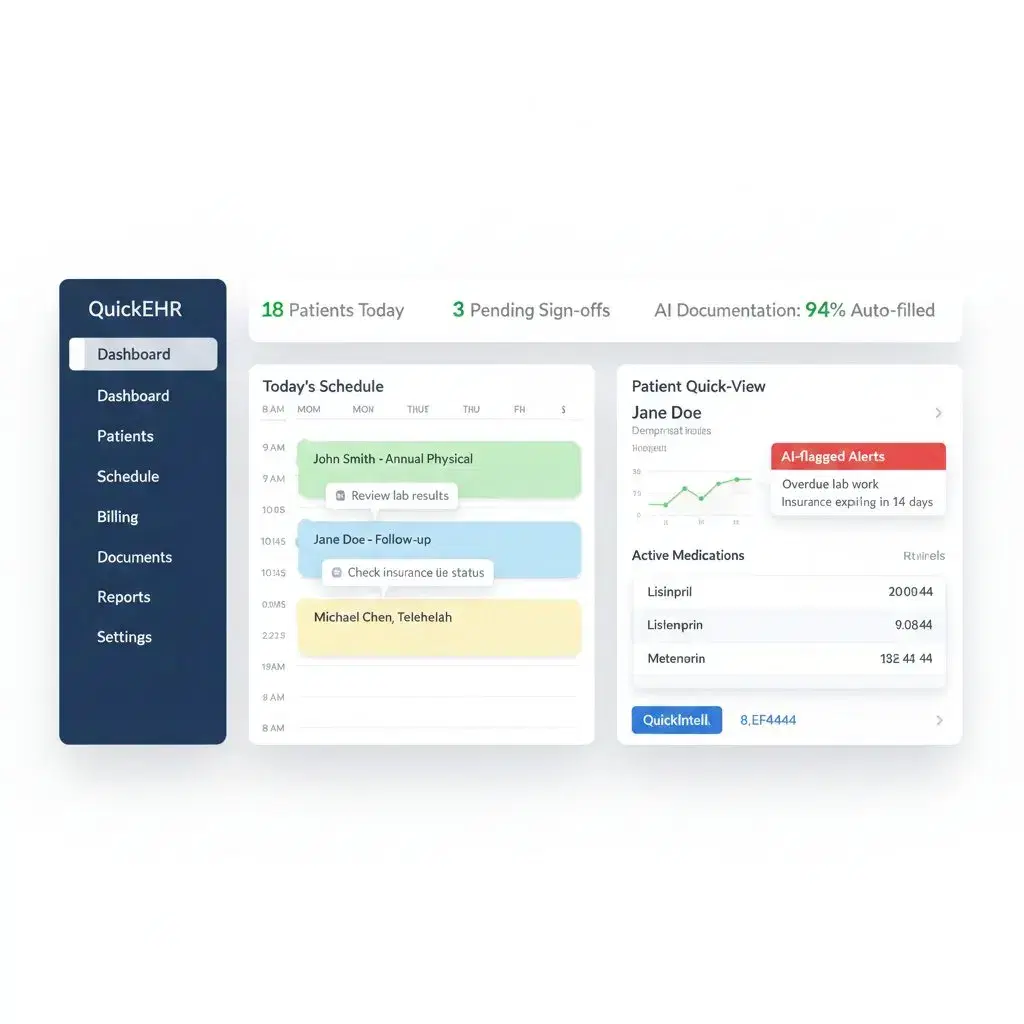
QuickEHR clinical chart workspace

Patient chart, AI note draft, coding and auth follow-up

QuickEHR dashboard showing charting, documentation, coding, and revenue workflows

Chart context

Problems, meds, history

Draft note

Clinician review path

Follow-through

Coding, auth, RCM

Clinical workflow

Charting should not stop at a signed note.

Searchers comparing medical charting software and EHR charting software need to know how a patient chart supports the whole visit. QuickEHR keeps documentation close to the work that follows.

Before the visit

Start from the scheduled encounter

QuickEHR clinical documentation starts with the patient chart context providers already need: demographics, appointment reason, problems, medications, allergies, and prior notes.

  • Surface chart context before the rooming workflow begins.
  • Keep intake, eligibility, and scheduling context close to the note.
  • Use specialty templates without forcing every provider into the same note style.

During the visit

Draft the note while care is happening

QuickScribe can help draft visit notes for clinician review while QuickEHR keeps the clinical source of truth organized around the encounter.

  • Support SOAP-style and specialty-specific documentation patterns.
  • Let providers review and edit before anything becomes final.
  • Route missing documentation questions back into the chart workflow.

After the visit

Turn documentation into follow-through

Complete notes should move work forward. QuickIntell connects the chart to coding, prior authorization, claims, and remittance workflows.

  • QuickCode can suggest codes from signed or review-ready note context.
  • QuickAuth can assemble authorization packets from clinical details.
  • QuickRCM and QuickERA use encounter context to keep revenue work aligned.

Patient chart requirements

A provider-facing page has to explain the chart, not just the platform.

QuickEHR documentation is built for everyday ambulatory care: complete patient charts, practical templates, clinician review, and downstream work that can use the note without duplicate manual entry.

For the OpenEMR-specific architecture, see the OpenEMR integration. For certification boundaries, review QuickEHR certification.

Patient charts

Organize problems, medications, allergies, history, results, orders, notes, and encounter context in one OpenEMR-powered charting experience.

Specialty templates

Configure visit note patterns for primary care, urgent care, behavioral health, cardiology, orthopedics, pediatrics, and other ambulatory workflows.

Clinical review

Keep clinician approval visible. AI can assist drafts and suggestions, but providers remain responsible for final documentation decisions.

Downstream readiness

Use cleaner chart context for coding review, prior authorization packet assembly, claims worklists, and denial follow-up.

OpenEMR and QuickEHR fit

OpenEMR clinical documentation, managed through QuickEHR.

QuickEHR uses the OpenEMR foundation for the EHR layer and adds QuickIntell configuration, support, and automation around patient charts. That gives clinics a clear boundary between the EHR foundation, the managed QuickEHR experience, and the assistive AI modules around the chart.

OpenEMR foundation

QuickEHR is built on the OpenEMR foundation, giving clinics a familiar ambulatory EHR base for patient charts, scheduling, clinical documentation, billing workflows, and extensibility.

QuickEHR managed workflows

QuickIntell adds managed deployment, configuration, support, integrations, and AI workflow design around that foundation.

QuickEHR Connect

Clinics keeping another EHR can use QuickEHR as the integration layer around documentation, coding, prior authorization, RCM, and ERA workflows.

Implementation and trust

Build the documentation workflow before go-live.

A clinical charting page should be clear about operational responsibility. QuickIntell can help configure the workflow, but the clinic still needs review paths, user roles, note policies, and implementation evidence that match its environment.

Confirm whether the clinic will use QuickEHR-managed OpenEMR or connect an existing EHR.

Map note templates, encounter types, provider roles, approval steps, and signature workflows.

Review enabled interfaces, FHIR or API scope, HL7 feeds, and any implementation-specific data flow.

Define which AI suggestions need clinician, coder, authorization, or billing team review.

Review trust, security, data handling, support, and implementation documentation before go-live.

Separate the OpenEMR foundation from QuickEHR managed services and assistive AI workflow claims.

FAQs

QuickEHR clinical documentation questions.

These answers are written for providers and operators evaluating patient charts, AI documentation, OpenEMR fit, and downstream QuickIntell workflows.

What is QuickEHR clinical documentation software?+

QuickEHR clinical documentation software is the provider-facing charting workflow in QuickEHR. It helps teams organize patient charts, draft notes for clinician review, use OpenEMR-powered EHR workflows, and connect documentation to coding, prior authorization, RCM, and remittance operations.

For the full platform overview, see QuickEHR.

How does QuickEHR use OpenEMR for patient charts?+

QuickEHR is built on the OpenEMR foundation. That foundation supports the core EHR charting environment, while QuickIntell adds managed deployment, configuration, support, integrations, and AI workflow automation around the chart.

Is this the same as an AI medical scribe?+

No. AI scribing is one part of the workflow. QuickScribe is the AI clinical documentation software layer that can help draft clinical notes, while QuickEHR organizes the patient chart and encounter workflow. QuickCode, QuickAuth, QuickRCM, and QuickERA can then use reviewed documentation for downstream operations.

Can QuickEHR support specialty-specific templates?+

Yes, QuickEHR workflows can be configured around specialty documentation patterns such as primary care, urgent care, behavioral health, cardiology, orthopedics, pediatrics, and other ambulatory settings. Template scope should be confirmed during implementation.

Does QuickEHR support EHR charting software buyers who want automation?+

Yes. The page is designed for EHR charting software buyers who want patient charts, clinical documentation, AI-assisted note drafting, coding support, authorization packet assembly, and revenue-cycle workflows connected around the encounter.

Does AI replace clinician review in QuickEHR documentation?+

No. QuickIntell frames AI as assistive automation. Providers, coders, authorization teams, and billing teams should keep the review and approval responsibilities that apply to their workflow.

How does clinical documentation improvement software fit here?+

Clinical documentation improvement software often focuses on completeness, coding support, and revenue integrity. QuickEHR approaches that intent from the provider charting side: cleaner notes, structured patient charts, reviewable AI suggestions, and connected coding, authorization, and RCM workflows.

Does QuickEHR make certification claims beyond OpenEMR?+

This page does not add broad certification claims. QuickEHR is built on the OpenEMR foundation, and any certification, procurement, regulatory, or payer-program evidence should be reviewed for the specific implementation packet and deployed configuration.
Need provider-facing charting in QuickEHR?

QuickIntell can walk through OpenEMR-powered patient charts, AI documentation workflows, specialty templates, coding, prior authorization, RCM, ERA, and trust documentation for the clinic environment you are evaluating.