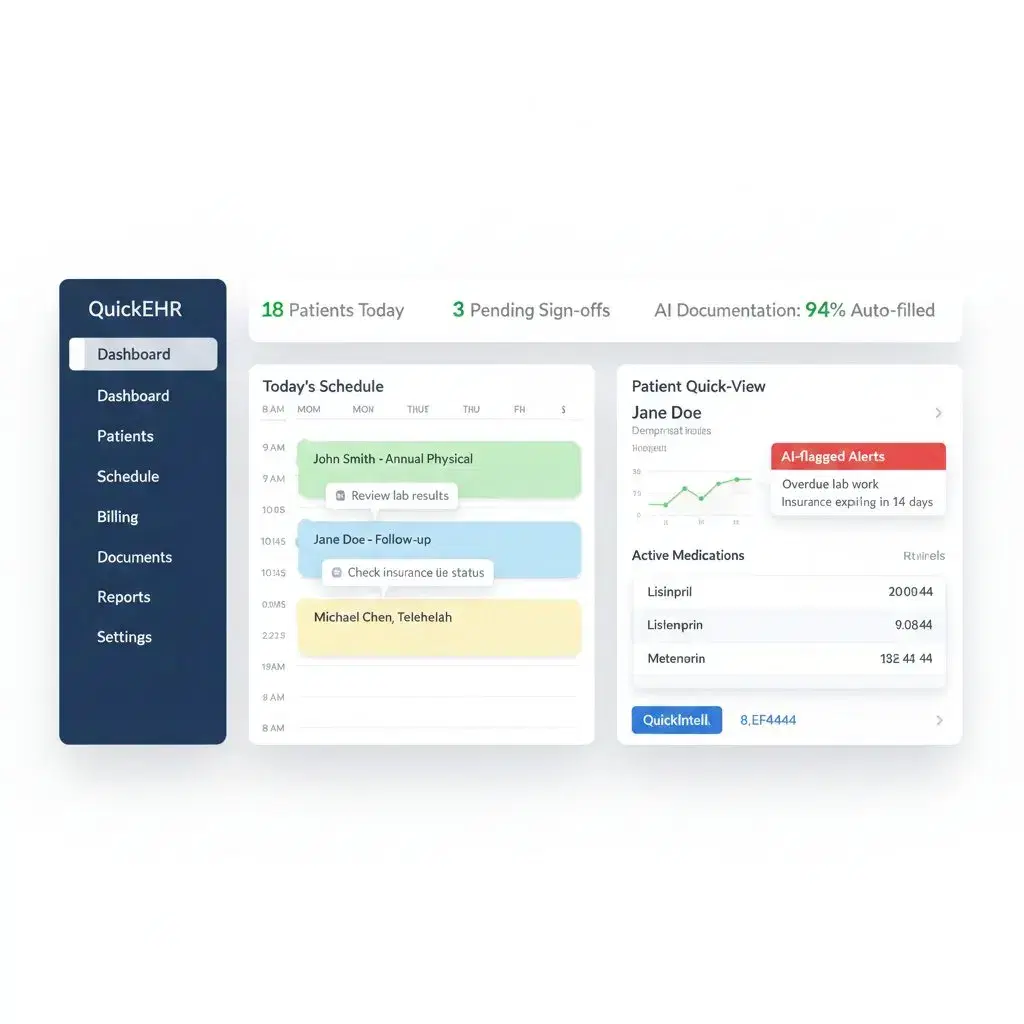
Medical billing clearinghouse software for QuickEHR workflows
QuickEHR medical billing clearinghouse workflows help practices prepare clean claims, route them through the right clearinghouse or payer path, track responses, and feed rejections, denials, ERA, EOB, and payment posting work back into QuickIntell AI-assisted revenue cycle operations.
Chart evidence, scrubber holds, route, status, ERA
Inputs
Chart, codes, auth
Route
Clearinghouse, payer
Feedback
Status, ERA, denials
Clearinghouse workflow
Connect claim readiness, submission routing, and payment feedback.
The medical billing clearinghouse SERP expects a practical explanation of what the clearinghouse layer does. QuickEHR focuses that workflow inside the OpenEMR-powered chart, claim, and revenue cycle context your team already needs.
Chart to claim
Prepare a clean claim from the encounter
QuickEHR keeps patient, provider, location, coverage, documentation, coding, authorization, and charge context close before the claim is sent to a medical billing clearinghouse route.
Use OpenEMR-powered chart, scheduling, eligibility, and billing context to reduce avoidable reconstruction.
Bring QuickScribe documentation and QuickCode suggestions into review only where your team defines human approval points.
Hold missing notes, orders, referrals, attachments, member details, charges, or authorization evidence before release.
Pre-submit checks
Scrub and format the submission
Clearinghouse software and connected claim workflows should catch common rejection triggers before transmission, then make each hold visible to the right owner.
Review demographics, subscriber data, payer, provider identifiers, place of service, diagnoses, procedures, modifiers, units, and charge details.
Represent configured EDI, API, portal, batch, payer, interface-engine, or clearinghouse routes without hiding the routing path from billing teams.
Separate warnings from hard holds so teams know which findings need correction before submission.
Transmission
Route claims and track responses
QuickEHR does not need to replace every existing clearinghouse. It acts as the EHR and workflow layer that keeps the submission route, status, rejection, and repair work tied to the original encounter.
Track accepted, rejected, pending, corrected, resubmitted, and attachment-request states by patient, claim, payer, and owner.
Route fixes to patient access, coding, authorization, clinical, or billing teams with the evidence needed for review.
Keep clearinghouse rejection details and payer status updates visible near the chart and claim.
Payment feedback
Close the loop with remittance and denials
A medical claims clearinghouse workflow is strongest when payer responses, ERA, EOB, payment posting, denial patterns, and patient balances feed back into the next claim review cycle.
Use QuickERA and payment posting workflows to connect remittance, adjustments, posting exceptions, and patient responsibility to the original claim.
Move denials, AR follow-up, and recurring payer patterns into QuickRCM queues with claim and encounter context intact.
Tune front-desk, documentation, coding, authorization, and billing handoffs from repeated rejection and denial signals.
Clearinghouse layer
Turn clearinghouse requirements into reviewable work.
A clearinghouse can format, route, and return responses, but practices still need the EHR context that explains what to fix and who should fix it. QuickEHR keeps the claim, chart, billing owner, and revenue cycle follow-up in view.
Review patient data, coverage, provider identifiers, service location, diagnosis pointers, procedure codes, modifiers, units, charges, and missing evidence.
Clearinghouse and payer routing
Map the configured EDI, API, payer portal, batch, interface-engine, or clearinghouse path for each claim type and billing workflow.
Claim scrubbing context
Connect payer edits, clearinghouse requirements, coding questions, authorization gaps, and documentation prompts to visible review queues.
Coding and modifier evidence
Bring ICD-10, CPT, HCPCS, modifiers, diagnosis support, units, NDC details where relevant, and reviewable QuickCode context into the claim workflow.
Authorization and referral support
Keep QuickAuth status, payer requirements, approval windows, authorization numbers, referral notes, and packet gaps visible before release.
Status and rejection repair
Route accepted, rejected, held, corrected, resubmitted, and attachment-request responses back to the right billing owner.
ERA, EOB, and payment posting
Tie remittance, contractual adjustments, denial codes, patient responsibility, write-offs, and posting exceptions back to the claim.
RCM feedback loops
Use recurring payer and clearinghouse responses to adjust intake, documentation, coding, authorization, and billing operations.
AI EHR clearinghouse automation
AI prepares the clearinghouse exception story for review.
For practices comparing AI EHR clearinghouse workflows, QuickIntell uses AI to classify, summarize, route, and pattern-match claim issues while keeping billing, coding, authorization, and clinical review points explicit.
Readiness triage
Classify missing data, coding questions, authorization gaps, payer routing issues, attachment needs, and hard holds before submission.
Exception summaries
Summarize why a claim is held, what evidence is missing, which payer route is affected, and who should review the issue.
Payer-pattern detection
Group recurring clearinghouse rejections, payer status responses, denial reasons, and posting exceptions so teams can fix upstream workflows.
Review-aware routing
Route work to billers, coders, authorization teams, front desk staff, or clinicians while keeping the final billing decision points explicit.
OpenEMR clearinghouse planning starts with the encounter and ends with payment feedback.
QuickEHR is built on the OpenEMR foundation. It can operate as a managed OpenEMR-powered EHR, connect approved existing OpenEMR tenants, or support QuickEHR Connect workflows around another system when interfaces are available.
QuickEHR is built on the OpenEMR foundation and adds QuickIntell-managed workflow configuration, implementation support, integrations, and AI work preparation around claims and clearinghouse operations.
Existing OpenEMR tenants
Practices already using OpenEMR can evaluate approved OpenEMR API, FHIR, HL7, EDI, clearinghouse, or interface-engine paths for patient, encounter, charge, claim, status, and remittance context.
QuickEHR Connect
Clinics keeping another EHR or practice management system can evaluate QuickEHR as the workflow layer that carries claim and clearinghouse context around the current system of record.
Related QuickIntell workflows
A clearinghouse workflow sits between claim prep and revenue recovery.
The strongest clearinghouse operating model can see eligibility, documentation, coding, authorization, claim submission, status, denial follow-up, payment posting, and specialty-specific billing context.
QuickEHR and trust links
Use these pages to understand the QuickEHR foundation, OpenEMR integration, related claim workflows, and procurement review path.
Claim edits, authorization requirements, documentation support, clearinghouse rejection patterns, and denial risk vary by specialty. Scope QuickEHR around the visit types, payers, and procedures your team actually bills.
Define the clearinghouse route before claims go live.
Medical clearinghouse software workflows touch patient data, payer contracts, coding decisions, authorization evidence, claim formats, interface routes, remittance files, staff ownership, and audit expectations. QuickEHR implementation should make every route, rule source, and review point explicit.
Security and procurement teams can review current materials through the QuickIntell Trust Center. Available evidence, controls, and contracting terms should be confirmed for the specific QuickEHR deployment you are evaluating.
Clearinghouse implementation checklist
Confirm whether the clinic will use QuickEHR-managed OpenEMR, an existing OpenEMR tenant, or QuickEHR Connect around another EHR or practice management system.
Define which claim scrubber findings warn, hold, route, or require biller, coder, supervisor, clinician, or authorization-team review.
Document how QuickScribe, QuickCode, QuickAuth, QuickRCM, and QuickERA context should appear in clearinghouse and claim work queues.
Confirm enabled OpenEMR API, FHIR, HL7, EDI, clearinghouse, payer, ERA, EOB, batch, portal, or interface-engine paths for the deployment.
Review current trust, data handling, access controls, audit expectations, support ownership, and procurement evidence before production use.
FAQs
QuickEHR clearinghouse questions
Common questions for practices comparing medical billing clearinghouse software, medical claims clearinghouse workflows, clearinghouse software, and OpenEMR-connected billing operations.
What is QuickEHR medical billing clearinghouse software?
QuickEHR medical billing clearinghouse software is the QuickIntell workflow layer around claim readiness, claim scrubbing, clearinghouse or payer routing, status tracking, rejection repair, ERA/EOB handoff, and RCM follow-up. It keeps OpenEMR-powered chart context, billing context, and AI-assisted work queues close to the claim.
Is QuickEHR itself a healthcare clearinghouse?
QuickEHR should not be treated as a replacement for every clearinghouse by default. It is the EHR and workflow layer around the clearinghouse, payer, EDI, API, portal, batch, or interface route configured for a specific deployment. The final routing model should be scoped during implementation.
How does a medical claims clearinghouse fit into QuickEHR?
A medical claims clearinghouse fit can include pre-submit claim checks, routing to the selected clearinghouse or payer path, status response handling, rejection repair, attachment work, and ERA or EOB feedback. QuickEHR keeps those steps tied to the encounter, chart, charge, coding, authorization, and billing owner.
How is clearinghouse workflow different from claims scrubbing?
Claims scrubbing focuses on checking a claim before submission. Clearinghouse workflow is broader: it includes formatting, routing, status responses, rejections, corrected claims, remittance, and feedback into RCM workflows. QuickEHR links both layers so staff can see the issue and the owner.
How does OpenEMR clearinghouse planning work with QuickEHR?
QuickEHR is built on the OpenEMR foundation. For QuickEHR-managed OpenEMR or approved existing OpenEMR tenants, QuickIntell can help plan available OpenEMR API, FHIR, HL7, EDI, clearinghouse, payer, batch, or interface-engine paths for patient, encounter, charge, claim, status, denial, and remittance context.
What AI automation helps with clearinghouse workflows?
QuickIntell AI can help classify claim-readiness issues, summarize missing evidence, identify payer or clearinghouse response patterns, and route work to the right team. Practices should define where billers, coders, clinicians, authorization staff, or supervisors review and approve decisions.
Can QuickEHR work with an existing clearinghouse vendor?
Yes, when the required interfaces and data flows are available for the deployment. QuickEHR can be scoped around the clearinghouse, payer portal, EDI partner, API route, batch file, or interface engine your billing operation already uses.
How do QuickRCM and QuickERA connect to clearinghouse responses?
QuickRCM can manage rejected claims, payer denials, AR follow-up, appeals, and billing exceptions with encounter context in view. QuickERA can connect EOB and ERA context to payment posting, adjustment, denial, and patient responsibility workflows tied back to the original claim.
What should practices prepare before launching a clearinghouse workflow?
Practices should prepare payer routes, clearinghouse setup, claim formats, claim edit policies, provider and location rules, charge sources, status feeds, rejection handling, attachment workflows, ERA/EOB handling, user roles, support ownership, and review boundaries for AI-assisted work.
See how QuickEHR connects clearinghouse work to the full RCM loop.
QuickIntell can help map your OpenEMR or QuickEHR clearinghouse workflow across documentation, coding, authorization, claim routing, denials, ERA, and payment posting.