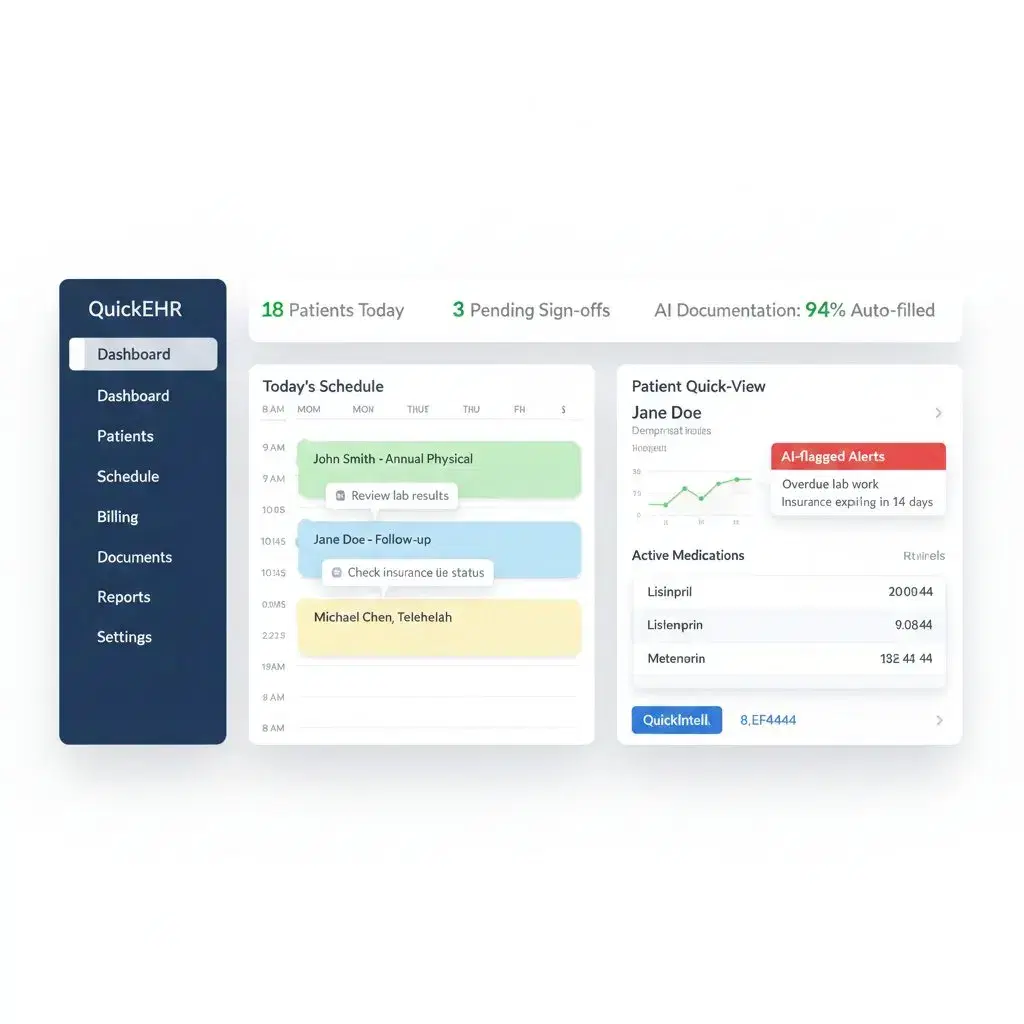
Payment posting should inherit the claim context that created the remittance.
Search intent around ERA posting blends education, operational how-to, and software evaluation. QuickEHR answers all three by showing how electronic remittance advice, payment posting, denials, AR, and patient balances connect inside an OpenEMR-powered workflow.
835 intake
Receive the ERA with claim context
QuickEHR ERA posting starts with electronic remittance advice, payer payment details, claim lines, adjustments, and OpenEMR-powered patient and encounter context in the same review path.
Keep the patient, encounter, payer, provider, claim, charge, and remittance reference visible before posting.
Support configured ERA, EOB, clearinghouse, payer, SFTP, API, batch, or interface-engine handoffs when they are enabled for the deployment.
Separate clean remittance from missing claim matches, payer takebacks, partial payments, adjustment mismatches, and denial work.
Reconciliation
Match payment details before posting
ERA payment posting in medical billing depends on accurate matching between the remittance, EFT or check detail, claim, service line, allowed amount, contractual adjustment, and patient responsibility.
Review claim-level and line-level payment, denial, coinsurance, deductible, copay, write-off, and contractual adjustment details.
Flag ERA lines that need a billing owner before balances update in the practice workflow.
Keep CARC, RARC, payer notes, and remittance evidence available for denial, appeal, and underpayment review.
Posting
Post clean lines and route exceptions
QuickEHR is designed to make clean ERA posting fast while preserving review queues for exceptions that should not be silently applied.
Route clean posting work, unapplied cash, secondary billing, patient balance handoff, recoupments, and underpayment questions to the right queue.
Use QuickRCM follow-up and AR context when an ERA exposes a denial, partial payment, payer request, or stalled claim issue.
Keep staff review points explicit so AI can prepare work without replacing billing team judgment.
Close the loop
Feed the next revenue cycle action
Payment posting software should improve the next workflow. QuickEHR connects ERA outcomes to accounts receivable, denials, coding, authorization, eligibility, and patient billing follow-through.
Use posted outcomes to update AR, denial queues, secondary claim prep, patient balances, and adjustment review.
Connect EOB-to-ERA work through QuickERA when paper or PDF EOBs need structured 835-style posting context.
Surface repeated payer and posting exceptions so teams can tune front-end, coding, claim, and billing workflows.
Posting operations
Cover the jobs buyers expect from ERA payment posting software.
QuickEHR ERA posting is designed for billing teams that need electronic remittance advice, medical billing payment posting, adjustment review, denial capture, secondary billing, unapplied cash, and patient balance handoff to stay connected to the source claim.
Keep CARC, RARC, payer comments, remark codes, and supporting remittance evidence close to denial and appeal work.
Patient balance handoff
Move patient responsibility to the right billing workflow with the supporting ERA and claim context visible.
Secondary billing prep
Identify remaining balances, crossover gaps, secondary payer needs, COB questions, and claim follow-up after primary payment.
Unapplied and underpaid work
Route unapplied cash, payment variance, partial payment, and possible underpayment work into review queues instead of burying exceptions.
AI EHR automation
AI can prepare ERA posting work while your team keeps the review points.
For practices comparing AI EHR ERA posting, ERA posting software, or payment posting software, QuickEHR uses QuickIntell modules to connect remittance, claims, denials, AR, coding, authorization, and EOB-to-ERA workflows.
ERA-to-claim matching assistance
AI can help prepare candidate matches between remittance lines, claims, service dates, providers, payers, and patient accounts for staff review.
Posting exception summaries
Summarize why a payment line is not clean: missing claim, amount mismatch, denied service, takeback, secondary billing need, or patient responsibility handoff.
Denial and remark routing
Group CARC and RARC patterns so billing teams can route denials to QuickRCM, coding, authorization, documentation, or front-desk owners.
EOB-to-ERA conversion path
Use QuickERA for paper and PDF EOB workflows that need EOB-to-ERA conversion before reviewable payment posting.
Underpayment review prep
Highlight variance patterns, expected adjustment questions, missing contract context, and partial payments that need billing review.
Revenue cycle feedback
Turn repeated payment posting exceptions into upstream signals for eligibility, authorization, coding, claims, and AR workflows.
OpenEMR and QuickEHR fit
QuickEHR ERA posting can follow the billing architecture your clinic chooses.
QuickEHR can be a managed OpenEMR-powered EHR or the connection layer around an existing system. In either model, OpenEMR ERA posting depends on the approved claim, remittance, payment, adjustment, and writeback paths available for that deployment.
QuickEHR is built on the OpenEMR foundation and adds QuickIntell-managed workflow automation, remittance context, billing queues, and implementation support.
Existing OpenEMR tenants
Practices already using OpenEMR can evaluate approved OpenEMR API, FHIR, HL7, EDI, clearinghouse, ERA, or interface-engine paths for payment posting context.
QuickEHR Connect
Clinics keeping another EHR or practice management system can evaluate QuickEHR as a workflow layer around claims, remittance, denials, and AR follow-up.
Related QuickIntell products
ERA posting works best when it is connected to the rest of the revenue workflow.
QuickEHR ERA posting is not a standalone billing island. It connects to documentation, coding, authorization, RCM, EOB-to-ERA conversion, and the OpenEMR-powered chart context.
Validate the remittance path before you automate posting.
ERA posting touches payments, adjustments, denials, patient balances, and financial audit trails. QuickIntell scopes the enabled data sources, user roles, posting rules, exception thresholds, and support ownership before production workflows are enabled.
Review the QuickIntell Trust Center for security and procurement materials, then confirm deployment-specific evidence in the implementation packet.
ERA posting launch checklist
Select QuickEHR-managed OpenEMR, an existing OpenEMR tenant, or QuickEHR Connect around another EHR or practice management system.
Map ERA, EOB, EFT, check, lockbox, clearinghouse, payer portal, SFTP, API, batch, or interface-engine sources available for the deployment.
Confirm claim, charge, payer, provider, location, encounter, patient, CARC, RARC, and remittance fields needed for accurate posting review.
Decide where AI may draft, classify, match, summarize, or route work before staff approval.
Review data handling, access controls, audit expectations, support ownership, implementation evidence, and escalation paths before production use.
Related workflows
Keep the ERA posting page connected to nearby billing and specialty journeys.
Use these related pages when evaluating QuickEHR ERA posting alongside QuickEHR billing, AR, claims, RCM automation, EOB-to-ERA conversion, and specialty workflow requirements.
ERA posting workflows can vary by payer mix, documentation burden, authorization patterns, and patient balance operations. Review specialty pages when scoping implementation details.
Answers for practices comparing ERA posting, electronic remittance advice, ERA payment posting, payment posting software, OpenEMR ERA posting, AI EHR ERA posting, and connected RCM workflows.
What is ERA posting in QuickEHR?
ERA posting in QuickEHR is the workflow for reviewing electronic remittance advice, matching payment and adjustment details to claims and service lines, posting clean remittance, and routing exceptions such as denials, partial payments, recoupments, underpayments, and patient responsibility handoffs.
What is the difference between EFT and ERA?
EFT is the movement of funds, usually through an electronic payment. ERA is the electronic remittance advice that explains how a payer adjudicated claims and service lines. ERA posting uses the remittance detail to apply payments, adjustments, denials, and patient responsibility to the billing workflow.
How does ERA payment posting in medical billing work?
ERA payment posting typically receives an 835 remittance, matches claim and service-line details, compares payment and adjustment amounts, applies clean lines, and routes mismatches, denials, takebacks, secondary billing needs, or patient balances for staff review.
Does QuickEHR include payment posting software workflows?
QuickEHR can support payment posting software workflows around enabled ERA, EOB, claim, clearinghouse, payer, and billing data sources. The exact posting rules, interfaces, review thresholds, and writeback path should be confirmed during implementation for the specific clinic environment.
How does QuickERA fit with ERA posting?
QuickERA is used when a practice receives paper or PDF EOBs that need to be converted into structured ERA-style context. QuickEHR can then use that remittance context for review, posting exceptions, denial routing, patient balance handoff, and QuickRCM follow-up.
Can QuickEHR support OpenEMR ERA posting?
QuickEHR is built on the OpenEMR foundation. OpenEMR ERA posting workflows depend on the deployment's enabled OpenEMR API, FHIR, HL7, EDI, clearinghouse, ERA, EOB, or interface-engine paths. QuickIntell reviews those paths during implementation before automation is enabled.
Can AI help with EHR ERA posting?
Yes. AI EHR ERA posting can help prepare candidate matches, summarize exceptions, classify denial and remark codes, group payer patterns, and route work to billing, coding, authorization, or AR owners. QuickEHR treats this as assistive automation with human review points.
Does ERA posting replace denial management?
No. ERA posting often creates denial work by surfacing CARC, RARC, payer notes, partial payment, and adjustment data. QuickEHR connects those signals to QuickRCM denial queues, appeals, corrected claims, AR follow-up, and upstream workflow improvement.
What should a practice review before launching ERA posting?
Review ERA sources, EOB sources, EFT or check reconciliation, clearinghouse routes, payer-specific rules, claim and charge mapping, adjustment policies, secondary billing, patient responsibility handoff, user roles, audit expectations, and which AI-prepared work requires staff approval.
Does this page make compliance or certification claims?
No. This page describes QuickEHR ERA posting workflow planning. QuickEHR is built on the OpenEMR foundation, and any certification, regulatory, payer, security, or procurement evidence should be verified in the current implementation packet and contract for the specific deployment.
Need ERA posting inside your EHR workflow?
QuickIntell can walk through QuickEHR, OpenEMR integration, QuickERA, QuickRCM, payment posting, claims, denials, patient balances, and trust documentation for the clinic environment you are evaluating.