Multi-Client AI RCM Automation for Billing Companies
Scale RCM delivery across every client workflow
Run eligibility batches, prior auth queues, coding review, claims checks, denial prevention, posting, AR follow-up, payer enrollment, and client reporting from one AI-assisted platform.
QuickIntell helps RCM companies standardize multi-client work queues, surface payer-specific exceptions before submission, and keep human reviewers in control of revenue cycle decisions.
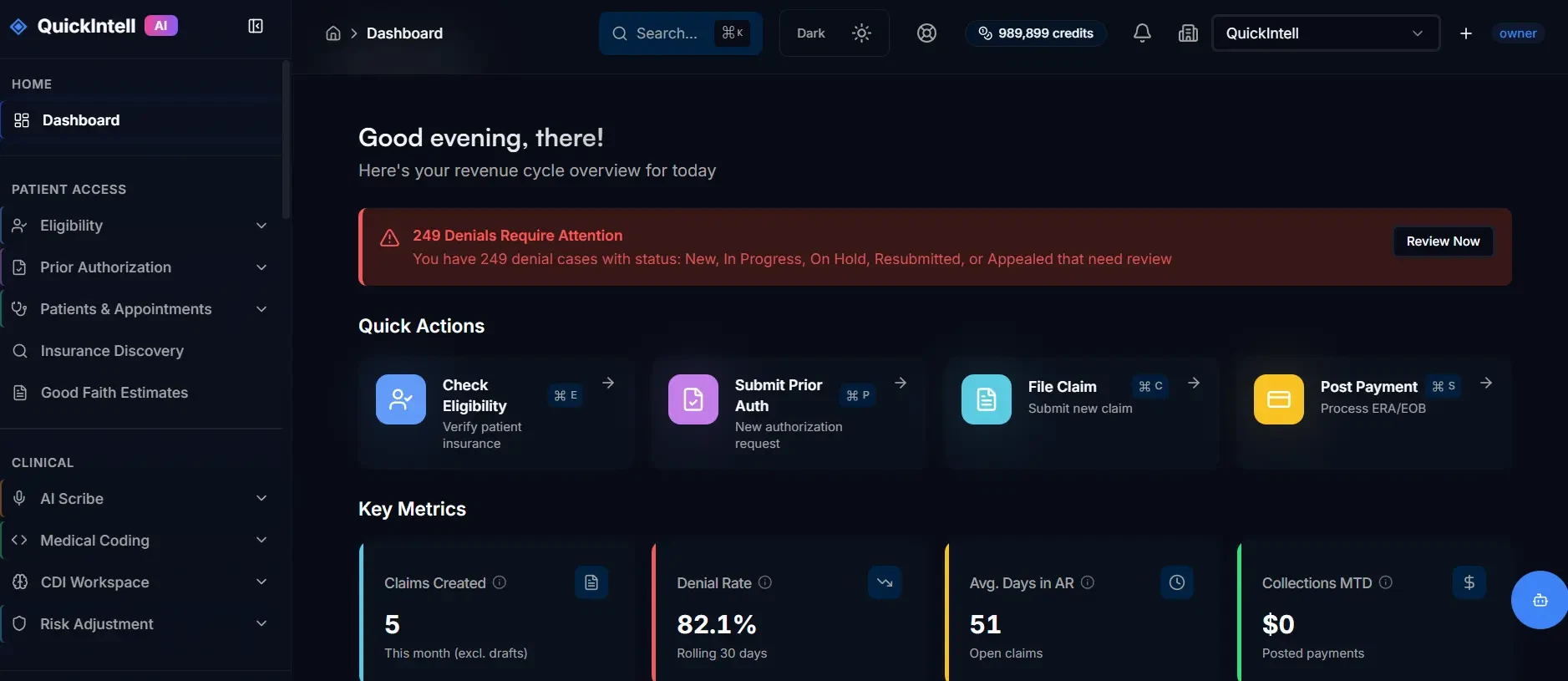

What RCM teams need first
Proof points for multi-client revenue cycle scale
Multi-client operations
Separate client workspaces, queues, and controls for scaled RCM teams.
Clean-claim lift
Eligibility, coding, and claim checks improve first-pass readiness.
Denial risk before submission
Pre-submit rules flag missing data and payer-specific denial risk.
AR work queues
Aged balances, follow-up tasks, and exceptions stay organized by priority.
EHR/clearinghouse integration
Connect RCM workflows to EHR, PM, clearinghouse, and 835/837 data flows.
Human approval controls
AI recommendations route sensitive actions to user review before release.
RCM company pains
The operating friction that keeps revenue cycle teams reactive
QuickIntell focuses on the queue-level work that determines whether billing companies can scale service quality across many client books without losing control of claims, denials, and AR.
Client variation slows scale
Each client brings different EHR exports, payer edits, locations, and contract rules, so one-size workflows break down quickly.
Denial signals arrive too late
Missing coverage details, coding gaps, authorization issues, and payer-specific requirements often surface after submission.
AR teams chase scattered work
Aged balances, no-response claims, payment exceptions, and payer follow-up need prioritization by value, SLA, and next action.
Revenue cycle workflow
One connected path from scheduled visit to client reporting
QuickIntell maps the full RCM operating chain from scheduling and eligibility through prior authorization, scribe, coding, claims, denials, appeals, posting, AR, and analytics.
Scheduling and eligibility
Scheduled visits trigger coverage checks so intake teams can confirm benefits, copays, and payer requirements before service.
Prior authorization
Authorization requirements, clinical packets, status tracking, and approval details stay connected to the encounter.
Scribe and coding
Attested documentation flows into coding review so notes, diagnoses, CPTs, modifiers, and edits are resolved before billing.
Claims
Claim drafts move through denial-prevention checks, payer-specific rules, and clearinghouse submission workflows.
Denials and appeals
Denied claims route to classification, next-action guidance, appeal drafting, and recovery tracking.
Payment posting
ERA data posts back to the revenue workflow, with exceptions, adjustments, and reconciliation routed for review.
AR follow-up
Aged balances, no-response claims, payer follow-up, and patient balances land in prioritized work queues.
Reporting
Leaders review client-specific dashboards, KPI tiles, saved views, exports, and drill-downs to source claims.
Module depth
AI RCM modules for claims, denials, AR, and supporting work
RCM companies can start with the queues causing the most leakage and expand into adjacent workflows as client operations mature.
AI RCM command center
Coordinate eligibility, authorizations, coding, claims, denials, payment posting, AR, and reporting from one operating layer.
Document classification
Classify EOBs, clinical attachments, payer letters, and intake documents so teams can route exceptions without manual sorting.
Eligibility and authorization
Run coverage checks and authorization workflows before service so downstream claims avoid preventable payer friction.
Scribe and coding review
Connect documentation, diagnosis capture, CPT review, modifiers, and payer edits before the claim leaves the queue.
Voice agents and follow-up
Support payer calls, status checks, reminders, and administrative outreach with human-supervised AI voice workflows.
Payment and reconciliation
Post payments, identify exceptions, reconcile ERA details, and move underpaid or unresolved balances into the right AR queue.
Integrations and trust
Connect client systems without removing operational controls
QuickIntell implementation starts by reviewing each client system, export, API, clearinghouse, approval process, and PHI handling requirement, then maps the workflow to the safest available integration path.
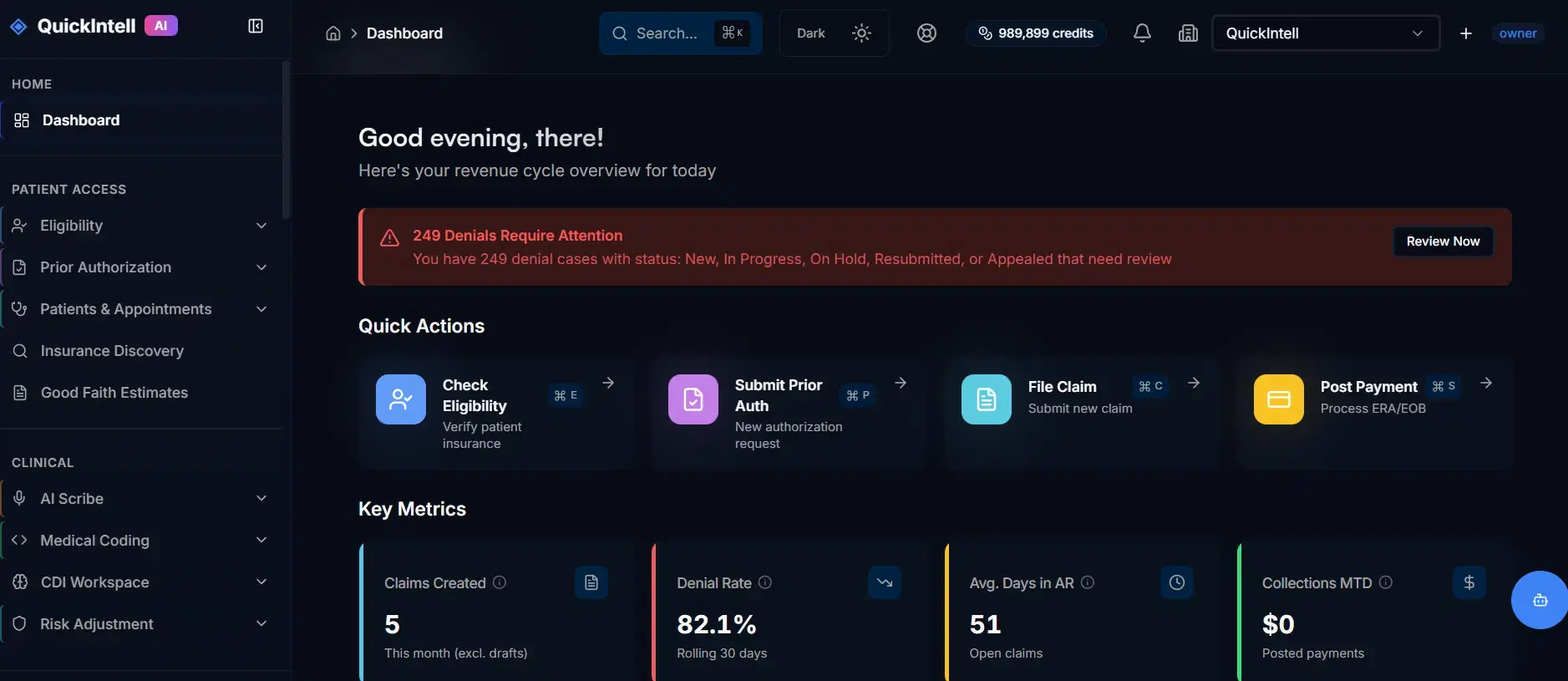
EHR, PM, and clearinghouse paths
Map each client to the available APIs, exports, 835/837 files, clearinghouse flows, and approved data exchange method.
Tenant-scoped client books
Keep client workspaces, records, saved views, users, roles, and permissions scoped while leadership manages one operating model.
Role-based access
Align reviewers, supervisors, client users, and admin permissions to the work each team is approved to perform.
Human approval gates
Route claim release, payer follow-up, appeal submission, and account updates to user review before sensitive actions occur.
Audit-ready activity history
Track queue movement, user decisions, AI recommendations, and approval events for operational review and client reporting.
Healthcare data safeguards
Use secure handling patterns for PHI workflows, including encryption, access controls, audit trails, and BAA review.
Proof before rollout
RCM company implementation pattern
Customer-specific outcomes are published only after product, customer, and legal substantiation. The rollout pattern below keeps configuration, review, and reporting aligned before scale.
Phase 1
Connect client operations
Set up client workspaces, EHR or PM feeds, clearinghouse paths, users, roles, and permission controls.
Phase 2
Run reviewed queues
Launch eligibility, coding, claims, denials, posting, and AR queues with configured rules and human approval gates.
Phase 3
Report and expand
Deliver client dashboards, saved reporting views, exports, and operating summaries before expanding more workflows.
For RCM and billing teams
Give rate-to-remit reviews a defensible evidence path
Use aggregate public benchmarks to prioritize a client review—then keep the signed payer contract, expected reimbursement logic, and 835 or ERA outcome separate and traceable before recommending action.
Frequently Asked Questions
Get answers to common questions about AI revenue cycle automation for multi-client RCM company operations.

Need More Information?
Our team of AI healthcare experts is ready to answer your specific questions and provide personalized guidance for your organization.
Contact Us
Ready to revolutionize your healthcare operations? Visit us at quickintell.com or email us at info@quickintell.com to schedule a personalized consultation.
Transform Your Healthcare Operations Today
Join the healthcare revolution with QuickIntell's AI-powered solutions. Experience unprecedented efficiency, cost savings, and improved patient care.
Start Your Transformation