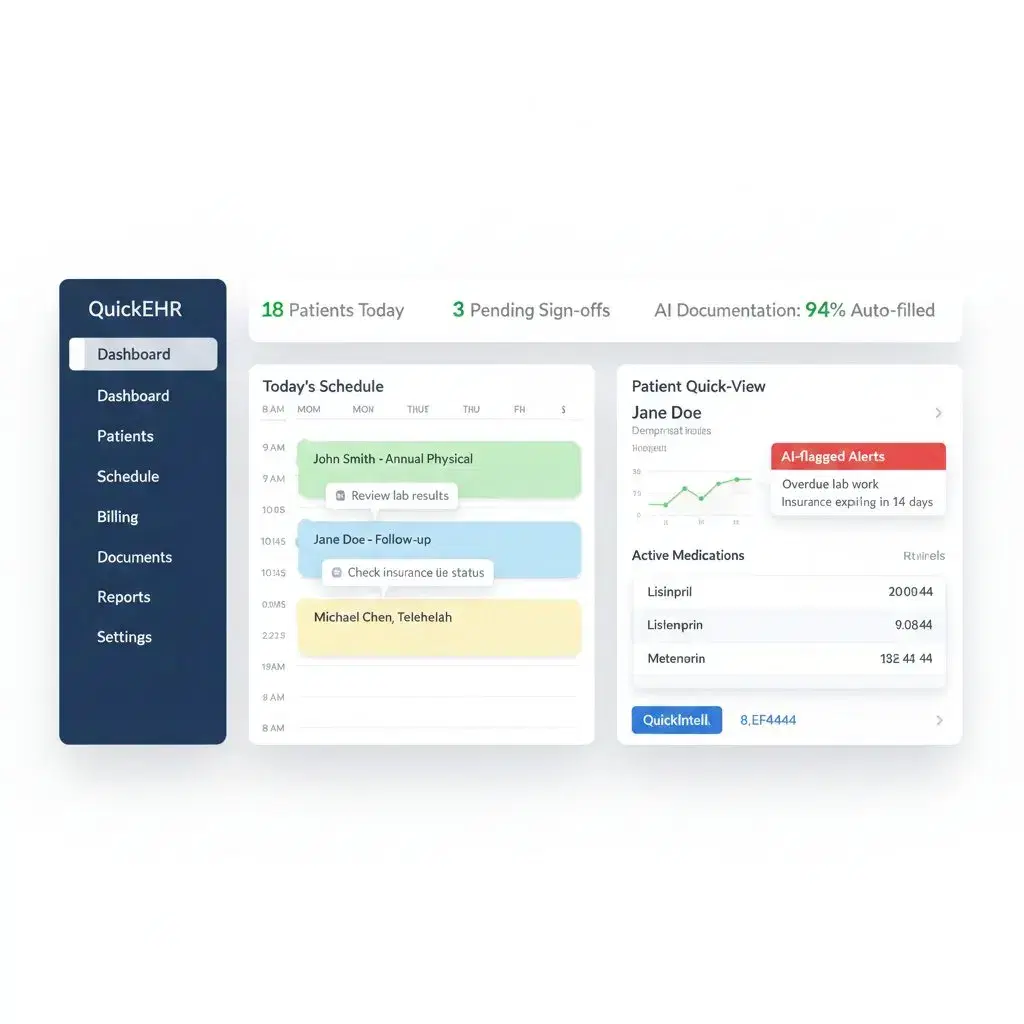
Patient self scheduling software for medical practices using QuickEHR
QuickEHR gives ambulatory clinics an online patient scheduling software workflow that lets patients book or request appointments while keeping visit type rules, intake, reminders, eligibility, prior authorization, documentation, coding, RCM, and remittance follow-through connected to the OpenEMR-powered chart.
Online booking, intake, reminders, auth, and RCM handoff
Patient choice
Configured slots and requests
Staff control
Exceptions and approvals
Follow-through
Auth, coding, RCM, ERA
Self-scheduling workflow
Online booking should reduce phone work without losing operational control.
Practices comparing self scheduling software usually need patient convenience, fewer calls, and fewer no-show surprises. QuickEHR adds the healthcare-specific context: visit rules, chart context, intake, eligibility, authorization, coding, claims, and follow-up.
Patient access
Offer self-scheduling without opening every slot
QuickEHR patient self scheduling software lets practices define which appointment types, providers, locations, visit lengths, and patient paths can move forward without a phone call.
Publish configured visit types while keeping complex visits, procedures, referrals, and exceptions in staff review.
Use appointment reason, patient status, provider rules, location, and resource requirements before a time is offered.
Keep self-scheduled visits attached to the QuickEHR chart, not a disconnected booking calendar.
Front desk control
Route incomplete requests before they become day-of-visit rework
Patient self scheduling should reduce calls without hiding intake, coverage, referral, authorization, or preparation gaps from the clinic team.
Queue requests with missing demographics, coverage details, visit reason, referral status, or preparation requirements.
Connect confirmations, reminders, cancellation fills, and reschedules to staff-owned worklists.
Preserve review points when a patient request needs scheduling, billing, or clinical judgment.
Downstream work
Use the appointment to start the work that follows
Self scheduling software is most useful when the appointment triggers intake, eligibility, prior authorization, documentation, coding, claims, ERA, and follow-up work in the same operating model.
Start eligibility checks and prior authorization review from the scheduled visit when configured.
Carry visit reason, provider, location, payer, and patient context into QuickScribe, QuickCode, QuickAuth, QuickRCM, and QuickERA.
Turn no-shows, cancellations, recalls, and follow-up needs into structured queues instead of informal notes.
Self-scheduling rules
Let patients choose a time, but keep the practice rules explicit.
Patient self scheduling software for healthcare should not behave like a public calendar. As medical appointment scheduling software, QuickEHR is designed around appointment type guardrails, chart context, patient intake, reminder workflows, and revenue tasks that happen before and after the visit.
Configure which patients can book directly and which requests should land in a staff queue before the appointment is confirmed.
Visit-type guardrails
Control appointment types, visit lengths, provider templates, location rules, procedure readiness, telemedicine paths, and blocked slots.
Intake before arrival
Collect visit reason, demographics, forms, coverage updates, consent packets, and preparation answers before check-in.
Reminders and confirmations
Use reminder, confirmation, reschedule, cancellation, and recall workflows to reduce preventable phone work and stale appointments.
Waitlist and cancellation fills
Route openings to eligible patients while preserving provider, location, appointment type, and staff approval rules.
Revenue triggers
Use the scheduled visit to start eligibility, referral, prior authorization, estimate, coding, claim, and patient balance workflows.
AI EHR self scheduling
AI can prepare the work around the appointment while teams keep review control.
QuickIntell AI can help classify scheduling requests, organize intake gaps, prepare follow-up work, and connect the scheduled visit to documentation, authorization, coding, billing, voice, and remittance workflows.
OpenEMR self scheduling works best when it stays connected to the chart.
QuickEHR is built on the OpenEMR foundation. The self-scheduling workflow should be scoped around the clinic deployment: managed QuickEHR, an existing OpenEMR tenant, or a QuickEHR Connect pattern around another system.
Review the OpenEMR integration for approved API, FHIR, HL7, and interface paths that may be available for a specific deployment.
QuickEHR-managed OpenEMR
QuickEHR is built on the OpenEMR foundation and adds managed implementation, appointment workflow design, integrations, and QuickIntell automation around the chart.
Existing OpenEMR tenants
Practices already using OpenEMR can evaluate approved OpenEMR API, FHIR, HL7, or interface-engine paths for self-scheduling, intake, and downstream worklists.
QuickEHR Connect
Practices keeping another EHR or practice management system can use QuickEHR as a workflow layer around appointments, encounters, claims, and remittance context.
Related QuickIntell products
Self-scheduling is the first step in a larger QuickIntell workflow.
A self-scheduled appointment can become intake, documentation, coding, authorization, claim, ERA, patient billing, or outreach work. These product links keep the workflow connected.
New patient rules, procedure prep, referral needs, follow-up intervals, no-show risk, and authorization requirements can vary across primary care, urgent care, behavioral health, cardiology, orthopedics, pediatrics, and OB-GYN.
Define the self-scheduling operating model before patients see it.
Medical appointment self scheduling touches patients, front desk teams, clinicians, prior authorization, billing, and support. QuickEHR implementation should make the rules, review points, interfaces, patient-facing language, and ownership explicit before launch.
Security and procurement teams can review current materials through the Trust Center. Any implementation-specific evidence should be verified in the current contract and deployment packet.
Self-scheduling implementation checklist
Scope these items before production use.
Choose direct booking, request review, or a hybrid self-scheduling model by appointment type.
Decide where AI may draft, classify, summarize, route, or queue work before staff or clinician review.
Review patient-facing language, access controls, audit expectations, data handling, support ownership, and procurement evidence before launch.
QuickEHR navigation
Related QuickEHR pages for self-scheduling buyers.
Self-scheduling buyers usually need the surrounding EHR, portal, eligibility, documentation, scheduling, and OpenEMR integration context before selecting a workflow.
Answers for practices comparing patient self scheduling software, self scheduling software, OpenEMR self scheduling, online appointment scheduling software for medical practices, and AI EHR self scheduling.
What is patient self scheduling software?
Patient self scheduling software lets patients request or book appointments online while the practice controls appointment types, provider rules, locations, visit lengths, intake requirements, reminders, and exception routing. In QuickEHR, self-scheduling stays connected to the OpenEMR-powered chart and QuickIntell workflows.
How is QuickEHR self-scheduling different from a generic booking link?
A generic booking link confirms a time. QuickEHR self-scheduling keeps the appointment tied to patient chart context, visit reason, provider and location rules, intake, eligibility, prior authorization, documentation, coding, claims, and patient follow-up.
Can QuickEHR support direct booking and request review?
Yes. Practices can plan direct booking for appropriate visit types and request review for complex appointments, new-patient rules, procedures, referrals, coverage issues, authorization-sensitive services, or any workflow that needs staff review before confirmation.
How does OpenEMR self scheduling fit with QuickEHR?
QuickEHR is built on the OpenEMR foundation. Self-scheduling can be planned for QuickEHR-managed OpenEMR workflows or connected to an existing OpenEMR tenant when approved OpenEMR API, FHIR, HL7, or interface-engine paths are available for the deployment.
Can self-scheduling trigger eligibility or prior authorization?
Yes, when configured. The scheduled visit can provide patient, payer, provider, location, visit type, order, procedure, diagnosis, and service-date context for eligibility review and prior authorization worklists before the appointment.
How does AI EHR self scheduling work in QuickEHR?
QuickIntell AI can help classify requests, draft intake summaries, flag missing information, route reminder follow-up, prepare authorization or billing work, and summarize scheduling exceptions for review. It is assistive workflow automation, not an autonomous clinical decision maker.
Does QuickEHR replace the front desk?
No. The goal is to reduce avoidable phone work and organize requests so front desk, billing, and clinical teams can focus on exceptions, patient support, complex visits, and high-value review points.
Can self-scheduling connect to reminders, waitlists, and rescheduling?
Yes. QuickEHR self-scheduling can be scoped with reminder, confirmation, cancellation, waitlist, recall, and reschedule workflows, with patient-facing language and escalation paths defined before launch.
How does self-scheduling connect to QuickRCM and billing?
Appointment context affects revenue work. QuickEHR can carry patient, provider, location, eligibility, authorization, visit type, and encounter context into QuickRCM and QuickERA workflows so billing teams have a clearer trail from booking to payment.
What should practices review before launching self-scheduling?
Practices should review appointment types, patient eligibility, provider templates, location rules, visit lengths, intake questions, reminders, cancellation paths, coverage collection, authorization triggers, OpenEMR interfaces, access controls, data handling, and support ownership before go-live.
Does this page make certification or compliance claims?
No. This page describes QuickEHR self-scheduling workflows and implementation planning. QuickEHR is built on the OpenEMR foundation, and any certification, security, payer, HIPAA, SOC 2, procurement, or regulatory evidence should be verified in the current implementation packet and contract for the specific deployment.
QuickEHR self-scheduling
Give patients a cleaner path to book without disconnecting the practice workflow.
See how QuickEHR can connect self-scheduling, OpenEMR-powered chart context, patient intake, QuickIntell AI automation, and revenue workflows for your clinic.