AI Revenue Cycle Platform for Hospitals & Health Systems
QuickIntell provides AI agents for hospitals to automate documentation, coding, prior auth, claims, and denials. Reduce cost-to-collect, shorten days in A/R, and relieve clinician burnout—without replacing your core systems.
Whether you're a CFO protecting margin, a CIO under pressure to "do AI" responsibly, or a CMO fighting clinician burnout—these challenges are draining your health system every day.
CFO Pain
Denial Rates Climbing
High-value service lines like ED, cardiology, oncology, and surgery are seeing denial rates creep up, bleeding margin.
10-15%avg denial rate
VP RCM Pain
Coding Backlogs & BPO Costs
Dependence on expensive temp coders or offshore BPOs creates quality issues and unpredictable costs.
$$$temp coder costs
Clinical Pain
Prior Authorization Delays
Authorization delays block scheduling and OR utilization, frustrating patients and surgeons alike.
24-72havg PA delay
CIO Pain
Fragmented Point Solutions
Multiple vendors that don't talk to each other, all glued together with spreadsheets and portals.
12+avg vendor count
CMO Pain
Documentation Burden
Clinicians spending more time documenting than seeing patients—driving burnout and turnover.
2-3 hrsdaily charting
QuickIntell exists to solve this
Turn these into automated, measurable, and governed workflows
Meet QuickIntell
Why Hospitals & Health Systems Choose QuickIntell
QuickIntell provides AI agents for healthcare that plug into your EHR, payer connections, and RCM tools to orchestrate end-to-end workflows. All modules are HIPAA and SOC2 aligned, with multilingual support and deep EHR integration.
Customized to Your System
Every deployment starts with your goals: service lines to prioritize, payors to target, and KPIs to move. We configure templates, models, and rules to match your existing workflows and payer mix.
Seamless EHR & PMS Integration
Connect via FHIR APIs, HL7 feeds, batch files, and RPA where needed. Works alongside Epic, Cerner, Meditech, Allscripts and others—no rip-and-replace required.
Proven Impact, Not AI Theater
Built around real metrics: documentation time saved, denials reduced, first-pass yield improved, payment posting automated. AI wired into revenue and clinical outcomes you care about.
Scalable for Complex Systems
Whether you're a single tertiary hospital or a multi-state IDN, QuickIntell scales from one pilot service line to system-wide deployment—without losing governance or local nuance.
Built by Healthcare RCM & AI Experts. Our team combines deep revenue cycle expertise with cutting-edge AI engineering. We serve US hospitals and health systems with HIPAA-compliant, SOC2-architected solutions. Every deployment is backed by BAAs and designed for clinical and financial leaders who need measurable results—not AI theater.
HIPAA
Aligned
SOC 2
Architected
BAA
Ready
Ready for a Custom AI RCM Blueprint?
Every hospital starts from a different baseline. We'll design a roadmap tailored to your health system's unique needs, payer mix, and priority KPIs.
How AI Agents Transform Your Hospital Revenue Cycle
Seven powerful AI solutions for hospitals and health systems: from AI medical coding and prior authorization to EOB automation and voice agents. Deploy individually or as an integrated autonomous RCM platform.
QuickRCM – Autonomous RCM Workflows
The backbone of AI-driven revenue cycle
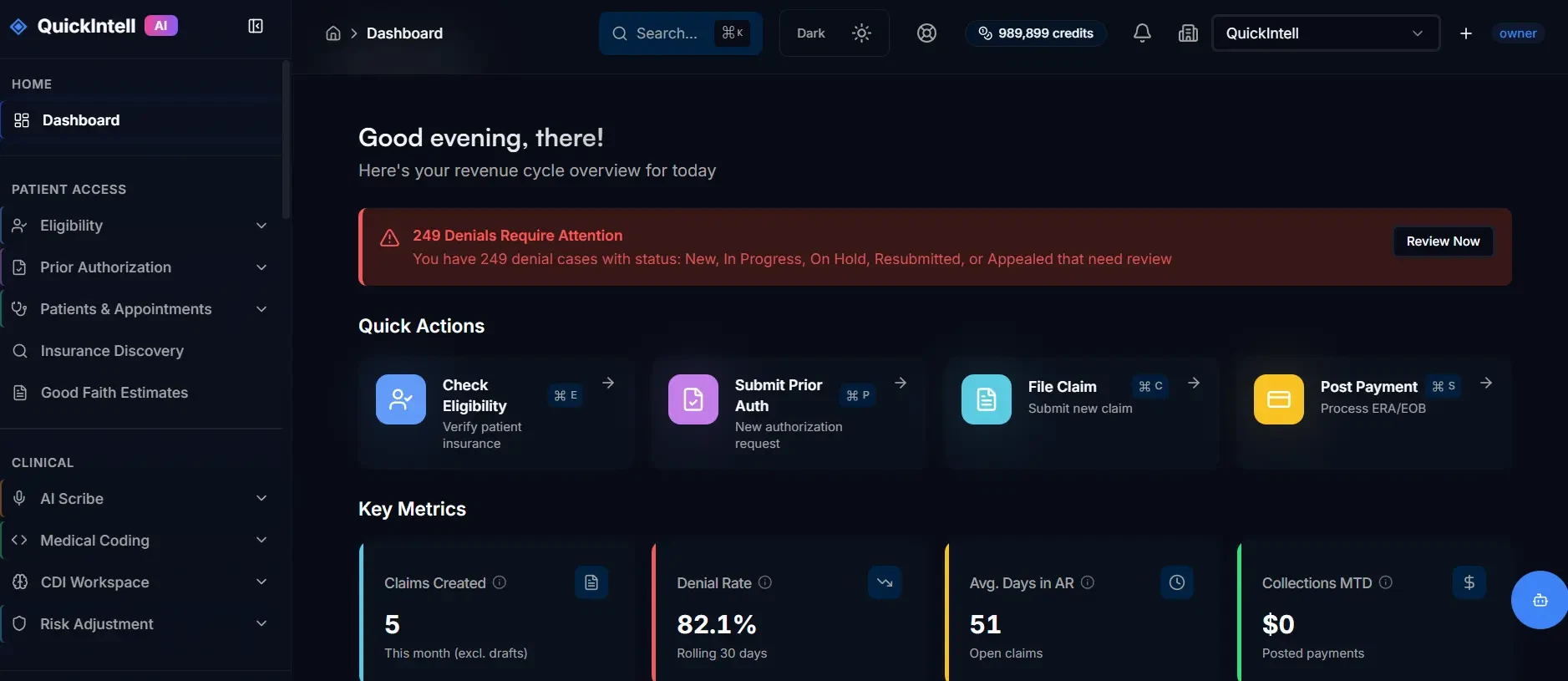
Comprehensive RCM automation layer that connects eligibility, prior auth, coding, claims scrubbing, claim status, payment posting, denials, and analytics in a single flow.
Back-end: Auto claim status, payment posting via EDI 835
Analytics: Root-cause denial insights by payer, code, provider
Hospital Value
• Reduce cost-to-collect
• Predictable cash flow
• 3,500+ payor integrations
QuickScribe – Hospital-Grade AI Scribe
Clinical documentation without the burden
Listens to clinician–patient encounters and converts them into completed notes (SOAP, H&P, consults, discharge summaries, procedure notes) mapped to your hospital templates.
Key Capabilities
Structured notes drafted for clinician review and attestation
Supports in-person and telehealth encounter capture
Integrates with major EHRs (Epic, Cerner, Meditech)
Automates prior auth so clinicians and schedulers aren't stuck waiting. Detects requirements, gathers documentation, submits via APIs/RPA/voice, and monitors status.
Hospitals still receive significant remittances as PDFs, images, and portal letters. QuickERA classifies, extracts, and converts EOBs into standardized ERA (EDI 835) files.
Key Capabilities
Classifies denial letters, EOBs, and correspondence
AI voice agents that handle inbound and outbound calls for reminders, eligibility follow-up, balances, FAQs, and appointments with human handoff when needed.
For health systems that manage or affiliate with independent physician groups. A $0 EHR option with AI-driven scheduling, documentation, coding, and billing features.
Key Capabilities
EHR foundation with migration and workflow support
White-glove migration with no licensing/training fees
AI features for scheduling, documentation, coding, billing
Most health systems begin with QuickRCM for end-to-end automation or QuickScribe to relieve clinician burden. We'll help you prioritize based on your biggest pain points.
QuickIntell is mapped to the actual work hospitals run every day: patient access, clinical documentation, mid-cycle coding, institutional billing, cash posting, denial recovery, AR, finance, and governance.
Front end
Eligibility
Nightly schedule sweeps and single-patient checks turn coverage, COB, copay, and deductible data into clean intake decisions.
Manual-backed flow: Eligibility dashboard, 270/271 routing, response viewer, inactive coverage to Insurance Discovery, and patient AR handoff.
For the provider-side chronology that connects patient status, authorization, notices, and human review, see our hospital utilization management software workflow.
Implementation Process
How QuickIntell Works in Your Health System
The result is fewer manual touches per encounter, predictable workflows, and better visibility from C-suite to front line.
Step 01
Connect
We connect to your EHR, PMS, data warehouse, and payer channels via FHIR, HL7, SFTP, and API/RPA.
Secure integration with Epic, Cerner, Meditech, Allscripts, and others
Connect to your existing clearinghouses and payor portals
Establish data pipelines for claims, EOBs, and clinical notes
Configure access controls and audit logging
Step 01
Connect
We connect to your EHR, PMS, data warehouse, and payer channels via FHIR, HL7, SFTP, and API/RPA.
Step 02
Ingest
Clinical notes, orders, claims, EOBs, and call logs are ingested and normalized for AI processing.
Step 03
Augment
AI agents propose notes, codes, eligibility outcomes, auth decisions, and denial risks.
Step 04
Automate
Routine tasks (status checks, posting, reminders, low-risk coding) are executed automatically with configurable guardrails.
Step 05
Govern
Every action is logged, explainable, and auditable. You choose what is fully automated, what requires sign-off, and what stays in shadow mode.
Measurable Outcomes
Outcomes You Can Aim For
Every hospital starts from a different baseline, but these are typical goals we help health systems achieve. We translate these into a custom AI RCM Blueprint with clear KPIs and timelines.
>95%
First-Pass Clean Claim Rate
Industry avg: ~80%
50-70%
Less Provider Charting Time
With AI Scribe
60-80%
Reduced Manual Coding
With QuickCode
~90%
Auto-Posted Payments
With QuickERA
↓ IDR
Reduce Initial Denial Rate
Focus on documentation, coding quality, and front-end eligibility to catch issues before they become denials.
↑ FPY
Increase First-Pass Yield
Payer-specific rules and pre-bill denial prediction mean cleaner claims that pay the first time.
↓ TAT
Cut Coding Turnaround
Reduce backlogs especially in high-volume departments like ED, radiology, and surgery.
↓ DSO
Shorten Days in A/R
Faster claim submission, automatic status follow-up, and auto-posting accelerate cash flow.
↓ Burden
Reduce Documentation Time
Give clinicians hours back each week while improving note quality and completeness.
↓ CtC
Lower Cost-to-Collect
Shift staff from repetitive work to high-value exceptions and analytics.
Ready to define your targets?
We'll create a custom AI RCM Blueprint for your health system with clear KPIs, timelines, and projected outcomes.
Handling PHI at scale demands more than clever models—it demands rigor. You remain in control of your data. QuickIntell's job is to turn it into value—not into risk.
HIPAA
Aligned
SOC 2
Type II program
BAA
Process
HITRUST
unknown
ONC Certified
EHR Core
HIPAA-Aligned Platform
Standard BAA process for covered entities and business associates before PHI workflows go live.
SOC 2 Status
SOC 2 Type II controls program in place; current report and evidence are shared under NDA.
Encryption Everywhere
TLS in transit and encryption at rest, with strong key management practices.
RBAC & Audit Logging
Least-privilege RBAC plus audit logging for user, data, workflow, and configuration actions.
Data Retention Controls
Retention windows, export, deletion, and contract-end purge are handled in the BAA and security annex.
Model-Training Boundaries
Hospital PHI is not used to train public or cross-customer models. Any hospital-specific tuning is isolated and contract-governed.
Trust Center and Security Packet
Procurement review can include the BAA template, SOC 2 status and evidence, model-training terms, RBAC and audit logging details, data-retention controls, subprocessors, and security questionnaire. HITRUST status is unknown unless verified in the packet.
Connect public market signals to contract and remit review
Public hospital benchmarks can help a revenue cycle or contracting team decide where to investigate. Expected reimbursement still comes from the applicable signed contract, and the adjudicated outcome comes from the 835 or ERA.
Hospital & Health System FAQ
FAQs: QuickIntell for Hospitals & Health Systems
Everything hospital executives need to know about QuickIntell—from strategic impact to implementation details.
Most Asked Questions
Categories
Strategic & Business Impact
3 questions
QuickIntell tackles the operational bottlenecks that hit both margin and clinician time: denials, coding backlogs, prior auth delays, manual eligibility checks, payment posting from paper EOBs, and overloaded call centers. It connects these workflows instead of treating them as isolated "point problems." The result is fewer avoidable denials, faster cash, lower cost-to-collect, and less administrative burden on clinicians and RCM teams.
QuickIntell is a unified AI revenue cycle platform with modular products. You can start with a specific use case—like AI coding, prior auth, or EOB automation—and expand over time to cover front-end, mid-cycle, and back-end workflows. Under the hood, it's one AI "fabric" that understands your data end-to-end instead of multiple disconnected tools.
Impact depends on your baseline and scope, but hospitals typically target goals like:
Lower initial denial rates
Higher first-pass yield
Reduced coding TAT and backlogs
Shorter days in A/R
Reduced labor intensity in status checks and posting
We work with you to build an AI RCM blueprint with concrete KPIs and timelines rather than generic "AI will help" promises.
Still have questions?
Our healthcare specialists understand both the clinical and financial sides of health systems. Let's discuss your specific situation.
Ready to See What AI Agents Can Do for Your Health System?
If you're exploring how AI can materially move your denial rate, days in A/R, cost-to-collect, and clinical burnout, QuickIntell can help you design and execute a roadmap tailored to your health system.
Primary CTA
Request an AI RCM Blueprint
Get a custom roadmap tailored to your health system's denial rate, days in A/R, cost-to-collect, and clinical burnout challenges.
We'll meet you where you are today—and help you build the AI-enabled revenue engine your health system needs for tomorrow.
Results vary by organization; metrics shown are representative of deployments and targets under typical configurations. Security and integration details available on request under BAA/NDA.