EHR data conversion for QuickEHR and OpenEMR workflows
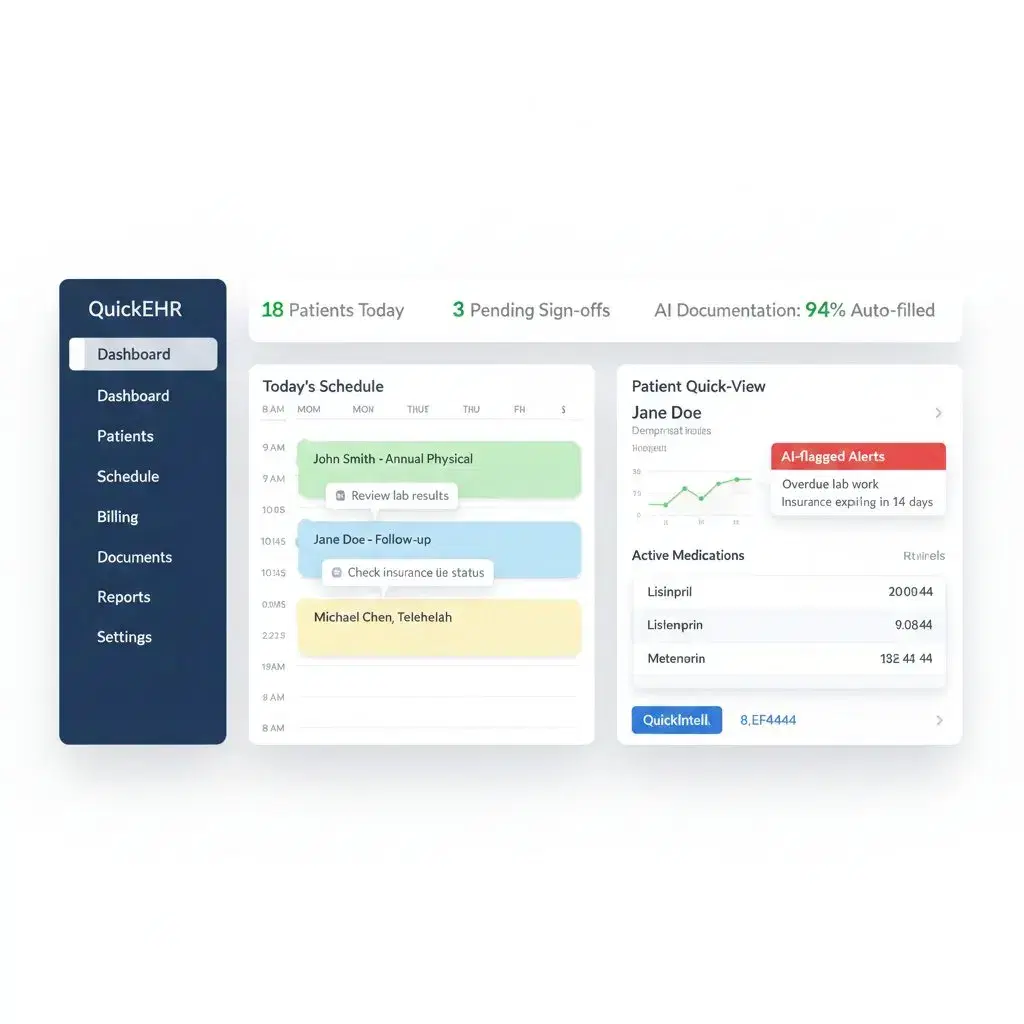
QuickEHR EHR data conversion services help ambulatory practices move from legacy EHR, OpenEMR, practice management, billing, and document systems into a reviewable QuickIntell workflow. Convert patient charts, schedules, insurance, claims, AR, authorizations, remittance context, and files with AI-assisted mapping, reconciliation, and exception routing for human review.
Move the records that protect clinical and revenue continuity.
The search results for EHR data conversion focus on what conversion means, which data moves, and how practices reduce migration risk. QuickEHR treats conversion as a scoped operational handoff across chart, practice management, billing, and document workflows.
Patient demographics and schedules
Convert the operational data that drives daily clinic flow: patients, guarantors, contacts, appointments, providers, locations, insurance profiles, and active registration exceptions.
Preserve source identifiers, dates, provider/location mappings, and active patient status.
Flag duplicate patients, missing subscriber details, inactive coverage, and appointment conflicts before import.
Keep scheduling and registration data connected to eligibility and patient access workflows.
Chart, clinical, and document history
Plan chart conversion around the data clinicians actually need at go-live: problems, allergies, medications, immunizations, labs, notes, forms, attachments, and encounter history.
Separate structured clinical fields from PDFs, images, scanned records, and imported document packages.
Use sample-chart validation so providers can verify migrated history before production cutover.
Keep ambiguous mappings in review queues instead of silently rewriting clinical meaning.
Practice management and billing data
Data conversion services for EHR migration should also protect revenue continuity when PM, billing, claims, balances, denial, remittance, and payment context is in scope.
Map payer plans, fee schedules, provider identifiers, claim status, open balances, and AR owners.
Tie converted claims and remittance context to QuickRCM and QuickERA workflows where appropriate.
Keep financial cutover rules explicit so staff know what stays in the legacy system and what moves forward.
OpenEMR and QuickEHR configuration
For OpenEMR data conversion or QuickEHR data conversion, the implementation plan should include forms, templates, document categories, roles, locations, billing settings, and workflow-specific data rules.
Review OpenEMR source exports, reports, APIs, FHIR paths, files, and database-backed outputs before mapping.
Align migrated data with QuickEHR's configured chart, schedule, billing, and automation workflows.
Document any custom fields, unsupported records, attachments, and manual review responsibilities.
Data conversion workflow
Conversion should be tested, reconciled, and owned.
Generic data conversion services pages often stop at file transformation. Healthcare conversion needs source inventory, field mapping, clinical review, billing continuity, import testing, and post-go-live ownership.
Inventory
Know what exists before deciding what moves
EHR data conversion starts with source-system inventory. QuickIntell helps teams identify databases, exports, reports, attachments, forms, code sets, document stores, and open workflow queues before mapping begins.
Define required, optional, archive-only, and do-not-convert data groups with named owners.
Record source identifiers and provenance so every converted record can be traced during validation.
Map
Build a field map around QuickEHR workflows
A clean conversion map translates source fields into the QuickEHR operating model, not just a new set of tables. The map should account for clinical review, billing continuity, patient access, and AI workflow handoffs.
Define how custom fields, inactive records, historic notes, document categories, and code-set differences will be handled.
Keep source-to-target rules visible to clinical, billing, IT, and implementation reviewers.
Clean
Clean duplicates, stale records, and risky exceptions
Data cleansing should reduce avoidable go-live friction without pretending every record can be corrected automatically. QuickEHR conversion workflows keep uncertain records in review queues.
Flag duplicate patients, invalid dates, inactive insurance, missing identifiers, unmapped providers, and orphaned documents.
Route clinical, billing, authorization, and payer exceptions to the right human reviewer.
Keep before-and-after reconciliation evidence so stakeholders can review what changed.
Test
Run test imports before production cutover
The SERP for EHR migration emphasizes validation because conversion risk shows up late. QuickEHR data conversion should include test loads, sample charts, claim/balance checks, document review, and sign-off checkpoints.
Compare record counts, sample patients, chart history, appointments, documents, balances, claims, and remittance context.
Validate provider, location, payer, diagnosis, procedure, modifier, and status mappings.
Resolve failed imports, missing documents, code mismatches, and duplicate records before go-live.
Cutover
Protect continuity during go-live and hypercare
Conversion is not finished when files import. QuickIntell helps teams decide legacy read-only access, delta loads, cutover timing, rollback paths, and post-go-live exception ownership.
Define freeze windows, final extracts, delta loads, go-live support, and legacy-system access expectations.
Keep open claims, denials, authorizations, patient balances, and appointments visible during transition.
Use post-go-live reconciliation to catch missing records, staff questions, and workflow friction quickly.
AI EHR data conversion
AI can prepare conversion work while reviewers keep control.
QuickIntell AI is useful for repetitive conversion prep: classifying files, suggesting mappings, identifying gaps, summarizing exceptions, and routing work. It should not replace clinical, legal, billing, or implementation sign-off.
Document classification
QuickIntell AI can help label scanned charts, imported PDFs, referrals, payer letters, lab documents, and billing attachments so reviewers can find the right content faster.
Mapping suggestions
AI can suggest source-to-target mappings for common demographics, clinical fields, payer details, document types, and billing attributes while implementation owners approve final rules.
Duplicate and gap detection
Assistive checks can surface likely duplicate patients, missing identifiers, unmapped providers, incomplete insurance profiles, orphaned documents, and unusual balance patterns.
Reconciliation summaries
Generate reviewable summaries of record counts, sample-chart findings, failed imports, unresolved exceptions, open AR, and cutover blockers for human sign-off.
Workflow routing
Route clinical, coding, authorization, billing, payment, and IT exceptions to the right queue so conversion work does not stall inside spreadsheets.
OpenEMR and QuickEHR fit
Built for the practical path from OpenEMR or legacy systems into QuickEHR.
QuickEHR data conversion keeps the OpenEMR foundation visible while adding QuickIntell migration planning, AI-assisted review queues, and RCM workflow continuity. Use the same plan to evaluate source exports, approved interfaces, field maps, test imports, and go-live ownership.
QuickEHR is built on the OpenEMR foundation. Data conversion can be planned around the configured chart, schedule, documents, billing workflow, roles, templates, and QuickIntell automation modules.
Existing OpenEMR tenants
For organizations already on OpenEMR, QuickIntell can review approved exports, reports, APIs, FHIR paths, documents, custom fields, and database-backed outputs before designing the conversion plan.
Legacy EHR and PM systems
When practices move from another EHR or practice management platform, QuickEHR conversion planning covers patient, chart, schedule, insurance, billing, claims, AR, and document handoffs.
Connected QuickIntell products
Keep conversion tied to the workflows that depend on the data.
Data conversion affects documentation, coding, authorizations, claims, AR, remittance, and daily practice management. These QuickIntell products keep migrated context actionable after cutover.
A strong migration plan makes scope, validation, and risk ownership explicit.
EHR migration services are judged by what happens after the test load. QuickEHR data conversion should give practices a clear scope, source map, validation method, exception queue, cutover timeline, and trust review path before production data moves.
Confirm source systems, export formats, access owners, extraction timing, and the conversion authority before files are requested.
Define which data moves into QuickEHR, which data remains read-only in the legacy system, and which data belongs in archive-only packages.
Answers for practices comparing EHR data conversion services, data conversion software, OpenEMR migration, and QuickEHR implementation planning.
What is EHR data conversion?
EHR data conversion is the process of extracting data from a legacy EHR, OpenEMR tenant, practice management system, billing platform, document store, or spreadsheet and transforming it into a format that can be loaded, reviewed, and used in a new EHR workflow. For QuickEHR, conversion planning focuses on patient, chart, schedule, insurance, billing, claims, document, and workflow context.
What do QuickEHR data conversion services include?
QuickEHR data conversion services can include source inventory, export review, field mapping, data cleansing, document classification, test imports, reconciliation, cutover planning, and post-go-live exception review. The exact scope depends on the configured QuickEHR environment, the source system, available exports or interfaces, and the practice's approved migration plan.
How does QuickEHR data conversion work with OpenEMR?
QuickEHR is built on the OpenEMR foundation. For OpenEMR data conversion, QuickIntell can evaluate approved OpenEMR exports, reports, API paths, FHIR resources, documents, custom fields, database-backed outputs, and implementation constraints before mapping data into the QuickEHR workflow.
Can QuickEHR convert billing, claims, and AR data?
Billing and revenue-cycle data can be included when it is in scope for the implementation. That may include payer plans, provider identifiers, open claims, denials, balances, payment history, ERA/EOB context, remittance exceptions, and AR owner queues. Some financial data may remain in the legacy system or archive depending on cutover rules.
How does AI help with EHR data conversion?
QuickIntell AI can assist with document classification, mapping suggestions, duplicate detection, gap detection, reconciliation summaries, and exception routing. It is designed to prepare and prioritize conversion work for review, not to silently decide clinical meaning, legal scope, or final migration acceptance.
Is data conversion the same as data export?
No. Data export is the process of retrieving data from a system in approved files, reports, APIs, or document packages. Data conversion adds mapping, cleansing, transformation, test import, validation, and cutover work so that the data can be used safely in the receiving EHR or operational workflow.
What data should be tested before go-live?
Teams should test patient counts, sample charts, demographics, appointments, providers, locations, insurance profiles, document attachments, problem lists, medications, allergies, labs, authorizations, charges, claims, balances, and remittance context when those items are in scope.
Can QuickEHR support legacy EHR migration services?
QuickEHR can be evaluated for legacy EHR migration services when the source system can provide approved exports, reports, files, database extracts, APIs, or other handoff paths. The implementation plan should define what moves, what remains in read-only access, what is archived, and how unresolved exceptions are handled.
Who should review an EHR data conversion plan?
Clinical operations, billing, coding, prior authorization, IT, compliance, legal, finance, front office, and the receiving system owner should review the plan. Each group sees different risks, such as missing clinical history, broken payer mappings, open AR, inaccessible documents, or unclear access controls.
Does this page make certification or compliance claims?
No. This page describes QuickEHR data conversion workflow planning. QuickEHR is built on the OpenEMR foundation, and any regulatory, security, certification, payer, or procurement evidence should be verified in the current Trust Center materials, implementation packet, and contract for the specific deployment.
Data conversion planning
Bring your legacy EHR, OpenEMR, PM, billing, and document data into a reviewable QuickEHR migration plan.
QuickIntell can help your team scope source systems, define the conversion map, test imports, reconcile exceptions, and protect clinical and revenue continuity around go-live.