AI Voice Agent for Healthcare: Answer Every Patient Call, 24/7
HIPAA-aligned AI voice agent for healthcare that automates patient calls, reduces no-shows, and eliminates staff burnout—without adding FTEs.
QuickVoice is a fully autonomous AI voice agent for healthcare that answers and places calls in 50+ languages. This HIPAA-aligned AI phone agent for clinics and hospitals books appointments directly into your EHR/PMS, handles inbound and outbound patient communication, and provides structured call insights in seconds. Perfect for clinics, hospitals, health systems, and RCM teams.
No-shows
~22% to 10-12% in 90 days
Reminder completion
~55% to ~98%
Patient AR 90+
Down 25-40% in Q1
TCPA/DNC
Quiet hours and opt-outs checked before dial
Human review
Low-confidence calls routed for staff confirmation
EHR/AR write-back
Outcomes sync to charts, tasks, and balances

What are AI voice agents in healthcare?
AI voice agents in healthcare are automated phone systems powered by natural language processing that handle inbound and outbound calls for medical organizations. Unlike traditional IVR systems, AI voice agents conduct natural conversations — booking appointments, sending reminders, verifying insurance eligibility, following up on prior authorizations, and handling patient billing inquiries. QuickVoice processes calls in 50+ languages, integrates with EHR and practice management systems, and handles both patient and payer interactions. Healthcare organizations using QuickVoice report no-show rates moving from about 22% to 10-12% within 90 days, reminder-call completion rising from about 55% to 98%, patient AR over 90 days dropping 25-40% in the first quarter, and inbound call abandonment falling under 5%. The system is HIPAA-aligned, with BAA available, SOC 2 controls, encrypted call recordings, and PHI handling safeguards.
Why Phones Leak Revenue: The Problem AI Voice Agent for Healthcare Solves
The Problem
- •Front desks are flooded with calls, voicemails, and "please hold" queues
- •Patients hang up, go elsewhere, or simply never show up
- •Staff spend hours on repetitive calls—reminders, reschedules, insurance info, refills—that add little clinical value
- •Leaders lack visibility: what are patients calling about? how many calls are dropped? where are we losing revenue?
Every missed call is lost revenue. Every hour on hold is patient frustration. Every repetitive task is staff burnout.
The Solution
QuickVoice fixes this by putting an intelligent, healthcare-native AI voice agent on every call:
- ✓Talks like a human for both inbound and outbound calls, in 50+ languages
- ✓Uses prebuilt healthcare call-flow templates for configuration, with integration testing before launch
- ✓Connects to your data—EHRs, PMS, RCM systems, websites, knowledge bases, and third-party APIs
- ✓Captures structured data from every call—call intent, callerName, appointmentTime, date, insurance details, and more
- ✓Pushes everything into a customizable dashboard/CRM so your team sees exactly what happened on each call
- ✓Transfers seamlessly to humans when needed, with call waiting and warm handoff
HIPAA-aligned, with BAA available, SOC 2 controls, encryption, RBAC, and audit trails baked in. No FTEs needed.
Business Impact: What You Can Expect
This AI voice agent for healthcare delivers measurable value across your entire organization—from front office to revenue cycle. Whether you're a clinic, hospital, health system, or RCM company, AI call automation for healthcare transforms patient communication.
For Operations Leaders & Front Office Managers
Reduce missed calls & abandoned calls
Provide consistent, instant answering 24/7. No more busy signals or long hold times that drive patients away.
Free up hundreds of staff hours per month
Automate repetitive calls—appointment reminders, reschedules, insurance info, refills—so your team focuses on complex, sensitive calls.
Cut no-shows via multi-touch reminders
Proactive outreach with frictionless rescheduling over the same call. Multi-touch campaigns ensure patients show up.
Real-time visibility into call performance
See exactly what patients are calling about, call volumes, automation rates, and where revenue opportunities exist.
For RCM Leaders & Billing Teams
Improve revenue capture
Capture more appointments, recalls, and compliant balance follow-ups. Every call is a revenue opportunity.
Automated balance & statement reminders
Patient-friendly scripts for billing inquiries and payment reminders, with structured data captured automatically.
Follow-ups on missing information or denials
Proactive outreach to collect missing documentation, clarify claims, and reduce denial rates.
Structured call data for analytics
Every call generates structured data—call intent, outcomes, captured fields—for revenue cycle insights.
For Clinical Leaders & Care Teams
Lab/radiology result notifications
Policy-based messaging for test results with appropriate clinical guardrails and escalation rules.
Chronic care & recall campaigns
Automated outreach for diabetes, hypertension, AWVs, and preventive care reminders.
Refill request triage & routing
Intelligent routing of medication refill requests to the right provider or pharmacy.
Patient satisfaction & NPS calls
Automated post-visit calls with structured feedback captured for quality improvement.
For IT & Integration Teams
Connect to any data source
EHRs, PMS, RCM systems, websites, knowledge bases, and third-party APIs via APIs, FHIR/HL7, webhooks, and secure file exchange.
HIPAA-aligned, BAA available, SOC 2 controls
Enterprise-grade security with PHI encryption, RBAC, SSO/MFA, IP allow-listing, and detailed audit logs.
No-code flow builder
Operations teams can customize scripts, tone, and logic from prebuilt healthcare templates before integration testing and launch.
Fast implementation
Simple reminder and inbound scheduling flows can go live in days; full multi-department rollout typically takes a few weeks.
Instead of adding FTEs every time call volume spikes, you scale with AI.
See How QuickVoice Fits Your WorkflowHow QuickVoice Works (In 4 Steps)
From call start to structured insights—all in seconds
Call Starts
Inbound: Patient calls your normal number; QuickVoice answers first or alongside staff. Outbound: QuickVoice dials a list from your EHR/PMS/RCM (reminders, recalls, balances).
AI Listens & Understands
Real-time speech-to-text, intent detection ('book,' 'reschedule,' 'billing question,' 'refill,' etc.), and context checks (who is calling, existing appointments, balances, clinical flags).
Agent Acts & Documents
Books/reschedules/cancels appointments based on your rules. Captures details like callerName, appointmentTime, date, insurance info, call_intent. Writes structured data into your dashboard/CRM and integrated systems.
Insights & Handoffs
Generates a concise call summary and outcome. Routes to staff when needed with full context. Updates analytics and KPIs automatically.
One Dashboard for Every Conversation
Real-time View
Live calls, wait times, automation rates—all visible in one place.
Unified Call Log
Inbound & outbound, AI & human, with rich filters and search capabilities.
Per-Call Detail
Audio recording, full transcript, AI-generated summary, call intent & disposition, appointment details, insurance & other captured fields.
Analytics & Reports
Call volume, answer rate, containment rate, booking & confirmation rates, no-show impact, first-call resolution, and campaign performance.
Compliance controls
Compliance gates run before QuickVoice places a call
QuickVoice campaign rules, scripts, recordings, and review queues are built around healthcare calling requirements so risky calls are blocked, routed, or reviewed before they become audit issues.

TCPA quiet hours
Outbound campaigns enforce the default 8 AM-9 PM patient-local calling window before the dial is placed.
DNC opt-outs
Verbal opt-outs such as "stop calling me" mark the patient do-not-call and remove them from active campaigns.
FDCPA Reg-F frequency limits
Collections-related calls respect Reg-F frequency rules, including 7-call-per-week checks and state-specific restrictions.
Consent recording
Call-recording and HIPAA disclosure language can be built into scripts, with acceptance or refusal captured as structured data.
Strict HIPAA Mode
Inbound agents refuse to read balances or appointment details until the caller verifies name and date of birth.
Human review
Low-confidence or out-of-scope calls route to Needs Review so staff can listen, correct the outcome, and confirm write-back.
Operational workflow
Triggers in, structured write-backs out
QuickVoice does not create a parallel ledger. It reads the same scheduling, eligibility, Patient AR, and EHR context your team uses, then returns call outcomes to the systems of record.
Trigger sources
- Scheduling: tomorrow's appointments, cancellations, and reschedule queues
- Eligibility: stale or partial coverage that needs patient confirmation
- Patient AR: balances, payment-plan candidates, and overdue statements
- EHR: patient name, phone, timezone, appointment, and caller-ID context
Write-back destinations
- Scheduling: confirmations, cancellations, reschedule requests, and callback tasks
- Patient AR: payment promises, accepted plans, and balance-call outcomes
- Eligibility: new insurance details that trigger a fresh coverage check
- Reports: connect rate, outcome rate, opt-outs, cost, and campaign KPIs
- Collections: FDCPA audit trail, contact history, and DNC enforcement
- EHR: appointment status updates, call notes, and structured summaries
Why This AI Voice Agent for Healthcare Is Different
Three key differentiators that set this HIPAA-aligned AI voice agent apart from traditional IVR systems and outsourced call centers
Human-Like Conversations, Not IVR Menus
Understands natural language, handles interruptions, adapts to accents and background noise. Patients talk to QuickVoice like a receptionist, not a robot.
Built for Healthcare, Not Retro-Fitted
Designed around scheduling rules, red-flag symptom handling, insurance workflows, consent language, and healthcare privacy requirements. Never diagnoses or prescribes.
Connected to Your Systems
Integrates with EHRs, PMS, CRMs, clearinghouses, payment gateways, and knowledge bases. Calls do real work: appointments written back, notes logged, tasks created automatically.
Key Capabilities at a Glance
Languages Supported
Natural conversations in 50+ languages, adapting to accents and dialects
Go-Live
Simple flows can go live in days after template configuration, integrations, and testing
Availability
Never miss a call—instant answering around the clock, no breaks needed
HIPAA-aligned
BAA available with SOC 2 controls, encryption, and audit trails
FTEs Added
Scale call volume without adding headcount—AI handles the load
Human Handoff Ready
Seamless transfers to human agents with full context and warm handoff
Designed for Front-Line Teams
QuickVoice isn't just for IT. It's easy for operations teams to own and manage.
2-Minute Setup
Launch a new agent in under 2 minutes with prebuilt healthcare call-flow templates (reminders, recalls, intake, lab results, billing inquiries). No engineering support needed.
No-Code Flow Builder
Use a no-code flow builder to customize scripts, tone, and logic. Update flows, business rules, and guardrails without engineering support. Pause or modify outbound campaigns in real-time.
Quick Training
Training is quick—most teams are productive after a single session. Operations teams can own QuickVoice without constant IT involvement.
Who Uses QuickVoice?
QuickVoice is designed for healthcare organizations with high call volumes, repetitive workflows, or multiple locations
Ambulatory clinics & multi-specialty groups
Hospitals & health systems
FQHCs, MSOs, ACOs
Telehealth & virtual-first care
Behavioral health, dental, vision practices
Labs, imaging centers
RCM and BPO companies
Providers & payers
"Implementation: From Idea to Live in Weeks, Not Months"
QuickVoice is designed for rapid deployment. Simple reminder and inbound scheduling flows can go live in days; a full multi-department rollout typically takes a few weeks depending on integrations.
Top Use Cases: Front Office, Clinical, RCM
This AI voice agent for healthcare fully or partially automates the calls that consume your team's time. From appointment scheduling to balance reminders, AI call automation for healthcare handles it all.
Front-Office Automation
- Appointment scheduling, rescheduling & cancellations – directly in your EHR/PMS
- Reminders & confirmations – with easy reschedule over the same call
- No-show recovery – proactive outreach to rebook missed visits
- Intake & pre-visit questionnaires – symptoms, history, forms reminders
- Insurance & eligibility information capture – payer, policy, group, DOB, relationship
At any point, callers can be transferred to a human agent, with context automatically passed along.
Clinical & Patient Engagement
- Lab/radiology result notifications with policy-based messaging
- Chronic care & recall campaigns (diabetes, hypertension, AWVs)
- Refill request triage & routing
- Patient satisfaction & NPS calls with structured feedback captured
At any point, callers can be transferred to a human agent, with context automatically passed along.
RCM & Back-Office Support
- Balance & statement reminders with patient-friendly scripts
- Follow-ups on missing information or denials
- Claim/statement clarification calls
At any point, callers can be transferred to a human agent, with context automatically passed along.
Core Capabilities of This AI Voice Agent for Healthcare
Everything you need for intelligent, healthcare-native voice automation. This HIPAA-aligned AI phone agent for clinics delivers human-like conversations with enterprise-grade security.
Natural Language Understanding
Understands natural language ('I need to move my appointment tomorrow afternoon'), handles interruptions, corrections, and clarifying questions. Adapts to accents, background noise, and elderly callers.
Multi-Language Support
Conversations in 50+ languages. Can switch language on request, slow down for clarity, or repeat information as needed.
Structured Data Capture
Captures structured data from every call: call_intent, callerName, appointmentTime, date, insurance details, and any other values you need. All available in your customizable CRM/dashboard.
Seamless Human Handoff
Transfers seamlessly to human agents when needed, with call waiting and warm handoff. Full context automatically passed along.
Real-Time Dashboard
Single pane of glass for phone performance: live calls, unified call log, per-call detail (audio, transcript, summary), and analytics that leadership actually uses.
No-Code Flow Builder
Operations teams can customize scripts, tone, and logic without engineering support. Update flows, business rules, and guardrails in real-time.
Campaign governance
Controls for outbound call campaigns
Operations teams can build, approve, throttle, cap, and measure campaigns before QuickVoice starts dialing patients.
Cohort builder
Filter by balance, aging bucket, active payment plan, stale eligibility, visit date, location, and DNC status before any campaign runs.
Schedule windows
Pick days and patient-local time windows while TCPA quiet-hour checks block calls outside approved windows.
Throttles
Set max calls per minute so outreach matches staffing capacity, patient experience goals, and escalation queues.
Max attempts
Limit retries per patient, such as three attempts spaced 24 hours apart, with outcomes logged after each call.
Semi-automatic approval
Run new or sensitive collections campaigns in SEMI_AUTOMATIC mode so a manager approves each batch before dialing starts.
Daily caps
Apply daily call and spend caps so campaign volume and telephony costs cannot run beyond operating limits.
Cost-per-outcome dashboard
Track connect rate, outcomes by type, opt-outs, total spend, and cost per successful outcome in campaign reporting.
See QuickVoice in Action
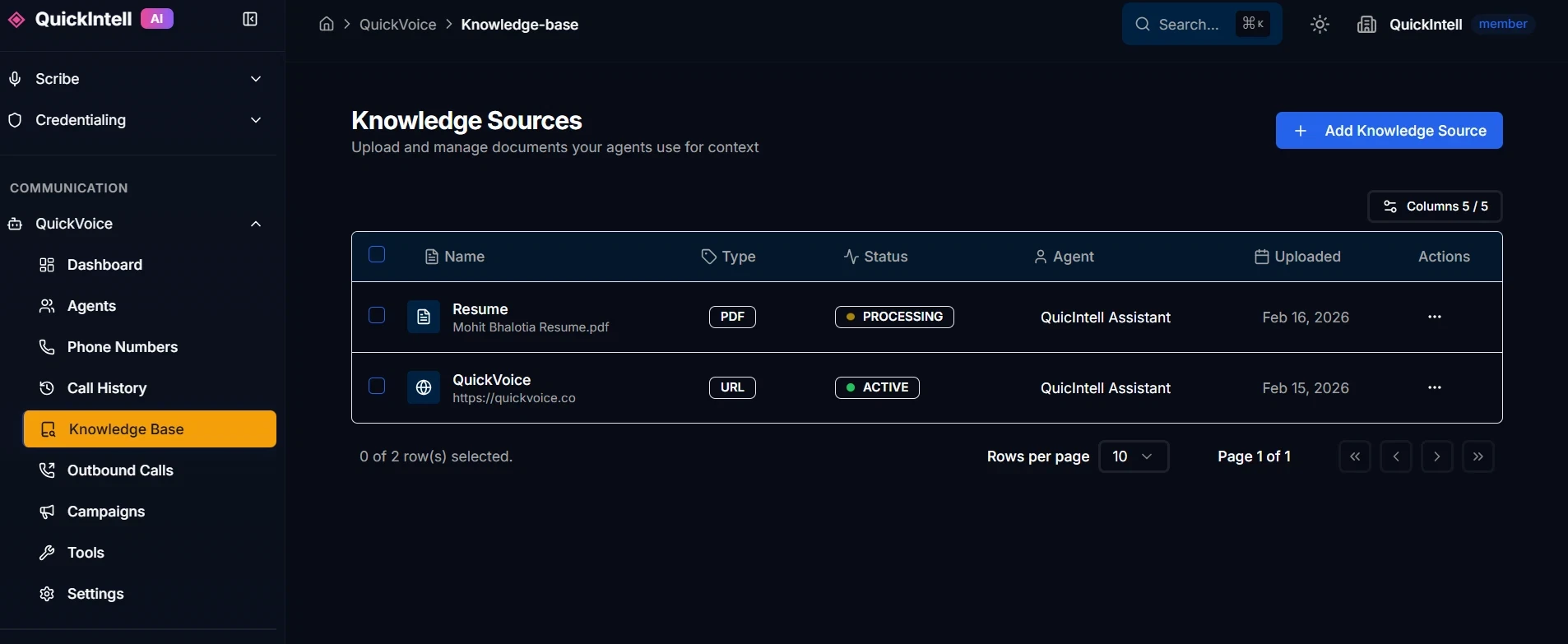
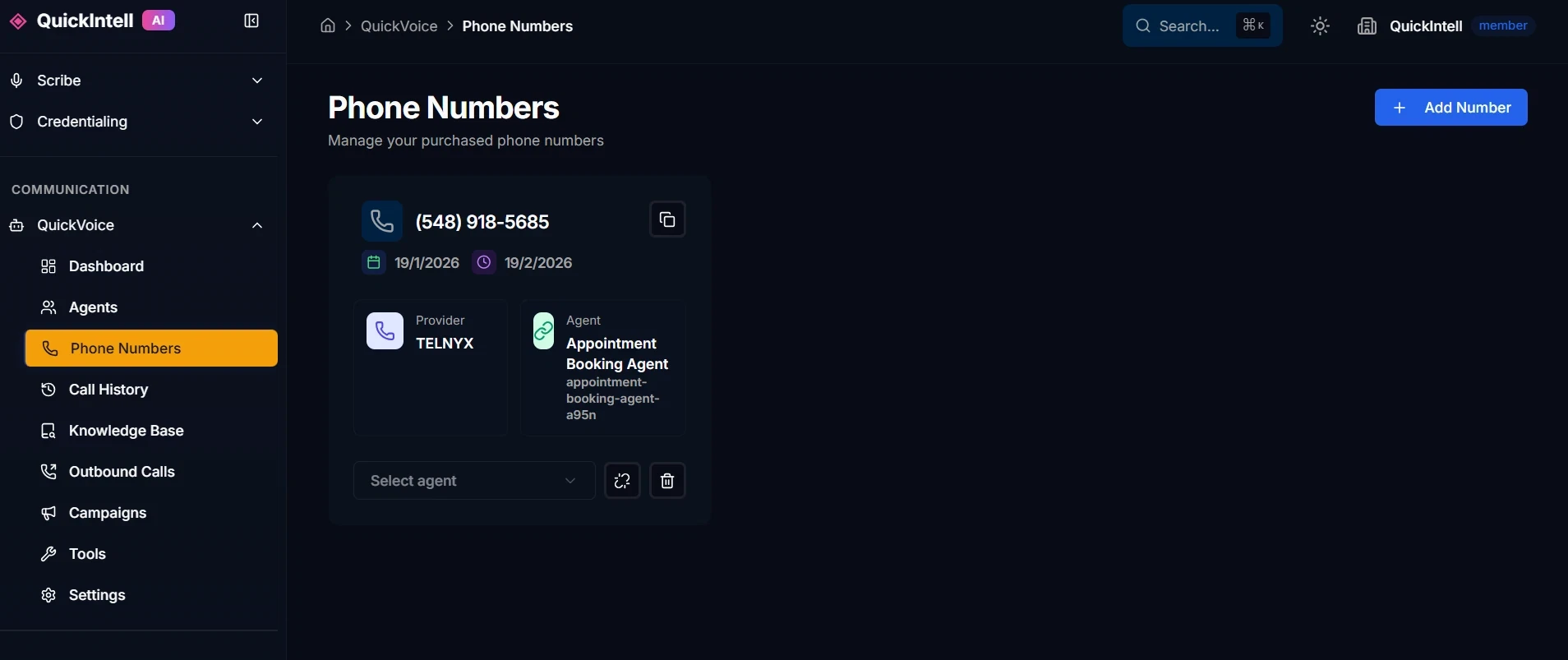
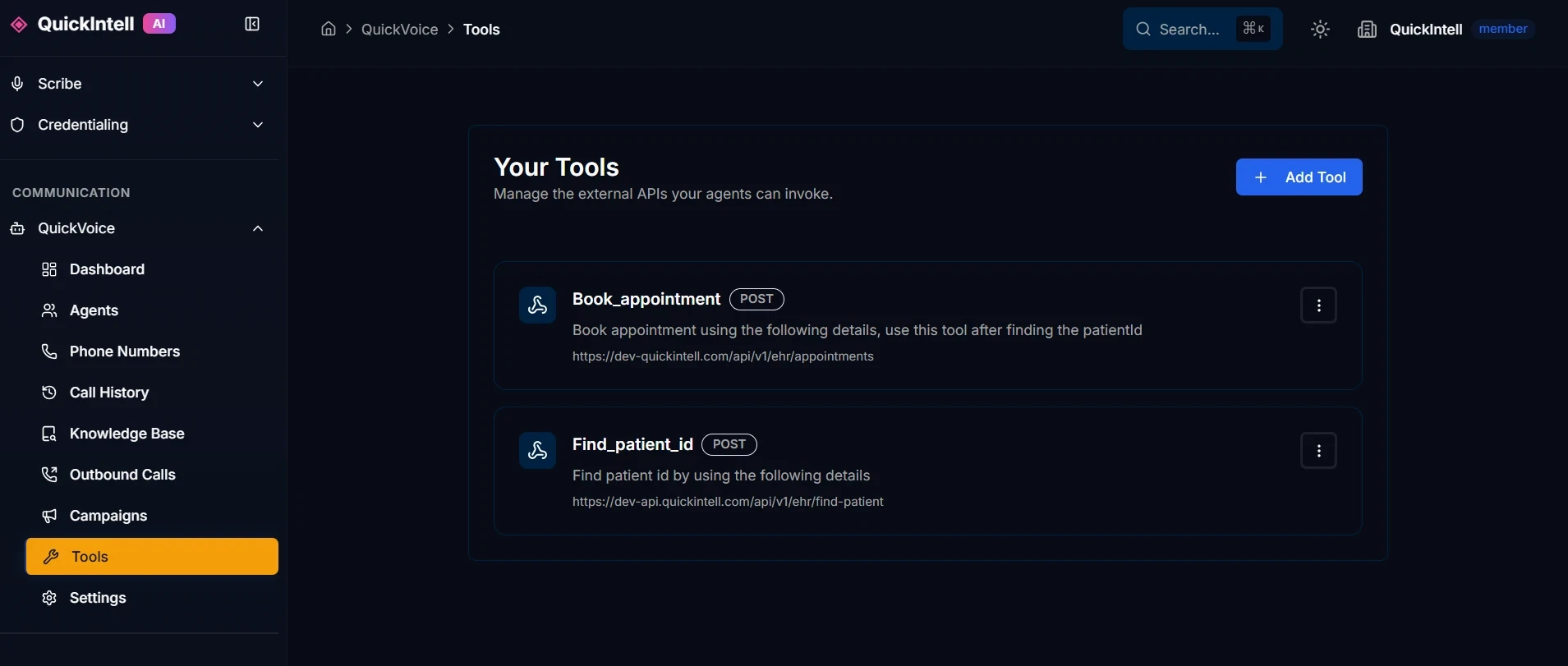
Want to see how these workflows look in your EHR/PMS? This AI voice agent for healthcare integrates seamlessly with your existing systems.
Book a Live DemoConnected to Your Systems
QuickVoice integrates seamlessly with the systems you already use. No data silos, no manual entry.
EHRs & PMS
Epic, Cerner, eClinicalWorks, Athena
RCM Systems
Revenue cycle platforms
APIs & Webhooks
REST APIs, FHIR/HL7
CRMs
Salesforce, HubSpot
Knowledge Bases
Your website, docs
Payment Gateways
Stripe, Square
Connect to Your Data
QuickVoice connects via APIs, FHIR/HL7, webhooks, and secure file exchange to EHRs, PMS, CRMs, clearinghouses, payment gateways, websites, and knowledge bases.
Real-Time Data Sync
Calls do real work: appointments are written back to your EHR/PMS, notes are logged, and tasks are created automatically in your systems.
Structured Data Output
Every call generates structured data—call_intent, callerName, appointmentTime, date, insurance details, and any other values you need—available in your customizable dashboard/CRM.
Flexible Integration Options
Works with your existing telephony stack via APIs, SIP, or call forwarding. Can sit alongside your current phone system or replace it entirely.
Can it work with your existing phone system and EHR? In most cases, yes. QuickVoice integrates with major EHRs/PMSs and can sit alongside your current telephony stack.
See Integration OptionsQuickVoice vs Traditional IVR vs Outsourced Call Center
See how this HIPAA-aligned AI voice agent for healthcare compares to traditional patient communication solutions
| Feature | Traditional IVR | Outsourced Call Center | QuickVoice AI Voice Agent |
|---|---|---|---|
| Conversation Style | Rigid menu trees (Press 1-9) | Human agents (limited hours) | Natural, two-way conversations |
| Language Support | Limited (1-5 languages) | Depends on staffing | 50+ languages with accents |
| Availability | 24/7 (but limited functionality) | Business hours + overtime costs | 24/7 with full functionality |
| Appointment Booking | Routes to staff only | Manual entry required | Direct EHR/PMS integration |
| Cost per Call | Low setup, high maintenance | $15-25/hour per agent | Usage-based, scales efficiently |
| Reminder Completion | Staff time limits completion | Depends on staffing | ~55% baseline to ~98% |
| No-Show Impact | ~22% no-show baseline | Manual callbacks vary | ~10-12% within 90 days |
| Patient AR Aging | Statement cycles age balances | Manual collection queues | AR 90+ down 25-40% in Q1 |
| Inbound Abandonment | Menus and holds drive abandonment | Queues grow during spikes | Abandonment under 5% |
| Data Capture | Basic routing logs | Manual notes, inconsistent | Structured data, full transcripts |
| HIPAA Alignment | Varies by vendor | Depends on provider | Built-in safeguards, SOC 2 controls |
| Setup Time | Weeks to months | Days to weeks | Under 2 minutes with templates |
| Patient Experience | Frustrating menu navigation | Good, but wait times | Human-like, instant response |
Want to see how this AI voice agent for healthcare works in your clinic or hospital? Book a live demo to see sample call flows.
Book a Live DemoHIPAA-Aligned AI Voice Agent With BAA Available and SOC 2 Controls
Healthcare calls are full of PHI. QuickVoice is HIPAA-aligned, with BAA available and SOC 2 controls, plus enterprise-grade safeguards built into every aspect.
HIPAA Alignment
- HIPAA-aligned platform with BAA available
- PHI encrypted in transit and at rest
- Minimum-necessary access principles
- Formal policies, access controls, and staff training around PHI
SOC 2 Controls
- Architected to meet SOC 2 controls across Security, Availability, and Confidentiality
- Third-party assessments and penetration testing
- Access management, SSO/MFA, IP allow-listing
- Change management and audit logging
Data Protection
- Configurable data retention policies for recordings and transcripts
- Automatic redaction/masking of sensitive values (e.g., cards, SSNs) from transcripts and screens
- RBAC, SSO/MFA, IP allow-listing and detailed audit logs
- Your data never trains public models or 'leaks' to other tenants
Privacy by Design
- Healthcare privacy & security requirements built-in from the ground up
- Consent and legal language handling
- Emergency escalation rules defined by you
- Guardrails to prevent clinical advice—never diagnoses or prescribes
Built for Healthcare, Not Retro-Fitted
QuickVoice is designed around healthcare privacy & security requirements from day one. It doesn't guess at clinical answers. It never diagnoses or prescribes. It stays strictly within your approved workflows.
Frequently Asked Questions
Everything you need to know about QuickVoice AI voice agent for healthcare
58 questions organized into 9 categories
General & Product Overview
11 questions in this category
QuickVoice is a fully autonomous AI voice agent built specifically for healthcare. It answers and places calls in 50+ languages, talks like a human, connects to your systems (EHR, PMS, APIs), and turns every conversation into structured data such as call intent, caller name, appointment time, date, and more inside a customizable CRM/dashboard.
QuickVoice reduces missed and abandoned calls, cuts no-shows, and eliminates hours of repetitive phone work for staff. It gives you real-time visibility into why patients call, what happens on those calls, and how phone performance impacts access, revenue, and patient satisfaction.
QuickVoice is designed for clinics, hospitals, health systems, FQHCs, MSOs, ACOs, telehealth providers, behavioral health practices, dental and vision chains, labs, imaging centers, and RCM/BPO firms that handle high volumes of patient or payor calls.
No. Traditional IVRs force patients through rigid menus. QuickVoice has natural, two-way conversations: it listens, understands intent, asks clarifying questions, adapts to the caller, and completes workflows like booking appointments or updating information—instead of just routing calls.
QuickVoice uses natural neural voices with realistic intonation, pacing, and turn-taking. It can handle interruptions, corrections, accents, and background noise, and it can slow down or repeat details when patients ask.
QuickVoice checks TCPA quiet hours, DNC status, and FDCPA/Reg F frequency limits before outbound calls are placed. The default window is 8 AM-9 PM in the patient's local time, opt-outs are logged as do-not-call, and collections outreach can enforce 7-call-per-week and state-specific rules.
Strict HIPAA Mode requires the caller to verify name and date of birth before the agent reads account-specific details such as balances, appointment information, or other protected health information. Scripts can also be limited to the minimum information needed for the call purpose.
Yes. QuickVoice uses Telnyx to place and receive calls, assign or provision phone numbers, and track call legs. Your team configures agents, scripts, and workflows in QuickVoice instead of managing telephony infrastructure directly.
Yes. QuickVoice can write structured outcomes back to Scheduling, Patient AR, Eligibility, Reports, Collections, and the EHR. Examples include appointment confirmations or cancellations, payment promises, new insurance details, call notes, appointment status updates, and retry status when write-back fails.
Organizations can run campaigns in semi-automatic approval mode. New or sensitive cohorts, such as collections campaigns, stay Pending Approval until an authorized manager reviews the cohort, call window, throttles, attempts, and script, then approves the batch.
Yes. Campaigns can use daily call caps, max attempts, throttles, and spend or cost-per-outcome dashboards so usage-based pricing and Telnyx telephony costs stay within approved operating limits. Enterprise agreements can also set volume commitments or cost controls.
Still have questions?
Our team is here to help you understand how QuickVoice can transform your patient communication.
QuickVoice Works With the Full QuickIntell Platform
Follow the workflows QuickVoice reads from and writes back to across patient access, revenue cycle, reporting, integrations, and no-code agent configuration.
Eligibility Verification
Stale or partial coverage can trigger QuickVoice re-verification, then new insurance details write back for a fresh eligibility check.
Patient AR / Accounts Receivable
Balances and payment-plan candidates feed campaigns; payment promises and accepted plans write back to Patient AR.
Patient Collections
Soft-collection outreach, FDCPA contact history, DNC opt-outs, and patient financial workflows stay tied together.
Analytics / Reports
Connect rate, outcome rate, no-show impact, opt-outs, cost per outcome, and compliance dashboards flow into reporting.
EHR Integration
Appointment status updates, call notes, identity context, and EHR write-back retries stay aligned with the chart.
Agent Builder
No-code agent configuration controls personas, knowledge bases, disclosures, escalation rules, and workflow tools.
Ready to Let AI Handle Your Phones, 24/7, in 50+ Languages?
Give your patients faster, friendlier access. Give your staff their time back. And give your leadership the visibility they've always wanted.
We'll show you how QuickVoice can start taking real calls for your organization in as little as a few days.
We'll show you exactly how QuickVoice fits into your workflow, your systems, and your compliance requirements—and how quickly your team can see the difference in call handling and patient satisfaction.