Call
EHR-connected care workflows

Patient health management software for QuickEHR care workflows

QuickEHR patient health management software connects OpenEMR-powered chart context, AI EHR patient health management workflows, care gaps, follow-up tasks, outreach, authorization evidence, coding review, RCM queues, and ERA context in one QuickIntell operating model.

Care gaps, follow-up, outreach
OpenEMR-powered chart context
AI assists, humans review

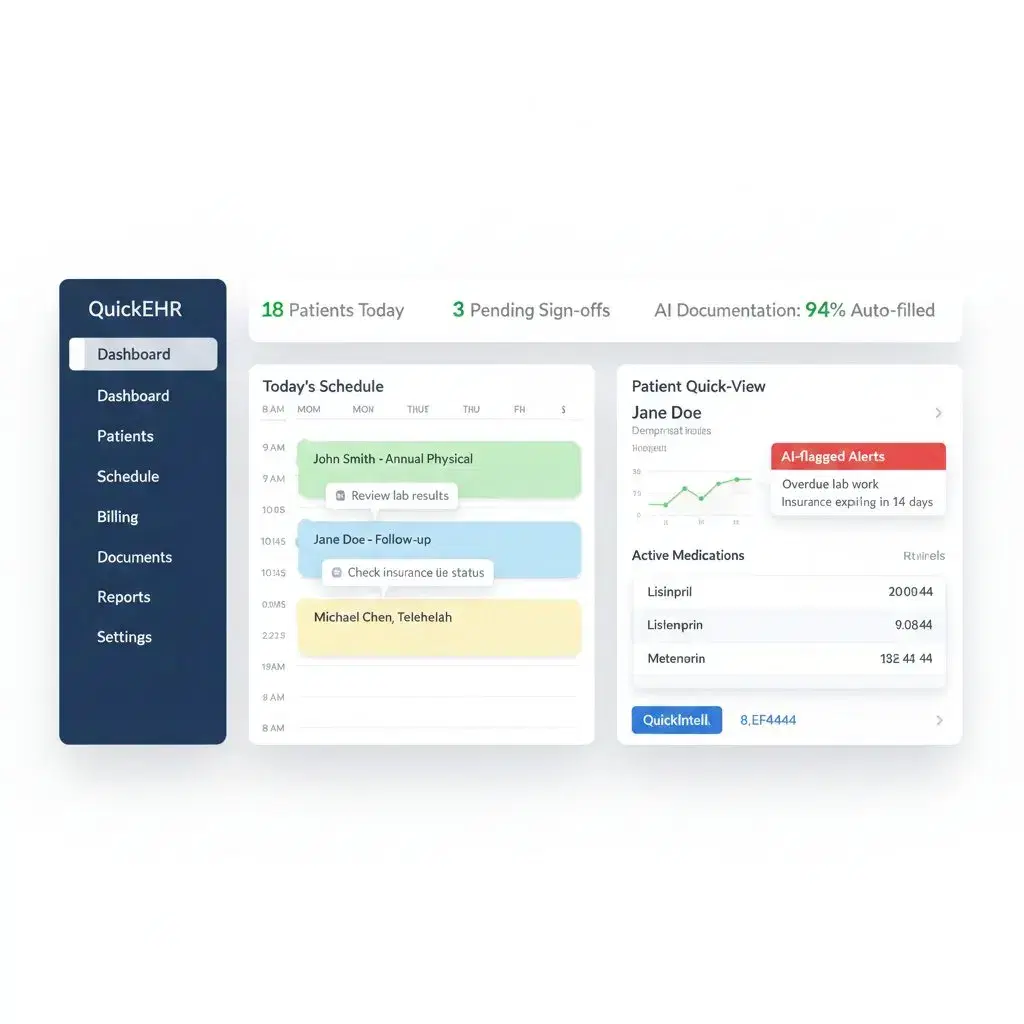
QuickEHR patient health management workspace

Care gaps, chart context, outreach, auth, coding, and RCM

QuickEHR patient health management software dashboard showing patient care tasks and workflow queues

Care signals

Gaps, orders, tasks

AI workflow

Draft, route, review

Handoff

Code, auth, RCM

Patient health management workflow

Care management software needs chart context and clear handoffs.

Searchers comparing patient health management and care management software need workflows that carry the patient story across visits, teams, tasks, and reimbursement work. QuickEHR keeps the patient record at the center.

Before the visit

Prepare care gaps before the patient arrives

QuickEHR patient health management software should help staff see open gaps, missing intake details, pending orders, referral status, coverage changes, and visit goals before the rooming workflow starts.

  • Bring appointment, chart, intake, eligibility, and prior task context into one review path.
  • Flag missing patient information for the staff queue that owns the next action.
  • Keep care plans, reminders, and follow-up needs attached to the patient record.

During care

Keep the care team aligned around the active chart

Care management software works best when clinical, administrative, and revenue teams can see the same patient story. QuickEHR keeps health management tasks close to the OpenEMR-powered chart.

  • Review problems, medications, allergies, history, results, orders, tasks, and open messages.
  • Use specialty-aware workflows for primary care, urgent care, behavioral health, pediatrics, cardiology, and other ambulatory settings.
  • Route questions to clinicians, care coordinators, front desk, authorization, billing, or follow-up teams.

After the visit

Turn the care plan into accountable follow-up

Patient care management software should make follow-up work visible after the encounter. QuickEHR connects instructions, tasks, messages, orders, and outreach needs to the same QuickIntell operating model.

  • Track follow-up calls, patient portal messages, reminders, order status, and referral work.
  • Surface documentation gaps before they become coding, authorization, or billing rework.
  • Keep patient-facing questions connected to clinical and revenue-cycle context.

Revenue handoff

Carry health-management context into downstream work

Reviewed chart context can support coding, prior authorization, claims, denials, ERA posting, and patient billing work when those workflows are configured.

  • Route diagnosis, order, procedure, and documentation context into QuickCode review.
  • Use clinical evidence and payer details to prepare QuickAuth worklists.
  • Connect QuickRCM and QuickERA teams to the source encounter and patient context.

Care signals

What QuickEHR keeps visible for patient care management.

Patient care management software should turn the open loops around a patient into structured work. QuickEHR connects those signals to the chart, care team, and downstream QuickIntell products.

Care gaps and preventive follow-up

Track open preventive care, chronic-care follow-up, ordered services, overdue results, and outreach tasks as configurable worklists rather than disconnected reminders.

Patient tasks and outreach

Coordinate portal messages, callbacks, reminders, status checks, and staff-owned follow-up with chart and encounter context nearby.

Orders, referrals, and evidence

Keep orders, referrals, supporting documentation, payer evidence, and missing details visible for care teams and authorization teams.

Medication and problem context

Use the OpenEMR-powered chart foundation to keep problems, medications, allergies, histories, and visit context close to care-management tasks.

Population-health adjacency

Represent population health management software needs such as cohorts, gaps, and outreach planning without losing sight of the individual patient workflow.

Billing and patient AR signals

Route patient billing questions, claim exceptions, balances, and remittance context to the revenue team without separating them from the care journey.

OpenEMR and QuickEHR fit

OpenEMR patient health management with QuickIntell automation.

QuickEHR is built on the OpenEMR foundation, then configured around the clinic's care-management, documentation, integration, and revenue handoff needs.

OpenEMR patient health management foundation

QuickEHR is built on the OpenEMR foundation, giving clinics a practical base for patient records, appointments, orders, messages, documentation, and billing context.

QuickEHR managed workflow design

QuickIntell adds workflow mapping, configuration, support, integrations, and AI automation around the OpenEMR-powered EHR experience.

QuickEHR Connect for existing systems

Practices keeping another EHR can evaluate QuickEHR Connect as a workflow layer for care-management tasks, documentation, coding, authorization, RCM, and ERA handoff.

For the broader OpenEMR integration architecture, review the OpenEMR integration page. For procurement, data handling, security, and governance review, start with the Trust Center.

Connected QuickIntell products

Patient health management is stronger when it reaches the next team.

Care gaps, documentation, authorization evidence, coding, claims, denials, remittance, and patient outreach should not live in separate operational islands. These QuickIntell products use the same patient context when configured.

Related solutions and specialties

Patient health management varies by setting.

QuickEHR workflows should be mapped to specialty visit types, chronic-care patterns, referral needs, follow-up ownership, documentation handoff, and revenue-cycle requirements. Related solution pages include care coordination and population risk.

Implementation and trust

Patient health management needs operational mapping before automation.

Patient health management touches clinical follow-up, patient-facing communication, documentation, orders, referrals, payer evidence, claims, remittance, and support workflows. QuickIntell scopes the workflow and review rules before automation is enabled.

Patient health management checklist

  • Choose QuickEHR-managed OpenEMR, an existing OpenEMR tenant, or QuickEHR Connect around another EHR.
  • Map care gaps, follow-up tasks, patient outreach, portal messages, orders, referrals, documentation gaps, and revenue handoff ownership.
  • Confirm which OpenEMR API, FHIR, HL7, interface-engine, payment, messaging, or file-exchange paths are available for the deployment.
  • Define which AI drafts, summaries, suggestions, classifications, and routes require clinician, staff, coder, authorization, or billing review.
  • Align escalation paths for urgent messages, after-hours items, clinical questions, billing questions, and patient support ownership.
  • Review trust, data handling, access controls, audit expectations, procurement evidence, and implementation-specific documentation before production use.

FAQs

Patient health management software questions

Short answers for teams evaluating QuickEHR, OpenEMR patient health management, AI EHR workflows, care management software, and downstream QuickIntell automation.

What is patient health management software in QuickEHR?

QuickEHR patient health management software organizes chart context, care gaps, follow-up tasks, patient outreach, orders, referrals, messages, documentation gaps, coding signals, authorization needs, RCM work, and ERA context around the patient record.

How is patient health management different from population health management software?

Population health management software often focuses on cohorts, quality measures, risk groups, and broad outreach. QuickEHR patient health management keeps those adjacent needs tied to individual patient charts, encounters, tasks, and follow-up workflows.

How does AI support patient health management in QuickEHR?

AI is assistive and reviewable. QuickScribe can draft visit context, QuickCode can prepare coding suggestions, QuickAuth can assemble authorization evidence, and QuickRCM or QuickERA can use chart context for downstream revenue work.

How does QuickEHR use OpenEMR for patient health management?

QuickEHR is built on the OpenEMR foundation. That foundation can support patient records, appointments, documentation, orders, messages, and billing context while QuickIntell adds managed configuration, integrations, and AI workflow automation.

Can patient care management software feed coding, prior authorization, and RCM?

Yes, when configured. Reviewed care-plan and chart context can support QuickCode coding review, QuickAuth authorization packets, QuickRCM claim and denial workflows, and QuickERA remittance follow-up.

What workflows should clinics map before implementation?

Clinics should map care-gap ownership, follow-up queues, outreach rules, patient portal routing, order and referral tracking, documentation review, coding handoff, prior authorization evidence, claim exceptions, and billing support responsibilities.

Does QuickEHR replace clinical judgment?

No. QuickEHR organizes patient health management workflows, and QuickIntell automation can assist with drafts, suggestions, routing, and worklists. Clinicians remain responsible for clinical review and patient care decisions.

Can QuickEHR patient health management work with another EHR?

Practices keeping another system of record can evaluate QuickEHR Connect as a workflow layer. Available read, write, and synchronization paths depend on the EHR, deployment environment, approved interfaces, and implementation scope.

Does this page make new certification or compliance claims?

No. This page describes QuickEHR as built on the OpenEMR foundation and avoids adding unsupported certification, regulatory, or deployment-specific claims. Implementation-specific evidence should be reviewed before go-live.

See how QuickEHR connects patient care and operations.

Bring your current care-gap, follow-up, documentation, coding, authorization, RCM, and remittance workflow. QuickIntell will map the patient health management path before automation is enabled.