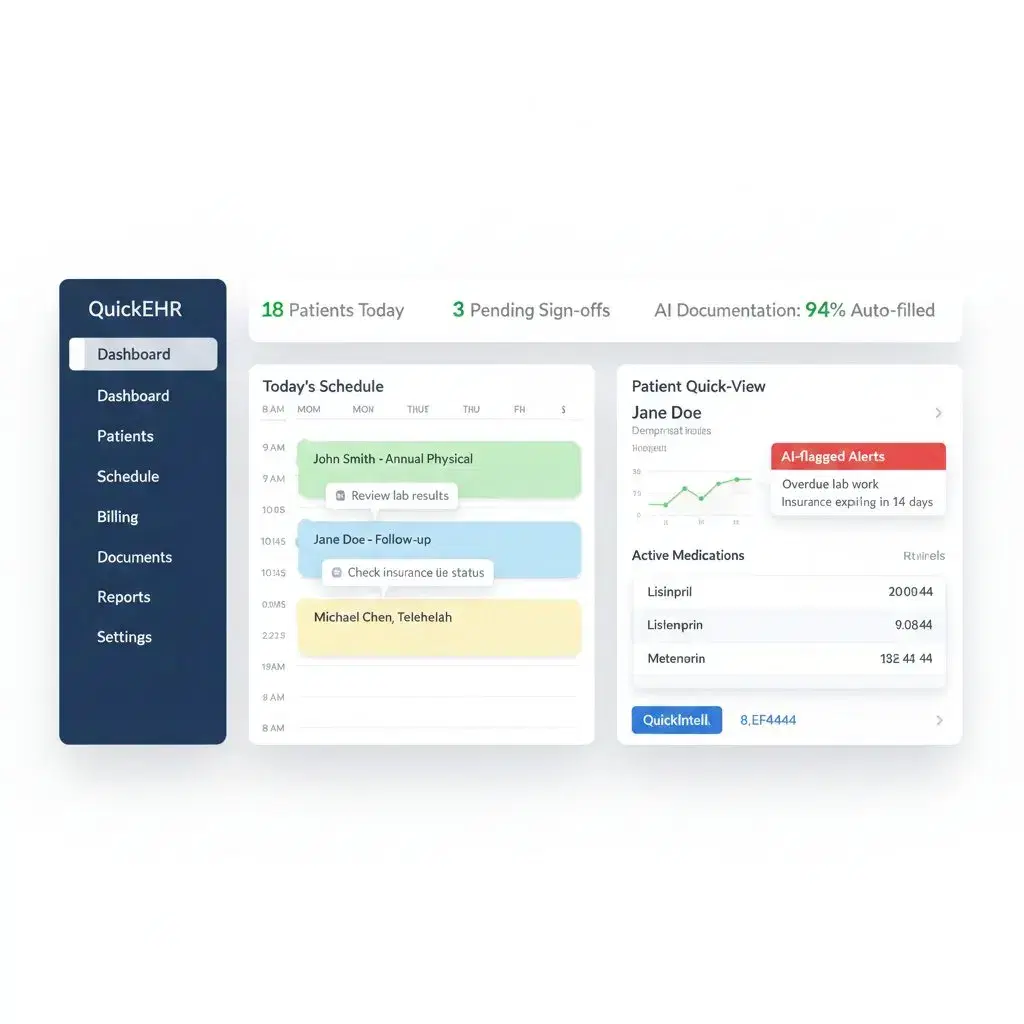
QuickEHR bundle FAQs
Answers for EHR, AI, OpenEMR, billing, and RCM bundle planning.
Use these questions to separate bundle scope, pricing variables, implementation work, AI review points, and third-party dependencies before the proposal is finalized.
What are QuickEHR bundles?
QuickEHR bundles are QuickIntell launch paths that combine the OpenEMR-powered QuickEHR foundation with optional AI documentation, coding, prior authorization, RCM, ERA, billing, implementation, and support workflows. They help practices scope the operating model before choosing exact modules and services.
Are QuickEHR bundles the same as fixed software packages?
No. QuickEHR bundles are workflow scopes, not one-size-fits-all packages. A practice can start with the QuickEHR core, add AI modules, attach RCM workflows, or combine EHR, AI, and revenue cycle work depending on users, specialties, payer mix, migration needs, and interface requirements.
How do AI EHR bundles work with QuickEHR?
AI EHR bundles add QuickIntell modules around the QuickEHR workflow. QuickScribe can support note drafting, QuickCode can support coding review, QuickAuth can organize prior authorization context, QuickRCM can route revenue cycle queues, and QuickERA can help with remittance workflows.
Can QuickEHR be bundled with medical billing and RCM?
Yes. QuickEHR can be scoped with billing and RCM workflows for charge review, claim readiness, claim submission handoff, denials, AR follow-up, payment posting, ERA/EOB review, and patient balance work. The final scope should clarify whether the clinic, QuickIntell, or a billing partner owns each queue.
How do OpenEMR bundles differ from QuickEHR bundles?
OpenEMR bundle questions usually focus on hosting, support, configuration, APIs, interfaces, and internal IT effort. QuickEHR is built on the OpenEMR foundation and adds QuickIntell implementation, AI automation, RCM handoff, workflow configuration, support planning, and trust review around it.
Do QuickEHR bundles include exact public pricing?
This page explains bundle scope rather than publishing exact add-on prices. QuickEHR pricing should separate the EHR core, optional AI modules, RCM services, implementation, integrations, add-ons, and third-party pass-through costs so the quote reflects the practice's workflow.
Can we start with QuickEHR and add modules later?
Yes. A practice can launch the QuickEHR core first, then add QuickScribe, QuickCode, QuickAuth, QuickRCM, QuickERA, patient workflows, or additional interfaces after the initial operating model is stable.
Can QuickEHR bundles work with an existing EHR or OpenEMR tenant?
Practices can evaluate QuickEHR-managed OpenEMR, an existing OpenEMR tenant, or QuickEHR Connect around another EHR. The available APIs, FHIR, HL7, EDI, clearinghouse, remittance, file, or interface-engine paths determine what can be automated.
What should we prepare before scoping a QuickEHR bundle?
Useful inputs include providers, users, locations, specialties, visit volume, payer mix, current EHR or practice management system, migration sources, desired AI modules, billing ownership, RCM scope, interface needs, reporting goals, and go-live timeline.
Do QuickEHR bundles make certification or compliance claims?
This page describes workflow and implementation planning. QuickEHR is built on the OpenEMR foundation, and any regulatory, certification, payer, security, or procurement evidence should be confirmed in the current implementation packet and agreement for the specific deployment.