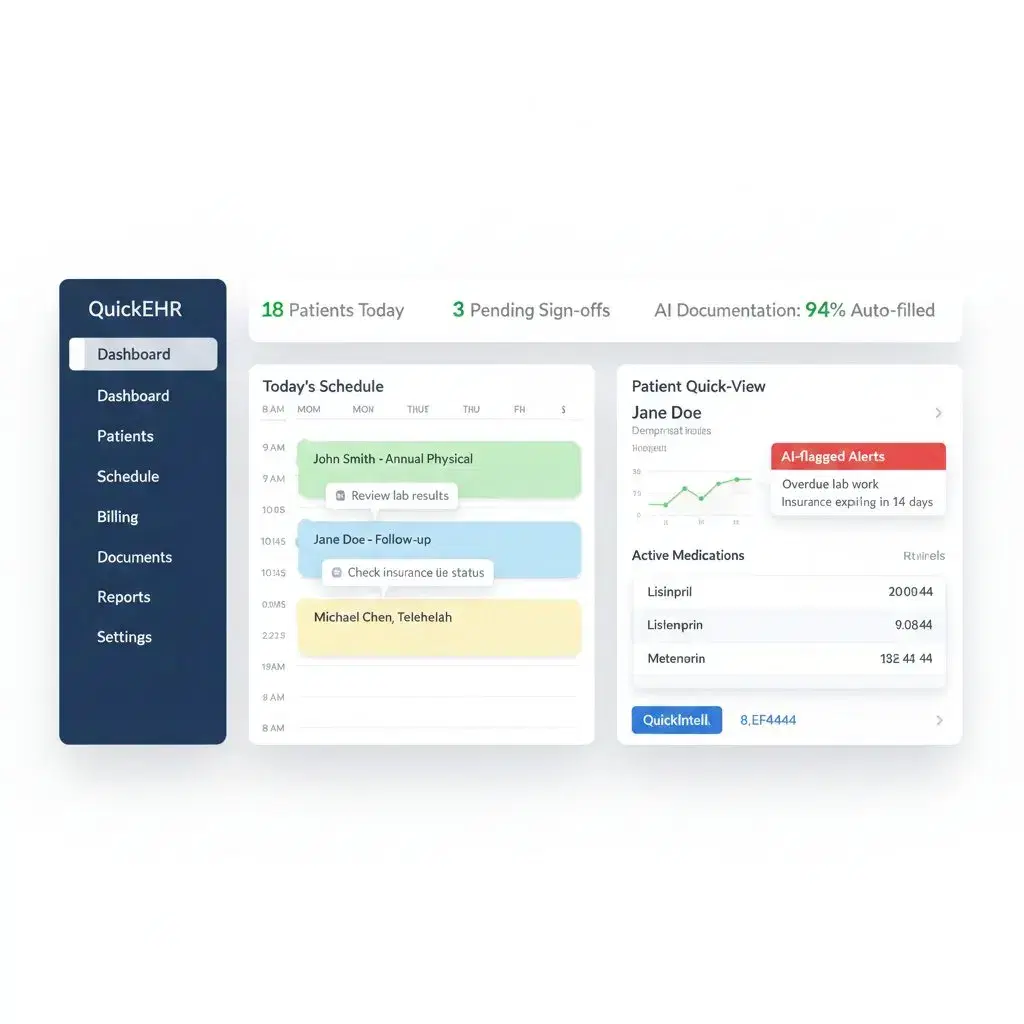
Interfaces, chart context, AI worklists, and handoff
Standards
FHIR, HL7, C-CDA
Adapters
Normalize and route
Review
Chart and teams
Interoperability standards
FHIR, HL7, CCD/C-CDA, and OpenEMR APIs each solve a different workflow problem.
Searchers comparing healthcare interoperability software need plain-language standards coverage. QuickEHR uses the standards and interfaces that fit the approved deployment, then turns them into work teams can review.
API-first exchange
FHIR integration
FHIR can support structured patient, encounter, condition, medication, observation, document, task, and appointment context when the approved endpoint exposes that scope.
Useful for modern app workflows, chart context retrieval, and workflow-specific updates.
Scoped by tenant permissions, implementation policy, and available FHIR resources.
Gives QuickIntell adapters a cleaner path to normalize clinical and operational context.
Event and interface feeds
HL7 integration
HL7 v2 feeds can carry patient, scheduling, order, result, charge, and encounter events through an interface engine when the clinic and connected systems support them.
Helpful for event-driven worklists instead of delayed spreadsheet cleanup.
Commonly scoped around ADT, SIU, ORM, ORU, DFT, or other configured message flows.
Requires field mapping, validation, exception handling, and monitoring before go-live.
Clinical document exchange
CCD and C-CDA exchange
CCD and C-CDA documents can bring summary-of-care, discharge, consult, medication, allergy, problem, and result context into reviewable QuickEHR workflows.
Useful when a document is the practical source of clinical history.
AI can help classify and summarize documents while preserving review responsibility.
Reconciliation rules should be agreed before document content changes chart workflows.
QuickEHR foundation
OpenEMR APIs
QuickEHR is built on the OpenEMR foundation. OpenEMR API access can be evaluated for managed QuickEHR deployments or existing OpenEMR tenants.
Supports OpenEMR interoperability planning without forcing a generic EHR template.
Lets QuickIntell map chart, appointment, encounter, task, and revenue context where enabled.
Available read, write, and synchronization paths depend on approved implementation scope.
Interoperability workflow
Connect the standard to the clinic workflow.
The protocol matters, but the workflow decides whether the data is useful. QuickIntell maps interoperability from source systems to patient chart review, AI-assisted work routing, and downstream operational follow-through.
Inventory
Start with systems, data, and ownership
EHR interoperability fails when a project starts with a protocol name instead of the actual workflow. QuickIntell maps source systems, owners, interfaces, data fields, review roles, and downstream work before automation is turned on.
Identify the system of record for patient, provider, location, schedule, encounter, document, claim, and payment data.
Confirm whether QuickEHR-managed OpenEMR, an existing OpenEMR tenant, or another EHR remains the primary chart.
Document who owns exceptions, data corrections, access decisions, and support tickets.
Normalize
Translate events and documents into a usable workflow model
QuickIntell adapters convert approved FHIR, HL7, CCD/C-CDA, OpenEMR API, file, and interface-engine inputs into a canonical workflow view for the clinic.
Preserve source metadata so users can trace summaries and worklist items back to the record.
Keep unmapped fields, missing values, and duplicate records in review queues instead of hiding them.
Review
Put interoperable data next to the patient chart
Connected data should help clinicians and staff move the visit forward. QuickEHR keeps interoperability context close to chart review, documentation, orders, coding, prior authorization, RCM, and remittance work.
Surface outside documents, event status, task ownership, and chart context in scannable views.
Let AI prepare summaries, classifications, and suggested next steps for human review.
Avoid writing data back to the chart until the clinic has approved the workflow and role controls.
Route
Move the same context into downstream QuickIntell modules
The value of interoperability software is not only data exchange. It is whether the right evidence reaches documentation, coding, authorization, claims, ERA posting, and patient follow-up without rebuilding the visit story.
Route documentation context to QuickScribe and coding signals to QuickCode.
Send order, diagnosis, payer, and document evidence into QuickAuth when configured.
Keep QuickRCM and QuickERA tied to the same encounter trail for claims, denials, and payment exceptions.
AI EHR interoperability
AI should prepare interoperable context, not silently decide what belongs in the chart.
QuickIntell can summarize, classify, draft, suggest, and route connected data for review. Each automation path should keep source records, review ownership, and downstream handoff visible.
OpenEMR foundation, standards-based interfaces, and QuickIntell adapters.
QuickEHR interoperability should be planned as an architecture block: OpenEMR-powered chart workflows, approved FHIR and OpenEMR APIs, HL7 feeds, CCD/C-CDA documents, and QuickIntell adapters that normalize the data for reviewable AI workflows.
QuickEHR-managed OpenEMR
For clinics adopting QuickEHR, QuickIntell can align OpenEMR-based chart workflows with the adapters, AI review paths, and operational queues needed for the deployment.
Existing OpenEMR tenants
For clinics already using OpenEMR, QuickIntell can evaluate the tenant, API scope, FHIR availability, HL7 feeds, document paths, and support model before integration.
QuickEHR Connect
Practices keeping another EHR can evaluate QuickEHR Connect as a workflow layer around chart context, documentation, coding, authorization, RCM, and ERA handoff.
For the broader OpenEMR integration plan, review OpenEMR integration. For procurement, data handling, support, and security review, start with the QuickIntell Trust Center.
QuickIntell adapters
Interoperability needs mapping, validation, and exception ownership.
QuickIntell adapters are the implementation layer between healthcare standards and operational worklists. They help normalize approved data, preserve source context, route exceptions, and connect AI outputs to human review.
Maps patients, providers, locations, visits, appointments, and encounter identifiers so clinical and revenue workflows can refer to the same record.
Clinical document adapter
Classifies CCD, C-CDA, PDFs, summaries, consult notes, outside records, and attachments so users can review source context before relying on it.
Event feed adapter
Turns configured HL7 or interface-engine events into worklist triggers for schedule changes, results, orders, charges, and operational follow-up.
OpenEMR API adapter
Connects QuickEHR-managed OpenEMR or an existing OpenEMR tenant to QuickIntell workflows when approved API scope and deployment access are available.
Payer and revenue adapter
Carries coverage, authorization, claim, denial, ERA, and EOB context toward QuickAuth, QuickRCM, and QuickERA without detaching it from the encounter.
Exception and audit adapter
Routes missing mappings, rejected messages, duplicate candidates, failed writes, and review-required AI outputs to teams that can resolve them.
Related QuickEHR pages
Keep interoperability connected to the rest of the EHR journey.
EHR interoperability sits beside patient charts, clinical documentation, record locator exchange, dashboards, and the OpenEMR integration page. These links help teams move from architecture to the day-to-day workflow.
Primary care may prioritize outside history and care gaps. Urgent care may need recent visits, medications, and results. Specialty groups may need referrals, imaging, procedures, authorizations, and payer evidence. QuickEHR interoperability should route each signal to the team that can act on it.
Record locator exchange often belongs in the same plan.
If outside clinical history is a major need, pair this page with QuickEHR record locator exchange so document discovery, retrieval, review, and routing are scoped with the same implementation assumptions.
Implementation and trust
Define the interoperability boundary before production use.
Interoperability software touches chart data, operational events, clinical documents, AI outputs, payer context, and revenue workflows. QuickIntell scopes the data paths, exception handling, and review ownership before each workflow is enabled.
This page avoids unsupported certification or compliance claims for a specific deployment. Procurement and compliance teams should review current documentation through the Trust Center and the implementation packet.
Map identifiers, field-level transformations, role access, data retention, source metadata, and exception ownership.
Define when AI can summarize, classify, draft, suggest, or route work and which human role reviews each output.
Test duplicate patients, rejected messages, failed API calls, document parsing errors, and write-back restrictions before go-live.
Connect interoperability context to QuickScribe, QuickCode, QuickAuth, QuickRCM, QuickERA, and patient follow-up where appropriate.
Review trust, data handling, support ownership, and implementation-specific evidence before production use.
FAQs
QuickEHR interoperability questions
Answers for teams evaluating EHR interoperability, OpenEMR interoperability, FHIR integration, HL7 integration, CCD/C-CDA exchange, and QuickIntell adapters.
What is EHR interoperability?
EHR interoperability is the ability for clinical, operational, and revenue systems to exchange usable patient and encounter context through standards, APIs, documents, interfaces, or workflow adapters. For QuickEHR, the goal is not just moving data. It is making that data useful in chart review, documentation, coding, prior authorization, RCM, ERA, and follow-up workflows.
How does QuickEHR interoperability work with OpenEMR?
QuickEHR is built on the OpenEMR foundation. QuickIntell can evaluate OpenEMR APIs, FHIR availability, HL7 feeds, CCD/C-CDA document paths, and interface-engine options for the specific deployment, then map those paths into QuickIntell adapters and reviewable workflows.
Does QuickEHR support FHIR integration?
FHIR integration can be part of a QuickEHR or OpenEMR interoperability plan when the approved endpoint, tenant permissions, resources, and implementation scope support it. QuickIntell uses FHIR context where available and avoids assuming that every resource or write path is enabled.
How do HL7 and CCD or C-CDA fit into QuickEHR?
HL7 can support event and interface feeds for patient, scheduling, order, result, charge, and encounter workflows. CCD and C-CDA documents can carry summary-of-care and outside-record context. QuickEHR implementations should map these inputs into reviewable chart and worklist flows before relying on them downstream.
What are QuickIntell adapters?
QuickIntell adapters are implementation-specific mapping and workflow components that normalize approved FHIR, HL7, CCD/C-CDA, OpenEMR API, file, and interface inputs into the patient, encounter, document, task, coding, authorization, RCM, and ERA workflows that teams can review.
Can interoperable QuickEHR data feed QuickScribe and QuickCode?
Yes, when configured. Reviewed chart, encounter, and document context can support QuickScribe note drafting and QuickCode coding review. Clinicians and coders remain responsible for reviewing final documentation, codes, and workflow decisions.
Can interoperability help prior authorization and RCM?
Yes. QuickAuth can use order, diagnosis, payer, and document context to prepare authorization packets for review. QuickRCM and QuickERA can use the same encounter trail to support claim follow-up, denials, ERA/EOB exceptions, and payment posting workflows.
Can QuickEHR connect to an existing OpenEMR tenant?
Practices already using OpenEMR can evaluate a QuickIntell integration without replacing the tenant. Available read, write, synchronization, interface, and support paths depend on the existing OpenEMR environment, approved access, customizations, hosting model, and implementation scope.
Does AI replace clinical or operational review?
No. AI can summarize, classify, draft, suggest, and route work, but the workflow should keep clinician, coder, authorization, billing, or staff review visible according to the task. QuickEHR interoperability should make review easier, not remove accountability.
Does this page make certification or compliance claims?
No. This page describes QuickEHR interoperability architecture and implementation planning. It avoids new HIPAA, SOC 2, ONC, EPCS, customer, payer, or nationwide exchange claims. Any regulatory, procurement, security, or contracting evidence should be reviewed for the specific deployed configuration.
Build QuickEHR interoperability around the workflows your teams actually run.
Bring your current EHR, OpenEMR tenant, interface inventory, document exchange paths, and downstream automation priorities. QuickIntell will map the interoperability plan before AI workflows go live.