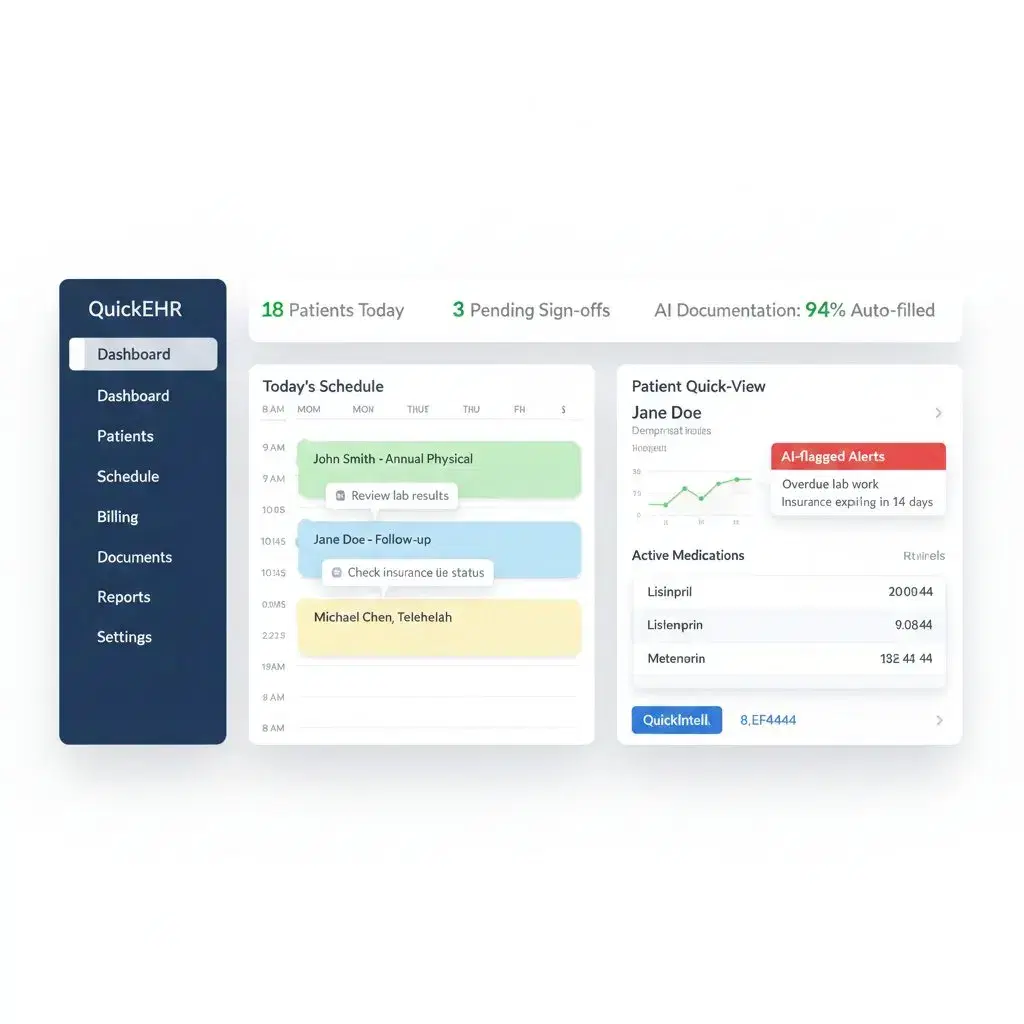
Record locator exchange for QuickEHR and OpenEMR workflows
QuickEHR record locator exchange software helps ambulatory clinics find, retrieve, review, and route outside patient records from approved exchange paths. QuickIntell adds AI summaries, reconciliation worklists, and downstream handoff around the OpenEMR-powered chart without removing human review.
Patient match, outside records, review, and handoff
Locate records
Sources and status
Review context
Summaries and chart
Route work
Scribe, code, auth
Record locator exchange workflow
Outside records should move through a governed chart workflow.
Searchers comparing record locator exchange software need more than a connection label. The workflow has to explain patient matching, source discovery, document review, reconciliation, and the handoff into care and revenue operations.
Patient matching
Start with the patient and encounter context
A record locator exchange workflow should begin inside the EHR visit, not in a separate research queue. QuickEHR keeps patient identity, appointment, provider, and chart context close to the exchange request.
Use demographics, visit reason, prior history, and configured identifiers to prepare the record search.
Keep staff review visible before outside clinical documents affect the chart.
Route incomplete patient or encounter details back to the right QuickEHR worklist.
External history
Locate where outside patient records may exist
Record locator service and health information exchange workflows help identify external care locations or record sources when the approved connection supports it.
Show source, date, organization, document type, and retrieval status where available.
Avoid burying outside-record work in generic inboxes or unmanaged attachments.
Keep exchange availability scoped to the interfaces, networks, policies, and patient context enabled for the deployment.
Clinical review
Bring retrieved records into a reviewable workflow
External documents are most useful when clinicians can review, reconcile, summarize, and reference them before documentation, orders, referrals, or follow-up work moves forward.
Organize outside notes, discharge summaries, labs, imaging reports, consults, and medication history when connected sources provide them.
Let AI prepare summaries and flags without replacing clinician judgment.
Preserve a clear path back to the underlying record when a summary is not enough.
Follow-through
Route relevant record context to downstream teams
A patient record locator exchange should support the whole clinic workflow: documentation, coding, prior authorization, claims, remittance, care gaps, and patient follow-up.
Carry reviewed chart context into QuickScribe, QuickCode, QuickAuth, QuickRCM, and QuickERA workflows.
Help teams avoid re-requesting the same record because the trail is tied to the encounter.
Keep exceptions, missing evidence, and follow-up tasks visible for staff review.
Patient record locator exchange
Locate records, then make them useful inside the visit.
A health information exchange record locator can point the clinic toward outside clinical history. QuickEHR focuses on what happens next: document intake, clinical review, problem and medication reconciliation, visit preparation, and downstream routing.
Capture retrieved documents, source metadata, retrieval status, and encounter relevance so staff can distinguish useful clinical history from noise.
Clinical reconciliation
Prepare problems, medications, allergies, procedures, recent visits, care gaps, and follow-up items for review before anything changes the working chart.
Visit-prep summaries
Use AI EHR record locator exchange context to summarize recent outside care for the provider while preserving links to the source documents.
Evidence for operations
Surface reviewed record context for documentation, prior authorization evidence, coding support, denial prevention, and claim follow-up.
Policy-aware routing
Plan consent, permitted-use, role access, audit, and retention expectations with the implementation team before exchange workflows go live.
Patient follow-up
Turn outside-record findings into reminders, messages, referrals, recalls, or care-management tasks when the clinic approves that workflow.
AI EHR record locator exchange
AI prepares outside-record context while teams keep review control.
QuickIntell can use retrieved record context to summarize, classify, draft, suggest, and route work across the clinical and revenue workflow. The page intentionally keeps AI framed as assistive automation.
OpenEMR record locator exchange needs implementation-specific paths.
QuickEHR is built on the OpenEMR foundation, then configured around the clinic's interfaces, exchange relationships, document workflows, review policies, AI boundaries, and downstream QuickIntell modules.
QuickEHR-managed OpenEMR
QuickEHR is built on the OpenEMR foundation and adds managed workflow design, implementation planning, integrations, and QuickIntell automation around the chart.
Existing OpenEMR tenants
Clinics already using OpenEMR can evaluate approved OpenEMR API, FHIR, HL7, interface-engine, and document-routing paths for record locator exchange workflows.
QuickEHR Connect
Practices keeping another EHR can evaluate QuickEHR Connect as the workflow layer for locating, reviewing, summarizing, and routing outside records.
Put record locator exchange next to the chart workflow.
Record locator exchange works best when reviewed documents can move into patient charts, clinical documentation, dashboard worklists, care-management follow-up, and OpenEMR integration planning without duplicate record chasing.
Primary care may need hospital discharge context, urgent care may need recent imaging or medication history, and specialty groups may need referrals, procedures, consult notes, and prior treatment evidence. QuickEHR should route the record trail to the team that can act on it.
Record exchange touches patient data, outside sources, clinical review, AI assistance, and downstream revenue work. Start with the QuickIntell Trust Center, then review the implementation-specific evidence for the exact exchange paths enabled.
Implementation and trust
Define the exchange boundary before go-live.
A record locator service health information exchange workflow depends on approved networks, interfaces, patient context, policy, and operational review. QuickIntell implementation planning should make the data sources, AI boundaries, and handoff responsibilities explicit.
This page avoids broad certification or compliance claims for a specific deployment. Procurement and compliance teams should review current documentation through the Trust Center and the implementation packet.
Record locator exchange planning checklist
Confirm whether the clinic will use QuickEHR-managed OpenEMR, an existing OpenEMR tenant, or QuickEHR Connect around another EHR.
Identify which record locator service, health information exchange, FHIR, HL7, document, or interface paths are approved for the deployment.
Define patient matching, consent, permitted-use, role access, audit, retention, and exception-handling responsibilities with the implementation team.
Map which outside-record metadata, documents, summaries, and reconciliation fields appear in QuickEHR for each role.
Decide where AI may summarize, classify, draft, suggest, or route work before clinician, coder, authorization, billing, or compliance review.
Connect reviewed record context to QuickScribe, QuickCode, QuickAuth, QuickRCM, QuickERA, and patient follow-up workflows where appropriate.
Review trust, data handling, support ownership, and implementation-specific evidence before production use.
FAQs
Record locator exchange questions for QuickEHR buyers
Answers for teams comparing record locator exchange, record locator service, OpenEMR record locator exchange, and AI EHR record locator exchange workflows.
What is record locator exchange in an EHR?
Record locator exchange is an interoperability workflow that helps identify where outside patient records may exist, then routes retrieval, review, reconciliation, and follow-up through approved exchange paths. In QuickEHR, the goal is to keep that work close to the patient chart and encounter workflow.
What is a record locator service?
A record locator service generally helps determine whether patient records may exist at other care locations or data sources. It is not the same as the full clinical record itself. The actual retrieval and use of records depend on the connected exchange path, permissions, patient context, and implementation policy.
Does QuickEHR record locator exchange promise nationwide access?
No. This page describes QuickEHR record locator exchange workflows and implementation planning. Available sources, geography, document types, networks, and retrieval behavior depend on the interfaces and exchange relationships approved for a specific deployment.
How does OpenEMR record locator exchange fit into QuickEHR?
QuickEHR is built on the OpenEMR foundation. QuickIntell can add managed workflow design, OpenEMR integration planning, document-routing logic, and AI-assisted review around the chart when approved OpenEMR API, FHIR, HL7, interface-engine, or exchange paths are available.
How can AI help with record locator exchange software?
AI can help summarize retrieved documents, classify outside-record types, flag potential medication or problem-list reconciliation items, prepare visit context, and route missing evidence to staff. AI should remain assistive and reviewable rather than making independent clinical decisions.
How does patient record locator exchange support QuickScribe?
Reviewed outside-record context can support QuickScribe visit-prep summaries and note drafting. The clinician should still review the underlying documents, edit the draft, and sign the final note according to the clinic workflow.
Can record locator exchange help coding and prior authorization?
Yes, when the retrieved records are relevant and reviewed. QuickCode can use documentation context for coding review, while QuickAuth can use outside clinical evidence such as consult notes, imaging reports, therapy history, or prior treatment details when payer rules require them.
How does the workflow connect to QuickRCM and QuickERA?
QuickRCM can use reviewed record context for claim worklists, denial prevention, appeal support, and AR follow-up. QuickERA can keep remittance and EOB exceptions tied to the clinical and claim context that helps explain the payment outcome.
What should a clinic review before launching this workflow?
The implementation team should review connected sources, patient matching, consent and permitted-use policy, role-based access, audit needs, retention, document naming, AI review boundaries, support ownership, and how record context moves into documentation, coding, authorization, RCM, ERA, and patient follow-up.
Does this page make certification or compliance claims?
No. This page avoids new certification, payer, HIPAA, SOC 2, ONC, EPCS, or customer claims. QuickEHR is built on the OpenEMR foundation, and deployment-specific regulatory, procurement, security, and contracting evidence should be reviewed with the current implementation packet and the QuickIntell Trust Center.
Build record locator exchange around the chart, not a detached inbox.
QuickIntell can help map QuickEHR record locator exchange across OpenEMR chart context, outside-document review, AI summaries, documentation, authorization, coding, RCM, and ERA workflows.