What to review in a product demo
Trace a claim from approved release through transmission, acknowledgment, acceptance or rejection, and subsequent status. Inspect submission evidence and the next action for an unresolved record.
Submit approved claims, retain clearinghouse and payer acknowledgments, review rejections, and track the next action. Scope payer routes, enrollment, and the EHR handoff before rollout.
Product workflow demonstration with sample records. Review submission, responses, and exception handling for your proposed scope.

Carry reviewed encounter information and validation findings into the submission queue; hold unresolved exceptions for the responsible staff.
Submit approved claims through enrolled clearinghouse and payer routes, retaining submission identifiers and batch evidence.
Track receipt, acceptance, rejection, payer status, and adjudication separately so staff can document the appropriate next action.
Authorized staff review corrections, supporting records, routing changes, and resubmissions with an audit trail and named queue owner.
Keep the original claim, transmitted version, acknowledgment, payer status, and reviewer action connected. For readiness checks before release, review claim scrubbing software.
The documented workflow includes Availity and Stedi routing options. Confirm payer availability, transaction type, enrollment, and account permissions for the proposed connection. During an outage, staff need to know whether a claim was sent, acknowledged, held, or eligible for another route. Reconcile identifiers and duplicate-submission risk before retrying.
Use the returned acknowledgment and originating claim identifiers to investigate a rejection. Staff review suggested changes, correct the source information, and approve a resubmission when appropriate. Preserve the original response, correction history, responsible reviewer, and next follow-up action.
Scope the EHR fields, permitted write-back, sync cadence, and exception ownership for the proposed deployment. Acknowledgments and payer status support follow-up; adjudication and remittance information support posting and reconciliation. Demonstrate failed syncs, unmatched responses, and missing remittances alongside the normal workflow.
Review the proposed claim types, enrolled routes, response matching, staff permissions, and recovery process with your team.
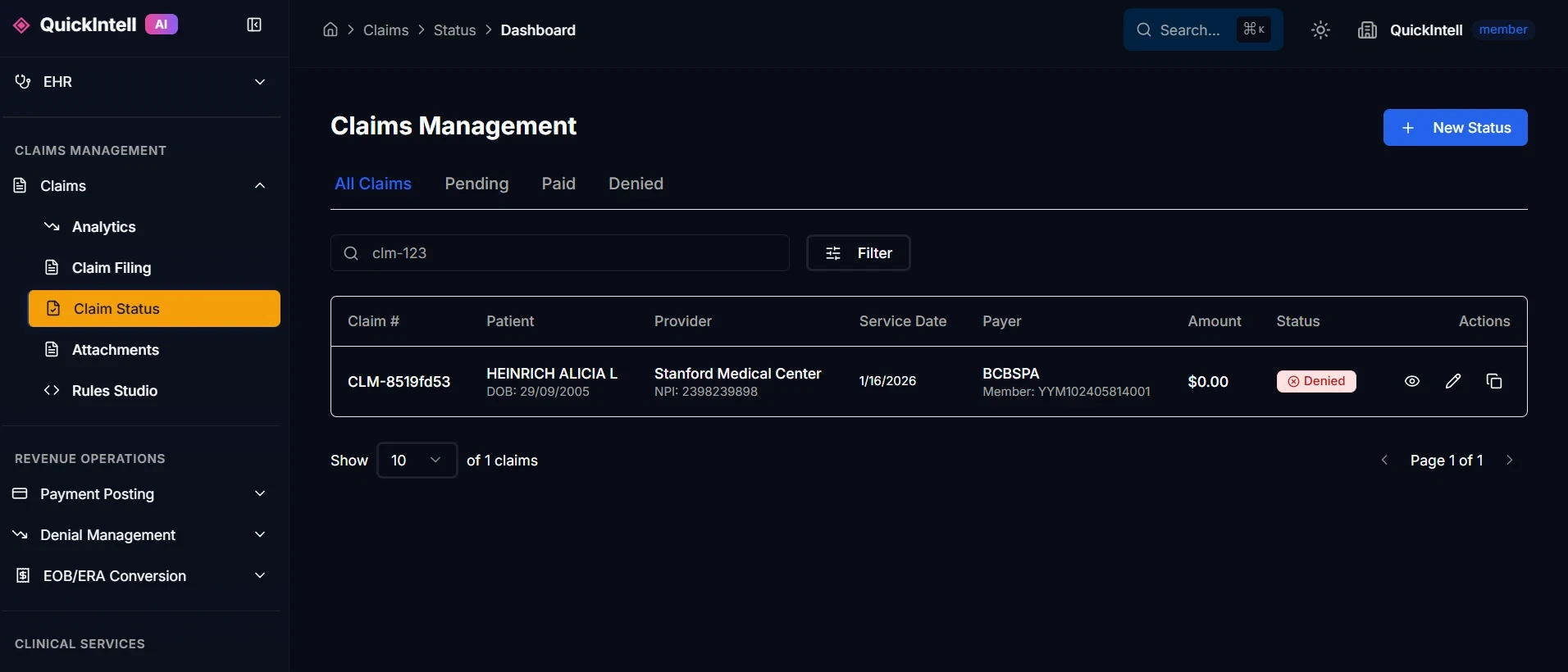

Import reviewed encounter information and confirm required claim inputs.
Resolve readiness exceptions and record the authorized release decision.
Transmit through a configured, enrolled route and retain submission evidence.
Review acknowledgments, handle rejections, and follow payer status through the remittance handoff.
Submission
Retain the claim identifier, batch, transmission time, selected route, and response state.
Review
Record staff review, the corrected information, resubmission evidence, and unresolved follow-up.
Measure
Compare acceptance, rejection handling, staff effort, payer response, and payment outcomes using the same cohort.
Billing staff release reviewed professional claims and track acknowledgment, rejection, and follow-up evidence.
Facility billing teams scope institutional claim inputs, payer routes, supporting records, and batch reconciliation.
Multi-client claims management with separate workflows, reporting, and clearinghouse routing.
Keep each claim connected to the upstream checks and downstream workflows that determine whether it gets paid.
Confirm active coverage before the claim is built.
Carry authorization numbers into claim validation.
Feed finalized CPT, ICD-10, and HCPCS codes downstream.
Add missed services before the final claim leaves.
Score risk before submission and hold claims for correction.
Follow adjudication and remittance evidence into ERA/EOB reconciliation.
Prioritize aged claims and follow-up work queues.
Generate appeal packages when denials need escalation.
Attach documentation when payers request records.
Create No Surprises Act estimates before service.
Track clean-claim rate, aging, and payer leakage.
Evaluate clearinghouse acceptance, payer acceptance, rejections, adjudicated denials, and payment separately for a defined claim cohort. A claim accepted for processing is not a payment approval. This page does not establish a universal acceptance or recovery benchmark; review representative results and your baseline during evaluation.
The documented workflow includes Availity and Stedi routing options. Confirm current transaction support, payer availability, enrollment, permissions, and fees for your proposed deployment. Available routes and any failover behavior must be tested for the specific scope.
Review the clearinghouse or payer acknowledgment, original claim identifiers, and returned error details. Authorized staff review suggested corrections, update the source information, and approve resubmission. Retain the response, correction history, and next-action owner.
The documented workflow includes professional and institutional claim formats. Scope the intended claim types, payer routes, enrollment, required fields, and validation with representative samples before enabling submission.
Submission follows staff approval, the configured schedule, route availability, and clearinghouse or payer processing. Define expected acknowledgment windows and escalation for missing responses during implementation.
Confirm which alternative routes are configured and enrolled. Staff should reconcile sent, acknowledged, held, and failed claims before retrying to avoid duplicate submissions. Test outage handling, escalation, and identifier preservation during implementation.
Patient estimation is a separate workflow to scope with your operational team. Review the intended patient context, approved inputs, calculation assumptions, staff review, delivery, and retained evidence. A submitted claim or estimate does not establish payment or compliance.
Dental claims are part of the documented claim-format scope. Confirm the proposed payer routes, enrollment, required data, supporting records, and rejection handling with a representative dental claim before rollout.
Define approved source fields, response matching, write-back permissions, sync cadence, and exception ownership for your EHR version. Demonstrate a normal acknowledgment, rejected claim, missing response, and failed write-back; retain the logs and reconciliation process.
Set release, correction, override, routing, and resubmission permissions by role. Billers and claims managers review exceptions and approve the actions assigned to them. Demonstrate the held queue, reviewer history, and escalation rather than assuming every action is automatic.
Inventory the EHR or practice management system, claim inputs, clearinghouse accounts, payer enrollments, and response channels. Test representative accepted, rejected, missing-response, duplicate-risk, and write-back cases. Agree on owners, reconciliation, and acceptance criteria before expanding volume.
Request a proposal covering claim volume, users, sites, selected modules, integrations, onboarding, support, and clearinghouse or transaction fees. Identify managed delivery work separately from software operated by your team. No fixed software price is established on this page.
Claim scrubbing checks readiness and routes exceptions before staff release a claim. Submission software handles transmission, acknowledgments, rejection review, payer status, and the remittance handoff. Payers make adjudication decisions; a successful validation or acknowledgment does not guarantee payment.
Predict and prevent denial risk before submission
Triage denied claims, find root causes, and automate appeals
Automated ERA/EOB processing and reconciliation
Staff-reviewed coding suggestions and the documentation handoff
Patient estimates with No Surprises Act workflows
Bring your claim types, EHR, payer mix, clearinghouse enrollment, and response-handling questions. Review the proposed workflow and validation plan in a product demonstration.

Billing teams responsible for sending approved claims, checking acknowledgments, resolving rejections, and following payer status.
Trace a claim from approved release through transmission, acknowledgment, acceptance or rejection, and subsequent status. Inspect submission evidence and the next action for an unresolved record.
Confirm practice-system claim intake, clearinghouse routing, payer connectivity, acknowledgment files, and status-response handling. Validate the identifiers and routes that apply to each transaction.
Billers approve release, resolve rejected records, and verify deadline evidence. Acceptance by an intermediary is not a payment decision; claim scrubbing happens before this submission workflow.
Reconcile sample transmissions and acknowledgments with the clearinghouse and practice ledger. Agree exception ownership, status checks, and timely-filing escalation before increasing volume.
Quote claim volume, clearinghouse and payer routes, system connections, users, onboarding, and support. Confirm external transaction fees in the proposal.
Use software when your staff will operate this workflow. Review managed service scope when you want Quickintell to perform the agreed work.
Book a product demo