Call
CMS-HCC v28·v22/v24 · ESRD · RxHCC

HCC Coding & Risk Adjustment Software

TL;DR

  • Captures every compliant HCC across v22/v24/v28/ESRD/RxHCC.
  • Submits RAPS/EDPS to CMS and assembles RADV packets in <24h.
  • Lifts recapture rate from 70-75% to 90%+ — ~$1,800/patient/year recovered.

Recover ~$1,800 per Medicare Advantage member per year. AI captures every compliant HCC across v22/v24/v28 plus ESRD, validates MEAT documentation, and assembles RADV-ready audit packets in under 24 hours.

QuickCode supplies the HCC capture pipeline, QuickScribe provides the clinical-note source, Claims carries MA submission data downstream, Revenue Integrity consumes recapture gaps, Analytics monitors RAF KPIs, and QuickEHR writes approved risk data back to the EHR.

15-20% RAF improvementV24/V28 compliantRADV-ready audits
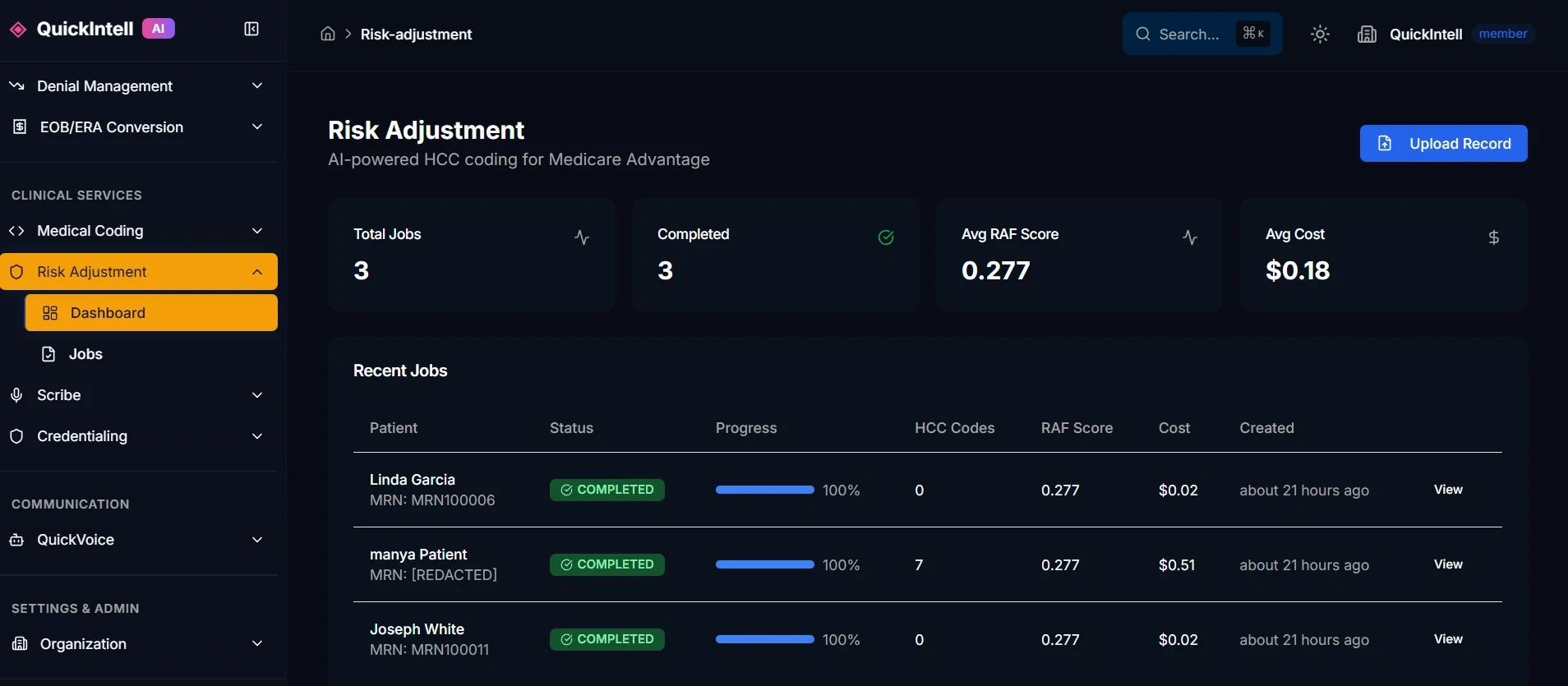
QuickIntell Risk Adjustment — dashboard: RAF score tracking, HCC capture rates, and Medicare Advantage revenue impact.
$1,800 / patient / yr
Unrecaptured baseline

Typical HCC revenue leakage for each Medicare Advantage member.

90%+
Achievable recapture

Compliant recapture benchmark vs. 70-75% industry performance.

<24 hr
RADV packet turnaround

Audit packet assembly time vs. 2-3 weeks of manual work.

40-50
Charts per coder/day

Daily coder throughput target vs. 18-25 charts manually.

Security and audit readiness

HIPAASOC 2 Type IIHITRUST CSFRADV-Ready

Why Choose QuickIntell for Risk Adjustment?

RADV Packet in <24 hr

Assemble chart evidence, ICD-10 mappings, MEAT validation, hierarchy decisions, and reviewer trail into audit-ready packets within 24 hours.

90%+ Recapture Rate

Move from typical 70-75% performance toward a 90%+ achievable benchmark with AI-surfaced chronic condition gaps.

2x Coder Throughput (40-50/day)

Automate crosswalk lookups, model selection, and hierarchy rules so coders can review 40-50 charts per day instead of 18-25.

$1.4M-$2.6M on a 5K MA Panel

For a 5,000-life Medicare Advantage panel, closing compliant HCC gaps can unlock $1.4M-$2.6M in annualized incremental revenue.

Complete Risk Adjustment Features

Everything you need to optimize HCC capture and maximize RAF scores

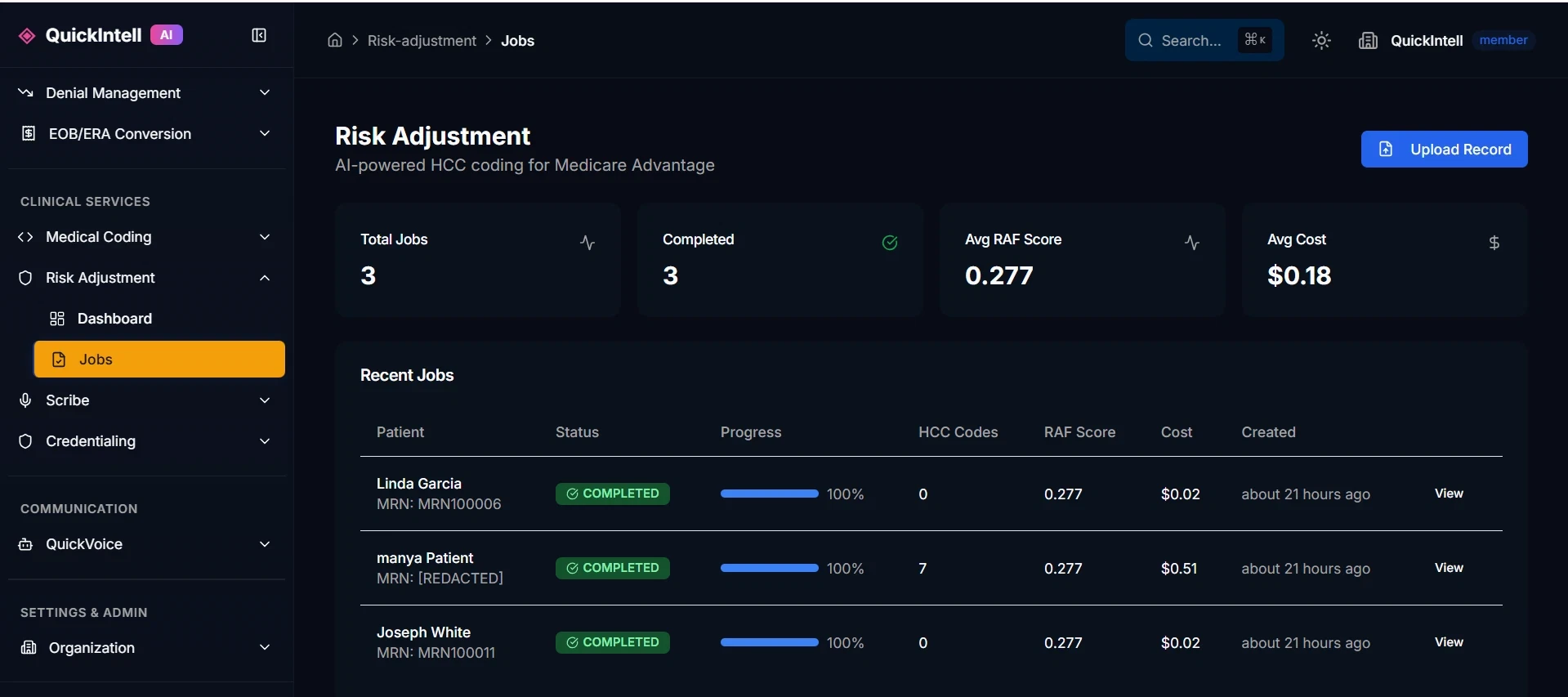
QuickIntell Risk Adjustment — batch processing view: large-scale HCC coding jobs, chart review queues, and retrospective Medicare Advantage analysis.
Batch processing — run large-scale retrospective chart reviews and HCC coding across entire patient populations

HCC Identification

  • AI chart review & analysis
  • Suspect condition alerts
  • Diagnosis recapture prompts
  • Clinical evidence mapping

Coding Support

  • HCC code suggestions
  • Specificity recommendations
  • V24/V28 model support
  • Hierarchy optimization

Compliance & Audit

  • Documentation validation
  • Audit trail & evidence
  • RADV preparation tools
  • Coder query workflows

Analytics & Reporting

  • RAF score dashboards
  • Provider scorecards
  • Trend analysis reports
  • Financial impact metrics

Compliance & Audit

Controls that keep HCC capture defensible

MEAT Documentation Validation

Requires Monitor, Evaluate, Assess, or Treat evidence before an HCC is accepted for the payment year.

MCE and Excludes1 Checks

Runs age/sex Medicare Code Editor validation and blocks ICD-10 Excludes1 conflicts before final RAF scoring.

RADV-Ready Audit Chain

Every captured HCC links source encounter -> ICD-10 -> model version -> hierarchy decision -> reviewer ID.

CMS Submission

Submission workflows stay attached to the score

Generate files, submit eligible batches, and keep deadline visibility in the same workflow that finalized the HCC capture.

RAPS/EDPS File Generation

Builds submission-ready files from finalized HCCs, demographics, encounter provenance, and review status.

Direct CMS Submission

Submits eligible batches when enabled and records CMS acknowledgment IDs back onto the submission record.

Submission-Window Calendar

Shows open, upcoming, and closed CMS windows so teams can stage sweeps before deadlines.
Model Coverage

CMS models covered across MA, ESRD, and Part D

CMS-HCC v22

Legacy Medicare Advantage payment-year analysis and back-testing.

Segments produced

CommunityInstitutionalNew enrollee

CMS-HCC v24

Concurrent Medicare Advantage scoring and historical comparison.

Segments produced

CommunityInstitutionalNew enrollee

CMS-HCC v28

Medicare Advantage cohorts using the fully phased-in v28 methodology.

Normalization factor: 1.000 PY26.

Segments produced

CommunityInstitutionalNew enrollee

ESRD-HCC v21/v24

End-Stage Renal Disease members, dialysis cohorts, and post-graft reviews.

Segments produced

DialysisPost-graftESRD community/institutional

RxHCC v08

Part D prescription drug benefit scoring, bid support, and reconciliation.

Segments produced

Configured Part DReconciliationNew enrollee

How Risk Adjustment Works

1

Analyze

AI reviews charts and identifies potential HCCs

2

Validate

System maps clinical evidence to support codes

3

Capture

Coders review and confirm compliant diagnoses

4

Monitor

Track RAF improvement and audit readiness

Who Uses QuickIntell Risk Adjustment?

Medicare Advantage Plans

Optimize RAF scores across your member population with prospective and retrospective HCC capture.

ACOs & Value-Based Care

Ensure accurate risk scoring for quality measurement and shared savings calculations.

Provider Organizations

Capture HCCs at the point of care with real-time alerts and documentation support.

Vendor Comparison

Why QuickIntell vs alternatives

CapabilityQuickIntellSpreadsheetsGeneric AI Coding ToolsLegacy Retrospective Vendors
Model coverageCMS-HCC v22/v24/v28, ESRD-HCC v21/v24, RxHCC v08Manual tabs and version driftPrompt-dependent model supportUsually tied to one retrospective program
Real-time vs retrospectiveProspective prompts plus retrospective sweepsAfter-the-fact reconciliationDetached from live chart workflowsPrimarily retrospective chart review
Dual-mapped ICD-10Crosswalk traces every mapped HCCEasy to miss secondary mappingsRequires manual verificationOften returned as coder notes
MEAT validationEvidence gate before HCC acceptanceManual reviewer judgmentNarrative suggestion onlySeparate QA review cycle
RAPS/EDPS submissionFile generation, direct submission, acknowledgment IDsExport prep outside the sheetNo native submission workflowBatch handoff after review
RADV packet turnaroundSource-to-reviewer chain assembled in under 24 hoursManual evidence chaseNo durable audit packetDays to weeks of binder assembly
Provider CDI workflowOne-click clarification and care-team routingEmail or task list follow-upCopy/paste query draftingLate provider outreach

Frequently Asked Questions

How does AI identify missed HCCs?

QuickIntell analyzes clinical documentation, lab results, medication lists, and historical claims to identify conditions that may qualify as HCCs. The AI surfaces these opportunities with supporting evidence for coder review.

Does this work with both V24 and V28 models?

Yes! We fully support the V28 model, which reached 100% implementation in 2026. Our system also retains V24 model support for historical analysis and calculates RAF scores under both models, highlighting coding differences.

How do you ensure compliance?

Every HCC suggestion includes the clinical evidence required for compliant coding. Our system validates that documentation supports the specificity level coded and maintains complete audit trails for RADV.

Do you support ESRD and RxHCC models?

Yes — ESRD-HCC v21/v24 and RxHCC v08 are first-class.

How fast can you assemble a RADV audit packet?

Under 24 hours, with full evidence chain per HCC.

Can the system submit RAPS/EDPS files directly to CMS?

Yes — QuickIntell generates the files and submits when the org-level toggle is on, capturing the CMS acknowledgment ID.

How does QuickIntell handle dual-mapped ICD-10 codes (e.g., E11.22)?

We capture all mapped HCCs simultaneously and apply hierarchy correctly — spreadsheets miss the second mapping.

Can this integrate with our EMR?

Yes! QuickIntell integrates with Epic, Oracle Health (formerly Cerner), athenahealth, eClinicalWorks, OpenEMR, NextGen, and Allscripts/Veradigm to access clinical data and surface HCC opportunities in real-time during documentation.

What's the typical ROI?

Most customers see 15-20% improvement in RAF scores within 6-12 months, translating to $50-150 additional revenue per member per month for Medicare Advantage populations.

Ready to Optimize Your RAF Scores?

Join healthcare organizations improving HCC capture rates by 15-20% with QuickIntell.