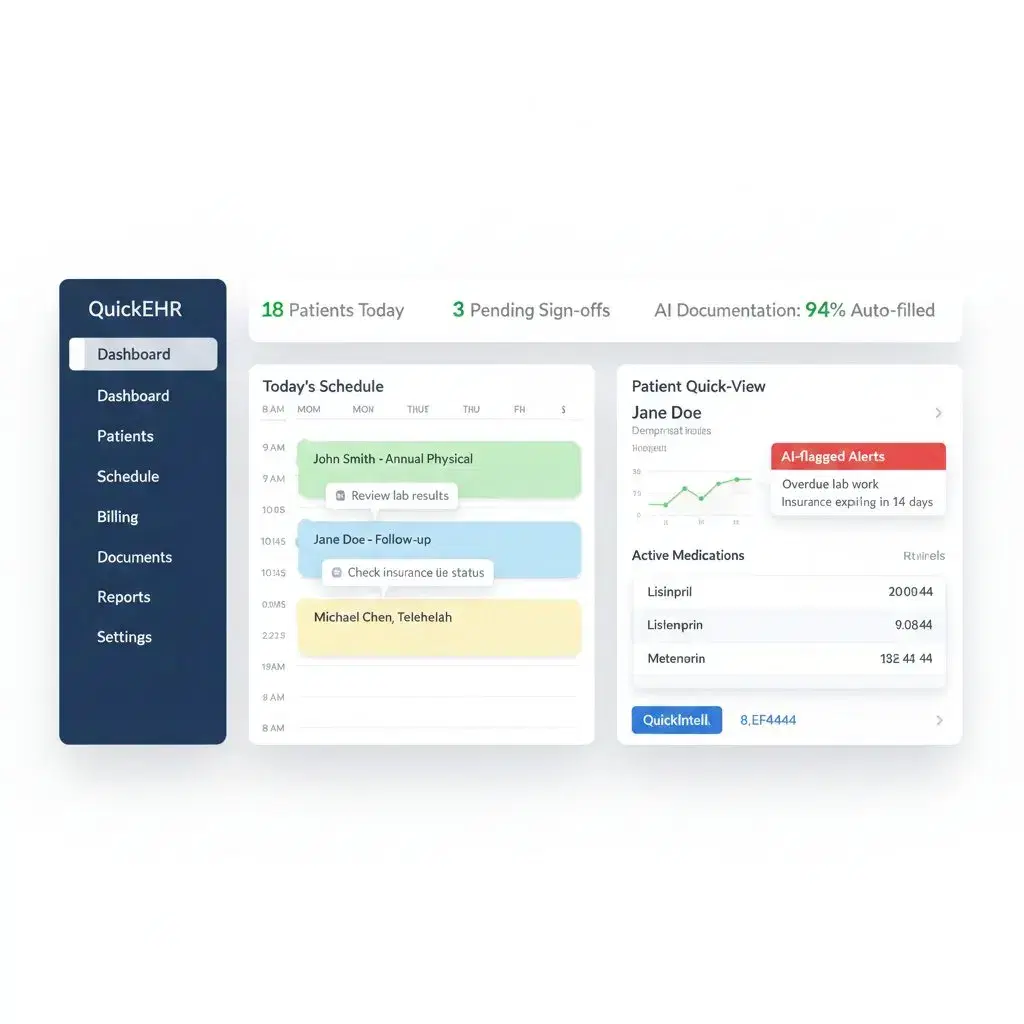
Mobile EHR software for QuickEHR clinician workflows
QuickEHR mobile EHR software gives clinicians and operating teams mobile-ready access to OpenEMR-powered chart context, provider schedules, messages, tasks, documentation handoff, AI-prepared work queues, and revenue follow-through without separating mobile activity from the encounter.
Schedule, patient chart, documentation, AI handoff, and RCM
Chart context
Problems, meds, notes
Mobile tasks
Messages and routing
Revenue handoff
Auth, coding, RCM, ERA
Mobile EHR workflow
Keep mobile work connected to the chart, not floating in another inbox.
Searchers comparing mobile EHR software expect schedule access, patient record review, documentation support, messages, quick tasks, and mobile EMR follow-through. QuickEHR keeps those jobs tied to the OpenEMR-powered source of truth and the QuickIntell automation layer.
Start of day
Review schedules and chart context before the first visit
Mobile EHR software should help clinicians and staff orient around the day without waiting for a workstation. QuickEHR keeps schedule, chart, coverage, and task context connected to the OpenEMR-powered record.
Scan appointments, visit reasons, rooming status, locations, and open pre-visit tasks.
Review patient chart context such as problems, medications, allergies, prior notes, documents, and recent activity.
Flag intake, eligibility, referral, or authorization gaps for the team that owns the next step.
During care
Capture mobile clinical context without splitting the encounter
QuickEHR mobile workflows keep notes, messages, photos or documents when configured, and task updates tied to the same encounter model instead of creating a side channel.
Add mobile task notes or documentation context for review inside the chart workflow.
Route patient questions, staff messages, and follow-up needs from the patient record.
Keep mobile activity assistive and reviewable before it affects clinical, billing, or patient-facing actions.
After the visit
Move mobile work into documentation, coding, auth, and RCM queues
A mobile EMR workflow is only useful if the follow-through lands in the right operating queue. QuickEHR carries mobile-triggered context into QuickIntell products for review.
Send encounter context toward QuickScribe note drafting and clinician review.
Route diagnoses, orders, documentation gaps, and payer context toward QuickCode and QuickAuth worklists.
Keep QuickRCM and QuickERA teams connected to the encounter, claim, denial, and remittance trail.
Mobile use cases
Cover the mobile jobs clinicians actually reach for.
QuickEHR mobile workflows are built for practical clinical and operational moments: checking the day, reviewing patient chart access, routing messages, capturing encounter context, and moving work into the right review queue.
For teams comparing mobile software for doctors or medical mobile app software, the implementation question is whether the mobile layer stays connected to chart governance, downstream revenue work, and review ownership.
Give clinicians a mobile view of appointments, visit reasons, status changes, and preparation tasks configured for the practice.
Patient chart access
Keep problems, medications, allergies, prior notes, documents, orders, and recent activity close to the active visit.
Mobile clinical documentation handoff
Use mobile encounter context to support QuickScribe drafts, template completion, clinician review, and downstream coding work.
Messages, tasks, and on-call work
Route urgent follow-up, staff questions, patient messages, and task ownership without losing the patient or encounter context.
Photos and documents when configured
Support approved attachment workflows with review rules before content is relied on in documentation, authorization, or billing.
Revenue and access follow-through
Carry mobile chart context into eligibility, prior authorization, coding, claims, denials, remittance, and patient outreach work.
AI EHR mobile automation
AI prepares mobile-triggered work while review remains explicit.
QuickEHR connects mobile clinical workflow activity to QuickIntell automation for note drafting, coding suggestions, prior authorization packets, claims follow-up, ERA context, and patient outreach. AI helps prepare and route work; people keep the configured review points.
OpenEMR mobile workflows need the same governance as desktop charting.
Practices may need a managed OpenEMR-powered QuickEHR deployment, a connection to an existing OpenEMR tenant, or QuickEHR Connect around another EHR. The common requirement is clear: mobile work must stay close to chart context, interfaces, access rules, human review, and operational queues.
Review the OpenEMR integration for integration architecture and implementation paths.
Managed QuickEHR on the OpenEMR foundation
QuickEHR is built on the OpenEMR foundation and adds managed deployment, configuration, support, integrations, and QuickIntell AI workflow design around the chart.
Existing OpenEMR environments
Clinics already using OpenEMR can evaluate approved API, FHIR, HL7, interface-engine, and document paths for mobile-ready QuickIntell worklists where available.
QuickEHR Connect for other systems
Practices keeping another EHR can use QuickEHR as an integration layer around chart, schedule, documentation, coding, authorization, RCM, and ERA workflows.
Related QuickIntell products
Mobile EHR software is only useful when downstream teams can act.
The same mobile-triggered context should help documentation, coding, authorization, claims, remittance, and outreach teams move faster without rebuilding the visit story.
Mobile workflows differ by specialty and care setting.
Primary care, urgent care, behavioral health, pediatrics, cardiology, and internal medicine teams all need different rules for chart context, messages, follow-up, documentation, and authorization review.
Define mobile access, review points, and support ownership before launch.
Mobile healthcare workflows touch patient data, clinical messages, documents, staff tasks, AI work preparation, and revenue operations. QuickEHR implementation should make device scope, interfaces, human review, and support ownership explicit.
Security and procurement teams can review current materials through the Trust Center. Any deployment-specific evidence should be confirmed in the active contract and implementation packet.
Mobile EHR implementation checklist
Scope these items before production use.
Confirm whether the deployment uses QuickEHR-managed OpenEMR, an existing OpenEMR tenant, or QuickEHR Connect around another EHR.
Define supported devices, browsers, authentication, role-based access, session expectations, and mobile workflow boundaries.
Confirm enabled OpenEMR API, FHIR, HL7, interface-engine, communication, payer, clearinghouse, and document paths for the deployment.
Decide which AI actions may draft, summarize, classify, route, or queue work before clinician, staff, coder, authorization, or billing review.
Review trust, data handling, patient-facing language, support ownership, and deployment evidence before go-live.
QuickEHR navigation
Related QuickEHR pages for mobile EHR software buyers.
Mobile buyers usually need the surrounding EHR, charting, scheduling, OpenEMR, documentation, and evidence-boundary context before selecting a workflow.
Answers for practices comparing mobile EHR software, EHR mobile app workflows, mobile EMR, OpenEMR mobile access, AI EHR mobile automation, and implementation requirements.
What is QuickEHR mobile EHR software?
QuickEHR mobile EHR software is the mobile-ready workflow layer for QuickEHR. It helps clinicians and staff review schedules, patient chart context, messages, tasks, documentation handoff, and downstream QuickIntell work around an OpenEMR-powered EHR foundation.
Is QuickEHR a native EHR mobile app for iPhone or Android?
This page describes QuickEHR mobile workflows rather than making a public app-store availability claim. Device, browser, authentication, and mobile access details should be confirmed in the current implementation packet for the practice.
How does QuickEHR mobile EMR workflow connect to OpenEMR?
QuickEHR is built on the OpenEMR foundation. QuickIntell adds managed configuration, support, integrations, and AI automation around that foundation. Existing OpenEMR users can evaluate approved API, FHIR, HL7, or interface-engine paths for connected mobile worklists where available.
What can clinicians do from a QuickEHR mobile workflow?
A configured QuickEHR mobile workflow can support schedule review, patient chart access, messages, tasks, documentation handoff, selected photo or document paths, on-call follow-up, and routing into QuickScribe, QuickCode, QuickAuth, QuickRCM, QuickERA, and QuickVoice.
How does AI EHR mobile automation work in QuickEHR?
QuickIntell AI can help draft, classify, summarize, route, and queue mobile-triggered work such as documentation gaps, coding context, prior authorization tasks, RCM follow-up, remittance questions, and patient outreach. AI is assistive, and the configured human review points remain explicit.
How is this different from the QuickEHR clinical mobile app page?
This page targets the broader mobile EHR software buying intent and implementation workflow. The QuickEHR clinical mobile app page focuses more narrowly on clinician-facing clinical mobility use cases.
Can mobile chart activity feed coding, prior auth, and RCM?
Yes, when configured. Mobile chart, task, document, and encounter context can feed QuickCode coding review, QuickAuth prior authorization packets, QuickRCM claim and denial worklists, and QuickERA remittance workflows.
Does this page make certification, HIPAA, SOC 2, EPCS, or customer claims?
No. This page describes QuickEHR mobile workflows and implementation planning. QuickEHR is built on the OpenEMR foundation, and any certification, regulatory, HIPAA, SOC 2, EPCS, payer, or procurement evidence should be verified in the current contract and deployment packet.
What should practices review before launching mobile EHR workflows?
Practices should review mobile access rules, role-based permissions, authentication, device policy, message routing, document capture, clinician review points, AI assistive boundaries, OpenEMR or EHR interfaces, support ownership, and Trust Center materials before go-live.
QuickEHR mobile workflow review
Scope mobile EHR software around your actual clinical and revenue workflows.
Bring your schedule, chart, documentation, authorization, coding, RCM, and OpenEMR integration questions to a workflow review.