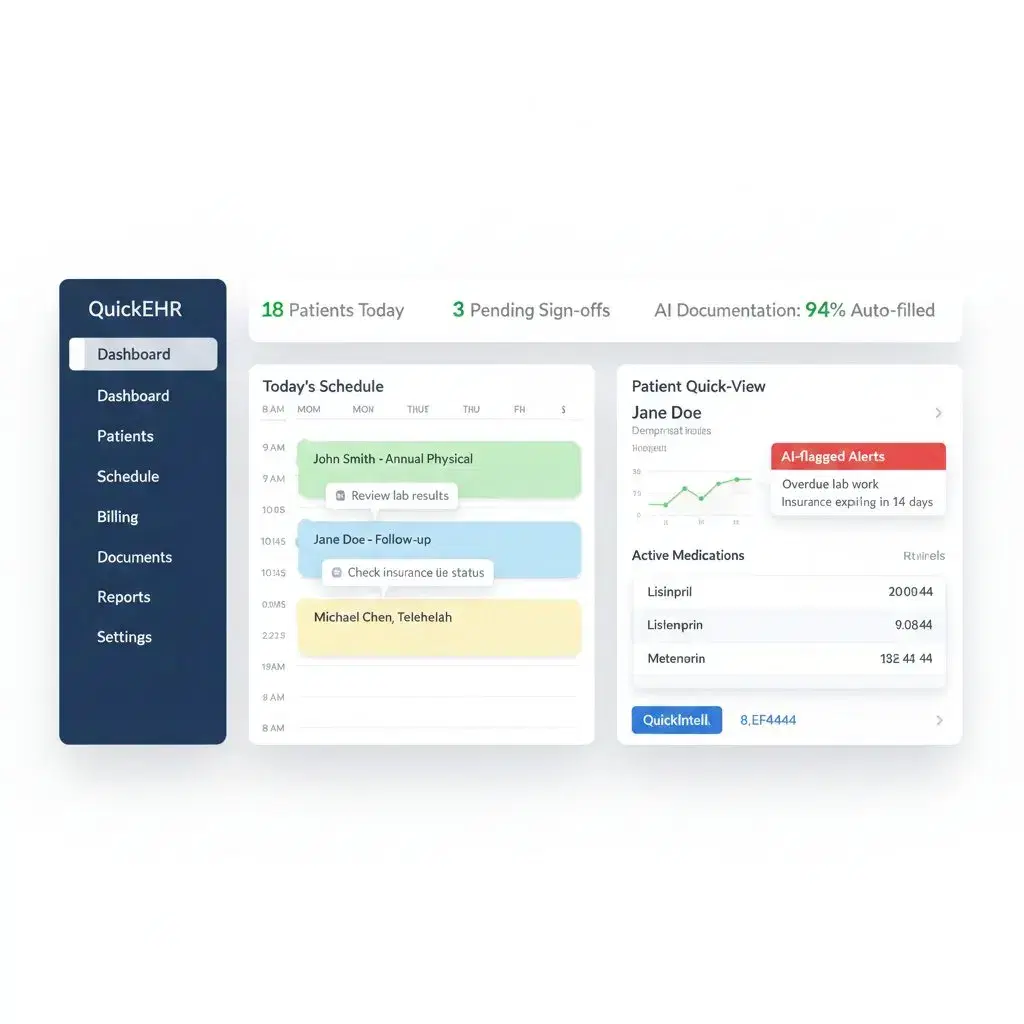
QuickEHR security brings OpenEMR-powered chart access, MFA planning, role-based permissions, audit trail readiness, data movement, and QuickIntell AI workflow controls into one implementation plan for medical practices.
Identity, access, chart activity, AI handoff, and revenue workflows
MFA and roles
Identity and access
Audit trails
Reviewable activity
AI boundaries
Draft, route, review
EHR security workflow
Security has to follow the work from login to payment.
Searchers comparing EHR security expect more than a generic statement. QuickEHR security planning connects identity, patient chart access, audit trails, data movement, and AI workflow controls to the way clinicians and revenue teams actually operate.
Identity
Start EHR security with the user, role, and session.
QuickEHR security planning starts by defining who can enter the OpenEMR-powered workspace, what role they carry, and which actions need stronger review.
Map providers, billers, front-desk staff, administrators, external support, and AI workflow users before go-live.
Confirm MFA policy, session expectations, device rules, and privileged-access handling for the deployment.
Keep authentication and access decisions visible in the implementation packet instead of relying on informal office policy.
Chart access
Keep patient-chart work tied to least-privilege permissions.
Electronic health record security depends on more than a strong login. QuickEHR implementations should keep schedule, patient chart, documentation, order, message, billing, and reporting access scoped to the work each team performs.
Separate patient demographics, clinical notes, orders, documents, billing, reporting, and administrative configuration rights.
Use role-based access review for patient chart workflows, mobile access, OpenEMR modules, and connected QuickIntell queues.
Review high-risk changes before they affect clinical documentation, claims, payments, or patient-facing communication.
Activity trail
Make security review practical with traceable workflow events.
A secure EHR workflow should show who touched which work item, where it came from, and how it moved across documentation, coding, authorization, RCM, and remittance queues.
Preserve source identifiers, user context, timestamps, and review status as work moves between systems.
Track AI-prepared drafts, coding suggestions, authorization packets, claim exceptions, and ERA questions as reviewable activity.
Route ambiguous or unsupported events into exception queues instead of silently changing records or downstream work.
Data movement
Control how EHR data leaves the chart and enters automation.
AI EHR security needs explicit data boundaries. QuickEHR should document the approved API, FHIR, HL7, document, export, clearinghouse, payer, and remittance paths that can move patient and revenue context.
Scope each interface around its intended clinical, access, coding, authorization, RCM, ERA, or reporting job.
Keep data export, file handling, attachment review, and integration support tied to the same trust review as the EHR.
Review retention, routing, support ownership, and procurement evidence before production use.
MFA and access control
EHR multi-factor authentication only works when roles and sessions are clear.
Healthcare MFA should be scoped around real users and real risk: clinicians logging into charts, billers handling claim data, administrators changing permissions, and support teams helping with implementation.
QuickEHR access planning should cover MFA, role-based access control, OpenEMR permissions, user lifecycle changes, support access, session policy, and mobile-ready workflows before production use.
Define EHR multi-factor authentication expectations for clinicians, staff, administrators, remote access, and sensitive workflows during implementation.
Role-based access control
Align OpenEMR and QuickEHR permissions to the job: front desk, provider, clinical support, coder, biller, authorization specialist, and administrator.
Privileged action review
Identify high-impact actions such as user administration, permissions changes, chart configuration, interface credentials, exports, and billing setup.
Session and device rules
Document browser, mobile-ready workflow, workstation, timeout, remote-access, and device expectations before production use.
Audit trail readiness
Confirm which events security, operations, and compliance reviewers need when investigating access, changes, queue movement, and support work.
Staff changes and offboarding
Plan onboarding, role changes, termination, temporary coverage, and external support access so permissions keep pace with staffing reality.
AI EHR security
AI automation should prepare work, preserve context, and keep review visible.
QuickEHR connects AI-assisted documentation, coding, authorization, RCM, remittance, and outreach workflows to the OpenEMR-powered chart. The security design should document which data is used, where it goes, and who reviews the output.
OpenEMR security and QuickEHR workflow security should be reviewed together.
QuickEHR is built on the OpenEMR foundation. Security planning should connect OpenEMR roles, modules, chart activity, APIs, exports, and support paths with the QuickIntell automation layer that moves work into documentation, coding, prior authorization, claims, and remittance queues.
Review the OpenEMR integration for integration architecture, API paths, and implementation planning.
QuickEHR-managed OpenEMR foundation
QuickEHR is built on the OpenEMR foundation and adds managed deployment, configuration, support, integrations, and QuickIntell workflow design around the chart.
Existing OpenEMR environments
Practices already using OpenEMR can review approved API, FHIR, HL7, interface-engine, export, and support paths before connecting QuickIntell work queues.
QuickEHR Connect around other EHRs
Teams keeping another EHR can scope QuickEHR as an integration and workflow layer for documentation, coding, authorization, RCM, and ERA follow-through.
Related QuickIntell products
Security boundaries matter across every connected product.
QuickEHR security is strongest when documentation, coding, authorization, RCM, remittance, and outreach workflows use the same source context, access model, and human review boundaries.
Primary care, urgent care, behavioral health, pediatrics, cardiology, and internal medicine teams use different chart access, documentation, authorization, messaging, and billing workflows.
Define security, MFA, AI review, and support ownership before launch.
EHR privacy and security concerns usually appear at workflow boundaries: remote access, mobile work, chart exports, AI drafts, API credentials, payer packets, claim files, support sessions, and staff changes. QuickEHR implementation should make those boundaries explicit.
Procurement and security teams can review current materials through the Trust Center. Deployment-specific evidence should be confirmed in the active contract and implementation packet.
QuickEHR security implementation checklist
Scope these items before production use.
Confirm whether the deployment uses QuickEHR-managed OpenEMR, an existing OpenEMR tenant, or QuickEHR Connect around another EHR.
Document authentication, MFA policy, role groups, administrator access, session rules, mobile-ready access, and offboarding.
Map OpenEMR permissions, QuickEHR configuration, connected app scopes, interface credentials, and support access.
Define which AI actions may draft, summarize, classify, route, or queue work before clinician, coder, authorization, billing, or support review.
Confirm audit trail expectations for patient chart access, documentation changes, exports, API events, claims, remittance, and support activity.
Review data handling, Trust Center materials, implementation evidence, procurement language, and deployment-specific requirements before go-live.
QuickEHR navigation
Related QuickEHR pages for security buyers.
Security review often needs the surrounding EHR architecture, OpenEMR integration, API scope, export, patient chart, and certification-boundary context.
Answers for practices comparing EHR security, electronic health record security, OpenEMR security, AI EHR security, healthcare MFA, and implementation requirements.
What is QuickEHR security?
QuickEHR security is the product-specific EHR security workflow for QuickEHR. It covers identity and MFA planning, role-based access, OpenEMR-powered chart permissions, audit trail readiness, data movement, AI workflow controls, and implementation review.
Does QuickEHR support EHR multi-factor authentication?
QuickEHR implementations can scope EHR multi-factor authentication requirements for clinicians, staff, administrators, remote access, and sensitive workflows. The exact identity provider, MFA method, session policy, and rollout plan should be confirmed in the current deployment packet.
How does OpenEMR security fit with QuickEHR?
QuickEHR is built on the OpenEMR foundation. Security planning should review OpenEMR users, roles, modules, API access, FHIR scope, exports, audit needs, and support permissions alongside the QuickIntell automation layer.
What EHR security measures should a practice review?
Common EHR security measures include MFA policy, role-based permissions, least-privilege access, administrator controls, audit trail review, data export rules, API scope, session expectations, staff offboarding, and clear human review points for AI-prepared work.
How does AI EHR security work in QuickEHR?
AI EHR security means AI can draft, summarize, classify, route, or queue work only within approved data paths and review workflows. QuickScribe, QuickCode, QuickAuth, QuickRCM, QuickERA, and QuickVoice should preserve source context and human review rather than silently finalizing clinical or revenue actions.
How is this page different from the QuickIntell Trust Center?
This page explains QuickEHR-specific security and MFA workflow planning. The Trust Center is the place to review current QuickIntell security, privacy, legal, and procurement materials, including deployment-specific evidence available through the appropriate review process.
Does this page claim HIPAA, SOC 2, ONC, EPCS, or customer certification status?
No. This page describes QuickEHR security workflow planning and the OpenEMR-powered QuickEHR architecture. Any HIPAA, SOC 2, ONC, EPCS, payer, customer, or certification evidence should be verified in the current Trust Center materials, contract, and implementation packet.
Can QuickEHR audit trails help with electronic health record security review?
Audit trail planning should identify the patient chart, user, role, timestamp, interface, export, support, and downstream queue events reviewers need. The final audit evidence available depends on the configured OpenEMR, QuickEHR, integration, and QuickIntell workflow scope.
What should practices review before launching QuickEHR security workflows?
Practices should review deployment model, MFA policy, role groups, OpenEMR permissions, data movement, API credentials, export rules, AI review boundaries, support ownership, offboarding, Trust Center materials, and deployment-specific evidence before production use.
QuickEHR security review
Scope EHR security around your actual clinical and revenue workflows.
Bring your OpenEMR, MFA, chart access, AI automation, API, export, support, and Trust Center questions to a workflow review.