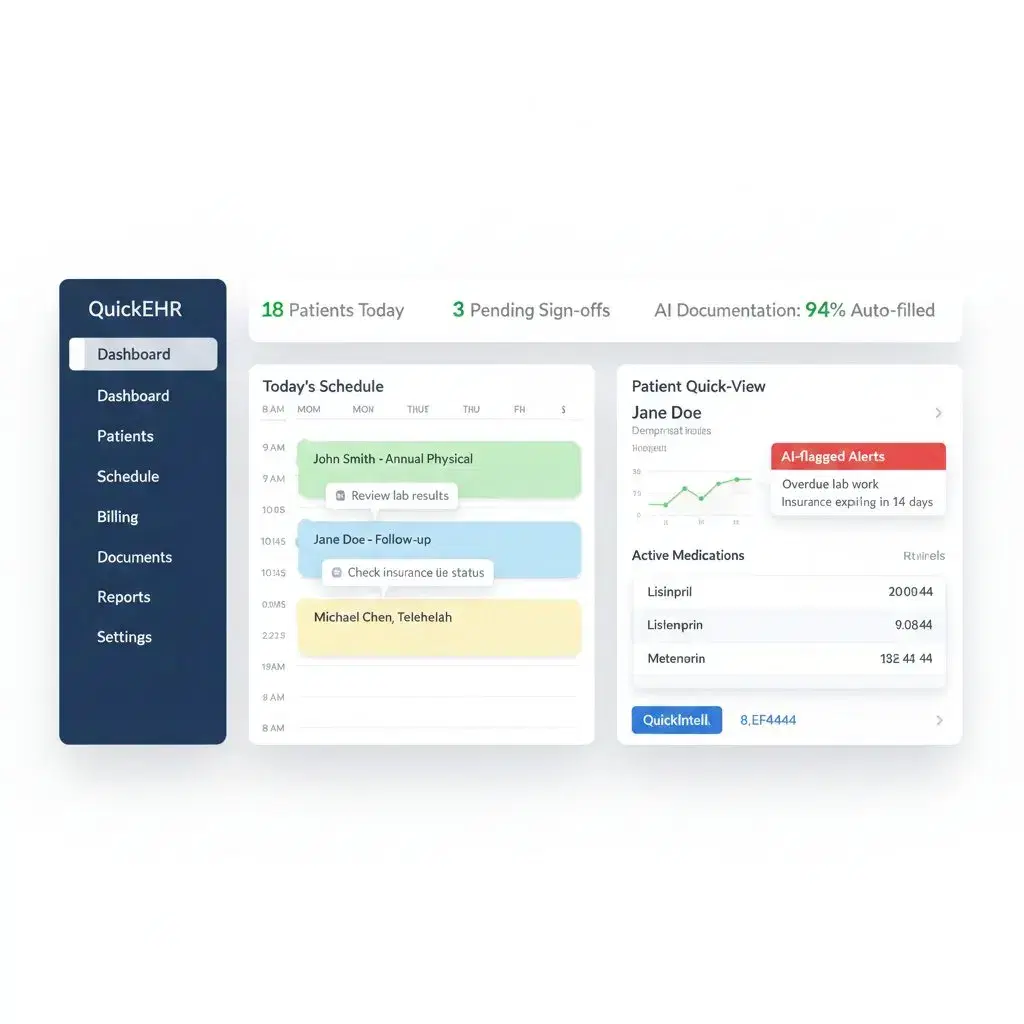
Primary intent: medical claims management software
Workflow fit: EHR, coding, auth, claims, ERA
AI role: assistive claim preparation
QuickEHR claims workspace
Encounter, codes, authorization, claims, denials, ERA
Claim readiness
Encounter, codes, charges
Submission work
Scrubs, edits, status
Payment loop
Denials, ERA, balances
Claims workflow
A claim should inherit the encounter context instead of rebuilding it.
The medical claims software SERP expects claim creation, submission, tracking, denial follow-up, and payment posting. QuickEHR anchors those tasks in the chart, coding, authorization, and revenue workflow that created the claim.
Before submission
Build the claim from reviewed encounter context
QuickEHR medical claims management software starts with the visit record: provider, location, payer, eligibility, authorization, diagnoses, procedures, modifiers, charges, and chart documentation.
Keep scheduling, eligibility, prior authorization, and patient chart context close to the claim worklist.
Use QuickCode output and clinician-reviewed documentation to prepare coding and charge review.
Route missing information to the right clinical, coding, billing, or authorization owner before submission.
Claim submission
Scrub, review, and submit electronic claims
Claims processing software needs more than a submit button. QuickEHR connects claim edits, clearinghouse or payer routing, work queues, and exception review around the EHR source of truth.
Check claim details for obvious demographic, coverage, provider, coding, authorization, and documentation gaps.
Prepare electronic claims submission software workflows for the clearinghouse or payer path enabled for the deployment.
Track rejections and status responses so staff can repair claims without reconstructing the encounter.
After submission
Close the loop with denials, ERA, and patient follow-up
Healthcare claims management software should carry claim context into denial management, payment posting, AR follow-up, and patient balance workflows instead of leaving billing teams to chase disconnected notes.
Group rejected claims, payer denials, attachment requests, and AR follow-up by patient, encounter, payer, and owner.
Connect QuickERA payment posting and remittance review to the original charge, claim, and patient chart context.
Use denial patterns to inform documentation, coding, authorization, eligibility, and front-desk workflow changes.
Claim operations
Cover the practical billing jobs buyers expect from healthcare claims management software.
QuickEHR claims management is built for provider workflows: claim scrubbing, electronic submission, payer status, rejection repair, denial follow-up, payment posting, and patient balance handoff tied back to clinical and billing source data.
Carry the signed note, coding review, payer, provider, location, place of service, authorization, and charge context into a claim-ready work queue.
Claim scrubbing
Use claim scrubbing software workflows to flag missing or inconsistent data for staff review before the claim leaves the practice workflow.
Electronic claims submission
Prepare electronic claim submission software paths for the clearinghouse, payer, EDI, or interface route configured during implementation.
Payer status and rejection repair
Keep accepted, rejected, pending, corrected, and resubmitted claim statuses tied to the encounter and billing owner.
Denial management handoff
Route CARC, RARC, payer notes, attachment requests, medical necessity questions, and appeal prep into structured follow-up workflows.
ERA and payment posting
Use QuickERA and payment posting workflows to connect remittance, contractual adjustments, patient balances, and exceptions back to the claim.
AI claims automation
AI can prepare claims work while teams keep the review points.
For practices comparing AI claims management software, AI EHR claims management, or claims processing software for healthcare, QuickEHR uses QuickIntell modules to connect documentation, coding, authorization, claim, denial, and remittance work.
QuickEHR claims management works around the EHR and billing path your clinic chooses.
QuickEHR can be a managed OpenEMR-powered EHR or the connection layer around an existing system. In either model, the claim workflow should know the chart, coding, authorization, payer, charge, status, denial, and remittance context.
QuickEHR is built on the OpenEMR foundation and adds QuickIntell-managed configuration, implementation support, and AI workflow automation around claims and billing operations.
Existing OpenEMR tenants
Practices already running OpenEMR can evaluate approved OpenEMR API, FHIR, HL7, clearinghouse, or interface-engine paths for claims, charge, remittance, and patient context.
QuickEHR Connect for other systems
Clinics keeping another EHR or practice management system can use QuickEHR as the workflow layer around documentation, coding, authorization, claims, denials, and ERA context.
Related QuickIntell products
Claims management sits between the chart and the payment loop.
A claim can depend on documentation, coding, authorization, eligibility, payer routing, denial work, AR follow-up, payment posting, and patient outreach. These links keep buyers moving through the connected QuickIntell workflow.
Claims buyers often need the surrounding eligibility, claims processing, denial, payment posting, and end-to-end RCM workflow before choosing a claims management model.
Claim edits, authorization risk, documentation support, and denial patterns vary by specialty. QuickEHR should be scoped around the visit types, payers, and procedures your teams actually bill.
Define the claims operating model before production use.
Medical claims and billing workflows touch patient data, payer contracts, coding decisions, authorization evidence, clearinghouse connections, remittance files, billing follow-up, and audit expectations. QuickEHR implementation should make interfaces, review points, and ownership explicit.
Security and procurement teams can review current materials through the Trust Center. Any implementation-specific evidence should be verified in the current contract and deployment packet.
Claims implementation checklist
Scope these items before go-live.
Choose QuickEHR-managed OpenEMR, an existing OpenEMR tenant, or QuickEHR Connect around another EHR or practice management system.
Map charge sources, encounter types, provider and location rules, payer routing, clearinghouse paths, claim status feeds, and billing team ownership.
Answers for practices comparing medical claims management software, medical claims software, OpenEMR claims management, electronic claim submission, AI claims automation, and connected RCM workflows.
What is QuickEHR medical claims management software?
QuickEHR medical claims management software is the provider billing workflow in QuickEHR. It connects OpenEMR-powered encounter context, coding review, authorization status, claim scrubbing, electronic claims submission, payer status, denial follow-up, ERA/payment posting, and patient balance handoff into one QuickIntell operating model.
How is claims management software different from medical billing software?
Medical billing software often covers charges, claims, payment posting, and patient balances. Claims management software focuses specifically on preparing, submitting, tracking, correcting, and following up on claims. QuickEHR connects that claims workflow back to chart, coding, authorization, eligibility, RCM, and ERA context.
Does QuickEHR support electronic claims submission software workflows?
QuickEHR can support electronic claims submission workflows when the required clearinghouse, payer, EDI, API, batch, or interface path is enabled for the deployment. The implementation team should confirm the route, claim status feed, rejection handling, and billing team ownership before go-live.
How does OpenEMR claims management fit with QuickEHR?
QuickEHR is built on the OpenEMR foundation. Practices can use QuickEHR-managed OpenEMR workflows or connect an existing OpenEMR tenant when approved OpenEMR API, FHIR, HL7, clearinghouse, or interface-engine paths are available for patient, encounter, charge, claim, and remittance context.
How does AI EHR claims management work in QuickEHR?
QuickIntell AI can help draft, classify, summarize, scrub, route, and queue claims-related work for review. It can help organize missing documentation, coding context, authorization status, rejection repair, denial follow-up, and ERA exceptions, but it should be treated as assistive automation with human review points.
Does QuickEHR replace a claims clearinghouse?
Not by default. QuickEHR is the EHR and workflow layer around the claim. A deployment may still use a clearinghouse, payer portal, EDI partner, API route, batch process, or interface engine based on the practice's billing stack and payer requirements.
How do QuickCode and QuickAuth help claims management?
QuickCode can prepare reviewable coding suggestions from documentation and encounter context. QuickAuth can keep authorization status, payer requirements, and approved service windows visible before claim submission. Both workflows help billing teams review claim readiness with less chart reconstruction.
How does QuickERA close the claim loop?
QuickERA connects EOB and ERA context to payment posting and exception review. When remittance, denial, adjustment, and patient responsibility data can be tied back to the original claim and encounter, teams can resolve posting and follow-up work with better context.
Can practices use QuickEHR claims management with another EHR?
Yes. Practices keeping another EHR or practice management system can evaluate QuickEHR Connect. That path is intended to route documentation, coding, authorization, claim, denial, and remittance context around the existing system of record when approved interfaces are available.
What should practices review before launching claims workflows?
Practices should review charge sources, provider and location rules, payer routing, clearinghouse setup, claim edits, status feeds, rejections, denials, attachment workflows, ERA/EOB handling, user roles, access controls, support ownership, and which AI suggestions require staff, coder, clinician, or billing review.
Does this page make compliance or certification claims?
No. This page describes QuickEHR claims management workflow planning. QuickEHR is built on the OpenEMR foundation, and any certification, regulatory, payer, HIPAA, SOC 2, security, or procurement evidence should be verified in the current implementation packet and contract for the specific deployment.
Need claims management inside your EHR workflow?
QuickIntell can walk through QuickEHR, OpenEMR integration, QuickScribe, QuickCode, QuickAuth, QuickRCM, QuickERA, claims, denials, payment posting, and trust documentation for the clinic environment you are evaluating.