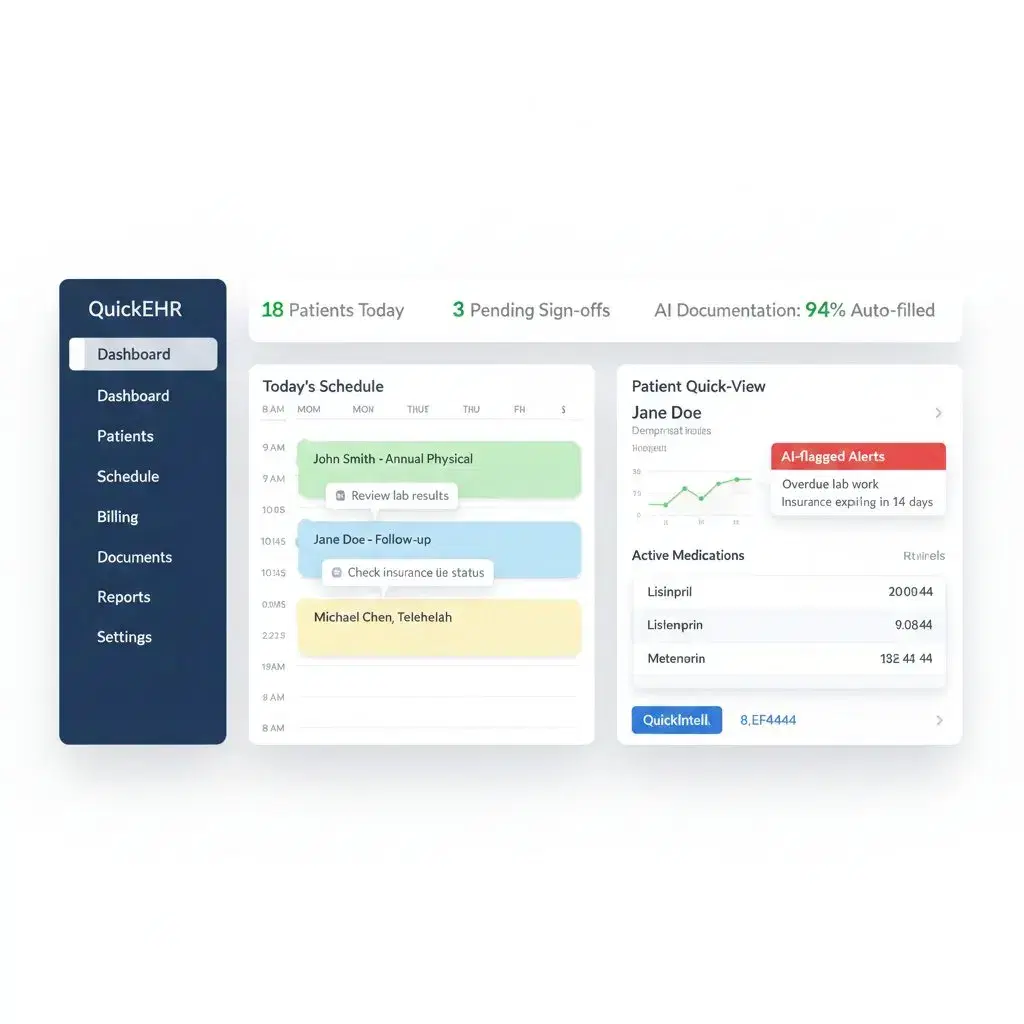
EPCS software planning for OpenEMR-powered QuickEHR workflows
QuickEHR helps clinics plan EPCS software workflows for electronic prescribing of controlled substances without separating the prescribing task from chart context, prescriber readiness, identity proofing review, two-factor workflow review, AI-assisted documentation, prior authorization, coding, RCM, and ERA follow-through.
Controlled-substance e-prescribing needs chart context and visible ownership.
The strongest EPCS workflows make it clear who reviewed the chart, who is authorized to act, what prescribing service is configured, and where exceptions move after the prescription is sent.
Before the prescription
Start with verified chart context
Controlled-substance prescribing should begin with the active patient chart, medication history, allergies, diagnoses, visit reason, coverage context, and prescriber role.
Use QuickEHR as the OpenEMR-powered chart workspace or as the connection layer around an existing EHR.
Keep medication changes, renewals, and supporting notes tied to the encounter being reviewed.
Surface the context reviewers need before a controlled-substance order moves forward.
Access and approval
Confirm prescriber and EPCS readiness
EPCS requirements often involve prescriber enrollment, identity proofing, two-factor signing, role setup, and audit expectations. QuickEHR treats those as implementation controls to verify, not assumptions.
Map authorized users, locations, workflows, and configured prescribing services before go-live.
Document identity proofing, two-factor workflow, role assignment, and audit review responsibilities.
Confirm DEA, state, payer, and clinic-policy expectations with the current implementation packet.
After signing
Route exceptions into operational queues
EPCS software work does not end with the send action. Pharmacy responses, cancellations, renewals, prior authorization needs, documentation follow-up, and billing context all need visible ownership.
Route renewals, missing information, and exceptions to clinical or administrative worklists.
Connect medication context to QuickAuth, QuickCode, QuickRCM, and QuickERA where configured.
Keep final clinical decisions with authorized clinicians while AI helps organize supporting work.
EPCS requirements
Use the page to prepare the implementation review, not skip it.
Searchers looking for EPCS requirements are often asking what must be true before controlled-substance e-prescribing is ready. QuickIntell keeps the review practical: the configured service, tenant setup, prescriber workflow, audit expectations, and downstream responsibilities all need to be documented for the deployment.
Scope note
This page is workflow and implementation guidance. It is not legal advice and does not make a blanket EPCS certification, compliance, HIPAA, SOC 2, ONC, or production-readiness claim for any tenant.
Identity proofing and user setup
Confirm who can prescribe, how prescribers are enrolled, which locations are enabled, and what evidence is required for the tenant.
Two-factor signing workflow
Review the configured authentication method, signing flow, backup process, and support path before using controlled-substance workflows.
Audit and policy review
Map audit expectations, role-based access, support ownership, and exception review with clinical, IT, compliance, and operations leaders.
Downstream handoffs
Plan how prescribing context moves into prior authorization, coding, claims, denial work, remittance review, and patient follow-up.
AI EHR EPCS
AI should organize the controlled-substance workflow, not make the prescribing decision.
QuickIntell automation can collect context, draft reviewable notes, assemble packets, and route worklists around the chart while the prescribing decision stays with authorized clinicians.
OpenEMR EPCS planning with QuickIntell workflow automation.
QuickEHR is built on the OpenEMR foundation and can be deployed as a managed EHR experience or as a workflow layer around another source of truth. That distinction matters for EPCS: the EHR foundation, configured prescribing service, integration path, and AI automation boundaries should be reviewed together.
QuickEHR is built on the OpenEMR foundation and adds managed configuration, support, integrations, and QuickIntell workflow design around the chart.
Existing OpenEMR tenants
Clinics already running OpenEMR can evaluate approved API, FHIR, HL7, or interface-engine paths for prescribing and operational handoffs.
Other EHR environments
QuickEHR Connect can help route chart, order, coverage, claim, and remittance context around an existing EHR without replacing it on day one.
Related QuickIntell products
EPCS software evaluation should not be isolated from documentation, authorization, coding, claims, denials, and remittance work. QuickIntell connects those teams around the same reviewed chart context.
EPCS touches prescribing authority, patient data, pharmacy routing, audit review, payer rules, and downstream operations. QuickIntell helps configure the workflow, but the clinic should define responsibilities and review implementation evidence before production use.
Decide whether EPCS is in scope for the initial QuickEHR deployment or a later phase.
Identify the configured e-prescribing service, evidence packet, user setup, and support ownership.
Map prescriber enrollment, identity proofing, two-factor signing, role setup, and audit review.
Confirm pharmacy routing, renewal, cancellation, denial, and exception workflows before go-live.
Review DEA, state, payer, and clinic-policy requirements with qualified internal stakeholders.
Document where QuickScribe, QuickAuth, QuickCode, QuickRCM, and QuickERA may use chart context.
Keep AI recommendations assistive and reviewable; authorized clinicians own prescribing decisions.
Review trust, access, data handling, and implementation documentation for the tenant being launched.
EPCS FAQs
Questions buyers ask before choosing EPCS software.
Use these answers to frame the QuickEHR EPCS conversation, then verify the exact implementation packet before go-live.
What is QuickEHR EPCS software?
QuickEHR EPCS software content describes how an OpenEMR-powered QuickEHR workflow can support controlled-substance prescribing implementation planning. It covers chart context, prescriber readiness, identity proofing review, two-factor workflow review, exception routing, and QuickIntell automation around the prescribing task.
What does EPCS mean?
EPCS means electronic prescribing of controlled substances. In practice, teams use the term for workflows that electronically transmit controlled-substance prescriptions through configured systems while meeting applicable identity, authentication, audit, DEA, state, payer, and clinic requirements.
Does this page claim QuickEHR is EPCS certified?
No. This page does not make a blanket EPCS certification, compliance, or production-readiness claim. EPCS scope must be verified for the specific tenant, configured prescribing service, OpenEMR version, implementation packet, prescriber setup, and local requirements.
How does QuickEHR use OpenEMR for EPCS workflows?
QuickEHR is built on the OpenEMR foundation. For EPCS planning, QuickEHR can keep chart context, medications, allergies, diagnoses, documentation, and operational handoffs close together while the implementation team verifies the configured prescribing path and evidence requirements.
How can AI help with controlled-substance e-prescribing?
QuickIntell AI can help organize the work around controlled-substance prescribing by surfacing chart context, drafting notes for review, preparing prior authorization packets, supporting coding review, and routing downstream tasks. It does not replace authorized clinician judgment or prescribe autonomously.
What EPCS requirements should a practice review?
Common review areas include prescriber enrollment, identity proofing, two-factor signing, role-based access, audit expectations, pharmacy routing, renewal and cancellation workflows, DEA and state requirements, payer rules, clinic policies, and implementation-specific support ownership.
Is EPCS the same as general e-prescribing?
No. General e-prescribing covers electronic medication prescribing broadly. EPCS is the controlled-substance subset and usually needs additional identity, authentication, audit, and policy controls. Practices should review both the broader QuickEHR e-prescribing workflow and the EPCS-specific scope.
Can EPCS workflows connect to prior authorization, coding, RCM, and ERA work?
Yes, when configured. Medication, diagnosis, order, note, and coverage context can feed QuickAuth prior authorization packets, QuickCode coding review, QuickRCM claims and denial work, and QuickERA remittance follow-up so teams avoid rebuilding the same clinical context repeatedly.
Can QuickEHR support EPCS around an existing EHR?
QuickEHR Connect can route approved chart, order, coverage, claim, and remittance context around an existing EHR. Whether EPCS itself is in scope depends on the configured prescribing service, integrations, user setup, evidence packet, and implementation responsibilities for that environment.
Plan EPCS with the chart, the clinician, and the downstream teams in the same workflow.
QuickIntell can walk through QuickEHR, OpenEMR integration, prescribing scope, AI automation, authorization, coding, RCM, and ERA handoffs for the environment you are evaluating.