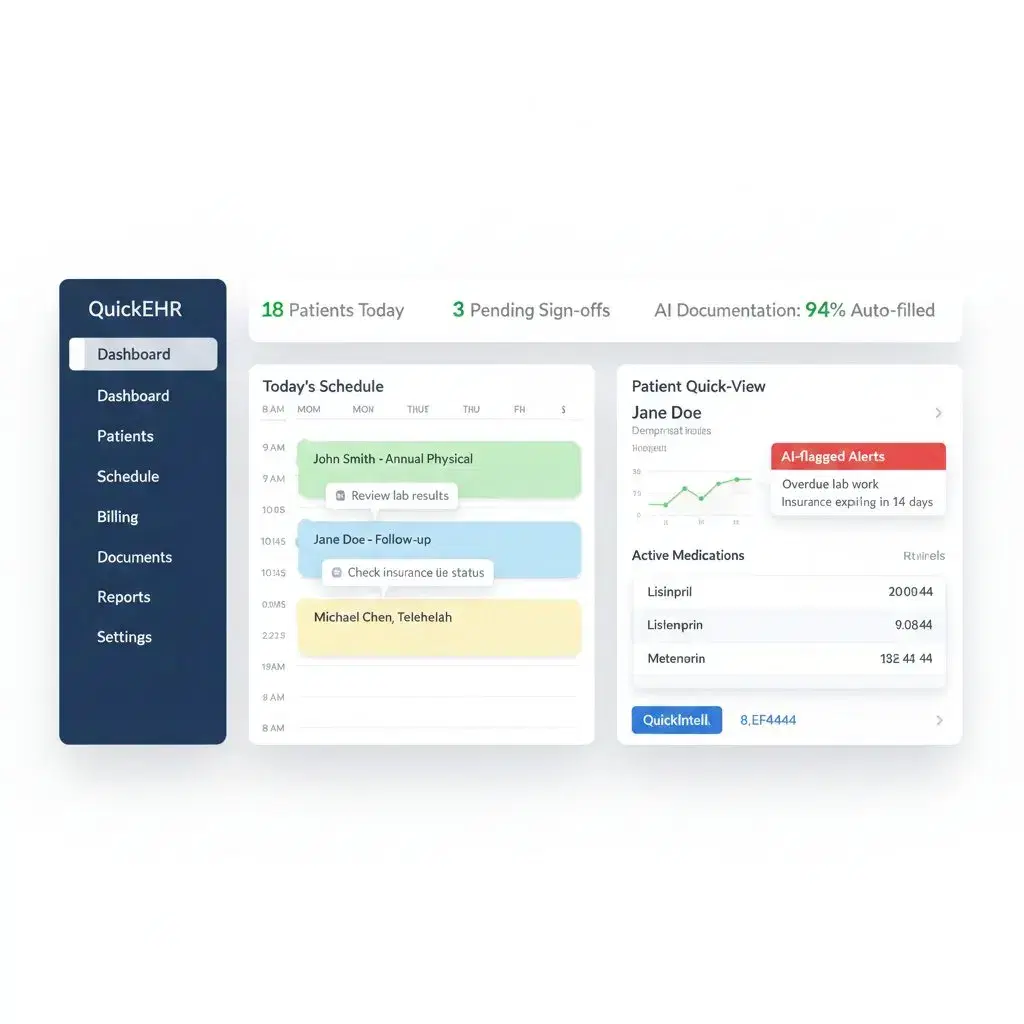
QuickEHR medical coding software connects OpenEMR-powered EHR documentation, QuickScribe notes, QuickCode suggestions, authorization evidence, code review, claim scrubbing, QuickRCM, and QuickERA so coders and billers review the same encounter context before claims go out.
Bring coding review into the encounter-to-claim path.
Practices evaluating medical coding software usually need code lookup, AI assistance, validation, EHR integration, billing handoff, and denial prevention in one workflow. QuickEHR frames those jobs around the chart and the claim workflow instead of a disconnected coding task.
Chart context
Start with the attested encounter
QuickEHR medical coding starts from the clinical visit, not a disconnected coding screen. The OpenEMR-powered chart, schedule, provider, location, orders, diagnoses, procedures, and documentation context stay close to the coding queue.
Use QuickScribe documentation handoff where enabled so coders review cleaner clinical context after clinician attestation.
Keep patient, encounter, payer, authorization, referral, order, and attachment signals visible before coding work moves forward.
Route missing documentation or medical-necessity support back to the team that can resolve it.
Coder review
Prepare reviewable coding suggestions
AI medical coding software is most useful when it prepares evidence, suggestions, and exceptions for review. QuickEHR connects QuickCode output to the source documentation and claim-readiness workflow.
Review ICD-10, CPT, HCPCS, modifier, units, diagnosis pointer, and encounter-type context before claim release.
Separate code suggestions, confidence cues, documentation evidence, and unresolved questions so reviewers know what changed.
Keep final coding decisions in the review workflow defined during implementation.
Claim readiness
Move clean coding into billing
Medical billing coding software should shorten the handoff from documentation to claim review. QuickEHR keeps code review, charge review, claim scrubbing, electronic claims, and payer response loops connected.
Feed reviewed codes into QuickEHR billing, claims scrubbing, electronic claims, and QuickRCM follow-up queues.
Use QuickAuth context so approved service windows and payer evidence are visible while coding and billing teams review the encounter.
Make coding holds, billing holds, released claims, corrected claims, and denial feedback visible to the right owner.
Feedback loop
Learn from denials and remittance
Coding workflow should improve as claims come back. QuickEHR ties denial reasons, payer notes, ERA and EOB exceptions, and payment posting questions back to the encounter and code review context.
Route CARC, RARC, payer notes, underpayment concerns, and missing evidence back into QuickRCM queues.
Use QuickERA remittance context to identify coding, modifier, documentation, or charge questions that need review.
Turn recurring payer patterns into implementation-level workflow changes rather than isolated rework.
Coding checks
Cover code lookup, review, and claim readiness details.
QuickEHR medical coding links documentation, diagnoses, procedure codes, modifiers, units, payer context, authorization evidence, claim scrubber findings, and denial feedback. The goal is a reviewable coding workflow before claim submission.
Link coding review to the clinical note, orders, reports, signatures, visit type, and medical-necessity context available for the encounter.
Diagnosis and procedure alignment
Review diagnosis support, procedure context, diagnosis pointers, problem-list carryover, encounter reason, and any mismatch that should be checked before billing.
CPT, HCPCS, modifiers, and units
Keep procedure codes, supply codes, modifiers, units, place of service, provider, location, and charge context in one reviewable workflow.
Specialty coding cues
Scope specialty templates, common visit types, procedure families, and documentation patterns for primary care, urgent care, behavioral health, cardiology, orthopedics, and other groups.
Authorization and referral context
Bring QuickAuth approvals, referral rules, order requirements, payer packet evidence, and approved service windows into coding and charge review.
Claim scrubber handoff
Route reviewed coding into QuickEHR claims scrubbing so demographic, coverage, provider, code, modifier, attachment, and payer checks are not separated.
Review status and ownership
Track who reviewed the encounter, what was held, what evidence was missing, what changed, and what is ready for billing or clinical follow-up.
Denial feedback
Tie denial reasons, payer notes, ERA/EOB exceptions, and corrected-claim outcomes back to coding patterns and documentation workflows.
AI medical coding automation
Use AI to prepare coding work without hiding the review boundary.
For practices comparing AI medical coding, AI medical coding software, medical coding automation, or AI EHR medical coding, QuickEHR keeps AI suggestions tied to encounter evidence, coding questions, billing holds, and staff review.
Evidence-aware suggestions
AI can prepare ICD-10, CPT, HCPCS, modifier, and documentation cues for review while showing which chart evidence should be checked.
Exception classification
Group coding work by missing documentation, diagnosis-procedure mismatch, modifier question, authorization gap, claim-edit issue, or denial pattern.
Claim readiness summaries
Summarize the visit, documentation, payer, authorization, coding, and charge context before a claim is released or a corrected claim is prepared.
Coder and biller handoff
Keep coding questions, billing holds, claim scrubber findings, payer responses, and remittance feedback connected so teams do not rebuild the same record twice.
OpenEMR and QuickEHR fit
OpenEMR medical coding works best when the coding queue knows the chart and billing context.
QuickEHR is built on the OpenEMR foundation. That makes QuickEHR medical coding a practical place to connect chart documentation, coding suggestions, authorization evidence, claim review, payer response, and remittance feedback.
QuickEHR is built on the OpenEMR foundation and adds QuickIntell workflow design around charting, documentation, coding, authorization, billing, claims, denials, and remittance.
Existing OpenEMR tenants
Practices already running OpenEMR can evaluate approved OpenEMR API, FHIR, HL7, clearinghouse, EDI, file, or interface-engine paths for coding and billing context.
QuickEHR Connect for mixed systems
Clinics keeping another EHR or practice management system can evaluate QuickEHR as the workflow layer around the coding, claim, denial, and remittance data available through approved interfaces.
Related QuickIntell products
Medical coding sits between documentation, authorization, claims, and payment.
These links help practices evaluate the connected QuickIntell workflow around code review, clinical documentation coding, claims, denial prevention, ERA feedback, and patient balance operations.
Medical coding software buyers often need the surrounding documentation, billing, claim, eligibility, and OpenEMR workflow before deciding how coding should run.
Coding rules, documentation patterns, authorization needs, payer edits, and denial reasons vary by specialty. QuickEHR should be scoped around the visits, procedures, and review queues your teams actually use.
Define code review, AI boundaries, and billing ownership before go-live.
Medical coding touches clinical documentation, payer rules, claim submission, denial risk, remittance feedback, and audit expectations. QuickEHR implementation should make data sources, interfaces, human review points, and support ownership explicit.
Security and procurement teams can review current materials through the Trust Center. Any implementation-specific evidence should be verified in the current contract and deployment packet.
Medical coding implementation checklist
Scope these items before production use.
Choose the operating model: QuickEHR-managed OpenEMR, an existing OpenEMR tenant, QuickEHR Connect, QuickCode with another system, or a hybrid workflow.
Map source data for patients, encounters, notes, orders, problems, diagnoses, procedures, charges, providers, locations, coverage, authorization evidence, and remittance feedback.
Define which ICD-10, CPT, HCPCS, modifier, units, place-of-service, specialty template, payer, and charge rules are in scope for review.
Set review gates for clinician attestation, coder review, billing review, claim scrubbing, corrected claims, denials, appeals, and payment posting feedback.
Decide which AI suggestions may draft, summarize, classify, prioritize, or route work before staff, coder, clinician, or billing manager review.
Confirm enabled OpenEMR API, FHIR, HL7, EDI, clearinghouse, payer, remittance, file, or interface-engine paths for the specific deployment.
Review data handling, access controls, audit expectations, support ownership, Trust Center materials, and implementation-specific evidence before production use.
FAQs
QuickEHR medical coding questions.
Answers for practices comparing medical coding software, AI medical coding software, OpenEMR medical coding, QuickEHR medical coding, and medical billing and coding software workflows.
What is QuickEHR medical coding software?
QuickEHR medical coding software is the coding workflow inside QuickEHR. It connects OpenEMR-powered chart context, clinical documentation, QuickCode suggestions, authorization evidence, claim readiness, claim scrubbing, denial feedback, QuickRCM, and QuickERA into reviewable work queues.
What software is used for medical coding?
Medical coding teams usually use a mix of EHR context, code lookup or encoder tools, coding edits, claim scrubbers, billing systems, and sometimes AI-assisted coding software. QuickEHR brings those medical coding tools into an OpenEMR-powered workflow so documentation, code suggestions, charge review, claim readiness, denials, and remittance feedback stay connected.
How is QuickEHR medical coding related to QuickCode?
QuickCode is QuickIntell's AI medical coding product. QuickEHR medical coding is the EHR workflow that brings QuickCode suggestions, documentation evidence, coding questions, charge review, and billing handoff into the OpenEMR-powered encounter context.
Does AI medical coding replace coders?
No. This page describes AI-assisted coding preparation and routing. QuickIntell AI can help draft suggestions, classify exceptions, summarize evidence, and prepare work, but the implementation plan should define clinician, coder, billing, and compliance review points before production use.
How does OpenEMR medical coding work with QuickEHR?
QuickEHR is built on the OpenEMR foundation. Practices can use QuickEHR-managed OpenEMR workflows or evaluate an existing OpenEMR tenant when approved API, FHIR, HL7, file, clearinghouse, remittance, or interface-engine paths are available for the deployment.
Which code types can the workflow prepare for review?
A QuickEHR medical coding implementation can be scoped around reviewable ICD-10, CPT, HCPCS, modifier, unit, diagnosis pointer, place-of-service, specialty template, and charge context. The exact scope depends on configured data sources, payer requirements, specialty workflow, and review rules.
How does medical coding software support billing and RCM?
Medical coding software supports billing when reviewed codes move directly into charge review, claim scrubbing, electronic claims, denial management, accounts receivable follow-up, payment posting, and remittance feedback. QuickEHR keeps that coding review before claim submission tied to the original encounter.
Can QuickEHR support specialty medical coding workflows?
Yes. QuickEHR can be scoped around specialty documentation and billing patterns for groups such as primary care, family medicine, internal medicine, urgent care, behavioral health, cardiology, orthopedics, pediatrics, dermatology, and neurology when the required templates, interfaces, and review rules are configured.
Can practices use QuickEHR medical coding with another EHR?
Practices keeping another EHR or practice management system can evaluate QuickEHR Connect or QuickCode integration paths. Those options depend on approved interfaces, available data, security review, workflow ownership, and implementation scope.
What should a clinic review before launching coding automation?
Review documentation sources, attestation timing, code families, charge rules, payer edits, authorization evidence, claim scrubber paths, denial feedback, ERA/EOB handling, user roles, access controls, audit expectations, support ownership, and which AI outputs require human review.
Does this page make certification or compliance claims?
No. This page describes QuickEHR medical coding workflow planning. QuickEHR is built on the OpenEMR foundation, and any regulatory, security, certification, payer, or procurement evidence should be verified in current Trust Center materials, the implementation packet, and the contract for the specific deployment.
Need coding inside your EHR workflow?
QuickIntell can walk through QuickEHR, OpenEMR integration, QuickScribe, QuickCode, QuickAuth, QuickRCM, QuickERA, claim scrubbing, billing, denials, payment posting, patient balances, and trust documentation for the clinic environment you are evaluating.