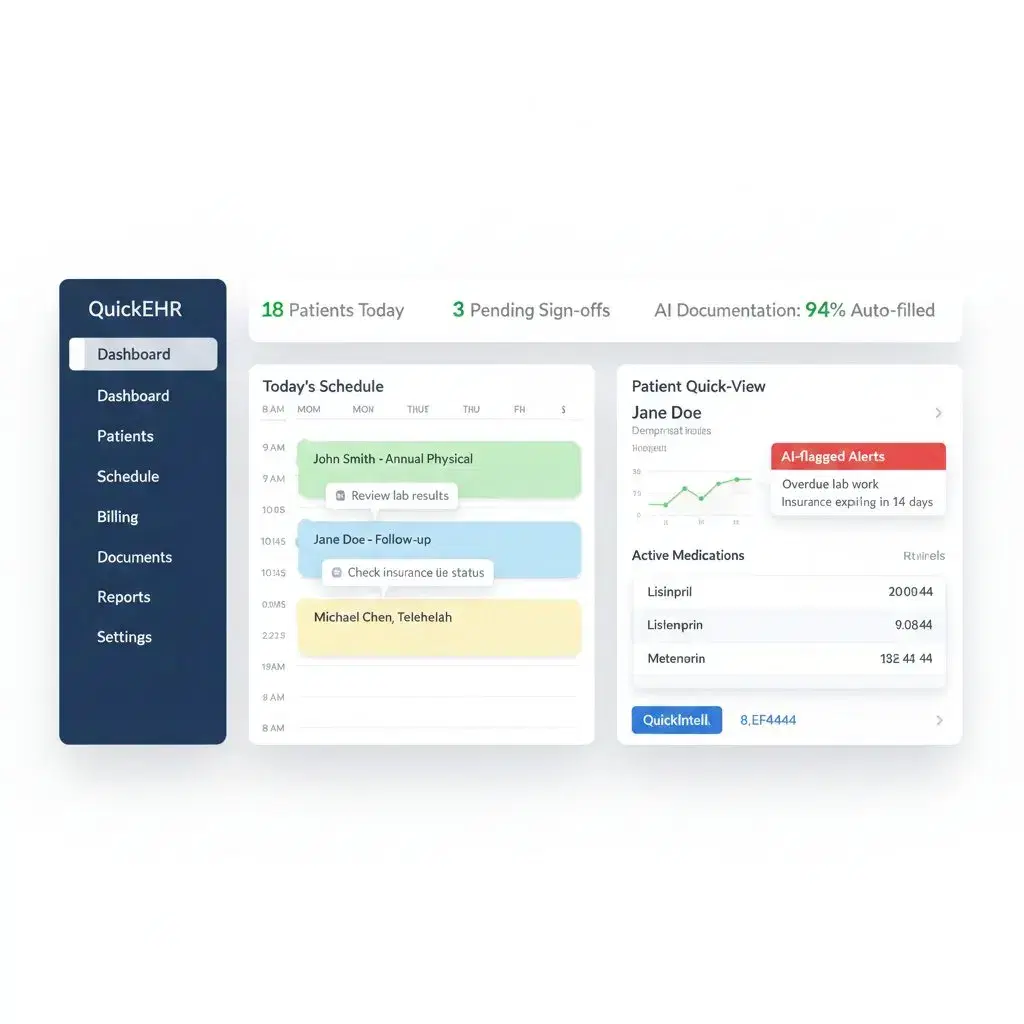
Cloud based EHR software for OpenEMR-powered QuickEHR workflows
QuickEHR is cloud based EHR software for clinics that want OpenEMR-powered charting connected to QuickIntell AI automation. Bring scheduling, patient charts, documentation, coding, prior authorization, claims, RCM, and ERA follow-up into one reviewable cloud workflow.
Charting, AI worklists, coding, authorization, RCM, and ERA
Chart
OpenEMR foundation
Automate
AI review queues
Follow up
Claims and ERA
Cloud EHR fit
Cloud based EHR systems should connect access, charting, and revenue work.
The search intent is not just hosting. Practices evaluating cloud EHR software want to know how the daily workflow changes, how chart context moves, what AI can assist, and how the system supports group-practice operations.
Web based EHR
Browser-based clinical access
A cloud EHR should keep schedules, patient charts, documents, tasks, and revenue work available through controlled web workflows instead of local workstation-only access.
Support front desk, clinical, coding, authorization, and billing teams across locations.
Keep chart context close to the visit rather than scattered across files and exports.
Plan role access, session expectations, and device workflows during implementation.
OpenEMR cloud EHR
OpenEMR-powered chart foundation
QuickEHR uses the OpenEMR foundation for core EHR workflows, then adds QuickIntell automation around documentation, coding, authorization, RCM, and remittance follow-through.
Useful for clinics that want an OpenEMR-centered path without managing every workflow manually.
Supports implementation planning around charting, scheduling, billing context, and exports.
Keeps QuickIntell AI workflows scoped to the approved deployment and review model.
Cloud EHR software
Connected clinical and revenue work
Cloud EHR software is more useful when the chart can support downstream work. QuickEHR connects visit context to QuickScribe, QuickCode, QuickAuth, QuickRCM, and QuickERA workflows.
Carry encounter context from the chart into note drafting, coding review, and authorization packets.
Keep claim and remittance questions tied back to the source visit story.
Route exceptions to staff queues instead of relying on manual spreadsheet cleanup.
Cloud based EHR systems
Group-practice operating model
Cloud based EHR systems need more than hosting. They need repeatable templates, consistent worklists, access review, migration planning, and support ownership across providers and sites.
Align locations, departments, providers, visit types, templates, payer context, and work queues.
Use local navigation and related workflows for scheduling, charts, documentation, and claims.
Define support paths before the EHR becomes the daily operating system.
Cloud EHR workflows
Run the visit from schedule to payment follow-up without rebuilding the story.
QuickEHR cloud workflows are designed around the work teams actually run: access, intake, charting, AI-assisted documentation, coding, authorization, claim review, and remittance exception handling.
Access
Start each day from a shared cloud workspace.
QuickEHR helps teams work from schedule, task, and patient context instead of disconnected tools. The daily view should make visit status, required work, and ownership easy to scan.
Role-specific access keeps each team focused on the work it owns.
Remote, multi-site, and coverage workflows can be planned without local-server assumptions.
Visit
Keep scheduling, intake, charting, and notes in one path.
A cloud based EMR software workflow should move naturally from booking to intake, chart review, documentation, orders, follow-up, and billing context.
Connect appointment data to patient charts, intake status, prior records, and visit prep.
Use OpenEMR-powered chart context for documentation and reviewable AI assistance.
Avoid re-keying the same visit information into coding, authorization, or claims tools.
Automation
Prepare documentation, coding, and authorization work for review.
AI EHR software should help users move faster while preserving review responsibility. QuickIntell can draft, classify, suggest, and route work without turning suggestions into unsupported final decisions.
QuickScribe can prepare draft documentation from reviewed encounter context.
QuickCode can surface ICD-10, CPT, HCPCS, and documentation-gap signals for coding review.
QuickAuth can prepare payer evidence packets when orders, diagnoses, and notes support the request.
Revenue
Carry the same encounter story into claims and remittance work.
Cloud EHR workflows should not stop at the signed note. QuickEHR context can support claim review, payer edits, denial follow-up, payment posting, and ERA/EOB exception work.
Route claim context toward QuickRCM and remittance context toward QuickERA where configured.
Keep documentation, coding, authorization, claim, and payment context linked to the visit.
Use exception queues for rejected claims, missing attachments, denials, and payment mismatches.
AI cloud EHR automation
AI should prepare cloud EHR work for review, not hide decisions.
QuickIntell connects cloud chart context to AI-assisted drafting, coding, authorization, claim follow-up, and remittance review. Source context, exception queues, and human ownership remain part of the workflow design.
OpenEMR foundation, QuickIntell automation, and implementation-scoped cloud workflows.
QuickEHR cloud EHR planning should make the foundation explicit: which OpenEMR workflows are used, which QuickIntell automations are enabled, which integrations are in scope, and how review responsibility works.
Managed QuickEHR cloud deployment
For clinics adopting QuickEHR as the primary EHR, implementation can align OpenEMR-powered chart workflows with QuickIntell worklists, AI review paths, and revenue handoffs.
Existing OpenEMR tenant review
For teams already using OpenEMR, QuickIntell can evaluate current hosting, APIs, exports, workflows, templates, user roles, and support ownership before proposing changes.
Interoperability and API planning
Cloud does not remove integration work. FHIR, HL7, OpenEMR APIs, files, and extracts should be mapped to the specific clinical and revenue workflow being improved.
Portability and data handoff
Cloud EHR implementation should document data ownership, export paths, archive needs, migration scope, and support responsibilities before production use.
A cloud EHR decision touches security, interoperability, APIs, data export, scheduling, charts, documentation, and claims. These related pages help teams move from cloud architecture to the workflow details they need next.
Primary care teams may prioritize intake, care gaps, chronic conditions, and preventive workflows. Urgent care may need quick documentation and clean claim handoff. Specialty groups often need templates, orders, referrals, procedures, authorization evidence, and denials support.
Keep cloud EHR evaluation connected to trust review.
Before go-live, review deployment scope, data handling, access controls, support ownership, exports, and procurement evidence through the QuickIntell Trust Center and project-specific implementation packet.
Implementation and trust
Define the cloud EHR boundary before production use.
Moving to cloud based EHR systems changes access, support, migration, exports, integrations, AI review, and daily operations. QuickEHR implementation should document each boundary before teams rely on the workflow.
This page avoids unsupported certification, security, customer, payer, or compliance claims for a specific deployment. Procurement and compliance teams should review current documentation through the Trust Center and implementation agreement.
Define role access, MFA expectations, device workflows, support ownership, migration responsibilities, and go-live decision makers.
Inventory APIs, FHIR, HL7, CCD/C-CDA, exports, clearinghouse paths, payer data, and document handoffs before automation starts.
Decide where AI may summarize, draft, classify, suggest, route, or prepare work and which human role reviews each output.
Test duplicate patients, missing mappings, failed exports, rejected claims, document parsing errors, and unsupported write-back paths before production use.
Review current trust, privacy, procurement, and data-handling evidence through the Trust Center and implementation packet.
FAQs
Cloud EHR questions for QuickEHR
Answers for teams evaluating cloud based EHR software, cloud EHR software, cloud EMR software, OpenEMR cloud EHR workflows, AI EHR software, and cloud based EHR security.
What is a cloud based EHR?
A cloud based EHR is an electronic health record workflow accessed through web-hosted software rather than a locally installed server-only setup. For QuickEHR, the cloud EHR model combines OpenEMR-powered chart workflows with QuickIntell automation for documentation, coding, prior authorization, claims, RCM, and remittance work.
How is QuickEHR different from generic cloud EHR software?
QuickEHR is positioned around the OpenEMR foundation and QuickIntell workflow automation. The goal is not only web-based chart access. It is connecting the chart to QuickScribe, QuickCode, QuickAuth, QuickRCM, QuickERA, data export, interoperability, and implementation-scoped AI review queues.
Does QuickEHR work as cloud EMR software for small or group practices?
QuickEHR is intended for ambulatory clinic workflows where scheduling, patient charts, documentation, coding, authorization, billing, and payment work need to stay connected. Group-practice setup should be scoped around providers, locations, roles, templates, payer workflows, reporting, and support ownership.
Is QuickEHR built on OpenEMR?
QuickEHR is built on the OpenEMR foundation. Available workflows, APIs, exports, templates, permissions, integrations, and deployment details should be confirmed during implementation for the specific clinic environment.
Can QuickEHR support AI EHR software workflows?
Yes, when configured for the deployment. QuickIntell AI can prepare draft notes, coding signals, authorization packets, claim exceptions, payment questions, summaries, classifications, and work routing for human review. AI outputs should remain traceable to source context and review ownership.
What implementation questions matter for cloud based EHR security?
Cloud based EHR security planning should cover user roles, MFA expectations, privileged access, session rules, device workflows, audit events, exports, integration paths, support access, and data-handling review. The page intentionally avoids making unsupported compliance or certification claims for a specific deployment.
Can QuickEHR connect to FHIR, HL7, or other interoperability paths?
Interoperability options depend on the approved endpoint, OpenEMR environment, interface inventory, connected systems, and implementation scope. QuickEHR planning can include FHIR, HL7, CCD/C-CDA, OpenEMR APIs, files, extracts, and QuickIntell adapters when those paths fit the workflow.
Can QuickEHR replace an older on-premise EHR?
It can be evaluated as a replacement path when a clinic wants a cloud EHR operating model. Migration scope should confirm demographics, charts, documents, appointments, templates, claims, reports, exports, archive requirements, user training, and parallel-run needs before switching production workflows.
Can an existing OpenEMR practice use QuickIntell automation without replacing everything?
An existing OpenEMR tenant can be reviewed for QuickIntell automation opportunities. The available path depends on hosting model, version, enabled modules, API access, exports, customizations, permissions, and the support model around the tenant.
Which QuickIntell products connect to the QuickEHR cloud workflow?
QuickEHR can connect chart and encounter context to QuickScribe for documentation, QuickCode for coding review, QuickAuth for prior authorization, QuickRCM for claims and denial workflows, and QuickERA for ERA/EOB remittance exception work when configured.
Build a cloud EHR plan around the workflows your clinic actually runs.
Bring your current EHR inventory, OpenEMR questions, migration scope, clinical templates, revenue workflows, and AI automation priorities. QuickIntell will map the QuickEHR cloud plan before production use.