Call
OpenEMR-powered fax workflow

Electronic faxing software for QuickEHR workflows

QuickEHR electronic faxing software connects OpenEMR-powered chart context, secure electronic faxing workflows, AI document classification, referral and records routing, prior authorization evidence, billing documents, QuickRCM queues, and QuickERA remittance follow-through.

Primary intent: electronic faxing software
Workflow fit: receive, send, route, attach
AI role: assistive document routing

QuickEHR electronic fax workspace

Records, referrals, auth evidence, RCM documents

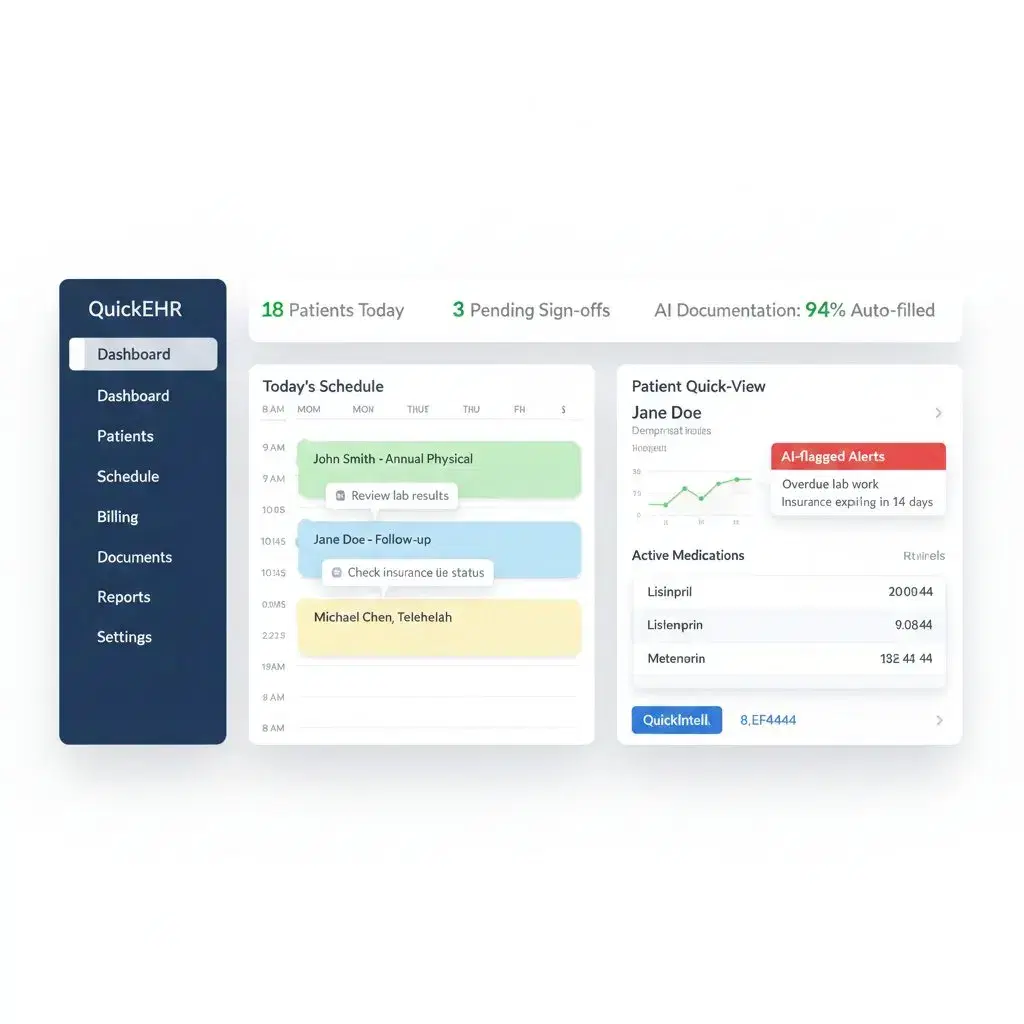
QuickEHR dashboard showing chart, document routing, authorization, claims, and revenue workflow context

Inbound review

Match, classify, route

Outbound packets

Referrals, records, auth

Follow-through

Chart, RCM, remittance

Electronic faxing workflow

Faxed documents should become accountable QuickEHR work.

The electronic faxing software SERP is full of generic online fax tools. QuickEHR is positioned for medical practices that need faxed records, referrals, payer letters, and billing evidence to stay connected to the chart and downstream work.

Inbound fax

Receive faxed records into a review queue

QuickEHR electronic faxing starts with documents that still arrive by fax: referrals, outside records, lab reports, radiology reports, orders, payer letters, and billing evidence.

  • Classify incoming fax documents before they become loose PDFs in a shared inbox.
  • Match likely patient, encounter, provider, payer, and location context for staff review.
  • Route documents to chart review, referral intake, prior authorization, billing, or records teams with ownership visible.

Outbound fax

Build outbound packets from chart context

Medical fax software for a practice should send the right material without forcing staff to rebuild the packet from scattered chart notes, orders, forms, and payer requirements.

  • Prepare referral packets, records requests, order follow-up, authorization evidence, and billing documentation from approved source data.
  • Keep recipient, cover sheet, attachment, provider, and patient context visible before release.
  • Track sent, failed, queued, retried, and completed fax work against the responsible team.

Follow-through

Close the loop inside clinical and revenue workflows

EHR faxing software should not stop at transmission. QuickEHR keeps faxed documents connected to chart tasks, QuickAuth packets, QuickRCM follow-up, and QuickERA remittance work where configured.

  • Attach reviewed faxes to the patient chart or route them to the next work queue.
  • Use document context for authorization, coding, claims, denial, AR, payment posting, and patient communication workflows.
  • Keep security, audit, and implementation review visible instead of treating fax as a separate back-office shortcut.

Fax operations

Cover the medical fax software jobs a practice still has to run.

Online fax for medical practices is rarely just a send button. QuickEHR keeps faxed records, referral documents, authorization evidence, payer requests, billing attachments, and remittance material close to patient and workflow context.

For the OpenEMR-specific architecture, see the OpenEMR integration. For broader patient-facing handoffs, review QuickEHR patient communications.

Inbound fax triage

Queue incoming fax documents by likely document type, patient, encounter, sender, department, urgency, and owner before chart attachment.

Outbound packet preparation

Assemble referrals, consult notes, orders, records requests, payer evidence, and billing packets from approved QuickEHR context.

Referral and records exchange

Support practices that still rely on fax for outside records, specialist referrals, consult reports, care coordination, and continuity documents.

Prior authorization evidence

Keep faxed clinical evidence, payer letters, order details, and authorization packet status connected to QuickAuth workflows.

Billing and RCM documents

Route payer correspondence, medical necessity requests, attachment prompts, denial letters, and billing evidence to QuickRCM queues.

Patient chart attachments

Attach reviewed documents to the appropriate OpenEMR-powered patient chart location when implementation scope supports it.

Fax status exceptions

Track failed sends, retries, duplicate documents, incomplete pages, missing recipient data, and staff follow-up tasks.

Security and trust review

Define access controls, audit expectations, data handling, retention, vendor responsibilities, and Trust Center review before production use.

AI EHR automation

AI can prepare fax work while staff keep the review points.

For practices comparing AI EHR electronic faxing or EHR faxing software, QuickEHR uses assistive automation to classify, summarize, match, and route documents without removing clinical, authorization, coding, billing, or records review.

Document classification

AI-assisted triage can separate referrals, records, lab results, radiology reports, payer letters, authorizations, and billing documents for review.

Patient and encounter matching

Suggest likely patient, provider, location, encounter, order, claim, or authorization matches before a user attaches or routes the fax.

Review summaries

Draft short summaries of faxed packets so clinical, authorization, coding, billing, and records teams can review context faster.

Owner-based routing

Route work to front desk, clinical review, referral coordination, prior authorization, coding, claims, AR, or payment posting teams.

Duplicate and retry detection

Flag duplicate faxes, repeated failures, incomplete pages, and documents that appear to be resent with corrected information.

Downstream workflow triggers

Create review tasks for QuickAuth, QuickCode, QuickRCM, or QuickERA when faxed evidence affects authorization, coding, claim, denial, or remittance work.

OpenEMR and QuickEHR fit

QuickEHR electronic faxing follows the EHR path your clinic chooses.

QuickEHR can be a managed OpenEMR-powered EHR or the connection layer around an existing system. In either model, faxed documents should be reviewed, routed, attached, and connected to the clinical or revenue work they affect.

QuickEHR-managed OpenEMR

QuickEHR is built on the OpenEMR foundation and adds QuickIntell-managed implementation, workflow configuration, and assistive AI around document routing.

Existing OpenEMR tenants

Practices already running OpenEMR can evaluate approved OpenEMR API, FHIR, HL7, document, referral, billing, and interface-engine paths for fax workflows.

QuickEHR Connect

Clinics keeping another EHR or practice management system can evaluate QuickEHR as a workflow layer around faxed documents and downstream work queues.

Related QuickIntell products

Electronic faxing sits between the chart, the payer, and the payment loop.

A fax can affect documentation, coding, prior authorization, claims, denials, AR follow-up, payment posting, and patient communication. These links keep the fax workflow connected to the rest of QuickIntell.

Implementation and trust

Treat fax as a scoped workflow, not a disconnected inbox.

Electronic faxing implementations should define document sources, routing, access, audit expectations, retention, vendor responsibilities, and review ownership before patient or payer documents start flowing.

Review the QuickIntell Trust Center for current security, contracting, and implementation materials relevant to your deployment.

Electronic faxing launch checklist

  • Choose the fax path: existing online fax service, integrated fax provider, API, email-to-fax, interface engine, or another approved route.
  • Map inbound and outbound document types: referrals, records, orders, labs, radiology, payer letters, authorization evidence, billing attachments, and remittance evidence.
  • Confirm enabled OpenEMR API, FHIR, HL7, document attachment, referral, billing, EDI, batch, or interface-engine paths for the deployment.
  • Define user roles, access controls, audit expectations, data retention, vendor responsibilities, and support ownership before launch.
  • Decide which AI suggestions may classify, summarize, match, route, or queue work before staff, clinician, coder, authorization, or billing review.
  • Separate the OpenEMR foundation, the QuickEHR managed workflow, and any fax-provider or compliance evidence required for the specific implementation.
  • Review Trust Center materials, contracting requirements, and implementation evidence before production use.

Specialty workflows that still depend on fax

Fax-heavy workflows often appear in referral coordination, outside records, prior authorization, imaging, lab follow-up, and payer correspondence. Start with the specialties and visit types where fax volume creates the most manual work.

FAQs

QuickEHR electronic faxing questions.

Short answers for teams evaluating electronic faxing software, medical fax software, EHR faxing software, OpenEMR electronic faxing, AI document routing, and implementation review.

What is QuickEHR electronic faxing software?

QuickEHR electronic faxing software is the QuickEHR workflow for receiving, sending, classifying, matching, routing, and attaching faxed healthcare documents. It connects OpenEMR-powered chart context, referrals, records, payer letters, authorization evidence, billing documents, QuickAuth, QuickRCM, and QuickERA workflows where configured.

How is electronic faxing software different from generic fax software?

Generic fax software focuses on sending and receiving documents. QuickEHR focuses on healthcare workflow context: patient matching, chart attachment, referral routing, prior authorization evidence, payer correspondence, billing documents, task ownership, and reviewable AI assistance around the EHR.

Does QuickEHR support OpenEMR electronic faxing?

QuickEHR is built on the OpenEMR foundation. Practices can evaluate OpenEMR electronic faxing workflows through QuickEHR-managed OpenEMR or an existing OpenEMR tenant when approved API, FHIR, HL7, document, referral, billing, fax-provider, or interface paths are available.

Can AI help with EHR faxing software workflows?

Yes. AI can help classify faxed documents, suggest patient or encounter matches, draft summaries, flag duplicate or failed faxes, and route work to the right queue. QuickEHR treats those suggestions as assistive automation with review points defined during implementation.

How should practices choose the best electronic faxing software?

The best electronic faxing software for a medical practice depends on the current EHR, fax provider, referral volume, payer correspondence, chart attachment workflow, security review, support model, and whether faxed documents can become accountable work instead of isolated PDFs.

Does QuickEHR claim to be HIPAA compliant electronic fax out of the box?

No blanket compliance claim is made on this page. Electronic faxing that involves protected health information should be reviewed against the specific fax provider, data flow, access controls, audit expectations, contract terms, Business Associate Agreement needs, and QuickIntell Trust Center materials for the deployment.

Does QuickEHR replace an existing online fax service?

Not by default. QuickEHR is the EHR workflow layer around faxed documents. A deployment may use an existing online fax service, a configured fax provider, an API route, email-to-fax, an interface engine, or another approved path depending on the practice's stack and implementation scope.

What documents can medical fax software route in QuickEHR?

Typical document categories include referrals, outside records, consult notes, orders, lab reports, radiology reports, payer letters, prior authorization evidence, medical necessity requests, claim attachments, denial correspondence, EOBs, and payment posting evidence.

Which QuickIntell products connect to electronic faxing?

QuickScribe can improve documentation packets, QuickCode can use reviewed documentation and attachments for coding context, QuickAuth can route payer and authorization faxes, QuickRCM can manage claim and denial-related correspondence, and QuickERA can connect remittance documents to payment posting work.

Can practices use QuickEHR electronic faxing with another EHR?

Practices keeping another EHR or practice management system can evaluate QuickEHR Connect. That path is intended to route faxed documents, documentation, coding, authorization, claim, denial, and remittance context around the current system when approved interfaces are available.

What should a practice review before launching electronic faxing?

Review fax provider responsibilities, document types, patient matching rules, chart attachment paths, outbound packet approvals, failed-send workflows, user roles, access controls, audit expectations, data retention, support ownership, and which AI suggestions require staff review.

Does this page make certification claims?

No. This page describes QuickEHR electronic faxing workflow planning. QuickEHR is built on the OpenEMR foundation, and any certification, regulatory, payer, security, or procurement evidence should be verified in the current implementation packet and contract for the specific deployment.

Put faxed documents into the QuickEHR workflow.

Scope how QuickEHR can route records, referrals, payer letters, authorization evidence, billing documents, and remittance material through reviewed QuickIntell work queues.