Call
OpenEMR-powered operating view

EHR dashboard for QuickEHR clinical and revenue workflows

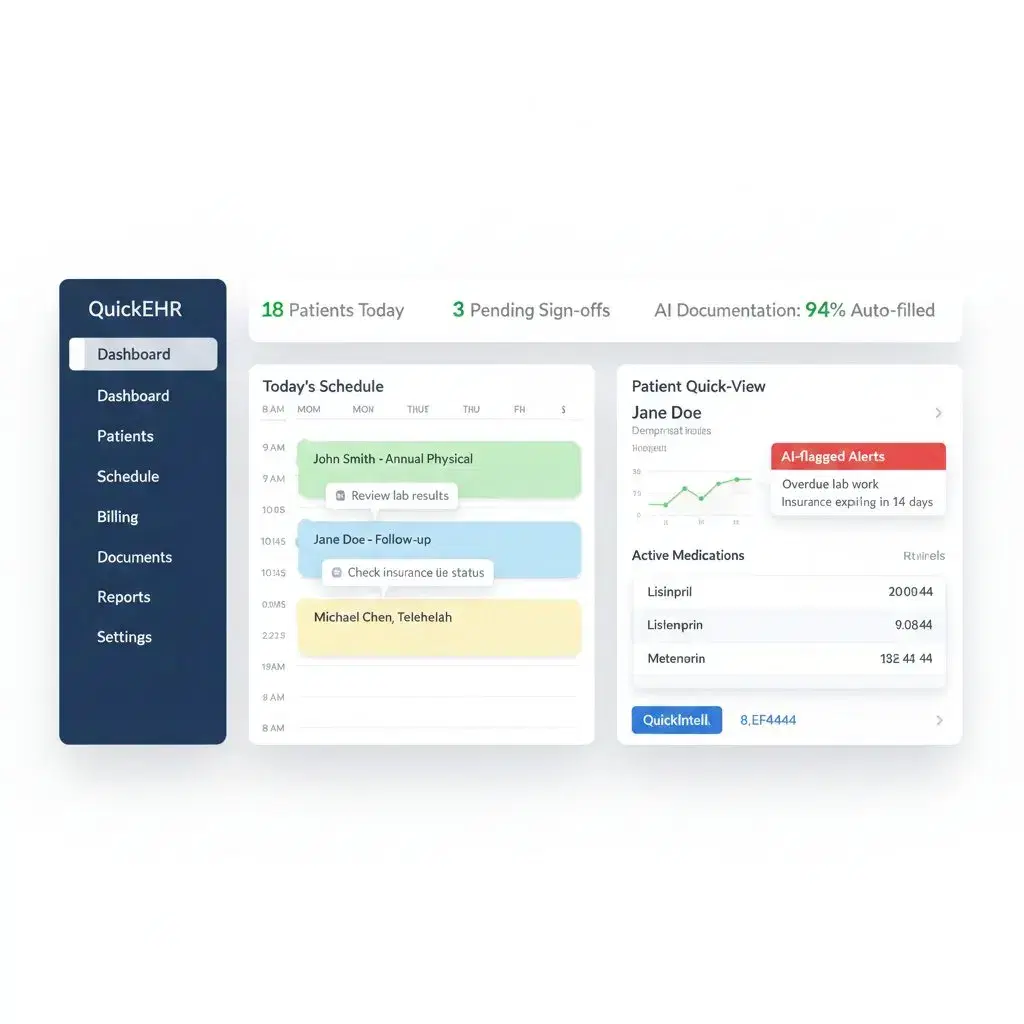
The QuickEHR dashboard gives clinics one place to review schedules, patient chart context, messages, open tasks, documentation status, AI-prepared work, prior authorization, coding, claims, ERA, and patient follow-up around an OpenEMR-powered EHR foundation.

Primary intent: EHR dashboard
EHR fit: OpenEMR and QuickEHR
AI role: assistive work routing

QuickEHR dashboard workspace

Tasks, chart context, AI worklists, RCM, and ERA

QuickEHR dashboard showing patient chart, scheduling, documentation, coding, prior authorization, and revenue workflow context

Clinical view

Schedules, messages, notes

AI worklists

Draft, classify, route

Revenue follow-up

Auth, claims, ERA

Dashboard workflow

A dashboard should help teams decide what to do next.

The EHR dashboard SERP expects a real-time view of patient information, operational tasks, and financial work. QuickEHR goes further by keeping every signal close to the chart, task owner, and QuickIntell workflow that can move it forward.

Start of day

See the worklist before the first patient arrives

The QuickEHR dashboard brings schedules, messages, unsigned notes, intake gaps, authorization flags, claim exceptions, and patient follow-up into a scannable operating view.

  • Review provider schedules, rooming status, pending documentation, and appointment risks in one place.
  • Keep front-desk, clinical, coding, prior authorization, and billing work visible without forcing every team into the same queue.
  • Use status and priority signals to decide what needs staff review first.

During the day

Move from dashboard signal to chart context

A useful EMR dashboard should not stop at metrics. QuickEHR keeps patient, encounter, order, payer, provider, and location context close to each task so teams can act.

  • Open patient chart, schedule, documentation, coding, authorization, or billing context from the relevant work item.
  • Keep AI-prepared suggestions reviewable before they affect clinical notes, coding, claims, or patient outreach.
  • Track clinical and administrative exceptions as structured work instead of comments hidden in the chart.

End of day

Close the loop across documentation and revenue work

QuickEHR connects dashboard work to the QuickIntell products that finish the visit: QuickScribe, QuickCode, QuickAuth, QuickRCM, QuickERA, and patient outreach workflows.

  • Carry completed encounter context into coding, prior authorization, claims, payment posting, and denial prevention work.
  • Show unresolved items before they become unsigned notes, missing authorizations, delayed claims, or manual remittance research.
  • Use dashboard analytics to review volume, aging, ownership, and bottlenecks without inventing unsupported outcome claims.

Dashboard requirements

Cover EMR dashboard needs without separating them from the work.

EHR dashboards, clinical dashboard software, medical dashboard software, and practice management dashboard tools all promise visibility. QuickEHR is designed around the next action: open the chart, resolve the task, send the work to the right reviewer, and keep the revenue handoff visible.

For the OpenEMR-specific architecture, see the OpenEMR integration. For the broader platform, review QuickEHR.

Schedule and patient flow

Show appointments, provider calendars, rooming status, no-show risk, reminder status, and handoffs from QuickEHR scheduling workflows.

Clinical tasks

Track unsigned notes, message follow-up, intake gaps, abnormal-result review tasks, referral needs, and other clinic-defined work queues.

Documentation readiness

Keep clinical documentation status visible so QuickScribe drafts, provider edits, signatures, and downstream coding handoff do not drift apart.

Authorization and coding work

Surface visits that may need QuickAuth packet preparation or QuickCode review before work reaches claim release.

Billing and remittance context

Use QuickRCM and QuickERA context to show claim exceptions, remittance posting work, patient balance questions, and revenue follow-up queues.

Dashboard analytics

Review task aging, ownership, throughput, and bottlenecks for clinical dashboard software, medical dashboard software, and practice management dashboard needs.

OpenEMR and QuickEHR fit

Use the dashboard around the EHR path your clinic chooses.

QuickEHR can be a managed OpenEMR-powered EHR or the connection layer around an existing system. The OpenEMR dashboard pattern gives teams familiar EHR context, while QuickIntell adds reviewable automation around the work that usually falls between systems.

QuickEHR-managed OpenEMR dashboard

QuickEHR is built on the OpenEMR foundation and adds managed configuration, support, integrations, and QuickIntell workflow automation around the dashboard.

Existing OpenEMR tenants

Clinics already using OpenEMR can evaluate approved OpenEMR API, FHIR, HL7, or interface-engine paths for routing chart, task, and revenue context into QuickIntell worklists.

QuickEHR Connect

Practices keeping another EHR can use QuickEHR as the integration layer around tasks, encounters, documentation, coding, authorizations, claims, and remittance context.

Implementation and trust

Build the dashboard around roles, queues, and review points.

A QuickEHR dashboard touches front desk, clinicians, coding, prior authorization, billing, payment posting, patient outreach, IT, compliance, and support. The implementation should define who owns each queue, what data appears, and which AI suggestions require review before action.

Choose QuickEHR-managed OpenEMR, an existing OpenEMR tenant, or QuickEHR Connect around another EHR.

Map dashboard roles, work queues, priority rules, task ownership, escalation paths, and review responsibilities.

Confirm which chart, schedule, message, order, claim, remit, eligibility, payer, and interface data should appear in the dashboard.

Define which AI actions may draft, summarize, classify, suggest, or queue work before human review.

Review patient-facing language, access controls, audit expectations, support ownership, and implementation-specific evidence.

Separate OpenEMR foundation capabilities from QuickEHR managed workflows and assistive QuickIntell AI automation.

FAQs

QuickEHR dashboard questions.

These answers are written for teams evaluating EHR dashboard software, OpenEMR fit, AI work routing, dashboard analytics, and QuickIntell workflow connections.

What is an EHR dashboard?+

An EHR dashboard is a centralized operating view for clinical and administrative work in an electronic health record. In QuickEHR, the EHR dashboard brings schedules, patient chart context, tasks, messages, documentation status, coding, prior authorization, claims, payment posting, and follow-up queues into one reviewable workflow.

For the full EHR overview, see QuickEHR.

What makes the QuickEHR dashboard different from a generic dashboard software page?+

Generic dashboard software can display charts and metrics. The QuickEHR dashboard is built for healthcare workflow context: patients, encounters, providers, locations, orders, payers, documentation, coding, authorization, claims, remittance, and patient outreach.

How does the QuickEHR dashboard use OpenEMR?+

QuickEHR is built on the OpenEMR foundation. Clinics can use QuickEHR-managed OpenEMR workflows or evaluate a connection to an existing OpenEMR tenant where approved OpenEMR API, FHIR, HL7, or interface-engine paths are available for that deployment.

Is this an AI EHR dashboard?+

Yes, in the sense that QuickIntell AI can help prepare, classify, summarize, route, and queue work for review. The AI EHR dashboard should be treated as assistive workflow automation, not an autonomous clinical decision maker or a replacement for provider, coder, authorization, billing, or compliance review.

Can the dashboard support clinical dashboard software and practice management dashboard needs?+

Yes. QuickEHR dashboard workflows can be configured around clinical tasks, schedules, message follow-up, patient flow, documentation status, authorization work, coding review, claims, remittance, and operational analytics. Scope depends on the deployment and enabled interfaces.

Does the dashboard include EHR dashboard analytics?+

The dashboard can support analytics around task volume, aging, ownership, queues, patient flow, documentation readiness, authorization status, claim exceptions, and remittance work. Teams should define which measures matter before go-live so reporting follows the operating model.

Is this the same as a donut dashboard?+

No. A donut dashboard or donut-style widget can be useful for a quick visual summary, but QuickEHR is designed as a work dashboard: the view should help teams open chart context, resolve tasks, prepare AI-assisted workflows, and move clinical and revenue work forward.

How does the dashboard connect to QuickScribe, QuickCode, QuickAuth, QuickRCM, and QuickERA?+

The dashboard can show documentation tasks for QuickScribe, coding review items for QuickCode, authorization work for QuickAuth, revenue queues for QuickRCM, and remittance exceptions for QuickERA. Each workflow keeps review and approval responsibilities visible.

Can practices use the QuickEHR dashboard with another EHR?+

Practices keeping another EHR can evaluate QuickEHR Connect. That path is intended to route task, encounter, documentation, claim, remittance, and patient follow-up context around the existing system of record instead of forcing every clinic to replace its EHR.

What should teams review before launching the dashboard?+

Teams should review roles, queues, task ownership, enabled data interfaces, OpenEMR or EHR connection scope, AI review points, audit expectations, support ownership, patient-facing workflows, and implementation-specific trust and procurement documentation before launch.

Does this page make certification or compliance claims?+

No. This page describes QuickEHR dashboard workflows and implementation planning. QuickEHR is built on the OpenEMR foundation, and any certification, security, payer, procurement, HIPAA, SOC 2, or regulatory evidence should be verified in the current implementation packet and contract for the specific deployment.

Need a dashboard that connects the clinic and the revenue team?

QuickIntell can walk through QuickEHR dashboard design, OpenEMR fit, AI work routing, QuickScribe, QuickCode, QuickAuth, QuickRCM, QuickERA, patient outreach, and the trust review materials for your deployment.