Call
Specialty documentation workflows

EHR templates for specialty clinical workflows

QuickEHR helps ambulatory clinics configure EHR templates around the way each specialty documents care: OpenEMR-powered patient charts, specialty note patterns, AI-assisted drafts, coding context, prior authorization evidence, RCM worklists, and ERA follow-through in one QuickIntell workflow model.

Specialty notes and templates
OpenEMR-powered chart context
Reviewable AI automation

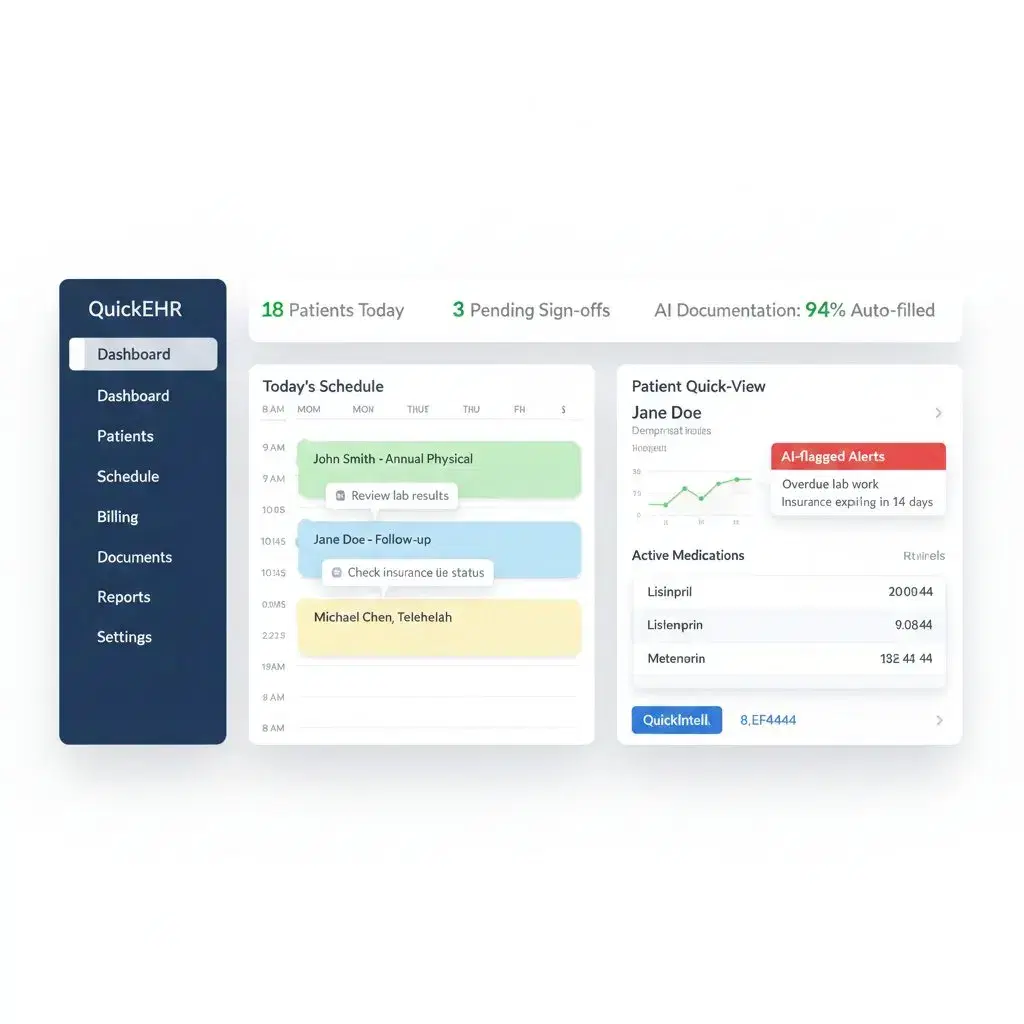
QuickEHR specialty template workspace

Chart template, draft note, code, auth, and revenue handoff

QuickEHR specialty templates dashboard with chart, documentation, coding, authorization, and revenue workflows

Template

Specialty visit flow

AI draft

Clinician review path

Handoff

Code, auth, RCM

Specialty template workflow

Templates should match the visit, not just the screen.

Searchers comparing EHR templates, EMR templates, and specialty templates software need to see how template content moves through the visit. QuickEHR keeps specialty documentation close to chart context, AI assistance, and downstream operations.

Before the visit

Start with the specialty and encounter type

QuickEHR specialty templates should begin with the visit pattern: annual exam, follow-up, procedure review, behavioral health session, post-op check, care-gap outreach, or chronic-condition visit.

  • Map note sections to the specialty's clinical workflow instead of using one generic form.
  • Keep schedule, intake, eligibility, prior notes, problems, medications, allergies, and open tasks close to the template.
  • Use configured templates to reduce repetitive chart setup before the provider opens the encounter.

During documentation

Give providers structured notes without rigid charting

EHR documentation templates need enough structure for consistency and enough flexibility for clinical judgment. QuickEHR supports reviewable note patterns around the patient chart.

  • Support SOAP-style, specialty-specific, and visit-specific note flows where configured.
  • Keep clinician review and signature responsibilities explicit.
  • Make template gaps visible before they become coding, authorization, or billing rework.

After the note

Turn template content into downstream context

Specialty EHR templates are most useful when the reviewed note can help coding, prior authorization, claims, remittance, and follow-up teams understand the visit.

  • Route diagnoses, procedures, orders, evidence, and documentation gaps toward QuickCode review.
  • Use relevant chart context to assemble QuickAuth packet workflows.
  • Keep QuickRCM and QuickERA teams connected to the source encounter and payment trail.

Continuous tuning

Improve templates with operational feedback

Template quality changes over time as providers, coders, authorization teams, and billers find missing fields or confusing handoffs. QuickEHR implementations should preserve that feedback loop.

  • Review which template prompts actually help care teams and which create noise.
  • Tune specialty templates around real denials, missing documentation, and authorization evidence needs.
  • Separate template configuration from unsupported regulatory or certification claims.

Template library

Build specialty templates around clinical and operational handoff.

QuickEHR specialty templates can support EHR note templates, exam patterns, orders, referrals, care plans, coding cues, prior authorization evidence, and team worklists. The goal is a charting workflow that helps the whole clinic move.

For the OpenEMR-specific architecture, review the OpenEMR integration. For provider-facing charting details, see QuickEHR patient charts.

Visit note templates

Configure encounter notes for annual visits, follow-ups, procedures, consults, post-discharge checks, therapy sessions, and other specialty workflows.

History, ROS, and exam patterns

Help teams capture specialty-relevant history, review of systems, physical exam, assessment, and plan details without starting each visit from scratch.

Orders, referrals, and care plans

Keep orders, referrals, instructions, care gaps, and follow-up tasks connected to the encounter so downstream teams can find the evidence trail.

Coding and documentation cues

Use reviewed template content to help QuickCode prepare coding suggestions and flag missing documentation for coder or clinician review.

Authorization evidence fields

Configure template prompts around payer-relevant clinical evidence where implementation scope allows, then hand that context to QuickAuth packet workflows.

Team worklists

Route incomplete notes, missing records, follow-up tasks, coding questions, authorization needs, and billing exceptions to the right queue.

OpenEMR and QuickEHR fit

OpenEMR specialty templates, managed through QuickEHR.

QuickEHR uses the OpenEMR foundation for the EHR layer and adds QuickIntell configuration, implementation support, integrations, and assistive AI workflows around the chart. That boundary matters when teams evaluate template scope, review paths, and procurement evidence.

OpenEMR foundation

QuickEHR is built on the OpenEMR foundation. Specialty template configuration should be reviewed within the deployed QuickEHR environment and implementation scope.

QuickIntell workflow layer

QuickIntell adds managed deployment, configuration, support, integrations, and assistive AI workflows around OpenEMR-powered clinical documentation.

QuickEHR Connect

Practices keeping another system of record can evaluate QuickEHR Connect for documentation, coding, authorization, RCM, and remittance handoff where interfaces allow.

Implementation and trust

Approve the template workflow before go-live.

Specialty EHR templates touch clinical documentation, AI assistance, coding, authorization, claims, remittance, and patient follow-up. QuickIntell scopes these workflows during implementation so template changes have owners and review paths.

Inventory specialties, encounter types, existing note templates, provider preferences, and required review steps.

Map OpenEMR-powered template fields to the clinic's deployed QuickEHR charting workflow.

Define which AI drafts, summaries, coding suggestions, authorization packets, and worklist items require human review.

Confirm how template content should hand off to QuickScribe, QuickCode, QuickAuth, QuickRCM, QuickERA, and any connected EHR.

Review interface scope, FHIR/API or HL7 availability, file exchange, data flow, and write-back assumptions for the implementation.

Assign template ownership so clinical operations can approve changes before providers use them.

Validate trust, security, support, procurement, and implementation documentation before go-live.

Keep certification, regulatory, payer-program, and controlled-substance evidence tied to the specific deployed configuration.

FAQs

QuickEHR specialty template questions

Short answers for teams evaluating EHR templates, EMR templates, OpenEMR fit, AI documentation, and downstream QuickIntell workflows.

What are EHR templates in QuickEHR?

EHR templates in QuickEHR are configurable documentation and workflow patterns that help ambulatory teams capture visit details, chart context, orders, follow-up tasks, coding evidence, authorization details, and revenue handoff information around the patient encounter.

Is this specialty templates software or a library of forms?

QuickEHR specialty templates are not positioned as generic downloadable forms. They are implementation-configured EHR and EMR templates that live inside the charting workflow and can connect to AI note drafting, coding, prior authorization, RCM, and remittance operations.

Can QuickEHR support EMR templates for different specialties?

QuickEHR workflows can be configured around specialty EMR templates for primary care, urgent care, behavioral health, pediatrics, cardiology, orthopedics, and other ambulatory settings. Final template scope should be confirmed during implementation.

How do AI EHR templates work with QuickScribe?

QuickScribe can help prepare draft documentation against configured encounter context and specialty note patterns. Clinicians still review, edit, and approve clinical documentation before it becomes final.

How does OpenEMR fit into QuickEHR specialty templates?

QuickEHR is built on the OpenEMR foundation. OpenEMR specialty templates and related charting configuration should be reviewed within the deployed QuickEHR environment, while QuickIntell adds managed implementation, integrations, support, and assistive AI workflows around that foundation.

Can specialty templates connect to coding and prior auth?

Yes, when configured. Reviewed template content can provide chart context for QuickCode coding review and QuickAuth authorization packet workflows, while keeping clinical, coding, and authorization review responsibilities visible.

Who approves template content and AI suggestions?

Template ownership should be defined during implementation. Clinical leaders, providers, coding teams, authorization teams, and billing operators may all need review paths depending on the template, specialty, payer workflow, and deployment scope.

Does this page add certification or compliance claims?

No. This page describes QuickEHR as built on the OpenEMR foundation and focuses on workflow configuration. Any certification, security, procurement, regulatory, payer-program, or controlled-substance evidence should be reviewed for the specific implementation packet and deployed configuration.

Need specialty templates inside QuickEHR?

Bring your current note templates, specialty workflows, coding questions, authorization evidence needs, and revenue handoff requirements. QuickIntell will map the QuickEHR template path before automation is enabled.