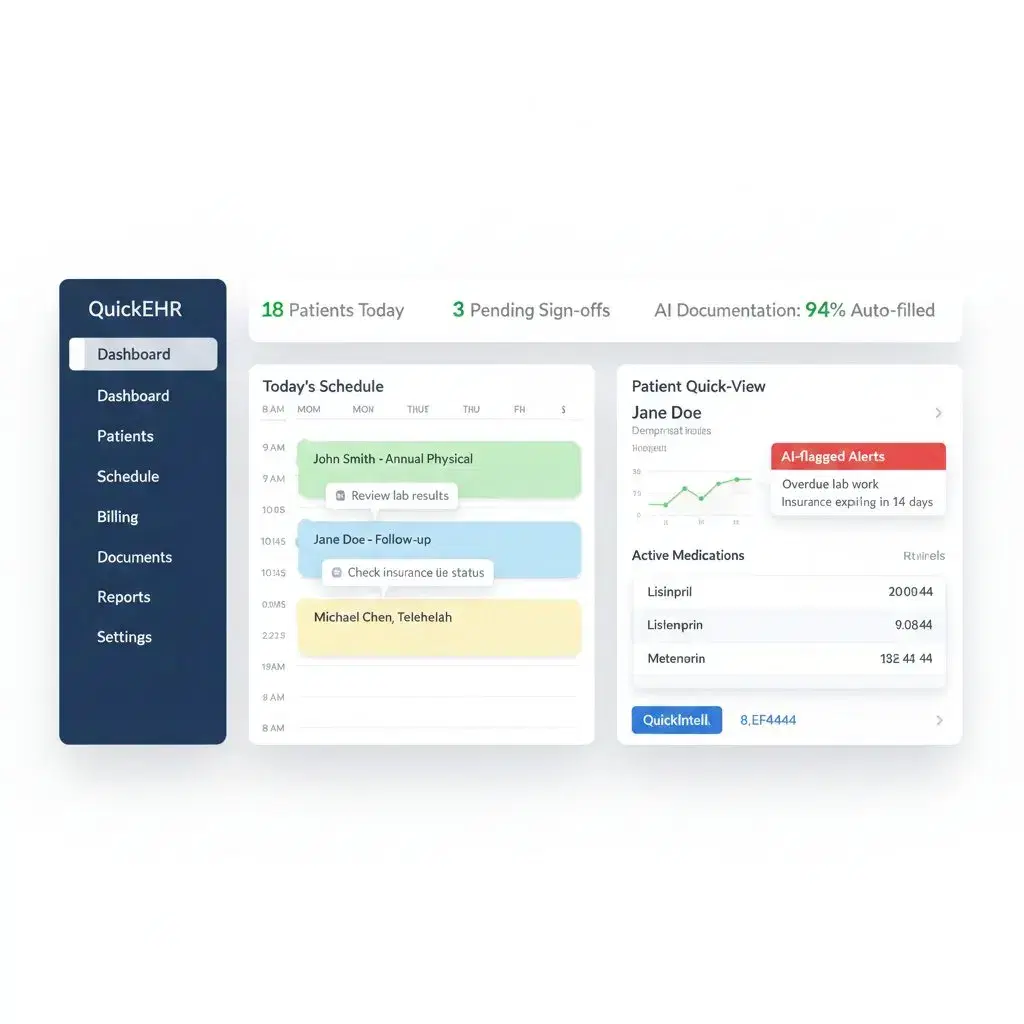
Appointments, reminders, intake, auth, and RCM handoff
Calendar context
Providers, visits, locations
Patient flow
Self-scheduling and reminders
Follow-through
Auth, coding, RCM, ERA
Scheduling workflow
A medical calendar should start the right clinical and revenue work.
The scheduling SERP expects more than available slots. QuickEHR ties appointments to patient context, front-desk review, intake, eligibility, authorization, clinical documentation, coding, claims, and patient follow-up.
Before booking
Start with appointment context, not a disconnected call list
QuickEHR medical scheduling software keeps visit type, provider, location, appointment reason, eligibility status, and referral or authorization context close to the patient chart.
Match appointment type, provider availability, location, and resource needs before a slot is confirmed.
Keep coverage, eligibility, referral, and authorization questions visible for staff review.
Route exceptions to the right front-desk, billing, or clinical queue instead of leaving them in notes.
During scheduling
Give patients self-scheduling with clinic-controlled rules
Patient self scheduling software is useful only when the practice can control visit types, holds, provider rules, patient instructions, and when staff review is needed.
Support patient self-scheduling paths through configured portal, outreach, or intake workflows.
Use appointment reminders, confirmation steps, and reschedule flows to reduce manual phone work.
Keep staff in control of exceptions, complex visit types, and operational approval rules.
After booking
Carry the appointment into documentation and revenue work
EHR scheduling software should move appointment context into intake, clinical documentation, coding, prior authorization, claims, ERA, and patient follow-up workflows.
Trigger intake, reminder, eligibility, and prior authorization tasks from the scheduled visit.
Keep no-show, cancellation, recall, and reschedule activity visible for follow-up.
Send reviewed encounter context into QuickScribe, QuickCode, QuickAuth, QuickRCM, and QuickERA workflows.
Scheduling requirements
Cover appointment scheduling software needs without separating them from the chart.
QuickEHR is built for ambulatory clinics evaluating medical appointment scheduling software, patient scheduling software, or scheduling software for a medical office. The scheduling workflow should know enough about the visit to route the next operational step.
Manage providers, locations, appointment types, room or resource needs, visit lengths, and clinic-specific scheduling rules in a healthcare scheduling software workflow.
Patient self-scheduling
Let eligible patients request or book configured appointment types while routing exceptions, complex visits, and staff review back to the clinic.
Reminders and confirmations
Use appointment reminder software workflows for confirmations, reschedules, preparation instructions, recalls, and other patient outreach needs.
Eligibility and authorization triggers
Use the scheduled visit to start eligibility checks, referral review, prior authorization work, missing-document follow-up, and payer-specific preparation.
Waitlists and recalls
Organize cancellation fills, follow-up intervals, recall lists, and stale scheduling tasks so teams can work from a structured queue.
Billing handoff
Carry appointment, eligibility, provider, location, authorization, and encounter context into practice management scheduling software and revenue workflows.
AI scheduling automation
AI can prepare scheduling work while teams keep the review points.
For practices comparing AI EHR scheduling or automated healthcare scheduling software, QuickEHR uses QuickIntell modules to connect appointment activity with reviewable clinical, authorization, coding, billing, patient outreach, and remittance work.
QuickEHR scheduling works around the EHR path your clinic chooses.
QuickEHR can be a managed OpenEMR-powered EHR or the connection layer around an existing system. Either way, the goal is the same: keep appointment context close to the chart, operational queues, and QuickIntell automation.
QuickEHR-managed OpenEMR scheduling
QuickEHR is built on the OpenEMR foundation and adds managed configuration, implementation support, integrations, and QuickIntell workflow automation around scheduling.
Existing OpenEMR tenants
Clinics already using OpenEMR can connect approved OpenEMR API, FHIR, HL7, or interface-engine paths into QuickIntell worklists where available for the deployment.
QuickEHR Connect for other systems
Practices keeping another EHR or practice management system can use QuickEHR as the integration layer around appointments, encounters, claims, and remittance context.
Related QuickIntell products
Scheduling is the start of a larger QuickIntell workflow.
A scheduled visit can become documentation, coding, authorization, claim, ERA, patient billing, or outreach work. These product links keep buyers moving through the connected workflow.
Visit lengths, referral needs, procedure readiness, reminders, and authorization risk are different for primary care, urgent care, behavioral health, cardiology, orthopedics, pediatrics, and OB-GYN.
Define the scheduling operating model before go-live.
Medical scheduling and billing software touches patients, front desk teams, clinicians, authorization teams, billing, reporting, and support. QuickEHR implementation should make rules, review points, interfaces, and ownership explicit.
Security and procurement teams can review current materials through the Trust Center. Any implementation-specific evidence should be verified in the current contract and deployment packet.
Scheduling implementation checklist
Scope these items before production use.
Choose QuickEHR-managed OpenEMR, an existing OpenEMR tenant, or QuickEHR Connect for another EHR or practice management system.
Decide which AI suggestions may draft, route, classify, summarize, or queue work before staff or clinician review.
Review trust, data handling, access controls, audit expectations, patient-facing language, and support ownership before launch.
QuickEHR navigation
Related QuickEHR pages for scheduling buyers.
Scheduling buyers usually need the surrounding EHR, portal, documentation, prescribing, OpenEMR, and evidence-boundary context before selecting a workflow.
Answers for practices comparing EHR scheduling software, patient scheduling software, self-scheduling, reminders, OpenEMR scheduling, and AI scheduling automation.
What is QuickEHR medical scheduling software?
QuickEHR medical scheduling software is the scheduling workflow layer for QuickEHR. It helps clinics organize provider calendars, appointment types, patient self-scheduling, reminders, eligibility and authorization triggers, intake handoff, and downstream QuickIntell automation around an OpenEMR-powered EHR foundation.
How is EHR scheduling software different from a generic appointment scheduler?
Generic appointment scheduling software focuses on booking a slot. EHR scheduling software needs clinical and revenue context: patient chart, visit reason, provider, location, coverage, referral or authorization needs, intake, documentation, coding, claims, and patient follow-up.
Does QuickEHR support patient self scheduling software workflows?
QuickEHR can support patient self-scheduling workflows when configured for the clinic. The implementation should define which appointment types patients can request or book, which slots need staff review, how exceptions are routed, and how portal, reminder, and phone workflows connect back to the schedule.
Can QuickEHR handle appointment reminder software workflows?
Yes, QuickEHR scheduling can connect to reminder, confirmation, recall, cancellation, and reschedule workflows when those paths are enabled. Reminders should be configured around the clinic's communication rules, patient-facing language, support ownership, and escalation process.
How does OpenEMR scheduling fit with QuickEHR?
QuickEHR is built on the OpenEMR foundation. Clinics can use QuickEHR-managed OpenEMR workflows or connect an existing OpenEMR tenant where approved OpenEMR API, FHIR, HL7, or interface-engine paths are available for the deployment.
How does AI EHR scheduling automation work in QuickEHR?
QuickIntell AI can help draft, classify, route, summarize, and queue scheduling-related work. For example, it can help organize reminder follow-up, intake gaps, authorization tasks, coding handoff, and billing exceptions for review. It should be treated as assistive workflow automation, not an autonomous clinical decision maker.
Can scheduling trigger eligibility checks or prior authorization?
Yes, scheduling is the right moment to start many front-end revenue tasks. QuickEHR can use the appointment, provider, location, payer, procedure, diagnosis, order, or visit-type context to queue eligibility review and prior authorization work for staff review when configured.
How does scheduling connect to QuickRCM and billing?
Appointment context can affect claims and denials. QuickEHR scheduling can carry provider, location, eligibility, authorization, visit type, and encounter context into QuickRCM and QuickERA workflows so billing teams do not have to reconstruct what happened before the visit.
Can practices use QuickEHR scheduling with another EHR?
Yes, practices keeping another EHR or practice management system can evaluate QuickEHR Connect. That path is meant to route scheduling, encounter, chart, claim, and remittance context around the existing system of record instead of requiring every clinic to replace its EHR.
What should practices review before launching scheduling?
Practices should review appointment types, provider schedules, locations, visit lengths, self-scheduling rules, reminders, cancellation workflows, eligibility checks, authorization triggers, patient portal handoff, data interfaces, access controls, support ownership, and staff review responsibilities before go-live.
Does this page make certification or compliance claims?
No. This page describes QuickEHR scheduling workflows and implementation planning. QuickEHR is built on the OpenEMR foundation, and any certification, security, payer, procurement, HIPAA, SOC 2, or regulatory evidence should be verified in the current implementation packet and contract for the specific deployment.
QuickEHR scheduling
Connect the appointment to the work that follows.
See how QuickEHR can connect scheduling, patient access, OpenEMR-powered chart context, QuickIntell AI automation, and revenue workflows for your clinic.