Billing cost keeps scaling with headcount
Traditional outsourced billing depends on people working queues manually. As volume grows, cost and delay grow with it.
Get a full-service revenue cycle operation at 2.9% of collections. QuickIntell combines specialized AI agents, payer workflow automation, and human RCM review for an agreed delivery scope. Define the included work, responsibilities, exception handling, and reporting during assessment.
2.9% pricing applies to eligible practices and agreed managed RCM scope. Final eligibility depends on specialty, payer mix, claim volume, system access, and historical denial profile.

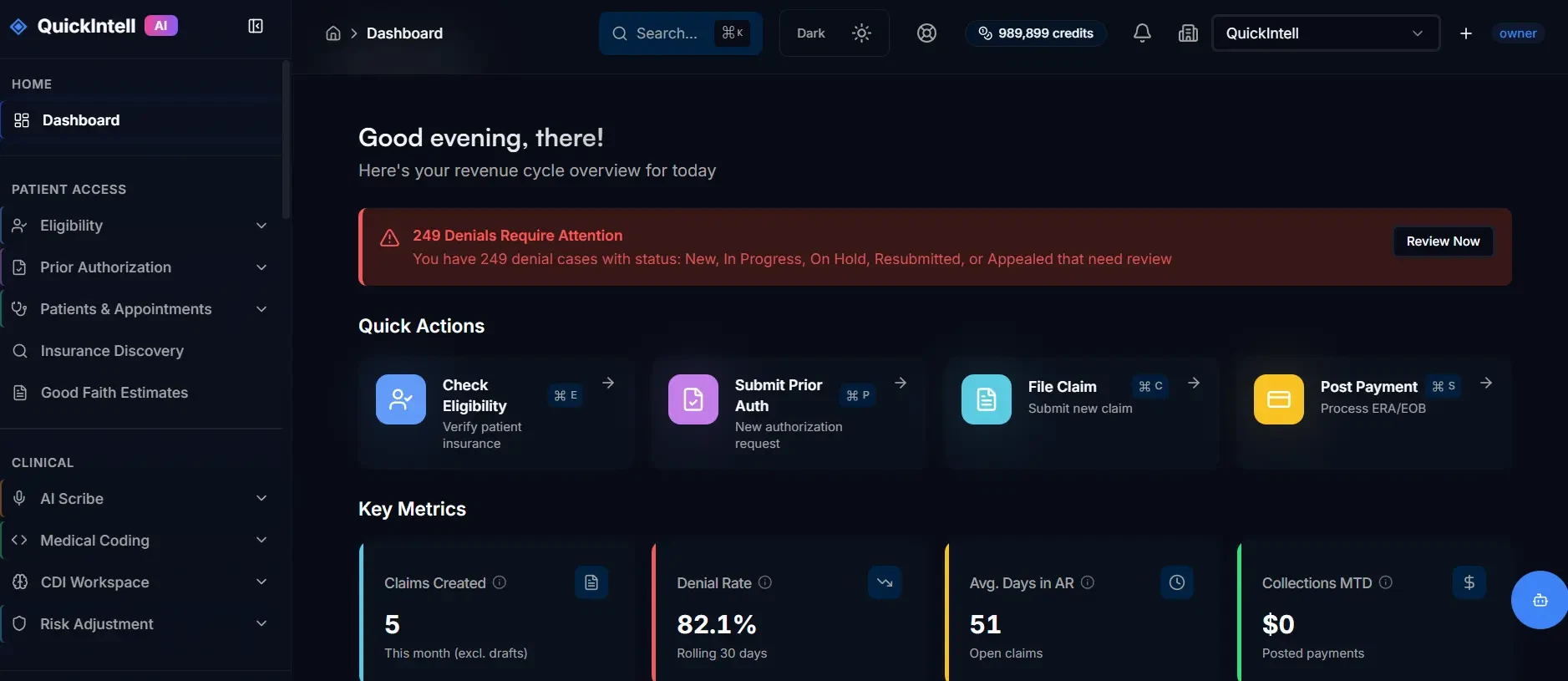
Dashboard illustration; displayed values are not verified service outcomes.
2.9%
of collections for eligible practices
Defined scope
workflows and handoff responsibilities
Payer review
access and routes checked for your mix
Human review
for exceptions and risky actions
The RCM Problem
Most billing teams are buried in eligibility checks, payer portals, claim edits, denials, underpayments, patient balances, and AR follow-up. Outsourced billing firms often add headcount without adding real automation.
Traditional outsourced billing depends on people working queues manually. As volume grows, cost and delay grow with it.
Eligibility, authorization, claim status, denials, payment posting, and AR follow-up live in disconnected payer tools.
Spreadsheets and status notes hide what is automated, what is stuck, what needs review, and what is at risk.
AI Agent Workforce
QuickRCM Managed RCM breaks the revenue cycle into clear agent-owned workflows. Routine, validated work moves through automation. Exceptions move to people with context.
Verifies active coverage, COB, deductibles, PCP requirements, plan limits, and front-desk exceptions before the visit.
Detects authorization requirements, prepares clinical packets, checks status, and escalates payer issues for review.
Checks documentation, ICD-10, CPT, HCPCS, modifiers, bundling, medical necessity, and payer edits before claim release.
Scrubs claims, finds missing data, monitors claim status, prepares corrected claims, and routes stalled work.
Connects ERA and EOB context, prepares posting queues, flags adjustment mismatches, and detects underpayments.
Classifies CARC and RARC reasons, drafts appeal packets, tracks overturns, and feeds root causes upstream.
Prioritizes old, high-value, timely-filing-risk, and recovery-likely accounts so the right claims get worked first.
Supports patient statements, payment questions, payment-plan exceptions, soft collections, and balance handoff.
Human-in-the-loop
QuickRCM does not blindly submit every action. Routine, validated work can be automated. Complex coding questions, ambiguous payer responses, high-dollar write-offs, appeals, and compliance-sensitive actions route to trained human reviewers.
Control model
Start in observe or assist mode, approve the work, then graduate specific payer workflows to auto mode once accuracy and review thresholds are validated.
Complex coding questions and documentation ambiguity
Medical necessity denials, appeals, and payer disputes
High-dollar write-offs, unusual adjustments, and refunds
Payer portal failures, missing records, and edge-case policy interpretation
Compliance-sensitive actions that require staff approval or signature
Customer-specific rules for specialties, locations, providers, and payers
Full-service pricing
Confirm the fee basis, minimums, excluded work, and implementation charges in your written proposal. Define the workflows QuickIntell operates and the decisions your team retains before the engagement begins.
Review eligibility for 2.9%Eligibility and benefit verification
Prior authorization coordination
Charge and coding review support
Claim scrubbing and submission support
Claim status follow-up
Denial management and appeal preparation
ERA, EOB, and payment posting support
Underpayment and adjustment review
Accounts receivable prioritization
Patient balance and soft collections support
Provider and payer performance scorecards
Monthly optimization and reporting

Why This Model
Use the same questions when evaluating software, outsourced billing, and QuickRCM Managed RCM. Confirm each proposal’s scope and responsibilities.
Implementation
QuickIntell connects around your existing EHR, practice management system, clearinghouse, and payer workflows, then phases automation into production with review controls.
Review payer mix, EHR/PMS, clearinghouse, denial profile, AR, posting, staffing model, and current billing cost.
Connect scheduling, demographics, coverage, claims, remits, and historical outcomes so agents can compare against current operations.
Define which actions can run automatically and which route to human approval by payer, specialty, dollar value, and risk.
Launch eligibility, claims, denials, posting, AR, and patient-balance queues with QuickIntell RCM oversight.
Tune payer rules, denial prevention, scorecards, recovery workflows, and automation thresholds as production data improves.
Main product fit
Use it when you want QuickIntell to operate the revenue cycle. Use the QuickRCM Platform when you want your own staff or billing vendor to run the software layer.
FAQs
For eligible practices, QuickRCM Managed RCM is priced at 2.9% of collections for the agreed managed RCM scope. That scope can include eligibility, prior authorization coordination, claim readiness, claim follow-up, denials, payment posting support, AR, patient balances, reporting, and human exception review. Final eligibility depends on specialty, payer mix, volume, system access, and current revenue cycle complexity.
Scope is determined by the agreed tasks, available system access, representative case validation, and your review requirements. Establish a baseline and measure completed tasks, manual touches, and exceptions during evaluation. Do not assume a universal automation percentage.
QuickIntell routes ambiguous, high-risk, compliance-sensitive, or payer-specific exceptions to human RCM specialists. The customer can also keep internal billers, coders, or managers in the approval path for defined queues.
No. QuickRCM Managed RCM is built to work with the EHR, practice management system, clearinghouse, payer portals, and file workflows already in place. If a direct API is unavailable, implementation can use secure files, EDI, or assisted workflow automation where appropriate.
Yes. Some practices use QuickIntell as a full managed RCM service. Others use it as a hybrid model where internal billers work exception queues while QuickIntell automates routine payer and claims work.
The QuickRCM Platform is the AI revenue cycle software layer. QuickRCM Managed RCM is the service model where QuickIntell operates the revenue cycle for eligible practices using that platform, AI agents, and human-in-the-loop RCM specialists. Platform pricing and managed-service pricing are separate offers.
Compare the actual proposals using the same included workflows, system access, review responsibilities, reporting, escalation, and fee basis. QuickRCM Managed RCM combines an agreed service scope with configured software workflows and human exception review. Request current evidence and demonstrations from each provider.
Most implementations start with discovery, integration, shadow-mode validation, and a phased go-live by workflow, payer, or location. Exact timing depends on system access, data quality, payer mix, volume, and how much of the revenue cycle is included in the first scope.
AI and human actions are logged with workflow context, owner, source data, status, and review path. High-risk actions can be configured to require approval before submission, posting, appeal, write-off, or EHR/PMS write-back.

Bring your payer mix, current billing cost, denial profile, and approximate monthly collections. We will show where AI agents can automate the work and where human specialists stay in the loop.
Review delivery scope, customer responsibilities, reporting, onboarding, and pricing for each workflow. An assessment defines the work covered by your agreement.
Prepare provider profiles, coordinate payer applications, follow up on enrollment, and track effective dates with Quickintell's managed credentialing services.
Explore service scopeOutsource pre-visit coverage and benefits verification, resolve incomplete responses, and give patient access teams an actionable exception queue.
Explore service scopeCoordinate authorization requirements, document readiness, submissions, status follow-up, and renewals with a managed prior authorization team.
Explore service scopeCoordinate documentation readiness, coder review, clarification requests, and a controlled billing handoff through Quickintell managed medical coding services.
Explore service scopeOutsource denial investigation, evidence gathering, correction or appeal coordination, follow-up, and recovery reporting with explicit customer approval controls.
Explore service scopeCoordinate ERA and EOB posting, deposit reconciliation, adjustment review, and exception handoffs through Quickintell payment posting services.
Explore service scopePrioritize medical AR, investigate payer status, document follow-up, and route denial or underpayment cases with an evidence-based next-action queue.
Explore service scopeOrganize payer agreements, reconcile fee schedules, investigate reimbursement differences, and prepare evidence for renewals and negotiation decisions.
Explore service scope