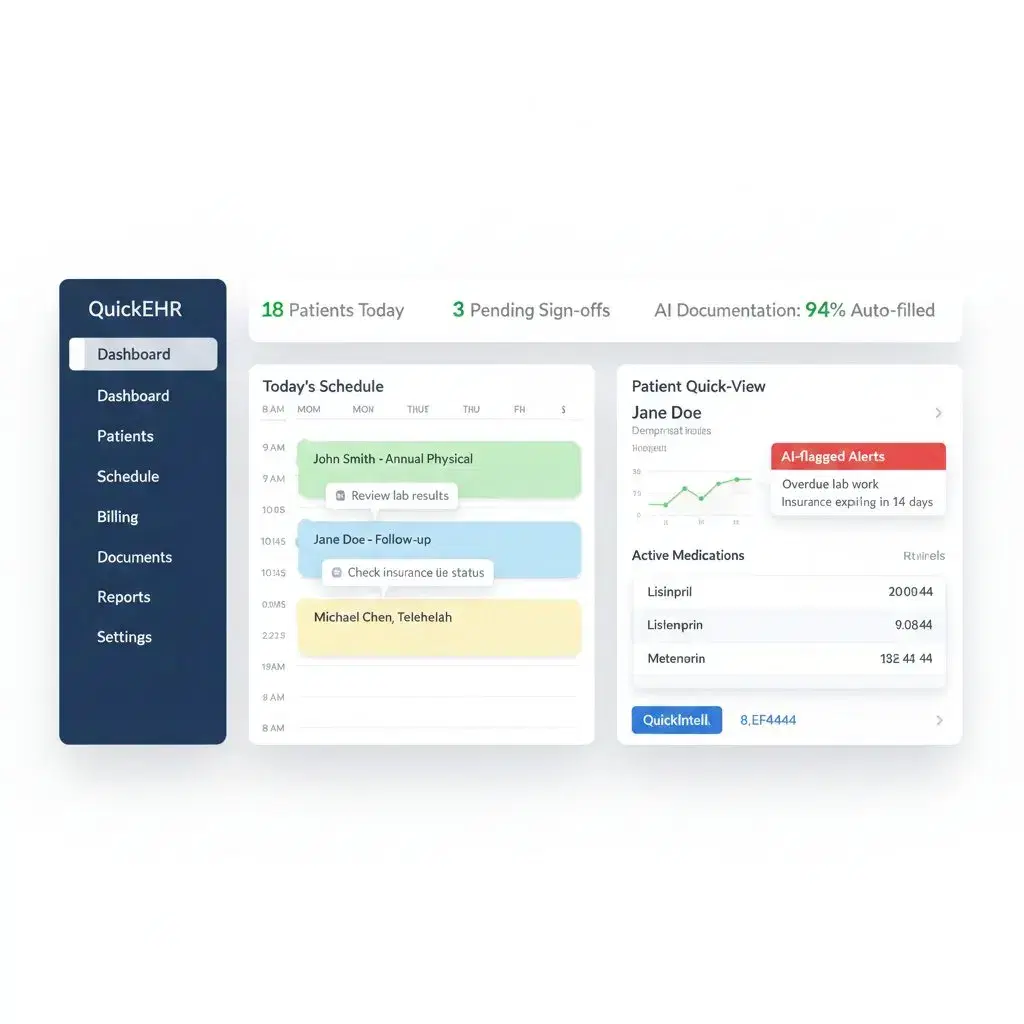
Addiction medicine practice management software for QuickEHR workflows
QuickEHR addiction medicine practice management software connects OpenEMR-powered scheduling, intake, SUD and MAT documentation, AI-assisted review queues, billing, claims, denials, ERA, payment posting, patient balances, and RCM workflows for specialty teams.
SUD, MAT, counseling, and recovery-program context
Scheduling, intake, eligibility, authorization, and consent routing
AI handoff across documentation, billing, claims, ERA, and RCM
QuickEHR addiction medicine practice workspace
Schedule, intake, chart, auth, billing, claims, ERA
Front office
Schedule, intake, eligibility
Encounter review
Notes, codes, authorizations
Revenue loop
Claims, ERA, denials, AR
Practice management workflow
The front office, chart, and billing team need one operating story.
Practices comparing practice management software, medical practice management software, and EHR practice management software need more than a generic calendar-and-claim page when the specialty workflow includes SUD, MAT, payer evidence, billing, and remittance follow-up.
Patient access
Schedule the visit with program and payer context
Addiction medicine practice management software has to bring appointment, referral, coverage, consent, provider, location, and care-program details into the same operating view before the patient arrives.
Route demographic, eligibility, referral, authorization, consent, and intake gaps before the encounter starts.
Keep appointment type, provider, facility, payer, program, and care-team details visible to front desk and clinical teams.
Use owner-based worklists instead of asking staff to reconcile calendars, intake forms, payer notes, and chart tasks by hand.
Encounter readiness
Prepare documentation, coding, and authorization together
Practice management for addiction medicine cannot stop at scheduling. QuickEHR keeps SUD and MAT documentation context close to QuickScribe, QuickCode, and QuickAuth review workflows.
Carry SUD history, counseling context, medication history, treatment-plan updates, lab follow-up, and care coordination into review.
Route AI-prepared notes, coding cues, claim-readiness summaries, and authorization evidence to the right staff checkpoints.
Connect missing documentation, service-window questions, referral details, payer evidence, and visit holds before charges move downstream.
Revenue operations
Close claims, denials, payments, and AR follow-up
EHR practice management software is strongest when the billing team can see the source encounter. QuickEHR connects charge review, claim release, denial repair, ERA context, payment posting, and patient balances.
Review ICD-10, CPT, HCPCS, modifiers, units, diagnosis pointers, provider, location, payer, and authorization support before submission.
Move rejections, denials, payer requests, corrected claims, appeals, and AR follow-up into QuickRCM work queues.
Use QuickERA to connect ERA and EOB context to posting exceptions, adjustments, underpayments, denials, and patient responsibility.
Addiction medicine operations
Practice management should cover the whole specialty workflow.
Buyers comparing addiction medicine EHR software, substance abuse EHR software, and addiction medicine billing software are usually trying to prevent gaps between intake, documentation, payer requirements, billing, and collections.
AI should prepare, classify, and route work for review.
QuickIntell automation helps addiction medicine teams summarize, check, and route work across the practice management workflow while staff keep the configured approval points.
OpenEMR practice management can connect to QuickIntell automation.
QuickEHR is built on the OpenEMR foundation. Addiction medicine teams can evaluate a managed QuickEHR deployment, an existing OpenEMR tenant, or QuickEHR Connect around another system depending on the approved data paths and operational scope.
QuickEHR is built on the OpenEMR foundation and adds QuickIntell workflow configuration around scheduling, documentation, billing, coding, authorization, claims, denials, and remittance.
Existing OpenEMR addiction medicine tenants
Practices already running OpenEMR can evaluate approved FHIR, OpenEMR API, HL7, EDI, clearinghouse, remittance, file, and interface-engine paths for OpenEMR practice management workflows.
QuickEHR Connect for mixed systems
Teams keeping another EHR or practice management system can scope QuickIntell automation around the schedule, chart, payer, claim, denial, and payment data available through approved interfaces.
Related QuickIntell products
Connect practice management to the products that resolve the work.
QuickEHR practice management works best when documentation, coding, authorization, claims, denials, ERA, payment posting, and patient-balance operations are connected to the rest of the QuickIntell stack.
Security, compliance, and procurement teams can review current materials in the Trust Center before production use.
Implementation and trust
Scope sensitive addiction medicine workflows before go-live.
Practice management for addiction medicine can touch sensitive SUD information, payer requirements, documentation support, coding review, authorization evidence, clearinghouse connections, remittance files, payment workflows, patient balances, and audit expectations. The implementation plan should make interfaces, access rules, review points, and support ownership explicit.
QuickEHR is the EHR and workflow layer. A practice may still use payer portals, clearinghouses, payment processors, statement vendors, lockboxes, billing services, or other operating partners depending on the deployment and contract model.
Implementation checklist
Use this before enabling AI-assisted workflows.
Choose QuickEHR-managed OpenEMR, an existing OpenEMR tenant, or QuickEHR Connect around another EHR or practice management system.
Map scheduling, intake, consent, eligibility, referral, authorization, documentation, coding, charge, claim, ERA, payment, denial, AR, and patient-balance data paths.
Define review gates for AI-drafted notes, coding suggestions, authorization packets, claim-readiness summaries, denial worklists, and payment exceptions.
Confirm enabled OpenEMR API, FHIR, HL7, EDI, clearinghouse, payer, remittance, batch, or interface-engine paths for the deployment.
Map sensitive SUD privacy, consent, access, segmentation, redisclosure, and audit workflows against the practice's legal and policy requirements.
Review current Trust Center materials, contract terms, implementation evidence, support ownership, and production readiness before go-live.
FAQs
Addiction medicine practice management questions
Short answers for practices comparing QuickEHR, addiction medicine practice management software, substance abuse EHR software, OpenEMR practice management, and AI EHR practice management workflows.
What is addiction medicine practice management software?
Addiction medicine practice management software helps SUD, MAT, counseling, and recovery-focused practices coordinate scheduling, intake, eligibility, consent, authorization, documentation, coding, billing, claims, denials, payments, patient balances, and operational reporting. QuickEHR brings those workflows into an OpenEMR-powered QuickIntell model.
How does QuickEHR support addiction medicine practice management?
QuickEHR can support addiction medicine practice management by keeping the chart, schedule, payer context, authorization status, documentation evidence, billing review, claim work, denial follow-up, ERA, and patient account context connected for staff review.
How is this different from generic medical practice management software?
Generic medical practice management software often focuses on appointment, billing, and payment operations. QuickEHR adds addiction medicine workflow context such as SUD intake, consent routing, MAT documentation context, counseling services, authorization evidence, QuickIntell AI review queues, QuickRCM, and QuickERA handoffs.
How does OpenEMR practice management fit with QuickEHR?
QuickEHR is built on the OpenEMR foundation. Practices can use QuickEHR-managed OpenEMR workflows or connect an existing OpenEMR tenant when approved FHIR, OpenEMR API, HL7, EDI, clearinghouse, remittance, batch, or interface-engine paths are available.
Does QuickEHR include addiction medicine billing software?
QuickEHR can support addiction medicine billing software workflows by tying encounter context, payer requirements, coding review, authorization evidence, claim release, denial repair, payment posting, ERA exceptions, and AR follow-up to the practice management workflow.
How does AI EHR practice management work in QuickEHR?
QuickIntell AI workflows can prepare reviewable notes, coding cues, authorization summaries, claim-readiness checks, denial classifications, and remittance exception context. Staff and clinicians keep the final review and approval points configured for the deployment.
Can QuickEHR connect to another EHR or practice management system?
Yes. Practices can evaluate QuickEHR Connect around another EHR or practice management system when approved API, FHIR, HL7, EDI, batch, payer, clearinghouse, remittance, or interface-engine paths are available for the implementation.
Can QuickEHR support substance abuse EHR software and MAT clinic workflows?
QuickEHR can be configured around substance abuse EHR software and MAT clinic workflow needs such as intake, consent routing, medication history context, counseling notes, lab follow-up, treatment-plan updates, authorization requirements, billing review, and care-team handoff. Deployment-specific medication, prescribing, dispensing, and regulatory requirements should be verified before go-live.
What should addiction medicine practices scope before go-live?
Scope the OpenEMR or EHR connection model, payer and clearinghouse paths, remittance and payment posting workflow, SUD privacy and consent requirements, AI review gates, staff ownership, support model, and the current Trust Center and implementation evidence needed for procurement.
QuickEHR for addiction medicine
Plan an OpenEMR-powered addiction medicine practice management workflow.
Bring scheduling, intake, documentation, coding, authorization, billing, claims, denials, ERA, payments, AR, and patient-balance workflows into one implementation discussion.