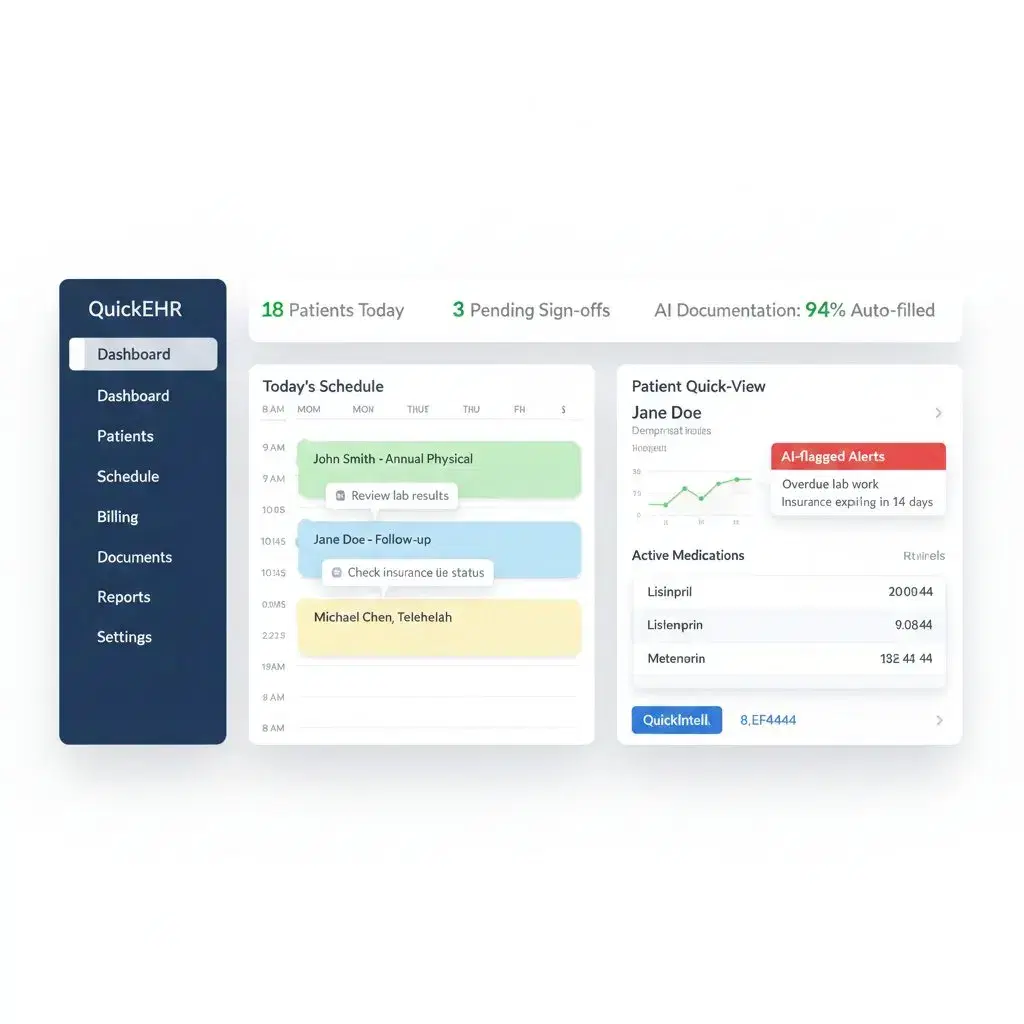
Addiction medicine software for SUD care and revenue workflows
Connect pre-visit coverage and authorization with clinician-reviewed SUD documentation, coding, specialty billing, claims, denials, and payment posting. QuickIntell keeps the work traceable across the source EHR while clinical and revenue-cycle teams retain the decisions that require their judgment.
Connect one reviewable path from scheduled service to payer follow-up.
A useful addiction medicine workflow preserves clinical, program, payer, and revenue context while making each review decision, exception owner, and escalation path visible.
Patient access
Resolve coverage, consent, and authorization gaps
Addiction medicine visits can involve sensitive SUD history, individual or group services, medication-assisted treatment context, lab follow-up, referrals, and payer rules. The workflow keeps those inputs visible before the encounter becomes a claim.
Use Eligibility Verification and Prior Authorization to route coverage, referral, authorization, consent, and program-enrollment exceptions.
Carry payer, plan, provider, location, appointment, and care-team details into the chart and billing worklist.
Assign unresolved items to patient access, clinical, authorization, or billing staff instead of silently clearing them.
Clinical workflow
Keep SUD treatment notes connected to reviewable evidence
AI Medical Scribe, Medical Coding, and Prior Authorization can prepare draft context while clinicians, coders, and staff retain the relevant approval points.
Document assessments, treatment plan updates, counseling context, medication history, lab follow-up, care coordination, and visit outcomes.
Prepare note summaries, code suggestions, and authorization evidence for clinician, coder, or staff review.
Keep sensitive SUD information, consent expectations, and routing rules explicit during implementation planning.
Revenue workflow
Move from encounter to claim, denial, payment, and AR follow-up
EHR Integration connects chart context to Specialty Billing, Denial Prevention, Claims, Payment Posting, and Denial Management worklists.
Review ICD-10, CPT, HCPCS, modifiers, units, provider, location, payer, authorization, and documentation context before claim release.
Route rejections, denials, payer requests, and follow-up through accountable work queues with a named escalation owner.
Connect remittance context to adjustment, underpayment, patient responsibility, and posting-exception review.
SUD intake and consent workflows
Organize intake history, consent expectations, referral source, coverage, and program enrollment details before documentation and billing begin.
MAT documentation context
Keep medication-assisted treatment notes, medication history, adherence context, counseling, lab follow-up, and care coordination visible for review.
Individual and group services
Support clinical and billing handoffs for evaluation visits, counseling, group services, care management, and recurring follow-up patterns.
Treatment-plan updates
Track goals, interventions, outcomes, relapse-risk notes, referrals, and payer-requested support in the same workflow as claims and authorization evidence.
AI should prepare work for review, not hide the review point.
QuickIntell can summarize, route, and prepare documentation, coding, authorization, claim, denial, and payment work while qualified staff retain the approval and escalation decisions.
Draft note and visit summaries
AI Medical Scribe can prepare reviewable summaries from encounter context while the clinician remains responsible for editing and attestation.
Code and claim readiness checks
Medical Coding can surface ICD-10, CPT, HCPCS, modifier, and documentation support for qualified coder review before charges move downstream.
Authorization and payer packet routing
Prior Authorization can organize missing evidence, summarize prepared context, and route authorization work to the responsible owner.
Denial and payment feedback loops
Payment Posting and Denial Management can turn payer responses, remittance exceptions, and denial reasons into reviewed follow-up queues.
EHR and payer integration
Define the data contract before enabling automation.
OpenEMR and other EHR environments do not all expose the same resources or write-back options. Integration discovery should identify the source of truth, the supported interface path, and what happens when a field is missing, stale, duplicated, or rejected.
Identify the EHR or practice management system that owns patient, schedule, encounter, charge, and payment data before mapping a workflow.
Approved interface path
Confirm which FHIR, API, HL7, EDI, clearinghouse, remittance, batch, or interface-engine paths are supported for the actual source system.
Write-back and exception plan
Define field mappings, update cadence, write-back scope, reconciliation, downtime steps, and the owner for missing, stale, duplicated, or rejected data.
Billing and practice management
Addiction medicine billing software needs the clinical story and the payer story.
Keep billing and practice-management work close to the source encounter so coders and billers can review the evidence behind each charge, claim, denial, posting exception, and patient balance before taking the next action.
Addiction medicine billing software workflows
Carry encounter, diagnosis, procedure, modifier, unit, provider, payer, authorization, and treatment-plan context into charge review.
Route rejected claims, payer status checks, CARC/RARC denial context, source evidence, and follow-up through Claims and Denial Management.
ERA and payment posting
Use Payment Posting to connect remittance files, adjustments, underpayments, denials, patient responsibility, and posting review.
Relevant modules
Configure the workflow around the systems and teams in scope.
These supported modules cover the connected path from EHR and coverage data through reviewed documentation, billing, claims, payment posting, and denial follow-up.
Move from observed workflow to controlled production use.
Start with the current process, validate representative records, compare prepared output with staff decisions, and expand automation only after the team agrees on interfaces, access rules, review points, escalation, and support ownership.
Security, compliance, and procurement teams can review current materials in the Trust Center. Any deployment-specific regulatory, certification, prescribing, payer, or procurement evidence should be verified in the current contract and implementation packet.
Addiction medicine implementation checklist
Use this before enabling AI-assisted workflows.
Identify the EHR or practice management system that owns patient, schedule, encounter, charge, claim, and payment data.
Map intake, consent, coverage, referral, authorization, documentation, coding, claim, denial, and remittance handoffs with a named owner for each exception.
Define approval points for AI-drafted notes, coding suggestions, authorization packets, pre-claim findings, denial worklists, and payment exceptions.
Confirm which approved FHIR, API, HL7, EDI, clearinghouse, remittance, batch, or interface-engine paths are available for the deployment.
Test representative individual, group, recurring, authorization-dependent, rejected, denied, and posting-exception scenarios before production use.
Record baseline exception categories, review role access and sensitive SUD data rules, and assign support and rollback ownership before go-live.
FAQs
Addiction medicine software questions
Answers for practices comparing addiction medicine, substance use disorder EHR, billing, and revenue-cycle workflows.
What is addiction medicine software?
Addiction medicine software supports the administrative and clinical handoffs used by addiction medicine, substance use disorder, MAT, and recovery-focused programs. Depending on deployment scope, that can include intake and coverage, authorization, documentation, coding, specialty billing, claims, denials, payment posting, and EHR integration.
How does it support SUD and MAT workflows?
A configured workflow can keep program enrollment, consent expectations, medication context, individual or group services, treatment-plan updates, lab follow-up, authorization windows, and billing details connected. The practice defines required fields, access rules, clinical review, and escalation steps during implementation.
Does QuickIntell support addiction medicine billing software workflows?
QuickIntell can connect encounter, coverage, authorization, coding, charge, claim, denial, ERA or EOB, payment posting, and follow-up context. Coders, billers, and payment staff retain the review and release decisions; the exact workflow depends on the source systems, payers, interfaces, and modules in scope.
Does AI replace clinician, coder, or biller review?
No. AI-assisted output is prepared work: clinicians review and attest documentation, qualified coders review code suggestions, billers control claim release, and revenue-cycle staff resolve payment and denial exceptions. Approval thresholds and escalation routes are configured for the deployment.
Can the workflow connect to OpenEMR or another EHR?
EHR Integration can be evaluated for OpenEMR or another source system when an approved interface path is available. Discovery should confirm supported resources, field mappings, update cadence, write-back scope, error handling, reconciliation, and downtime steps before production use.
How should an addiction medicine implementation be evaluated?
Start with a workflow and integration inventory, representative test cases, named human review points, access and consent requirements, exception ownership, support responsibilities, and baseline exception categories. Review current security, compliance, and procurement evidence in the Trust Center and deployment documents rather than assuming a certification or control applies to a specific setup.
Addiction medicine workflow review
Bring one representative case from intake through payment or denial.
Use a working session to identify source systems, missing handoffs, relevant modules, human checkpoints, integration dependencies, and a controlled implementation path.