Call
QuickEHR addiction medicine billing coding

Addiction medicine billing software for QuickEHR billing coding workflows

QuickIntell addiction medicine billing software connects OpenEMR-powered QuickEHR documentation, QuickScribe summaries, QuickCode review, QuickAuth evidence, claim scrubbing, QuickRCM worklists, and QuickERA remittance so SUD, MAT, and behavioral health billing teams can review the same encounter before claims go out.

SUD, MAT, counseling, and group-service billing context
QuickEHR billing coding on the OpenEMR foundation
QuickCode, QuickAuth, QuickRCM, and QuickERA handoffs

Encounter-to-remittance workflow

SUD documentation, coding, auth, claims, denials, ERA

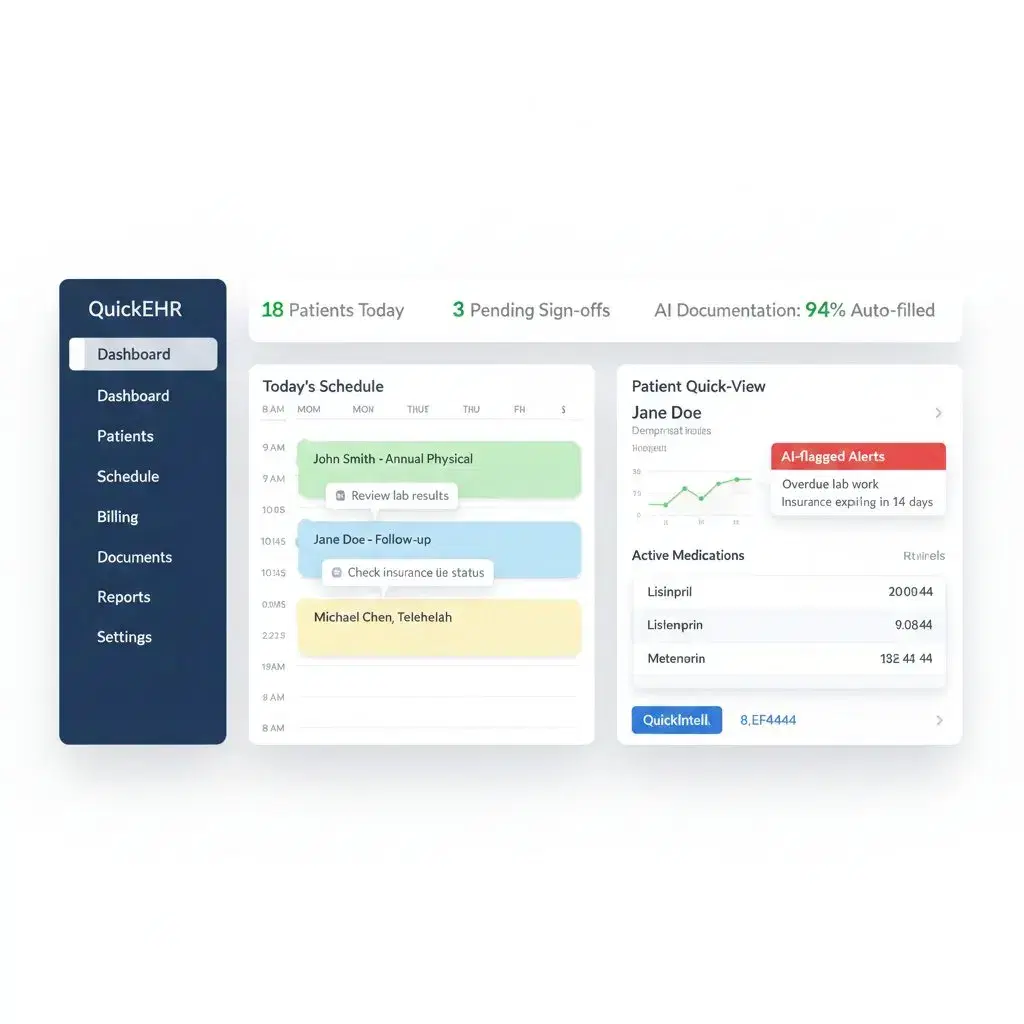
QuickEHR dashboard showing addiction medicine billing coding software context across documentation, authorization, claims, denials, and remittance

Code review

Evidence, holds

Claim readiness

Auth, scrub, send

Payment loop

Denials, ERA, AR

Workflow

Billing coding software workflow from intake to remittance

Search intent is commercial and practical. Addiction medicine teams need software that connects clinical documentation, payer requirements, code review, claim submission, denial recovery, and payment posting without forcing duplicate work.

Before the visit

Capture intake, eligibility, consent, and program context

Addiction medicine billing software has to start before the claim. QuickEHR keeps patient, payer, program, provider, location, referral, and authorization context close to the OpenEMR-powered chart so missing inputs can be routed early.

  • Review demographic, coverage, coordination-of-benefits, referral, and authorization gaps before services are documented.
  • Carry SUD intake, consent expectations, treatment program, appointment type, and care-team context into the encounter workflow.
  • Route intake, front desk, clinical, coding, authorization, and billing tasks without rebuilding the patient story.

During documentation

Keep clinical evidence tied to billing and coding review

SUD and MAT documentation often includes assessments, counseling, medication history, lab follow-up, treatment-plan updates, and care coordination. QuickEHR keeps that evidence available for review before charges move forward.

  • Use QuickScribe handoff where enabled so clinicians review cleaner visit summaries before coding work begins.
  • Keep treatment-plan support, session context, lab follow-up, medical-necessity notes, and payer-requested evidence visible.
  • Make sensitive SUD access, consent, and redisclosure rules part of implementation planning rather than hidden workflow assumptions.

Before claim release

Review codes, authorization evidence, and claim readiness

Medical billing and coding software should connect code review with payer evidence. QuickEHR can bring ICD-10, CPT, HCPCS, modifiers, units, diagnosis pointers, authorization windows, claim edits, and documentation support into one review queue.

  • Use QuickCode to prepare evidence-linked coding suggestions and exception cues for coder or clinician review.
  • Use QuickAuth context to keep approval numbers, service windows, referrals, and packet evidence near billing review.
  • Track coding holds, billing holds, missing documentation, claim edits, and released claims by owner.

After adjudication

Close the loop through denials, ERA, EOB, and AR follow-up

Behavioral health billing software becomes more useful when payer feedback improves the next claim. QuickRCM and QuickERA keep denial reasons, remittance exceptions, payment posting questions, and patient responsibility tied to the encounter.

  • Route rejections, denials, CARC/RARC context, payer notes, appeals, and AR follow-up through structured QuickRCM queues.
  • Use QuickERA to connect ERA and EOB context to adjustments, underpayments, denial routing, and posting review.
  • Turn repeated payer patterns into implementation rules for documentation, coding, authorization, or claim-review work.

Coding review

Substance abuse billing software needs specialty evidence

SUD billing, MAT follow-up, counseling, group services, and recurring care introduce documentation and payer details that generic claim workflows often miss. QuickEHR keeps those review points visible.

SUD diagnosis and visit support

Review diagnosis specificity, encounter reason, assessment context, treatment-plan updates, and source documentation before coding is released.

MAT and medication context

Keep medication history, adherence notes, counseling context, lab follow-up, and care coordination available when the encounter is reviewed.

Counseling and group-service logic

Preserve visit type, session context, provider, location, participant-level documentation, units, modifiers, and payer-specific review notes.

Authorization and referral evidence

Bring QuickAuth approvals, pending requirements, service windows, referral context, and missing-evidence queues into claim readiness.

Claim scrubber handoff

Review coverage, demographics, providers, locations, diagnosis pointers, CPT/HCPCS, modifiers, units, and attachments before submission.

Denial feedback for code patterns

Connect payer notes, denial reasons, corrected claims, and remittance exceptions back to documentation and coding worklists.

AI automation

AI EHR billing coding should stay review-gated

QuickIntell AI prepares, classifies, summarizes, and routes billing coding work. Implementation should define where staff, coders, clinicians, billing leads, and managers approve the next step.

Evidence-aware coding suggestions

AI medical coding software can prepare ICD-10, CPT, HCPCS, modifier, unit, and documentation-support cues while showing reviewers the source evidence to check.

Exception classification

Group work by missing documentation, authorization gap, diagnosis-procedure mismatch, modifier question, claim edit, denial reason, or remittance exception.

Claim readiness summaries

Summarize chart, payer, authorization, coding, charge, attachment, and owner context before claim release or corrected-claim repair.

Review-gated routing

Route AI-drafted summaries, coding suggestions, payer packets, denials, and payment exceptions to configured staff, coder, clinician, or manager checkpoints.

OpenEMR and QuickEHR fit

OpenEMR billing coding workflows need implementation scope, not disconnected tools.

QuickEHR is built on the OpenEMR foundation. That gives addiction medicine practices a practical route for managed OpenEMR-powered workflows while QuickIntell scopes the AI, billing, coding, claim, denial, and remittance automation that can safely run around the configured tenant.

QuickEHR-managed OpenEMR

QuickEHR is built on the OpenEMR foundation and adds QuickIntell workflow configuration around documentation, billing, coding, authorization, claims, denials, and remittance.

Existing OpenEMR addiction medicine tenants

Practices already running OpenEMR can evaluate approved FHIR, OpenEMR API, HL7, EDI, clearinghouse, remittance, file, and interface-engine paths for OpenEMR billing coding workflows.

QuickEHR Connect for mixed systems

Teams keeping another EHR or practice-management system can scope QuickIntell automation around the documentation, payer, claim, denial, and payment data available through approved interfaces.

Implementation and trust

Launch addiction medicine billing automation only after the boundaries are clear.

Addiction medicine billing and coding projects can touch sensitive SUD records, payer requirements, documentation support, authorization evidence, clearinghouse connections, remittance files, patient balances, and audit expectations. QuickIntell implementation planning defines which data is available, which AI outputs are review-only, which handoffs create downstream work, and who owns exceptions.

Billing coding implementation checklist

Use this before enabling AI-assisted workflows.

  • Choose QuickEHR-managed OpenEMR, an existing OpenEMR tenant, QuickEHR Connect around another EHR, or a hybrid workflow.
  • Map patients, intake, consent, coverage, referrals, authorizations, appointments, providers, locations, notes, diagnoses, procedures, charges, claims, ERA, EOB, denials, and patient balances.
  • Define review gates for QuickScribe summaries, QuickCode suggestions, QuickAuth packets, claim edits, denial worklists, ERA exceptions, and payment posting questions.
  • Scope addiction medicine code families, SUD and MAT documentation patterns, group-service rules, payer edits, claim scrubber checks, and corrected-claim ownership.
  • Confirm enabled OpenEMR API, FHIR, HL7, clearinghouse, EDI, payer, remittance, file, batch, or interface-engine paths for the deployment.
  • Map sensitive SUD consent, access control, segmentation, redisclosure, and audit workflows against the practice's legal and policy requirements.
  • Review current Trust Center materials, contract terms, implementation evidence, support ownership, and production readiness before go-live.

FAQs

Addiction medicine billing software questions

Short answers for teams comparing QuickEHR billing coding, OpenEMR billing coding, behavioral health billing software, AI medical coding software, and substance abuse billing software.

What is addiction medicine billing software?

Addiction medicine billing software helps SUD, MAT, counseling, recovery, and addiction treatment teams connect documentation, code review, authorization evidence, charges, claim scrubbing, denials, ERA/EOB review, payment posting, and AR follow-up. QuickIntell connects those workflows through OpenEMR-powered QuickEHR, QuickCode, QuickAuth, QuickRCM, and QuickERA.

How is QuickEHR different from generic medical billing and coding software?

Generic medical billing and coding software may focus on claim forms or code lookup. QuickEHR keeps addiction medicine chart context, SUD documentation, payer evidence, coding review, claim edits, denial reasons, and remittance feedback in one implementation workflow.

Can QuickEHR support substance abuse billing software needs?

QuickEHR can be scoped for substance abuse billing software workflows such as intake, consent routing, SUD history, counseling notes, MAT documentation context, treatment-plan updates, authorization evidence, code review, claim readiness, denials, and payment posting when the required workflows and interfaces are configured.

Does QuickEHR support OpenEMR billing coding workflows?

Yes. QuickEHR is built on the OpenEMR foundation. Practices can evaluate QuickEHR-managed OpenEMR workflows or an existing OpenEMR tenant when approved FHIR, OpenEMR API, HL7, EDI, clearinghouse, remittance, file, batch, or interface-engine paths are available.

How does AI medical coding software fit this workflow?

QuickCode can prepare evidence-linked ICD-10, CPT, HCPCS, modifier, unit, and documentation-support cues for review. AI medical coding software should support staff, coder, clinician, and manager review gates rather than bypass them.

Can QuickAuth help with addiction treatment claim readiness?

QuickAuth can help organize payer requirements, approval numbers, service windows, referrals, packet evidence, and missing-documentation tasks so authorization context is available before billing and claim review.

Can QuickEHR connect denials and ERA feedback to coding?

Yes. QuickRCM can route rejections, denials, appeals, corrected claims, and AR worklists, while QuickERA can connect ERA and EOB context to payment posting, adjustment review, underpayment questions, denial routing, and patient responsibility.

Does this page make certification or compliance claims?

No. This page describes workflow planning and implementation scope. Review the current Trust Center, contract, and implementation packet for the security, compliance, regulatory, prescribing, certification, and procurement evidence required for a specific deployment.
QuickEHR billing coding workflow

Scope addiction medicine billing, coding, claims, denials, and remittance in one connected workflow.

Start with the EHR and payer context you already have, then map where QuickEHR, QuickScribe, QuickCode, QuickAuth, QuickRCM, and QuickERA can reduce duplicate work while keeping review gates explicit.