Healthcare scheduling and patient access
Coordinate provider calendars, appointment types, patient registration, intake status, portal activity, reminders, and no-show follow-up before the visit starts.
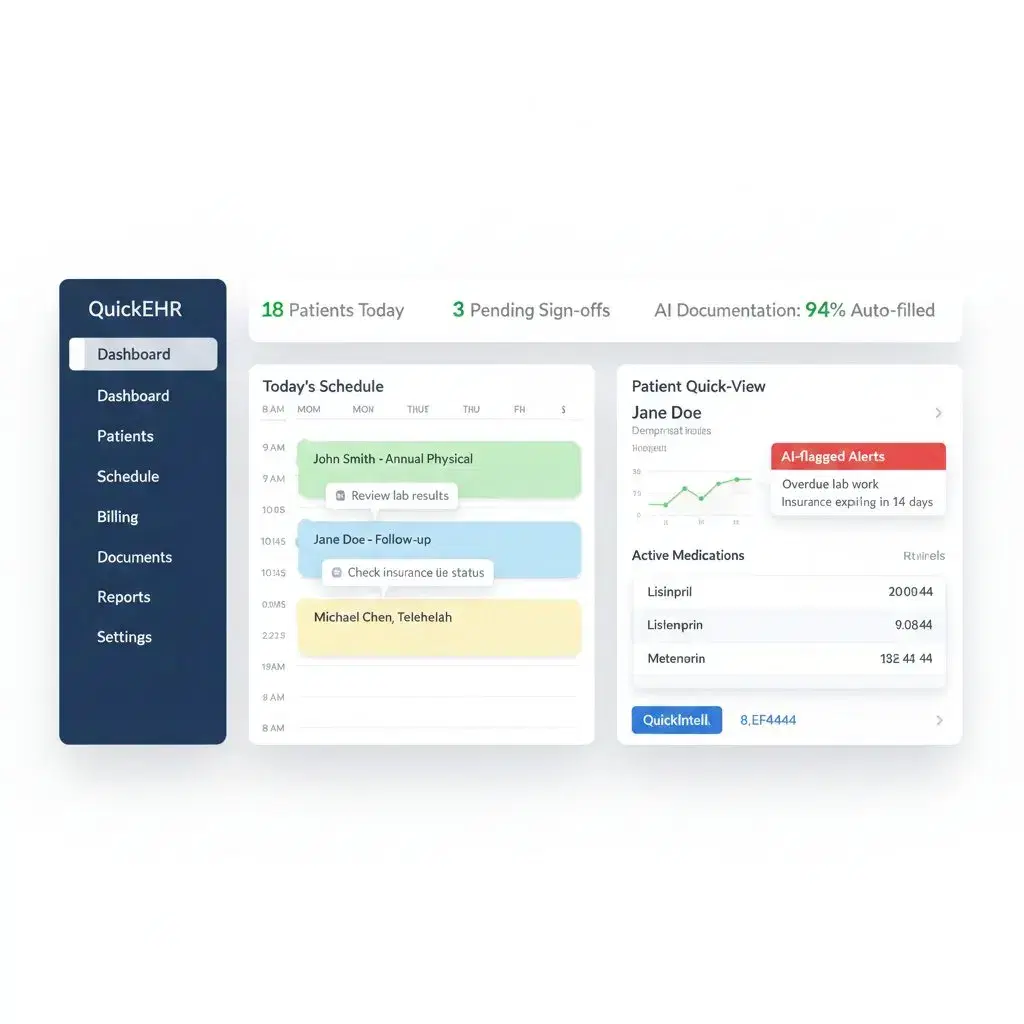
QuickEHR medical practice management software connects the day-to-day operating work around an ambulatory clinic: scheduling, registration, intake, eligibility, authorization readiness, documentation handoff, coding review, billing, claims, payments, denials, QuickRCM, QuickERA, and reviewable AI automation.

QuickEHR practice workspace
Patient access, chart, payer, claim, remittance
Patient access
Schedule, intake, eligibility
Billing prep
Docs, codes, charges
RCM follow-up
Claims, ERA, denials
Buyer fit
Medical practice management software has to manage the operating work around the chart: access, intake, payer readiness, documentation handoff, billing, claims, payments, denials, reporting, and patient communication.
Coordinate provider calendars, appointment types, patient registration, intake status, portal activity, reminders, and no-show follow-up before the visit starts.
Keep coverage checks, subscriber details, referrals, prior authorization evidence, payer requirements, and visit readiness exceptions visible for staff review.
Connect QuickEHR chart context with QuickScribe and QuickCode review points so billing teams can work from clearer documentation and coding evidence.
Move reviewed visits into charge capture, claim scrubbing, electronic claims, payments, ERA review, denials, AR follow-up, and patient balance workflows.
Review operational work by provider, location, payer, appointment status, intake gap, denial reason, AR aging bucket, owner, and queue status.
Use AI to classify exceptions, summarize context, draft work packets, and route queues while preserving staff, clinician, coder, and billing review.
Practice workflow
QuickEHR keeps healthcare practice management, EHR context, medical billing software workflows, and revenue cycle management software handoffs close enough that teams can act without reconstructing the encounter.
Front office
Medical practice management software should make the appointment operationally ready. QuickEHR keeps the schedule, patient profile, coverage, intake, provider, location, and visit requirements in one workflow.
Encounter handoff
EHR practice management software works best when documentation, coding, authorization, and charge review are tied to the encounter instead of scattered across separate tools.
Revenue loop
Practice management software for healthcare has to carry work through billing and revenue cycle management without losing the visit story that created the claim.
AI EHR practice management
For teams comparing AI practice management software or AI EHR practice management software, QuickIntell focuses on classification, summaries, routing, and work preparation with reviewable checkpoints.
Summarize schedule, patient, payer, intake, authorization, chart, coding, and billing context so teams know what needs review before care or claim release.
Group open work by scheduling issue, intake gap, eligibility exception, authorization blocker, documentation need, claim problem, denial, or payment exception.
Prepare handoffs for front desk, clinician, coder, biller, RCM specialist, and payment poster without allowing automation to replace required judgment.
Use denials, rejections, remittance exceptions, and patient balance trends to improve intake, authorization, documentation, coding, and billing workflows.
OpenEMR and QuickEHR fit
QuickEHR can be a managed OpenEMR-powered EHR or a connected workflow layer around an existing system. In either model, OpenEMR practice management software planning should account for schedule, patient, payer, chart, authorization, billing, claim, denial, remittance, and patient balance context.
QuickEHR is built on the OpenEMR foundation and adds QuickIntell workflow configuration around scheduling, patient access, documentation, coding, billing, RCM, and ERA follow-through.
Practices already using OpenEMR can evaluate approved API, FHIR, HL7, EDI, clearinghouse, remittance, batch, or interface-engine paths for practice management context.
Clinics keeping another EHR or practice management system can scope QuickEHR Connect as the workflow layer around patient access, billing, claims, denials, and remittance when interfaces are available.
Related QuickIntell products
Medical practice management software rarely succeeds as an isolated module. QuickEHR connects the workflows that sit between appointment readiness, clinical documentation, coding, authorization, billing, claims, ERA, and RCM follow-up.
QuickEHR
Use QuickEHR as the OpenEMR-powered chart, schedule, patient access, billing, and practice workflow layer.
QuickScribe
Draft visit documentation for clinician review so coding, authorization, billing, and RCM teams have clearer encounter context.
QuickCode
Bring ICD-10, CPT, HCPCS, modifier, and HCC suggestions into charge review and claim readiness workflows.
QuickAuth
Connect payer requirements, approved service windows, referral details, and packet evidence to visit and billing readiness.
QuickRCM
Coordinate claims, denials, AR follow-up, eligibility exceptions, patient balances, and payment questions with structured ownership.
QuickERA
Connect ERA and EOB context to payment posting, adjustment review, underpayments, denials, and patient responsibility workflows.
Use these pages to drill into the parts of practice management that usually drive software evaluation: scheduling, billing, claims, eligibility, patient portal, and OpenEMR fit.
Review the broader QuickEHR practice management workflow across scheduling, intake, billing, RCM, ERA, and reporting.
Coordinate provider calendars, appointment types, reminders, waitlists, self-scheduling, and visit readiness.
Connect charge capture, claim review, electronic claims, denials, AR follow-up, payments, and patient balances.
Prepare, submit, track, repair, and follow up on claims with chart, coding, authorization, and remittance context.
Use coverage checks and patient access exceptions to reduce preventable scheduling, authorization, and billing rework.
Review OpenEMR API, FHIR, HL7, and interface paths for QuickIntell workflows around the EHR and practice operations.
Practice management software and medical billing software for small practices should connect to revenue cycle, patient access, AR, payment, and reporting decisions.
AI-assisted revenue cycle workflows across eligibility, coding, claims, denials, AR, payments, and reporting.
Connect patient access, intake, messages, documents, payments, and follow-up activity to the practice workflow.
Coordinate aging AR, payer status, denials, patient balances, payment exceptions, and owner queues.
Review practice management reporting, medical billing analytics, RCM analytics, and OpenEMR-powered data scope.
Connect QuickEHR encounter context to reviewable ICD-10, CPT, HCPCS, modifier, and HCC coding workflows.
Plan patient payments, payment posting, remittance review, balances, and statement-related workflows.
Implementation and trust review
Practice management software touches front-office operations, clinical handoff, billing, payer workflows, patient balances, and reporting. QuickEHR implementations should define enabled interfaces, user roles, AI review gates, and support ownership before go-live.
Review the QuickIntell Trust Center for security and procurement review material, then confirm deployment-specific evidence in the implementation packet.
Practice management priorities vary by specialty. These pages show how QuickIntell products connect documentation, authorization, coding, RCM, and patient workflows for common ambulatory settings.
FAQs
Short answers for teams comparing medical practice management software, EHR practice management software, OpenEMR practice management, medical billing software, and AI-enabled workflows.
QuickEHR medical practice management software is the QuickEHR workflow for scheduling, patient registration, intake, eligibility, authorization readiness, documentation handoff, coding review, billing, claims, payments, denials, AR follow-up, patient balances, and reporting. It is built around QuickEHR's OpenEMR-powered clinical and operational context.
An EHR focuses on clinical records and charting. Practice management software focuses on operating the practice: scheduling, registration, coverage, billing, claims, payments, denials, patient communications, and reporting. QuickEHR connects both sides so teams can use appointment, chart, payer, and billing context together.
Yes. QuickEHR can support medical billing software for small practices through charge review, claim scrubbing, electronic claims, payment posting, denials, AR follow-up, patient balances, and reporting when those workflows are configured for the deployment. QuickRCM and QuickERA add deeper revenue cycle and remittance support.
QuickEHR is built on the OpenEMR foundation. Practices can use QuickEHR-managed OpenEMR workflows or connect an existing OpenEMR tenant when approved API, FHIR, HL7, EDI, clearinghouse, remittance, batch, or interface-engine paths are available.
QuickIntell AI can help classify exceptions, summarize visit readiness, prepare work packets, route queues, and highlight billing or RCM follow-up needs. The implementation should define which tasks require staff, clinician, coder, biller, or RCM review before action.
Practices keeping another EHR or practice management system can evaluate QuickEHR Connect. That path is intended to route patient access, documentation, coding, authorization, billing, claim, denial, remittance, and patient follow-up context around an existing system of record when approved interfaces are available.
QuickEHR anchors the chart and practice workflow. QuickScribe supports documentation handoff, QuickCode supports coding review, QuickAuth supports authorization evidence, QuickRCM supports claims and AR follow-up, and QuickERA connects remittance and payment posting context.
Review scheduling rules, intake forms, payer routing, eligibility workflows, authorization evidence, documentation and coding handoffs, charge sources, claim edits, ERA/EOB handling, patient balance rules, reporting needs, user roles, access controls, support ownership, and which AI suggestions require review.
No. This page describes medical practice management workflow planning. QuickEHR is built on the OpenEMR foundation, and any regulatory, security, certification, payer, or procurement evidence should be verified in the current implementation packet and contract for the specific deployment.
Plan scheduling, intake, eligibility, authorization, clinical documentation, coding, billing, claims, payments, denials, AR, reporting, and AI work preparation in one QuickEHR implementation conversation.