Call
QuickEHR for cardiology

Cardiology EHR software for cardiac practice workflows

QuickEHR cardiology EHR software connects OpenEMR-powered patient charts, cardiac visit documentation, diagnostic-test context, QuickScribe note drafting, QuickCode review, QuickAuth payer evidence, QuickRCM denial queues, and QuickERA remittance context so clinical and revenue teams work from the same encounter.

Echo, stress, cath, EP, device, and vascular context
OpenEMR-powered QuickEHR chart and practice workflow
AI handoffs to notes, coding, auth, RCM, and ERA review

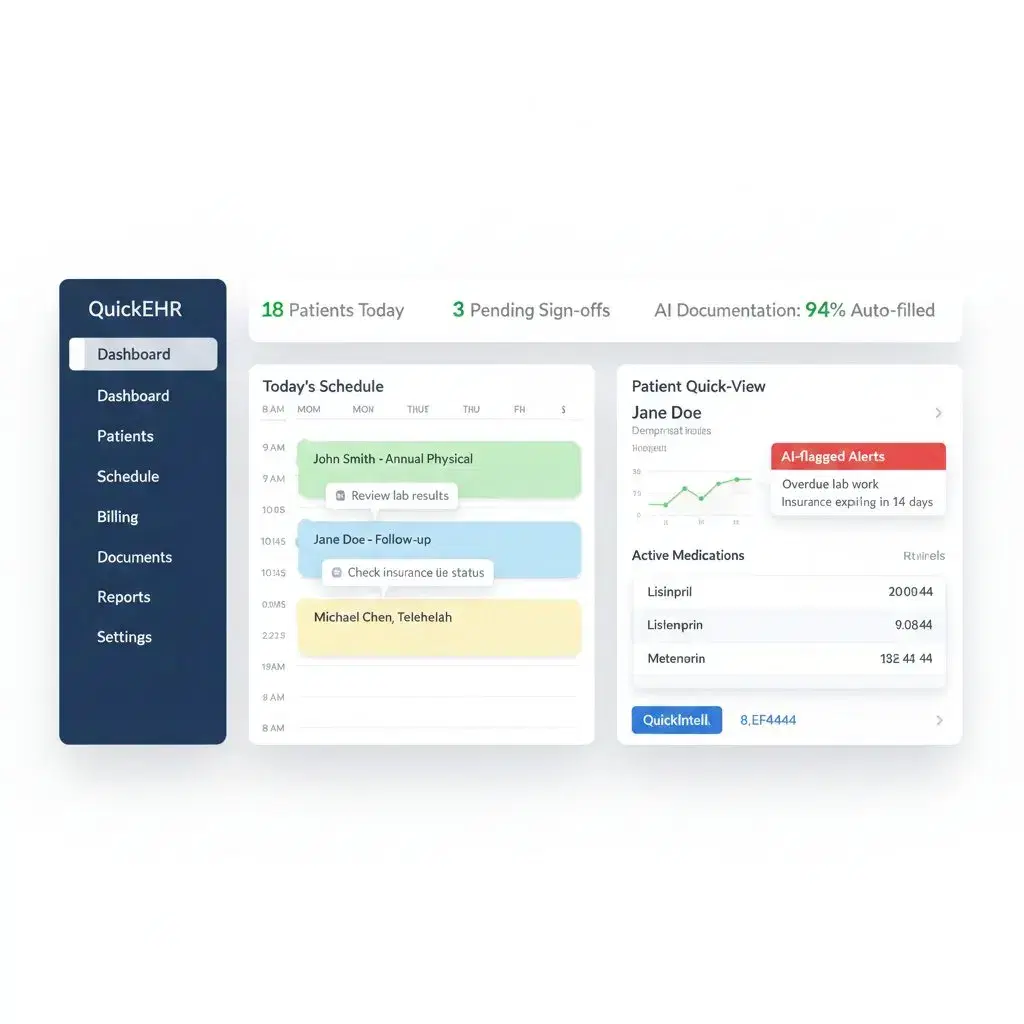
QuickEHR cardiology workspace

Chart, cardiac documentation, AI review, billing, and RCM

QuickEHR dashboard for cardiology EHR documentation billing and RCM workflows

Patient chart

Visits, tests, reports

AI review

Notes, code, auth packets

Revenue handoff

Claims, denials, ERA

EHR workflow

A cardiology EHR should carry the cardiac encounter forward.

Searchers comparing cardiology EHR software are usually evaluating more than charting. The page has to answer how the EHR supports intake, diagnostic context, documentation, authorization, billing, claims, denials, and payment operations.

Before the visit

Prepare schedule, coverage, referral, and test context

Cardiology EHR software has to start before the encounter. QuickEHR keeps appointment, patient, payer, provider, location, referral, and diagnostic context close to the OpenEMR-powered chart.

  • Review demographics, eligibility, coordination-of-benefits, referral, prior authorization, and missing intake details before the patient arrives.
  • Carry visit type, cardiac test, rendering provider, facility, location, payer, and task ownership into the encounter workflow.
  • Route front desk, clinical, authorization, coding, billing, and follow-up work from the same patient and encounter context.

During documentation

Keep cardiac notes connected to reviewable evidence

Cardiology EMR software should preserve the facts reviewers need later, including symptoms, diagnoses, test reports, medical necessity, device details, procedure context, and payer-specific support.

  • Organize office visits, echo, stress testing, ECG/EKG, vascular studies, EP, cath-lab, and device follow-up context around the same chart record.
  • Keep clinician review gates explicit for QuickScribe summaries, QuickCode cues, QuickAuth packets, and claim-readiness checks.
  • Support recurring cardiology patterns without separating clinical notes from authorization, charge, claim, and denial context.

After the encounter

Move test follow-up and payer evidence to the right owner

Cardiology teams often need signed reports, medical-necessity support, image or device references, missing modifiers, authorization evidence, and corrected encounter details before claims are released.

  • Track missing documentation, test-report status, service-window questions, referral details, and payer packet gaps by owner.
  • Use QuickAuth to organize authorization evidence, clinical packet context, payer rules, and follow-up tasks when data paths support it.
  • Keep open work visible instead of spreading cardiac follow-up across spreadsheets, inboxes, portals, and unsupported side processes.

Revenue workflow

Connect chart context to cardiology billing and RCM review

Search demand around cardiology EHR software overlaps with cardiology billing software. QuickEHR connects the chart, coding, claim review, denial routing, ERA, payment posting, and AR workflow into one operating model.

  • Review diagnosis support, CPT, HCPCS, modifiers, units, provider, location, payer, authorization, and documentation evidence before claim release.
  • Route rejections, denials, corrected claims, appeals, payer follow-up, underpayment questions, and aging balances through QuickRCM queues.
  • Use QuickERA to connect remittance context to payment posting, adjustment review, denial routing, and patient responsibility.

Cardiology charting

Cardiac documentation needs operational context around it.

Cardiology EMR software and cardiology practice management software need to keep clinical, diagnostic, payer, and claim context close enough that reviewers do not have to reconstruct the encounter after care is delivered.

Cardiac visit context

Keep chief complaint, history, cardiac risk factors, medications, assessment, plan, order context, payer details, and follow-up ownership close to the encounter.

Diagnostic test workflow

Organize ECG/EKG, echo, stress testing, vascular studies, imaging references, report status, authorization needs, and claim-support details for reviewer workflows.

Cath-lab and EP context

Preserve procedure, laterality, device, lead, stent, generator, modifier, supply, charge, and documentation context for human review before billing.

Device follow-up and monitoring

Connect device-check context, remote monitoring references, recurring visits, payer evidence, and missing-documentation tasks when supported by the deployment data paths.

Cardiology practice management

Support scheduling, eligibility, patient flow, prior authorization ownership, billing queues, reporting, multi-location operations, and provider productivity views.

Cardiology revenue cycle management

Tie cardiology medical billing software needs to coding review, claims, denials, appeals, ERA feedback, underpayment questions, and AR follow-up.

OpenEMR and QuickEHR fit

OpenEMR EHR software foundation, QuickIntell workflow layer.

QuickEHR is built on the OpenEMR foundation. QuickIntell then scopes the implementation, AI automation, integrations, review gates, and operating workflows that cardiology teams need around documentation, coding, authorization, billing, denials, and payment posting.

QuickEHR on the OpenEMR foundation

QuickEHR is built on the OpenEMR foundation and adds QuickIntell-managed configuration, support, integrations, and AI workflow design around the EHR.

Existing OpenEMR cardiology tenants

Practices already running OpenEMR can evaluate approved FHIR, OpenEMR API, HL7, EDI, clearinghouse, remittance, batch, file, or interface-engine paths.

QuickEHR Connect for mixed systems

Teams keeping another EHR, cardiology system, or practice management platform can scope automation around the available chart, payer, claim, denial, and payment data.

Implementation and trust

Scope the cardiology workflow before go-live.

Cardiology implementation decisions affect clinical documentation, diagnostic context, billing evidence, payer workflows, and staff ownership. QuickIntell scopes those decisions with the practice instead of treating them as generic EHR preferences.

Review the Trust Center, contract terms, and implementation packet for the current security, compliance, regulatory, prescribing, certification, and procurement evidence required for a specific deployment.
Implementation checklist

  • Choose QuickEHR-managed OpenEMR, an existing OpenEMR tenant, QuickEHR Connect around another EHR, or a hybrid workflow.
  • Map scheduling, referrals, eligibility, authorizations, orders, notes, reports, diagnoses, procedures, charges, claims, ERA, EOB, denials, and patient balances.
  • Define review gates for QuickScribe summaries, QuickCode suggestions, QuickAuth packets, claim edits, denial worklists, ERA exceptions, and payment posting questions.
  • Scope echo, stress, ECG/EKG, vascular, cath-lab, EP, device, remote-monitoring, modifier, medical-necessity, and payer-edit workflows for the practice.
  • Confirm enabled OpenEMR API, FHIR, HL7, clearinghouse, EDI, payer, remittance, file, batch, or interface-engine paths for the deployment.
  • Document which cardiac diagnostics, reports, device references, and external cardiology systems are in scope, read-only, imported, or manually reviewed.
  • Review current Trust Center materials, contract terms, implementation evidence, support ownership, and production readiness before go-live.

FAQs

Cardiology EHR software questions

Short answers for practices comparing QuickEHR cardiology, cardiology EMR software, OpenEMR EHR software, AI EHR software, cardiology practice management software, and cardiology billing software.

What is cardiology EHR software?

Cardiology EHR software helps cardiology practices manage patient charts, diagnostic-test context, procedure documentation, referrals, prior authorization, coding, billing, claims, denials, payment posting, and follow-up workflows. QuickEHR brings those workflows into an OpenEMR-powered QuickIntell operating model.

How does QuickEHR support cardiology EMR software workflows?

QuickEHR can support cardiology EMR software workflows such as scheduling, intake, cardiac visit documentation, echo and stress-test context, ECG/EKG references, vascular studies, cath-lab or EP details, device follow-up, authorization evidence, billing review, and RCM worklists when those workflows are configured for the deployment.

Is QuickEHR built on OpenEMR for cardiology practices?

QuickEHR is built on the OpenEMR foundation. Practices can evaluate QuickEHR-managed OpenEMR workflows or an existing OpenEMR cardiology tenant when approved FHIR, OpenEMR API, HL7, EDI, clearinghouse, remittance, batch, file, or interface-engine paths are available.

Can QuickEHR support cardiology practice management software needs?

QuickEHR can be scoped around cardiology practice management software needs such as scheduling, eligibility, referral and authorization tracking, patient flow, provider and location context, task ownership, billing worklists, reporting, and multi-location workflows.

Does QuickEHR include cardiology billing software workflows?

QuickEHR can support cardiology billing software workflows by keeping encounter, diagnosis, procedure, modifier, coverage, authorization, charge, claim, denial, ERA, payment posting, and AR context connected to the chart and practice management worklists.

How does AI EHR software fit cardiology workflows?

QuickIntell frames AI as assistive automation. QuickScribe can draft documentation for review, QuickCode can prepare coding cues, QuickAuth can organize payer evidence, QuickRCM can route denials and AR, and QuickERA can connect remittance context. Review gates remain part of the implementation design.

Can QuickEHR connect cardiology diagnostics such as ECG, echo, stress, cath-lab, or device data?

Those workflows are implementation-specific. QuickIntell scopes which diagnostic reports, references, device details, external cardiology systems, interfaces, files, or manual review steps are available through approved data paths before production use.

Is this a fit for best cardiology EHR searches?

This page is built for practices comparing cardiology EHR software, cardiology EMR software, and best cardiology EHR options. QuickEHR is most relevant when the practice wants an OpenEMR-powered EHR foundation with QuickIntell AI workflows around documentation, coding, authorization, billing, claims, denials, and ERA review.

Can QuickEHR support cardiology revenue cycle management work?

Yes. QuickEHR can connect cardiology revenue cycle management workflows across claim readiness, payer edits, denials, appeals, corrected claims, ERA exceptions, payment posting, underpayment questions, patient balances, and AR follow-up when deployment data paths support those steps.

Can QuickEHR connect to another EHR or practice management system?

Yes. Practices can evaluate QuickEHR Connect around another EHR or practice management system when approved API, FHIR, HL7, EDI, batch, payer, clearinghouse, remittance, or interface-engine paths are available for the deployment.

Does this page make certification or compliance claims?

No. This page describes workflow planning and implementation scope. Review the current Trust Center, contract, and implementation packet for the security, compliance, regulatory, prescribing, certification, and procurement evidence required for a specific deployment.

QuickEHR cardiology

Plan an OpenEMR-powered cardiology EHR workflow with AI-assisted operations around it.

Walk through cardiac documentation, diagnostic context, coding, authorization, claims, denials, ERA, payment posting, and practice-management handoffs with the QuickIntell team.

Schedule a workflow review