Call
EHR reporting software

EHR reporting software for QuickEHR billing, RCM, and practice performance

QuickEHR reporting gives practices EHR reporting software for OpenEMR-powered chart, schedule, patient, payer, billing, claim, denial, remittance, AR, and workflow visibility, with QuickIntell AI support for summaries and reviewable work queues.

Scope: clinical, PM, billing, RCM
Source: OpenEMR-powered workflows
AI role: reviewed summaries and routing

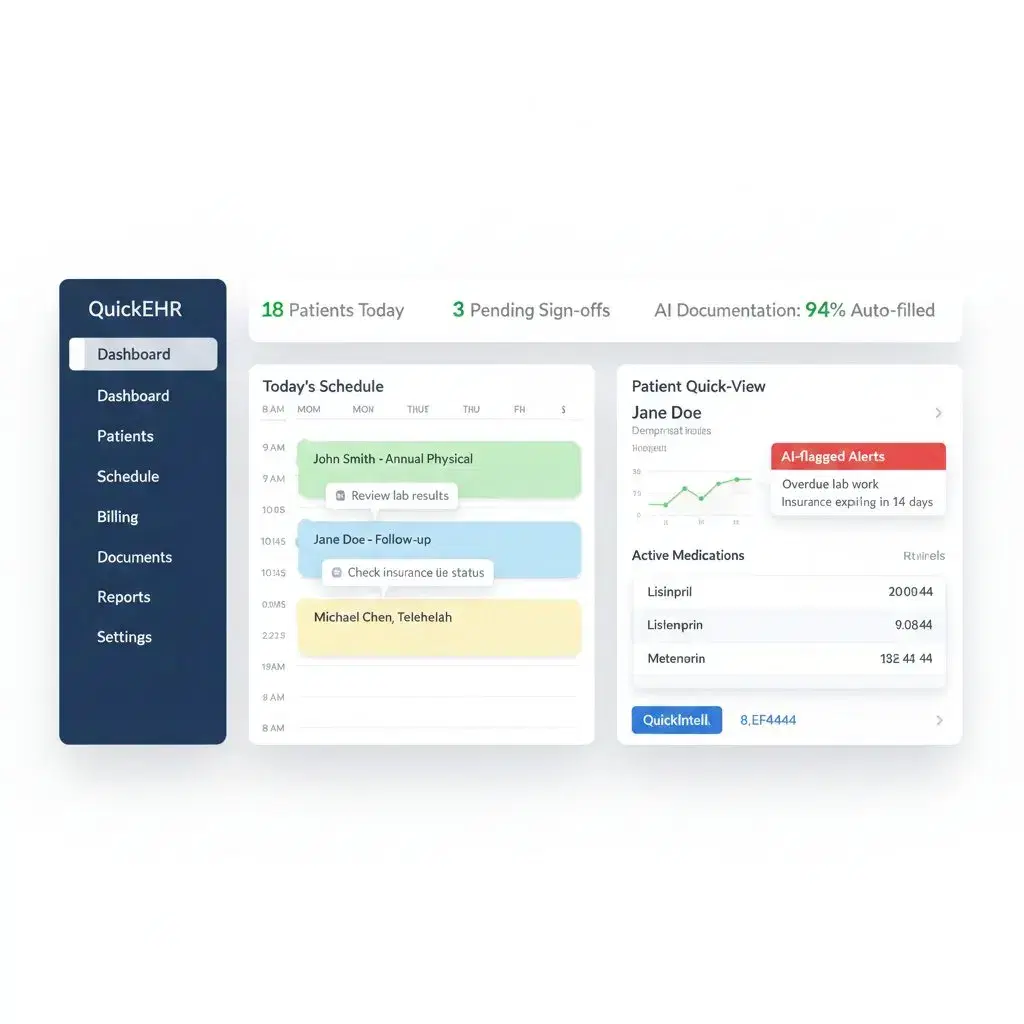
QuickEHR reporting workspace

Reports, queues, AI summaries, and revenue cycle context

QuickEHR reporting workspace showing EHR reporting software for billing, RCM, and practice management reports

Practice reports

Schedules, flow, queues

Billing analytics

Claims, AR, ERA

AI review

Summaries, flags, routing

Reporting workflow

Build reports around the work teams actually need to finish.

Search intent for EHR reporting software and medical billing reporting software expects more than charts. Practices need the data lineage, owner, and next action behind each schedule, chart, claim, denial, payment, or patient balance metric.

Define

Start with a report question and a trusted owner

EHR reporting software only works when every metric has a clear source, a decision owner, and a path back to the patient, provider, payer, or claim record that created the signal.

  • Define the report question, numerator, denominator, filters, refresh cadence, and owner before teams act on a chart or export.
  • Scope provider, location, payer, visit type, appointment, encounter, code, claim, denial, ERA, AR, and patient balance dimensions.
  • Separate source-of-truth fields from AI-prepared summaries, labels, and routing suggestions.

Connect

Keep the visit-to-payment trail visible

QuickEHR reporting keeps clinical, practice management, medical billing, and revenue cycle context close enough that teams can understand why a number changed and what needs review next.

  • Connect scheduling, registration, eligibility, documentation, coding, prior authorization, claims, denials, remittance, and follow-up context.
  • Move from a KPI into the related QuickEHR chart, QuickCode review, QuickAuth packet, QuickRCM worklist, or QuickERA remittance exception when configured.
  • Use reports to expose bottlenecks instead of forcing staff to reconcile spreadsheets against the EHR by hand.

Act

Turn reporting into reviewed work queues

The goal is not more dashboards. QuickIntell helps practices use reporting software to route exceptions, summarize patterns, and improve workflows while preserving human review for clinical, coding, billing, and operational decisions.

  • Route report findings to front office, clinical, coding, prior authorization, billing, payment posting, denial, AR, or leadership owners.
  • Track aging, status, payer, provider, location, dollar exposure, documentation dependency, and next action in the same operating model.
  • Use closed work, denial outcomes, payment exceptions, and patient access fixes as feedback for better reports.

Report types

Cover clinical, practice management, billing, and RCM reporting in one operating model.

QuickEHR reporting is meant to help teams understand where work is stuck, which payer or workflow pattern is growing, and which owner should review the next item. That requires healthcare reporting software that respects the chart, appointment, claim, payment, and patient balance context.

For the report library and scheduled exports, review QuickEHR report center. For KPI modeling and leadership dashboards, see QuickEHR business intelligence. For live queue views, see the QuickEHR dashboard.

Clinical reporting software

Review unsigned notes, draft documentation, order follow-up, message queues, care gaps, referrals, quality-program inputs, and provider review needs.

Medical practice management reports

Track scheduling demand, no-show patterns, patient flow, registration gaps, provider utilization, location performance, and front-office queue aging.

Medical billing reporting software

Connect charge readiness, claim status, rejections, denials, patient balances, payment posting, underpayments, and billing-owner queues.

Revenue cycle reporting software

Use QuickRCM context for eligibility issues, authorization blockers, payer follow-up, CARC/RARC patterns, AR aging, appeal workload, and collections risk.

ERA and payment analytics

Use QuickERA context for remittance, EOB, adjustment, takeback, patient responsibility, unapplied cash, and payment variance reporting.

EHR analytics reporting

Summarize operational and clinical performance by provider, payer, location, specialty, schedule type, queue, work owner, and aging band.

AI EHR reporting

Use AI to explain patterns, not to remove review.

QuickIntell applies AI to reporting as assistive workflow support: summaries, natural-language questions, anomaly flags, and owner-based routing. Teams keep the decision points for clinical, coding, billing, compliance, and operational action.

Natural-language questions

Ask reviewed questions about EHR reporting data, queue growth, payer behavior, claim aging, documentation bottlenecks, remittance exceptions, and location variation.

Plain-language summaries

Draft summaries that explain what moved in a report, which payer or workflow issue changed, and what a staff owner should review next.

Anomaly detection

Flag unusual patterns such as late charges, stale claims, denial spikes, missing authorizations, unposted payments, volume swings, or patient balance outliers.

Owner-based routing

Classify report rows by likely owner and next action while keeping approvals explicit for clinical notes, codes, claims, appeals, write-offs, or patient communication.

OpenEMR and QuickEHR fit

Scope OpenEMR reporting around the deployment path.

QuickEHR is built on the OpenEMR foundation. A reporting project should define whether the practice is using QuickEHR-managed OpenEMR, connecting an existing OpenEMR environment, or routing reports around another EHR and practice management system.

QuickEHR-managed OpenEMR reporting

QuickEHR is built on the OpenEMR foundation and adds QuickIntell workflow configuration for reporting across charts, schedules, billing, RCM, ERA, and AI-assisted review.

Existing OpenEMR environments

Practices already using OpenEMR can evaluate approved API, FHIR, HL7, EDI, clearinghouse, remittance, file, or interface-engine paths for reporting scope.

QuickEHR Connect for other systems

Clinics keeping another EHR or practice management system can evaluate QuickEHR as a reporting and workflow layer around approved source-system data.

Implementation and trust

Define reporting governance before teams rely on the numbers.

Reporting software touches patient data, provider productivity, payer workflows, claims, payments, patient balances, AI summaries, and leadership review. QuickEHR implementation should make data sources, access, exports, review gates, and accountability explicit.

Security, procurement, and compliance teams can start with the Trust Center, then verify any implementation-specific evidence in the current contract and deployment packet.

Reporting launch checklist

Use this before exposing reports to operations teams.

Select QuickEHR-managed OpenEMR, an existing OpenEMR tenant, or QuickEHR Connect around another EHR or practice management system.

Map source tables, interfaces, file drops, clearinghouse feeds, ERA/EOB inputs, payer status data, export rules, and refresh cadence.

Define each metric with numerator, denominator, filters, trusted source, owner, workflow action, and exception handling.

Confirm which AI features may summarize, classify, prioritize, explain, or route report findings before staff review.

Review role-based access, PHI exposure, audit expectations, export permissions, patient-facing language, and support ownership.

Validate reports with sample patients, appointments, encounters, charges, claims, denials, payments, reversals, and edge cases before launch.

FAQs

QuickEHR reporting questions.

These answers cover EHR reporting software, QuickEHR reporting, OpenEMR reporting, AI EHR reporting, medical billing reporting software, and implementation review.

What is EHR reporting software in QuickEHR?+

EHR reporting software in QuickEHR helps practices define, review, and act on reports across OpenEMR-powered charting, scheduling, practice management, medical billing, claims, denials, AR, remittance, patient balances, and clinical workflow data.

For the broader EHR platform, see QuickEHR.

How is QuickEHR reporting different from generic reporting software?+

Generic reporting software usually focuses on dashboards and exports. QuickEHR reporting is designed around healthcare workflows, so reports stay connected to patient charts, providers, locations, payers, appointments, codes, claims, denials, ERA/EOB details, and reviewable work queues.

Can QuickEHR support medical billing reporting software needs?+

QuickEHR can support medical billing reporting software workflows for charge readiness, claim status, claim rejections, denials, CARC/RARC patterns, AR aging, payer follow-up, ERA/EOB handling, payment posting exceptions, underpayments, and patient balances when those data paths are configured.

How does OpenEMR reporting fit with QuickEHR?+

QuickEHR is built on the OpenEMR foundation. Reporting can be scoped for QuickEHR-managed OpenEMR workflows or, when approved connections are available, an existing OpenEMR environment using API, FHIR, HL7, EDI, clearinghouse, remittance, file, or interface-engine paths.

What AI EHR reporting features can QuickIntell support?+

QuickIntell AI can help summarize report movement, explain payer or workflow patterns, flag anomalies, classify exceptions, prioritize work, and route findings to the right owner for review. It should not replace clinical, coding, billing, compliance, or implementation approval.

Which medical practice management reports can teams review?+

Teams can review medical practice management reports for scheduling demand, appointment outcomes, no-show patterns, patient flow, registration gaps, eligibility exceptions, provider utilization, location performance, payer mix, staff queues, and workflow aging when the deployment supports those sources.

Is this the same as QuickEHR report center or business intelligence?+

The pages are related but not identical. This page explains the broader QuickEHR reporting workflow. QuickEHR report center focuses on report library, filters, scheduled reports, and exports. QuickEHR business intelligence focuses on KPI models, dashboards, and leadership analytics.

Can QuickEHR reporting work with another EHR?+

Practices keeping another EHR or practice management system can evaluate QuickEHR Connect. That path is intended to route approved reporting and workflow context around the existing source system instead of requiring every clinic to replace its core EHR.

What should teams validate before launching reporting workflows?+

Teams should validate metric definitions, source systems, refresh timing, user roles, access controls, export rules, audit expectations, AI review points, payer and remittance interfaces, data quality, support ownership, and current trust or procurement materials before production use.

Need reporting that understands both the chart and the revenue cycle?

Scope QuickEHR reporting around EHR reporting software, OpenEMR workflows, medical billing analytics, practice management reports, QuickIntell AI support, and reviewed implementation controls.

Book a demo