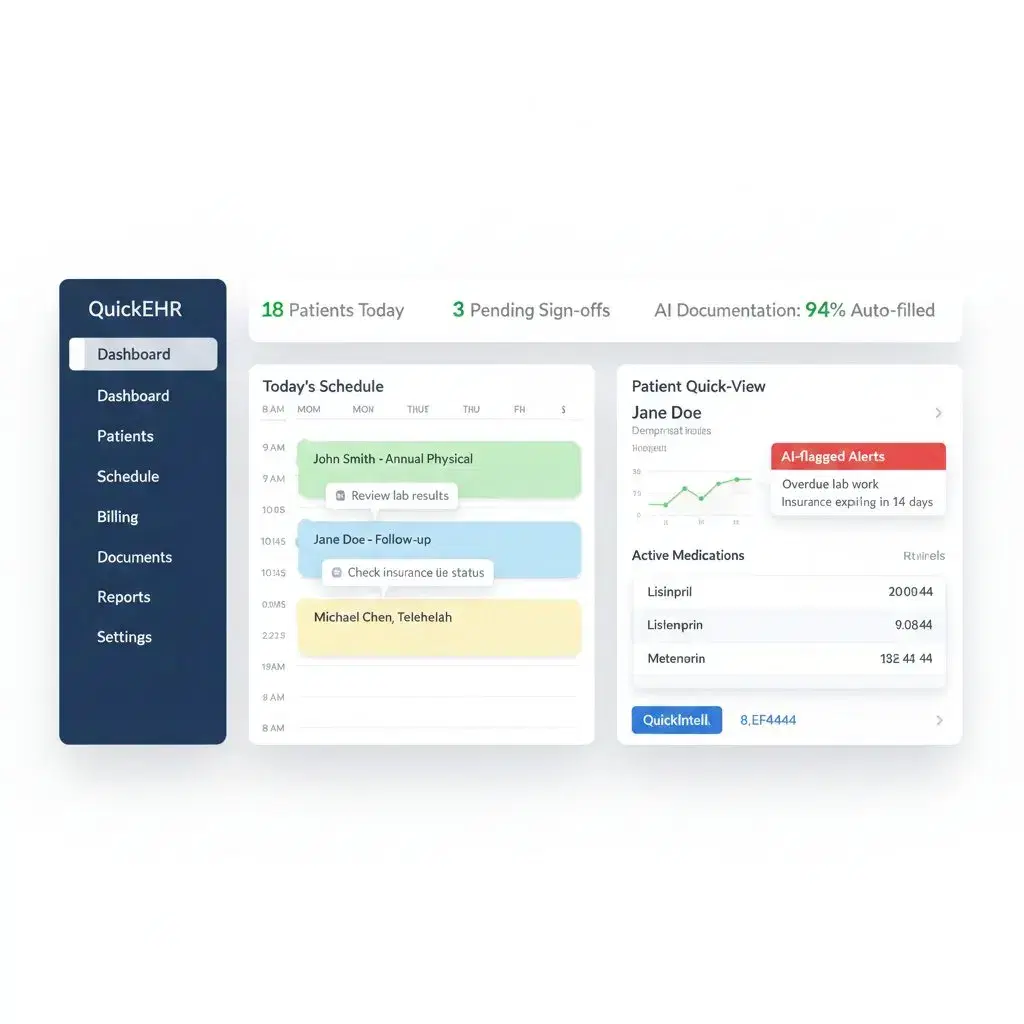
Telemedicine software for QuickEHR virtual encounter workflows
QuickEHR telemedicine software connects virtual visit readiness, patient access, OpenEMR-powered chart context, virtual encounter documentation, AI coding support, prior authorization, RCM, ERA, and follow-up in one reviewable workflow.
For practices comparing telemedicine EHR, telemedicine EMR software, or telehealth platforms for providers, QuickEHR focuses on the durable operating layer around the call: the patient story should move from intake to charting, coding, payer work, billing, and patient follow-up without being rebuilt by every team.
Virtual visit readiness, documentation, coding, RCM, and remittance context
Prepare
Intake and portal
Document
Encounter notes
Close loop
Auth, RCM, ERA
Telemedicine workflow
Virtual care works when the visit is connected before and after the call.
The search intent for telemedicine software emphasizes video access, scheduling, messaging, EHR integration, billing, and patient workflow. QuickEHR keeps those pieces tied to the chart, encounter, and review queue.
Before the visit
Prepare patients, providers, and the chart before the call
Telemedicine software is useful only when the virtual visit starts with the right patient, payer, schedule, intake, consent, and chart context already visible.
Coordinate QuickEHR scheduling, self-scheduling, patient reminders, intake, and forms around the OpenEMR-powered chart.
Surface missing demographics, coverage details, consent packets, visit reason, and documents before the virtual encounter.
Route exceptions to front-desk, clinical, authorization, or billing queues instead of leaving them inside disconnected video tools.
During the visit
Keep virtual encounters connected to clinical documentation
QuickEHR telemedicine workflows keep the visit, patient history, portal context, messages, documents, and follow-up tasks close to the encounter record.
Use QuickEHR patient charts, patient cards, clinical documentation, specialty templates, and dashboard workflows.
Attach visit notes, diagnoses, orders, care plans, messages, documents, and follow-up tasks to the patient story.
Confirm embedded video, third-party telemedicine, phone, or portal paths during implementation before relying on them in production.
After documentation
Carry encounter evidence into coding, auth, and claims
AI EHR telemedicine should reduce repeated context gathering while preserving human review for clinical, coding, authorization, and billing decisions.
Use QuickScribe to draft virtual encounter documentation for clinician review.
Use QuickCode and QuickAuth to prepare coding evidence and payer packets from reviewed encounter context.
Use QuickRCM and QuickERA to keep claim, denial, AR, ERA, EOB, and payment exceptions tied to the virtual visit trail.
Follow-up
Turn virtual care into accountable next actions
Telemedicine programs need follow-through after the encounter: instructions, messages, referrals, care gaps, patient balances, and unresolved payer work.
Route portal messages, callbacks, remote follow-up, and patient education tasks to the responsible team.
Connect patient health management and remote monitoring workflows when approved data paths are in scope.
Keep review gates clear for clinicians, staff, coders, authorization specialists, billers, and posting teams.
Virtual visit hub
Build telemedicine around the EHR workflow, not around a disconnected room link.
Patients and providers need an easy visit experience. Operators need the surrounding work to stay accountable: intake, consent, portal messages, documentation, coding, authorization, claims, payments, and follow-up.
Virtual waiting room and intake readiness
Plan the steps that decide whether a virtual visit is ready: appointment type, visit reason, consent, documents, insurance, instructions, and queue ownership.
Let QuickIntell prepare the work that surrounds a virtual encounter.
QuickEHR telemedicine workflows can connect QuickIntell products around the chart so clinicians, coders, authorization teams, billers, and posting teams review prepared work instead of reconstructing context.
QuickEHR is built on the OpenEMR foundation. That matters for virtual care because the appointment, chart, documentation, patient portal, task, billing, and data-exchange context can be planned around one EHR workflow instead of scattered tools.
QuickEHR is built on the OpenEMR foundation, giving telemedicine workflows chart, scheduling, portal, documentation, task, and billing context.
Existing OpenEMR telemedicine environments
Practices already using OpenEMR can evaluate available OpenEMR API, FHIR, HL7, interface-engine, file, or support paths before routing virtual encounter data into QuickIntell automation.
Telemedicine EMR software with review gates
QuickEHR can operate as the EHR workflow layer around configured virtual visit tools, but the implementation plan should define data access, write-back, support ownership, and review boundaries.
Related workflows
Connect the telemedicine page to the rest of QuickEHR.
These related pages help teams scope patient engagement, virtual practice operations, OpenEMR integrations, documentation, remote monitoring, and downstream revenue workflows.
Scope telemedicine workflows before enabling automation.
The best telemedicine software plan is operationally specific: what starts in the patient experience, what lands in the chart, what becomes AI-prepared work, and which team reviews each output before it affects care, coding, authorization, or revenue operations.
Confirm whether QuickEHR-managed OpenEMR, an existing OpenEMR tenant, or another connected EHR remains the system of record.
Map virtual visit types, appointment workflows, provider schedules, intake forms, consent requirements, patient portal prompts, video or phone paths, and staff ownership.
Define what virtual encounter context is available for documentation, coding, authorization, claims, denials, ERA, EOB, and patient follow-up.
Confirm enabled OpenEMR API, FHIR, HL7, interface-engine, telehealth platform, telephony, payment, clearinghouse, payer, and revenue-cycle data paths.
Set review points for AI summaries, note drafts, coding suggestions, authorization packets, patient-facing outreach, RCM follow-up, and remittance exceptions.
Review access controls, audit expectations, data handling, support ownership, contract scope, and current Trust Center materials before production use.
Video and third-party scope
This page describes QuickEHR telemedicine workflow planning. Embedded video, third-party telehealth platforms, device feeds, and phone workflows should be confirmed in the implementation scope.
Patient-facing approvals
Instructions, message templates, reminders, payment language, escalation scripts, and patient portal prompts should be approved before launch.
Clinical and billing review
AI can prepare, draft, summarize, classify, and route work, but the clinic should define final review ownership for clinical, coding, authorization, billing, and patient-facing actions.
Trust documentation
Use the QuickIntell Trust Center, contract, and implementation packet to review current security, privacy, access, procurement, and data-handling evidence for the specific deployment.
Answers for clinics comparing telemedicine software, telemedicine EHR workflows, OpenEMR telemedicine planning, and QuickIntell AI automation.
What is QuickEHR telemedicine software?
QuickEHR telemedicine software helps practices coordinate virtual visit readiness, patient intake, portal context, virtual encounter documentation, coding, prior authorization, RCM, ERA, and follow-up around OpenEMR-powered QuickEHR workflows and QuickIntell AI automation.
How is QuickEHR different from standalone telemedicine software?
Standalone telemedicine software often focuses on video visits, messaging, or patient access. QuickEHR focuses on the EHR workflow around the visit: schedule, chart, patient history, documentation, coding evidence, payer requirements, claims, remittance, and patient follow-up.
Does QuickEHR replace every telehealth video platform?
No. QuickEHR can support telemedicine workflows around configured video, phone, portal, or third-party telehealth paths, but the exact video visit scope should be confirmed during implementation.
How does OpenEMR telemedicine planning work with QuickEHR?
QuickEHR is built on the OpenEMR foundation. Practices can evaluate QuickEHR-managed OpenEMR or connect an existing OpenEMR tenant when approved API, FHIR, HL7, interface-engine, or file paths are available. The plan should define available data, write-back behavior, permissions, and support ownership.
What AI EHR telemedicine workflows can QuickIntell support?
QuickIntell AI can help prepare chart summaries, draft virtual encounter notes, identify coding evidence, organize prior authorization packets, route claim and denial follow-up, and surface ERA or EOB exceptions. Human review boundaries should be configured for each workflow.
Can QuickEHR support virtual encounter documentation?
Yes, when configured. QuickEHR can keep telemedicine visit notes, specialty templates, diagnoses, orders, attachments, patient messages, and follow-up tasks connected to the OpenEMR-powered encounter and QuickScribe documentation workflow.
How do coding, authorization, and RCM connect to telemedicine?
Virtual visits still create documentation, coding, payer, claim, denial, payment, and follow-up work. QuickEHR can carry reviewed encounter context into QuickCode, QuickAuth, QuickRCM, and QuickERA so teams do not rebuild the same evidence by hand.
Is QuickEHR a telemedicine software provider for clinics?
QuickEHR is an OpenEMR-powered EHR and workflow layer for clinics that may run virtual, hybrid, or in-person care. It is relevant for clinics comparing telemedicine software providers when the priority is EHR-connected workflow, documentation, billing handoff, and AI review queues.
What telemedicine software features should practices scope?
Practices should scope appointment types, patient intake, consent, virtual waiting room steps, patient portal prompts, video or phone paths, documentation templates, coding rules, authorization needs, claims, payment workflows, follow-up ownership, reporting, access controls, and support paths.
Can telemedicine workflows connect to remote patient monitoring?
Yes, when an approved RPM or device data path exists. QuickEHR can help route readings, alerts, patient messages, documentation evidence, coding questions, and RCM handoffs, but device and vendor scope should be confirmed during implementation.
What should a practice review before launching QuickEHR telemedicine workflows?
Review current EHR and OpenEMR environment, telehealth platform scope, patient-facing content, appointment rules, integration paths, access controls, audit needs, AI review gates, payer workflows, billing processes, support responsibilities, and current Trust Center materials.
Does this page make certification, HIPAA, SOC 2, EPCS, reimbursement, or customer claims?
No. This page describes QuickEHR telemedicine workflow planning and QuickIntell automation around the OpenEMR foundation. Certification, security, procurement, payer, reimbursement, legal, and compliance evidence should be verified in the current implementation packet, contract, and Trust Center materials for the specific deployment.
Build the workflow
Map telemedicine from patient access to documentation, billing, and remittance follow-through.
QuickIntell can help your team scope QuickEHR telemedicine workflows around OpenEMR, existing EHR context, virtual visit tools, AI review gates, and downstream revenue operations.