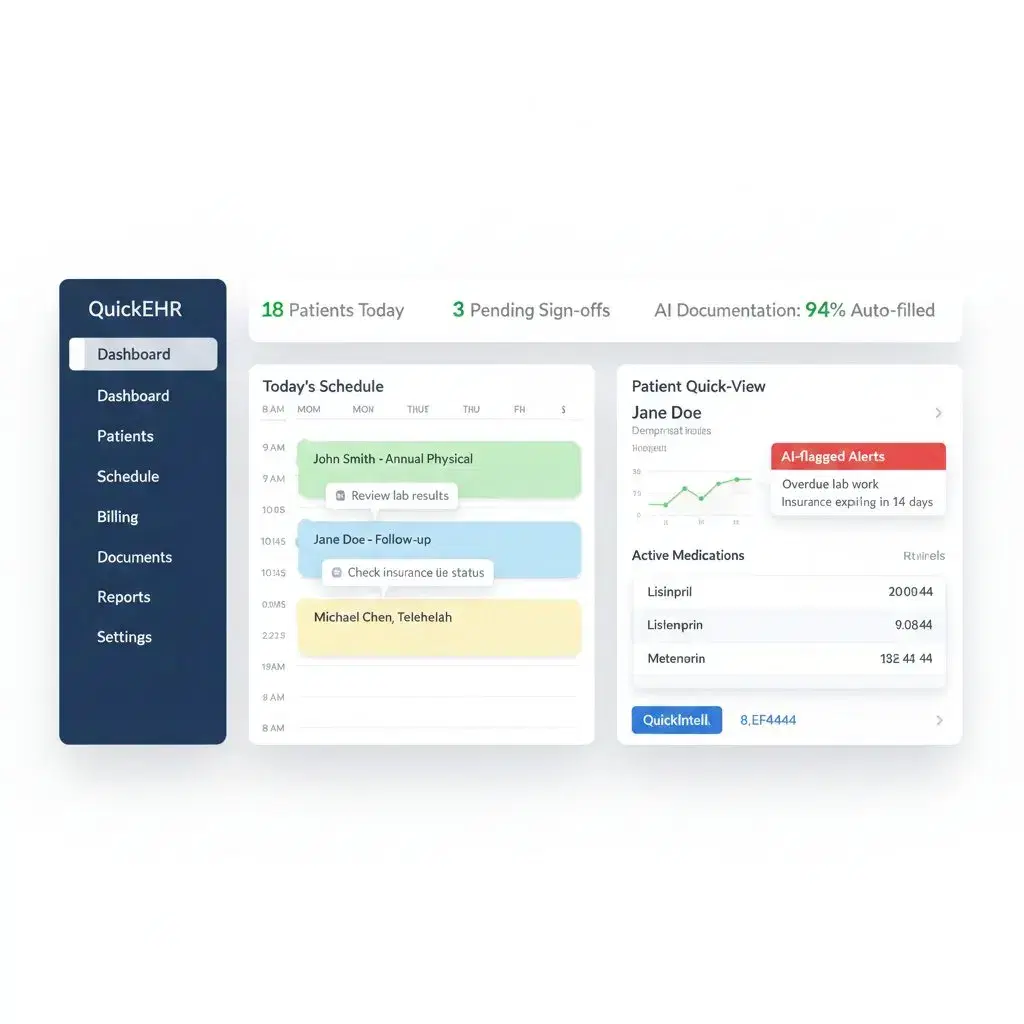
Virtual practice software for remote-first QuickEHR workflows
QuickEHR virtual practice software helps remote-first and hybrid clinics coordinate OpenEMR-powered charts, scheduling, patient portal context, AI documentation, coding, prior authorization, claims, ERA, EOB, and follow-up from one connected workflow.
For teams comparing virtual clinic software, telemedicine software for private practice, or remote patient care software, or group practice telehealth software, QuickEHR focuses on the durable operating layer: the patient story should move from intake to charting, review, billing, and follow-up without being rebuilt by every team.
Intake, chart context, AI queues, RCM, and remittance
Access
Intake and portal
Charting
OpenEMR-powered
Revenue
Claims to ERA
Virtual-practice model
Support the clinical, operational, and revenue work behind remote care.
Searchers evaluating virtual practice software expect more than a video visit. QuickEHR virtual-practice workflows connect patient access, charting, documentation, follow-up, coding, authorization, claims, and payment review.
Access workflow
Remote-first scheduling and intake
Virtual practices need appointment, eligibility, intake, forms, reminders, portal, and follow-up status visible before the patient encounter starts.
Coordinate self-scheduling, staff scheduling, coverage checks, and pre-visit task ownership.
Route missing demographics, insurance details, consent forms, and documents to staff queues.
Support remote-first and hybrid appointment patterns without losing location or provider context.
Clinical workflow
Telehealth-adjacent charting context
Virtual practice software should keep the visit record, patient history, documents, messages, tasks, and clinical review close to the EHR chart.
Use OpenEMR-powered QuickEHR charts, patient cards, patient portal context, and specialty templates.
Keep virtual visit notes, follow-up tasks, orders, documents, and care-team handoffs tied to the patient record.
Confirm any video visit, phone, portal, or connected telemedicine workflow during implementation.
Automation workflow
AI documentation and revenue handoff
QuickIntell automation can prepare reviewed outputs for note drafting, coding, prior authorization, claims, denial follow-up, ERA, and EOB work.
Carry chart context into QuickScribe and documentation evidence into QuickCode.
Route payer evidence and missing details into QuickAuth worklists.
Connect claims, denials, AR, ERA, and EOB exceptions to QuickRCM and QuickERA teams.
Care continuity
Remote patient follow-up
A virtual clinic needs accountable follow-up after the encounter: outreach, messages, care gaps, referrals, remote monitoring signals, and patient balances.
Use patient health management and population health workflows for outreach and unresolved follow-up.
Attach remote patient monitoring or home-care signals when an approved data path exists.
Keep patient, clinical, billing, and support tasks visible to the right team.
Operating workflow
Move from remote appointment to payment without rebuilding context.
A virtual practice needs shared context across the front desk, care team, documentation, coding, authorization, billing, and patient follow-up. QuickEHR organizes that handoff around the patient, encounter, task, and work queue.
Prepare
Make the remote encounter ready before the visit
QuickEHR virtual practice workflows start with the operational work that determines whether a remote or hybrid visit runs cleanly.
Route exceptions to front-desk, clinical, authorization, or billing teams instead of burying them in inboxes.
Visit
Keep virtual care attached to the OpenEMR-powered chart
The visit may happen by video, phone, portal, or hybrid workflow, but the clinical record still needs a durable chart, documents, orders, tasks, and review trail.
Use QuickEHR patient charts, patient cards, clinical documentation, templates, and dashboard workflows.
Keep visit notes, attachments, diagnoses, orders, care plans, follow-up tasks, and messages in patient context.
Confirm video, portal, phone, device, or third-party telemedicine paths as implementation-specific integrations.
Automate
Prepare documentation, coding, and payer work for review
AI EHR virtual practice workflows should reduce manual rebuilding of context, while preserving clinician, coder, authorization, and billing review.
Use QuickScribe to draft visit notes from approved patient and encounter context.
Use QuickCode and QuickAuth to prepare coding evidence and authorization packets for review.
Use QuickRCM and QuickERA to keep claim, denial, ERA, EOB, and payment exceptions tied to the encounter trail.
Follow up
Turn remote care into accountable next actions
Virtual practice management depends on follow-through after the visit: messages, care gaps, referrals, test results, balances, claim issues, and open tasks.
Track unresolved follow-up across patient, provider, operations, coding, authorization, and RCM work queues.
Use remote patient care software patterns for monitoring signals, outreach, and care-plan reminders where configured.
Review trust, access, audit, data-handling, and support ownership before production reliance.
AI EHR virtual practice
AI prepares the next action while teams keep review control.
QuickIntell automation helps virtual practices turn chart, patient access, and revenue context into reviewed documentation, coding, authorization, RCM, and remittance workflows.
QuickEHR brings virtual-practice workflow planning to the OpenEMR foundation.
QuickEHR is built on the OpenEMR foundation. OpenEMR virtual practices should still plan access, charting, portal context, telemedicine-adjacent integrations, AI review gates, support ownership, and production scope before relying on automated workflows.
QuickEHR-managed OpenEMR foundation
Practices adopting QuickEHR can plan OpenEMR-powered charting, scheduling, patient portal context, templates, documents, tasks, and AI worklists around a virtual practice model.
Existing OpenEMR virtual practices
Teams already using OpenEMR can evaluate available API, FHIR, HL7, interface-engine, file, and support paths before routing chart or billing data into QuickIntell automation.
Hybrid and group-practice fit
Virtual practice software often spans in-person locations, remote providers, telehealth partners, and billing teams. QuickEHR planning maps each workflow before automation is enabled.
Build the virtual practice from connected QuickEHR workflows.
Virtual practice management works best when the child workflows stay connected. These QuickEHR pages give teams the next level of detail for scheduling, portal, charts, interoperability, remote monitoring, and group-practice operations.
Start with care delivery, then connect automation.
Before turning on AI or integration workflows, align the team on which system owns each record, where remote-care tasks happen, and which human role reviews each output.
Confirm whether QuickEHR-managed OpenEMR, an existing OpenEMR tenant, or another connected system remains the system of record.
Virtual-care workflows need clear ownership before launch.
QuickEHR virtual-practice implementations should define what each remote, hybrid, and in-person team owns before AI or integration workflows are used for production decisions.
The current Trust Center and implementation packet should be reviewed for security, procurement, legal, support, and data-handling questions. This page describes workflow planning, not certification, reimbursement, or compliance attestations.
Virtual-practice implementation checklist
Confirm whether QuickEHR-managed OpenEMR, an existing OpenEMR tenant, or another connected system remains the system of record.
Review access controls, user roles, least-privilege credentials, source metadata, audit needs, support ownership, and exception queues.
Set human review points for AI summaries, note drafts, coding suggestions, authorization packets, RCM follow-up, and payment exceptions.
Pilot with representative providers, specialties, appointment types, payer scenarios, remote patients, and billing workflows before wider rollout.
Use the Trust Center and implementation-specific evidence review for procurement, security, legal, and data-handling questions.
Specialty fit
Useful for remote-first, hybrid, and multi-provider care models.
Virtual practice software can support different specialties, but each specialty still needs its own templates, follow-up rules, payer workflows, and review responsibilities.
Use these answers to frame QuickEHR virtual practice planning, OpenEMR fit, AI automation, telemedicine-adjacent workflows, and implementation readiness.
What is virtual practice software?
Virtual practice software helps healthcare teams run remote-first or hybrid care workflows across scheduling, intake, patient portal tasks, charting, documentation, telehealth-adjacent workflows, follow-up, coding, authorization, billing, and reporting. QuickEHR virtual practice software focuses on OpenEMR-powered chart context with QuickIntell AI automation around reviewed clinical and revenue work.
How does QuickEHR support a QuickEHR virtual practice?
QuickEHR can support a virtual practice with OpenEMR-powered patient charts, scheduling workflows, patient portal context, clinical documentation, specialty templates, patient health management, dashboards, and connected QuickScribe, QuickCode, QuickAuth, QuickRCM, and QuickERA worklists.
Is QuickEHR telemedicine software for private practice?
QuickEHR is an EHR and workflow layer for practices that may run virtual or hybrid care. Any video visit, phone, portal, remote monitoring, or third-party telemedicine path should be scoped during implementation. The page does not claim that every telemedicine feature is available by default.
How does OpenEMR virtual practice planning work with QuickEHR?
QuickEHR is built on the OpenEMR foundation. Practices can use QuickEHR-managed OpenEMR or connect an existing OpenEMR tenant when approved API, FHIR, HL7, interface-engine, or file paths are available. The implementation plan should confirm available data, permissions, support ownership, and any write-back rules before production use.
What AI EHR virtual practice workflows are supported?
QuickIntell AI can help prepare chart summaries, draft notes, identify coding evidence, organize authorization packets, route claim and denial follow-up, and surface ERA or EOB exceptions. Clinicians, coders, authorization teams, billing teams, and posting teams should retain final review responsibility.
Can QuickEHR support virtual clinic software for group practices?
Yes, when configured for the practice model. QuickEHR can support multi-provider and group-practice workflows across remote and in-person schedules, shared patient charts, staff queues, documentation, coding, authorization, RCM, and remittance review.
How does remote patient care software fit this workflow?
Remote patient care workflows can connect to QuickEHR when approved portal, messaging, patient health management, population health, remote monitoring, or outreach data paths exist. Implementation should define which signals are reviewed, who owns follow-up, and how activity is documented.
Can QuickEHR connect virtual encounters to billing and RCM?
Yes, when configured. QuickEHR can keep documentation, coding evidence, payer requirements, claims, denials, AR follow-up, ERA, EOB, and patient-balance context tied to the encounter trail through QuickCode, QuickAuth, QuickRCM, and QuickERA workflows.
What should a practice prepare before launching a virtual practice workflow?
Prepare provider schedules, appointment types, intake forms, patient portal needs, telemedicine or phone workflow details, existing EHR and OpenEMR information, payer workflows, billing rules, coding processes, authorization requirements, remote follow-up workflows, reporting needs, and access-control requirements.
Does this page make certification, HIPAA, SOC 2, EPCS, reimbursement, or customer claims?
No. This page describes QuickEHR virtual practice workflows and implementation planning. Certification, security, procurement, reimbursement, legal, and compliance evidence should be reviewed for the specific deployed configuration and current QuickIntell documentation.
Plan your virtual practice
Map the QuickEHR workflow for remote-first and hybrid care.
Bring your scheduling, telemedicine-adjacent, OpenEMR, portal, documentation, coding, authorization, RCM, and ERA questions into one implementation conversation.