Call
OpenEMR-powered patient access hub

Patient engagement software for QuickEHR patient access workflows

QuickEHR patient engagement software connects the patient portal, intake, reminders, messaging, forms, telehealth workflow handoffs, online patient payments, and QuickIntell AI automation to OpenEMR-powered chart and scheduling context.

Search fit: patient engagement software
Access hub: portal, intake, reminders
AI handoff: clinical and RCM workflows

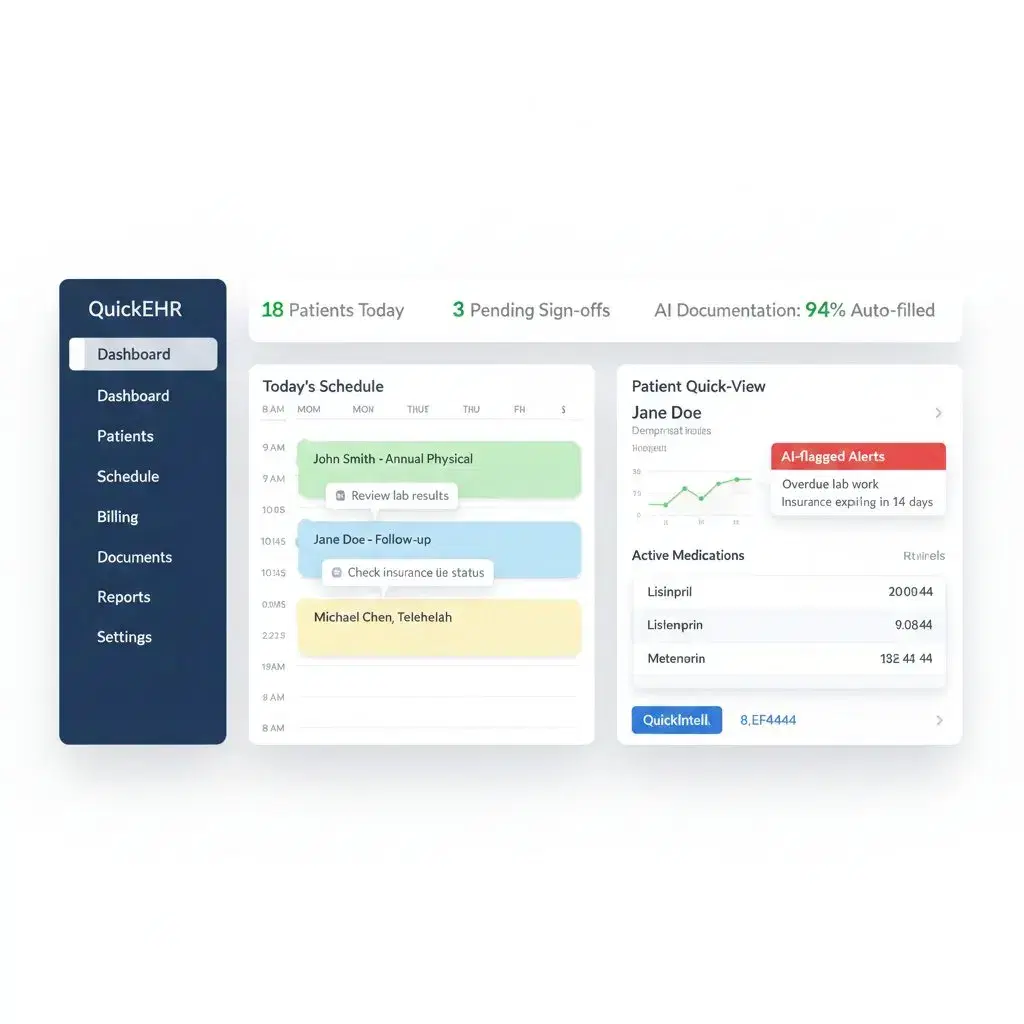
QuickEHR patient engagement workspace

Portal, intake, reminders, messaging, payments, and AI routing

QuickEHR dashboard showing patient engagement, chart context, scheduling, documentation, authorization, RCM, and ERA workflows

Access hub

Portal, intake, forms

Outreach

Reminders, messages, voice

Handoff

Clinical, auth, RCM

Patient engagement workflow

Patient engagement works when every touchpoint can become the next task.

The current SERP for patient engagement software emphasizes self-scheduling, reminders, digital intake, secure messaging, portal access, and payments. QuickEHR turns those touchpoints into chart-connected work that clinical, front-desk, and revenue teams can review.

Before the visit

Bring intake, scheduling, and reminders into one patient access flow

QuickEHR patient engagement software starts with the operational work that determines whether a visit is ready: appointment context, forms, demographic updates, coverage details, preparation instructions, and reminder outcomes.

  • Use QuickEHR scheduling, self-scheduling, and appointment reminder workflows around the same OpenEMR-powered chart context.
  • Collect intake forms, visit reason, history updates, consent packets, and missing documents before arrival when configured.
  • Route cancellations, reschedules, missing information, and coverage questions to staff instead of leaving them in disconnected tools.

During care

Keep portal messages, telehealth handoffs, and care-team tasks close to the chart

Patient engagement platforms are most useful when the portal, message thread, call, and visit workflow share context. QuickEHR keeps patient-facing activity connected to the patient, provider, appointment, encounter, and responsible team.

  • Organize patient portal software workflows for selected records, results, messages, instructions, and follow-up tasks.
  • Plan patient messaging software and QuickVoice paths for routine questions, callbacks, reminders, and escalations.
  • Support telehealth visit preparation and follow-up handoffs while confirming video, device, and third-party scope during implementation.

After the visit

Connect follow-up, payments, coding, auth, and RCM work

Patient engagement does not end when the patient leaves. QuickEHR can carry patient responses, portal activity, balance questions, missing documents, and follow-up needs into reviewable QuickIntell workflows.

  • Move online patient payments, statement questions, balances, and remittance issues into QuickRCM and QuickERA context.
  • Use QuickScribe, QuickCode, and QuickAuth context when patient follow-up affects documentation, coding evidence, or authorization packets.
  • Keep staff and clinician review boundaries clear for clinical decisions, patient-facing messages, and financial workflows.

Patient access hub

Cover the features buyers expect without separating them from the EHR.

Practices evaluating patient engagement software want one operating model for patient portal software, patient intake software, reminders, patient messaging, digital forms, telehealth handoffs, and online patient payments. Patient engagement software solutions should not split those signals away from the chart, schedule, or staff queue that owns the next action.

QuickEHR keeps that access work tied to OpenEMR integration, QuickIntell AI workflow design, and the staff queues that own the next step.

Patient portal software

Give patients a practical access path for selected records, messages, instructions, billing questions, and follow-up tasks while staff keep review ownership.

Review portal workflows

Digital intake and forms

Collect demographics, history updates, visit reason, consent forms, documents, and missing information before the rooming workflow starts.

Review forms workflows

Appointment reminders

Plan medical appointment reminders across SMS, email, and voice cadences around appointment type, location, preparation instructions, cancellations, reschedules, and recalls.

Review reminders

Patient messaging

Route patient messages, portal replies, callbacks, administrative questions, and low-confidence AI classifications to the right team queue.

Review messaging

Telehealth workflow handoff

Coordinate virtual visit preparation, portal prompts, instructions, documentation context, follow-up tasks, and billing handoff without claiming every video feature is included by default.

Review virtual workflows

Payments and revenue questions

Connect online patient payments, balances, statement questions, claim context, ERA details, and AR follow-up to revenue workflows.

Review QuickRCM

OpenEMR and QuickEHR fit

OpenEMR patient engagement needs more than a portal login.

QuickEHR is built on the OpenEMR foundation and adds managed workflow design around patient access, patient engagement, QuickVoice outreach, and QuickIntell AI automation.

OpenEMR-powered QuickEHR foundation

QuickEHR is built on the OpenEMR foundation, giving clinics a practical base for chart, scheduling, portal, forms, messaging, and billing context.

Existing OpenEMR environments

Practices already using OpenEMR can evaluate approved OpenEMR API, FHIR, HL7, or interface-engine paths for patient engagement data and task routing.

QuickEHR Connect for mixed systems

Clinics keeping another EHR or practice management system can scope QuickEHR as a workflow layer around patient access, encounter, claim, and remittance context.

Implementation and trust

Launch patient engagement with channels, review rules, and data paths defined first.

Patient engagement touches clinical care, front-desk work, billing, access, and support. QuickIntell scopes the implementation around the clinic workflow, enabled interfaces, patient-facing language, AI review boundaries, and support ownership.

Review current security, privacy, and procurement materials in the QuickIntell Trust Center with the implementation packet for the specific deployment.

Best-fit use cases

Ambulatory practices, multi-location groups, and specialty clinics that want a digital patient engagement platform tied to OpenEMR-powered QuickEHR context, QuickVoice, and QuickIntell automation.

Launch checklist

  • Choose QuickEHR-managed OpenEMR, an existing OpenEMR tenant, or QuickEHR Connect for another EHR or practice management system.
  • Map patient engagement workflows: portal, intake, forms, reminders, messaging, voice, telehealth preparation, payments, recalls, and follow-up.
  • Define patient-facing language, allowed channels, message templates, cadence, quiet hours, opt-out handling, and escalation rules.
  • Confirm enabled OpenEMR API, FHIR, HL7, interface-engine, portal, telephony, scheduling, payment, clearinghouse, payer, and revenue-cycle data paths.
  • Decide where AI may draft, classify, summarize, route, or prepare work before staff, clinician, billing, or support review.
  • Review access controls, audit expectations, data handling, implementation evidence, support ownership, and current Trust Center materials before production use.

Staff review boundaries

AI can help classify, draft, summarize, and route patient engagement work, but the clinic should define which actions require staff, clinician, billing, or support review.

Patient-facing language

Templates, reminder text, portal prompts, payment language, and telehealth instructions should be approved before launch and reviewed when workflows change.

Integration scope

Available read, write, sync, telephony, payment, and portal paths depend on the deployed EHR environment, vendor interfaces, and approved implementation scope.

Trust documentation

Use the QuickIntell Trust Center, contract, and implementation packet to review security, privacy, access, and procurement evidence for the specific deployment.

Specialty workflows

Patient engagement varies by specialty. Connect the portal, forms, reminders, messaging, telehealth handoff, and payment paths to the clinic's care model before go-live.

FAQs

QuickEHR patient engagement FAQs

Answers for teams comparing patient engagement software, patient engagement platforms, patient portal software, patient intake software, OpenEMR patient engagement, and AI EHR patient engagement workflows.

What is QuickEHR patient engagement software?+

QuickEHR patient engagement software helps clinics connect portal access, patient intake software workflows, appointment reminders, patient messaging software, digital forms, telehealth preparation, online patient payments, and follow-up tasks to OpenEMR-powered QuickEHR context and QuickIntell AI automation.

How is QuickEHR different from a generic patient engagement platform?+

A generic patient engagement platform may focus on messages, reminders, or check-in. QuickEHR keeps patient engagement connected to the chart, appointment, provider, location, payer context, staff queue, documentation, coding, authorization, RCM, and ERA workflows.

Does QuickEHR include patient portal software?+

QuickEHR can support patient portal software workflows for selected records, messages, intake prompts, forms, instructions, and billing questions when configured. The specific portal scope, data visibility, and review process should be confirmed during implementation.

Can QuickEHR support patient intake software workflows?+

Yes, patient intake workflows can be scoped for demographics, history updates, visit reason, documents, coverage details, consent forms, and missing information. Staff review rules and write-back behavior depend on the deployment.

Can QuickEHR handle appointment reminders and patient messaging?+

Yes, QuickEHR can support appointment reminders and patient messaging workflows around the appointment, chart, portal, QuickVoice, and staff queues. Clinics should define reminder cadence, allowed channels, message templates, opt-out handling, and escalation rules before launch.

How does AI patient engagement work in QuickEHR?+

AI patient engagement in QuickEHR means assistive automation for drafting, classifying, summarizing, routing, and preparing patient engagement work for review. AI does not remove the clinic's responsibility for clinical decisions, patient-facing approvals, billing review, or support ownership.

How does OpenEMR patient engagement fit with QuickEHR?+

QuickEHR is built on the OpenEMR foundation. For QuickEHR-managed OpenEMR deployments, patient engagement workflows can be planned around the managed chart, schedule, portal, forms, and billing context. Existing OpenEMR tenants can evaluate approved API, FHIR, HL7, or interface-engine paths.

Does QuickEHR replace a telehealth video platform?+

This page does not claim QuickEHR replaces every telehealth video platform. QuickEHR can support telehealth preparation, portal prompts, instructions, documentation context, follow-up tasks, and billing handoff when configured; any video, device, or third-party telehealth scope should be confirmed during implementation.

Can online patient payments connect to QuickRCM and QuickERA?+

Yes, when configured. Patient payment questions, balances, statements, claims, remittance details, ERA, EOB, denials, and AR follow-up can be routed into QuickRCM and QuickERA workflows with encounter context nearby.

What should practices review before launch?+

Practices should review patient-facing language, channel rules, opt-out handling, access controls, role ownership, escalation paths, OpenEMR or EHR interfaces, payment workflow scope, AI review boundaries, support responsibilities, and current Trust Center materials.

Does this page make compliance or certification claims?+

No. This page describes QuickEHR patient engagement workflow planning. QuickEHR is built on the OpenEMR foundation, and any required certification, security, payer, procurement, legal, or regulatory evidence should be verified in the current implementation packet, contract, and QuickIntell Trust Center materials for the specific deployment.

QuickEHR patient access

Connect patient engagement to the chart, the message, and the next workflow.

See how QuickEHR, QuickVoice, and QuickIntell AI can unify portal, intake, reminders, messaging, payments, and OpenEMR-powered workflow handoffs.