Call
Chart-aware patient education

Patient education software for QuickEHR care plans and portal delivery

QuickEHR patient education software helps OpenEMR-powered clinics prepare patient instructions, care plans, condition-specific education, and portal delivery with QuickIntell AI automation and clinician review built into the workflow.

Primary intent: patient education software
Workflow: instructions, care plans, portal delivery
EHR fit: QuickEHR and OpenEMR

QuickEHR education workspace

Instructions, care plans, portal delivery, and review queues

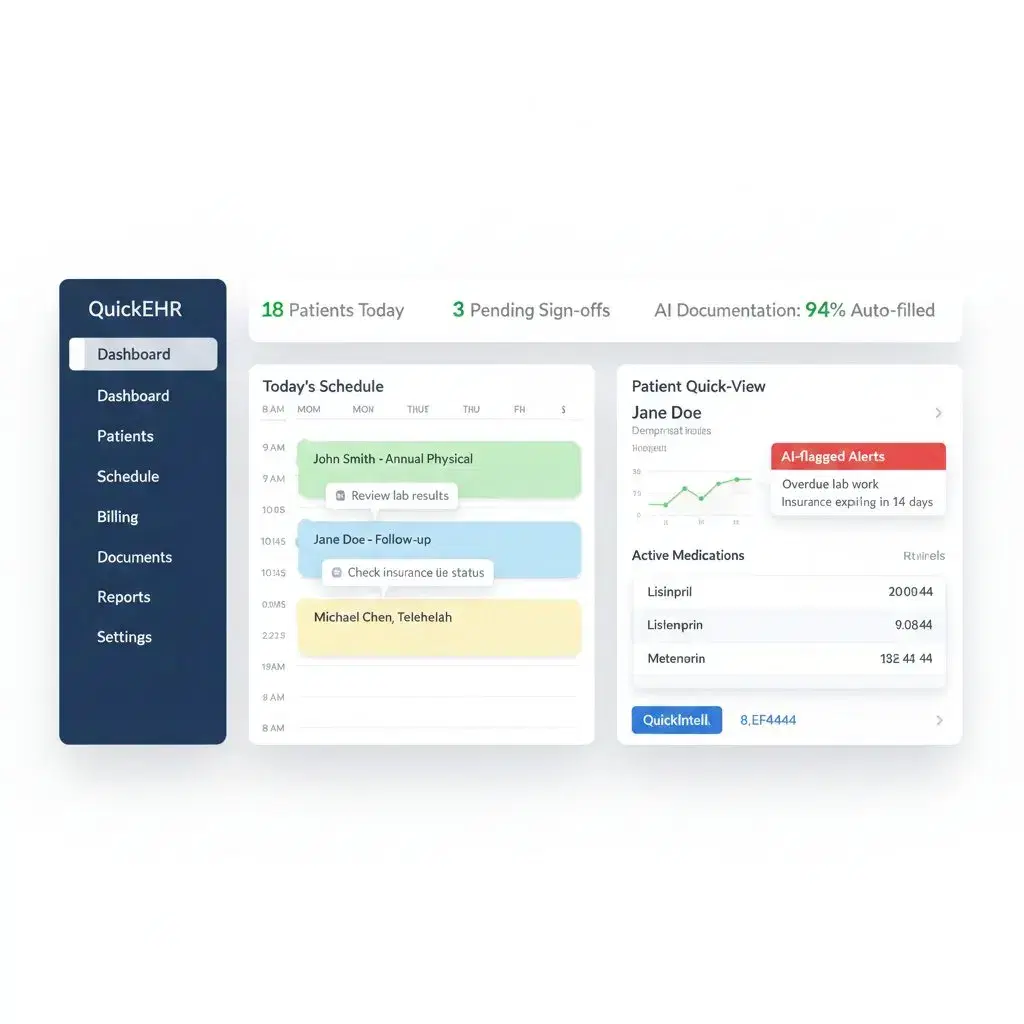
QuickEHR dashboard showing chart context, patient education tasks, portal delivery, documentation, coding, authorization, and revenue workflow context

Context

Patient, visit, plan

Education

Instructions, materials

Delivery

Portal, print, message

Patient education workflow

Patient instructions should come from the same workflow as the visit.

The patient education software SERP is full of education libraries, teach-back pages, and patient engagement tools. QuickEHR narrows that intent to the EHR workflow: what the clinician reviewed, what the patient needs next, and how the team will deliver and track it.

Visit context

Start education from the encounter, not a disconnected library

QuickEHR patient education software keeps the patient, diagnosis, procedure, visit type, provider, location, language needs, and follow-up work close to the instruction packet.

  • Use QuickEHR-managed OpenEMR chart context when the clinic runs on QuickEHR.
  • Connect education tasks to scheduling, intake, documentation, portal, and care-team worklists.
  • Keep staff and clinician review visible before patient-facing instructions are finalized.

Reviewable drafting

Prepare instructions and care plans for clinician approval

AI EHR patient education should help teams draft and organize patient instructions, not publish clinical guidance without review. QuickIntell automation can prepare the work while the clinic keeps approval responsibility.

  • Draft after-visit instructions from reviewed note context, diagnosis context, and clinic-approved templates.
  • Route uncertain, conflicting, or sensitive instructions back to the clinical owner.
  • Keep education language aligned with the configured workflow and implementation packet.

Portal delivery

Send the right material through the right patient channel

Patient instructions software is most useful when delivery status and follow-up questions are visible. QuickEHR can coordinate portal delivery, messaging handoff, reminders, and downstream work.

  • Deliver selected instructions through portal, message, print, or staff handoff paths when configured.
  • Use patient responses to create follow-up tasks, education reminders, portal messages, or staff review items.
  • Carry education context into documentation, coding, authorization, RCM, and ERA workflows when needed.

Education jobs

Cover instructions, materials, care plans, and follow-up tasks.

Patient engagement software should not stop at sending a PDF. QuickEHR helps practices plan patient education materials software around the chart, the approved template, the delivery channel, and the owner of the next task.

For adjacent workflows, review QuickEHR patient communications, QuickEHR consent forms, and QuickEHR patient health management.

After-visit instructions

Prepare visit-specific instructions, medication reminders, return precautions, follow-up timing, and task ownership for clinician review before delivery.

Condition education

Organize condition-specific education materials around the chart problem list, assessment, care team, and clinic-approved language.

Care plan software workflows

Turn treatment plans, monitoring needs, referrals, labs, imaging, and follow-up intervals into reviewable care plan tasks.

Procedure preparation

Coordinate preparation instructions, consent handoff, required documents, arrival details, and specialty-specific checks before the visit.

Portal and message delivery

Route patient education materials through the patient portal, message queue, print path, or staff handoff defined for the practice.

Follow-up tracking

Track delivered, pending, escalated, reviewed, and answered education tasks so teams can see where patient engagement needs attention.

OpenEMR and QuickEHR fit

OpenEMR patient education works best when delivery stays close to the chart.

QuickEHR is built on the OpenEMR foundation and adds workflow design for patient instructions, care plans, portal delivery, staff review, and QuickIntell AI automation.

QuickEHR-managed OpenEMR

QuickEHR is built on the OpenEMR foundation and adds managed implementation, education workflow design, portal routing, and QuickIntell automation around the chart.

Existing OpenEMR tenants

Practices already using OpenEMR can evaluate approved OpenEMR API, FHIR, HL7, portal, or interface-engine paths for patient education handoff and tracking.

QuickEHR Connect

Clinics keeping another EHR can use QuickEHR as the workflow layer for education tasks, care plan routing, portal delivery, and QuickIntell automation.

Implementation and trust

Launch patient education with review boundaries defined first.

Patient education can touch clinical instructions, follow-up plans, portal messages, billing questions, and patient support. QuickIntell scopes the implementation around the clinic workflow, enabled interfaces, approved language, and review responsibilities.

For security and procurement review, use the QuickIntell Trust Center alongside the implementation packet for the specific deployment.

Clinician-approved language

Define which templates, reading levels, specialty instructions, return precautions, and patient-facing messages require clinical review.

Delivery and escalation rules

Decide when education should be delivered through the portal, print, message, call, or staff handoff, and who owns patient questions.

Clear AI boundaries

Use AI to draft, classify, summarize, and route education work, while preserving staff and clinician responsibility for patient-facing guidance.

Trust and implementation review

Review access controls, audit expectations, data handling, procurement evidence, and deployment-specific responsibilities before production use.

Launch checklist

  • Choose QuickEHR-managed OpenEMR, an existing OpenEMR tenant, or QuickEHR Connect for another EHR or practice management system.
  • Map education moments: intake, rooming, visit close, after-visit summary, procedure prep, care plan follow-up, portal messages, and phone outreach.
  • Inventory clinic-approved templates, patient education materials, reading-level preferences, specialty instructions, and translation or language workflow needs.
  • Define who approves instruction drafts, who handles portal questions, who owns care plan follow-up, and which tasks escalate to clinicians.
  • Confirm enabled OpenEMR API, FHIR, HL7, patient portal, document, message, telephony, billing, payer, and clearinghouse workflow paths.
  • Decide where QuickIntell AI may draft, classify, summarize, route, queue, or measure patient education work before staff review.
  • Review trust documentation, access controls, implementation evidence, and contract-specific responsibilities for the deployed environment.

Best-fit use cases

Ambulatory practices, multi-location groups, and specialty clinics that want patient education, patient engagement software, and care plan software workflows tied to OpenEMR-powered chart context and QuickIntell automation.

FAQs

QuickEHR patient education FAQs

Answers for teams comparing patient education software, EHR patient education, patient instructions software, OpenEMR patient education, and AI EHR patient education workflows.

What is QuickEHR patient education software?+

QuickEHR patient education software helps clinics prepare, review, deliver, and track patient instructions, education materials, care plans, and portal follow-up around QuickEHR and OpenEMR-powered chart context.

How does QuickEHR support EHR patient education?+

QuickEHR keeps education workflows close to the encounter, chart, schedule, provider, diagnosis, procedure, follow-up plan, portal delivery path, and staff worklist. That context helps teams avoid disconnected patient education materials and missed follow-up tasks.

Can AI generate patient instructions in QuickEHR?+

QuickIntell AI can help draft, summarize, classify, and route patient instruction work for review. The clinic should define which instructions require clinician approval and should not use AI as a replacement for clinical judgment or patient-facing responsibility.

How do care plan software workflows fit into this page?+

Care plan software workflows in QuickEHR can organize follow-up intervals, labs, imaging, referrals, medication instructions, monitoring tasks, and patient questions into reviewable work tied to the chart and portal.

Does QuickEHR support OpenEMR patient education workflows?+

QuickEHR is built on the OpenEMR foundation. QuickEHR-managed OpenEMR deployments can plan education delivery around the managed chart and portal workflow. Existing OpenEMR tenants can evaluate approved API, FHIR, HL7, portal, or interface paths.

How is patient education different from patient communications?+

Patient education focuses on instructions, care plans, condition materials, procedure preparation, and follow-up learning. Patient communications focuses on the channels and routing, such as portal messages, reminders, email, SMS, voice calls, and staff escalation. QuickEHR connects both workflows.

Can education follow-up trigger QuickAuth, QuickRCM, or QuickERA work?+

Yes, when configured. Patient education follow-up may surface authorization-sensitive orders, coverage questions, billing questions, balances, claim status issues, or remittance context. QuickEHR can route those signals toward QuickAuth, QuickRCM, or QuickERA review.

What should a practice review before launching patient education software?+

Review education templates, clinical approval rules, portal delivery paths, message ownership, language needs, escalation rules, data access, OpenEMR integration paths, patient-facing disclaimers, staff training, and trust documentation for the deployed environment.

Does this page make certification or compliance claims?+

No. This page describes patient education workflow planning for QuickEHR. QuickEHR is built on the OpenEMR foundation, and any certification, security, procurement, payer, or regulatory evidence should be verified in the current implementation packet and contract for the specific deployment.

QuickEHR patient engagement

Connect patient instructions to the chart, portal, and next workflow.

See how QuickEHR and QuickIntell AI can unify patient education, care plans, portal delivery, documentation, coding, authorization, RCM, and ERA workflows.