FAQs
QuickEHR custom work questions
Use these questions to separate QuickEHR configuration, OpenEMR customization, AI automation, integration work, and implementation support.
What are EHR customization services?
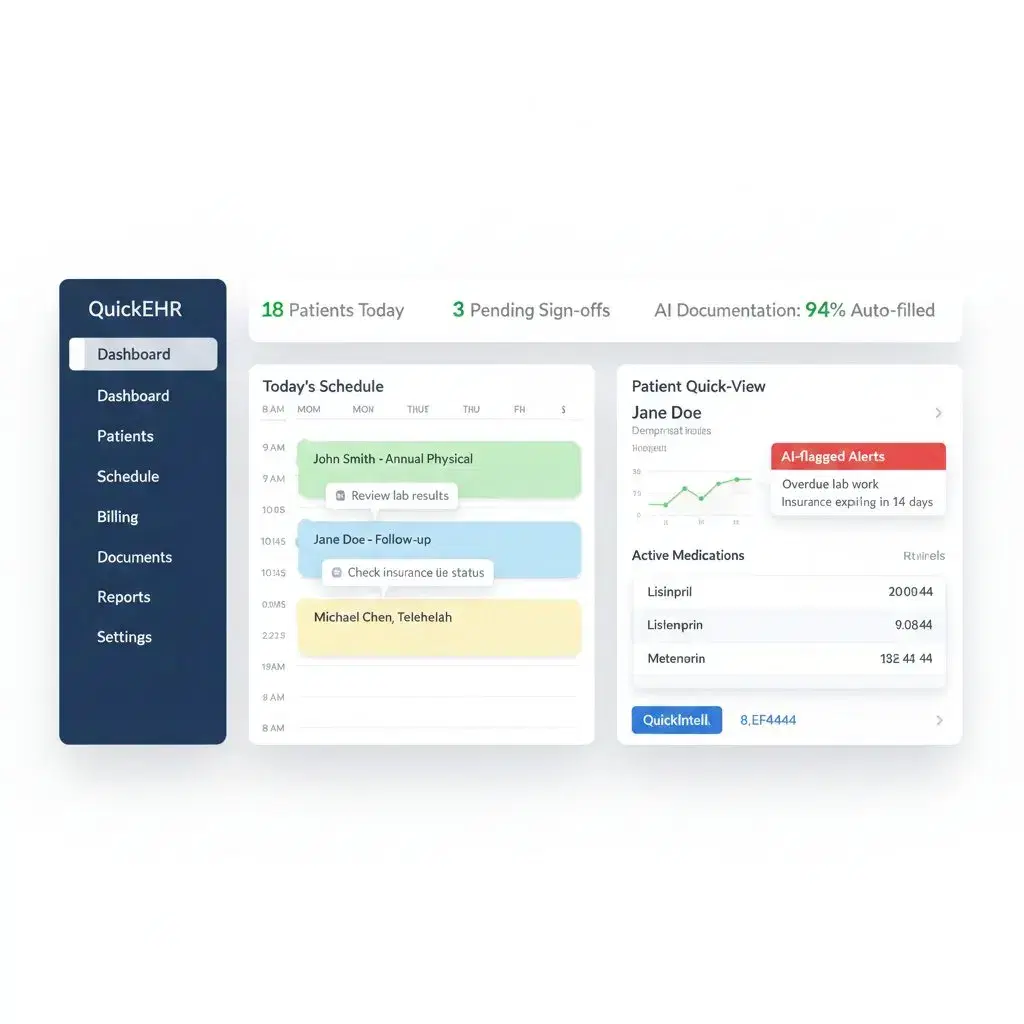
EHR customization services help a practice adapt an electronic health record workflow to specific clinical, operational, reporting, integration, and revenue-cycle needs. For QuickEHR, that means scoping QuickEHR configuration, OpenEMR customization review, custom forms, templates, reports, worklists, integrations, AI automation, testing, and support boundaries around the OpenEMR-powered foundation.
What kinds of QuickEHR custom work can QuickIntell scope?
QuickEHR custom work can include workflow mapping, custom forms, specialty templates, user roles, task queues, reports, dashboards, data mapping, interface planning, API or FHIR review, AI workflow extensions, documentation handoffs, coding review, prior authorization packets, claim worklists, ERA follow-through, and post-launch tuning.
Is this OpenEMR customization?
It can include OpenEMR customization review because QuickEHR is built on the OpenEMR foundation. The scope depends on the tenant, modules, hosting model, enabled APIs, FHIR support, HL7 feeds, custom forms, data quality, and support ownership. Some requests are QuickEHR configuration, some are OpenEMR custom work, and some require third-party coordination or separate approval.
Do you build custom EHR software from scratch?
This page is focused on QuickEHR and OpenEMR-powered custom work rather than a blank-slate custom EHR software project. QuickIntell typically starts with the QuickEHR/OpenEMR foundation, then scopes configuration, integrations, reports, AI workflows, and supported extensions around the practice's workflow requirements.
How does AI EHR custom work stay reviewable?
AI EHR custom work should define what AI is allowed to draft, classify, extract, summarize, suggest, route, or validate, and where a human must review the output. QuickIntell designs custom work with source context, exception queues, named owners, and review boundaries for clinical, coding, authorization, billing, and patient-facing actions.
Can custom work include EHR integrations and reports?
Yes. Custom work can include EHR integrations, OpenEMR API or FHIR review, HL7 or interface planning, file workflows, exports, custom reports, dashboards, reconciliation views, and monitoring rules. The final scope depends on data availability, permissions, source-system behavior, third-party systems, and implementation approvals.
How is QuickEHR custom work priced?
Custom work is priced by scope rather than a generic public rate. The estimate depends on practice size, locations, specialties, data sources, OpenEMR tenant complexity, integrations, reporting needs, selected QuickIntell products, testing requirements, launch timing, and support model.
Do we have to replace our current EHR to request custom work?
Not always. Some teams use QuickEHR as the EHR foundation, while others connect QuickIntell workflows around an existing EHR or OpenEMR tenant. The custom work plan should define which system remains the source of record and where QuickEHR, OpenEMR, QuickIntell modules, reports, and worklists fit.
Can custom work support specialty workflows?
Yes. Specialty workflows often need tailored templates, intake forms, documentation prompts, coding context, authorization evidence, task routing, reports, and staff roles. QuickEHR custom work can be scoped for specialties such as primary care, family medicine, internal medicine, urgent care, behavioral health, pediatrics, orthopedics, and cardiology.