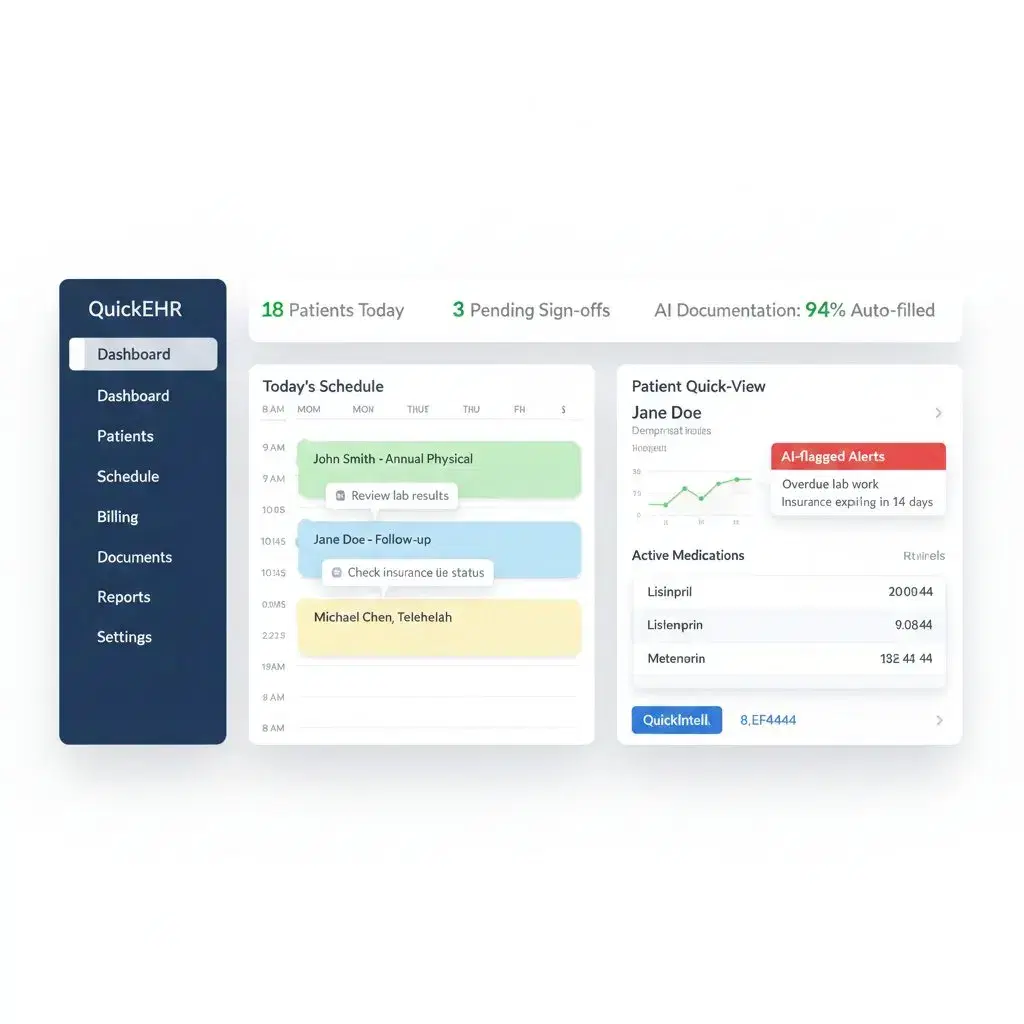
EHR consulting services for QuickEHR and OpenEMR workflows
QuickEHR EHR consulting helps ambulatory practices decide what to configure, automate, migrate, train, and support before the launch plan hardens. QuickIntell pairs OpenEMR-powered QuickEHR workflows with AI EHR consulting across documentation, coding, prior authorization, RCM, ERA, and patient operations.
Turn EHR consulting into a concrete QuickEHR operating plan.
Search intent for EHR consulting services is commercial and practical. Buyers want to know what gets assessed, what gets configured, what AI changes, and how the plan becomes implementation work.
EHR workflow assessment
Start EHR consulting with the way the practice actually works: scheduling, intake, charting, coding, authorization, billing, remittance, reporting, and support.
Map patient access, clinical, billing, coding, authorization, and RCM ownership before software decisions are finalized.
Identify duplicate clicks, spreadsheet handoffs, payer delays, documentation gaps, and unresolved work queues.
Turn findings into a QuickEHR roadmap that names owners, constraints, and decisions.
OpenEMR and QuickEHR design
Plan the OpenEMR-powered QuickEHR environment around roles, locations, templates, forms, documents, interfaces, and practice-management workflows.
Review whether the clinic needs QuickEHR-managed OpenEMR, an existing OpenEMR tenant, or a connected EHR workflow.
Scope chart, schedule, patient, billing, document, and reporting configuration before go-live.
Keep custom fields, unsupported records, and source-system constraints visible for review.
AI EHR consulting
Design where QuickIntell AI should draft, classify, suggest, route, summarize, or wait for human approval across the QuickEHR workflow.
Define assistive AI boundaries for documentation, coding, prior authorization, claims, ERA, patient communication, and reporting.
Connect chart, payer, claim, and remittance context to the right QuickIntell products.
Create review queues so uncertain suggestions move to named owners instead of disappearing into automation.
Implementation and optimization
Use consulting to turn recommendations into implementation scope, training tracks, launch readiness, post-go-live support, and measurable workflow tuning.
Align data conversion, interfaces, user roles, training, test scenarios, and go-live support.
Prioritize the first automation rollout around high-volume work rather than every possible workflow.
Use launch findings to tune templates, task routing, exception queues, and reporting views.
Consulting workflow
A useful EHR consulting plan is phased, owned, and testable.
QuickEHR consulting connects strategy to delivery: discovery, workflow mapping, OpenEMR-powered design, AI automation, training, and optimization.
Discover
Define the current-state operating model
QuickIntell EHR consulting starts by documenting the systems, people, queues, payer rules, templates, reports, and decisions that shape daily work.
Name the clinical, front-office, billing, coding, authorization, IT, compliance, and leadership reviewers.
Capture workflow pain by role instead of relying on generic feature checklists.
Map
Build a practical QuickEHR workflow map
A consulting plan should show what happens before, during, and after a visit. That includes chart prep, documentation, coding, payer checks, claim release, payment follow-up, and patient outreach.
Separate quick wins from workflows that need migration, interface, policy, or staffing decisions first.
Decide which tasks stay inside QuickEHR and which route to QuickIntell automation modules.
Design
Translate the map into configuration and implementation scope
QuickEHR consulting becomes useful when it produces build decisions: users, roles, templates, documents, data sources, interfaces, training paths, and launch controls.
Define role access, locations, providers, appointment types, templates, document categories, reports, and worklists.
Connect implementation scope to data conversion, interoperability, security, and OpenEMR integration reviews.
Document excluded items, unresolved questions, and post-launch backlog items before the timeline is committed.
Automate
Layer AI where the workflow is ready
AI EHR consulting should not start with tools in isolation. It should start with the work that is repetitive, evidence-based, reviewable, and connected to the chart.
Use QuickScribe, QuickCode, QuickAuth, QuickRCM, QuickERA, and QuickEHR context in the right sequence.
Define whether AI drafts, validates, classifies, summarizes, suggests, or routes each task.
Keep human review boundaries clear for clinical, billing, compliance, and launch decisions.
Train
Prepare staff around scenarios, not feature tours
Consulting should produce role-based training plans that match the actual launch workflow for front office, clinical, billing, coding, authorization, and reporting users.
Run scenario testing for scheduling, chart prep, visit documentation, authorization evidence, claim readiness, denials, and payment exceptions.
Create super-user coverage paths and issue triage rules for the launch period.
Use training feedback to fix template, routing, and reporting friction before production use.
Optimize
Keep tuning after go-live
Useful consulting continues into stabilization. The goal is to find bottlenecks early, refine ownership, and expand automation only after the baseline workflow is stable.
Review open tasks, chart completion, coding queues, authorization turnaround, claim exceptions, denials, AR, and ERA follow-up.
Build an optimization backlog that separates must-fix issues from later workflow improvements.
AI EHR consulting
Design automation around reviewable clinical and revenue workflows.
QuickIntell consulting identifies where AI can reduce manual work without skipping ownership, evidence, or review boundaries.
Documentation automation
Assess where QuickScribe can help prepare chart notes, summarize imported documents, and give coding and billing teams cleaner encounter context.
Coding review
Scope how QuickCode should surface ICD-10, CPT, HCPCS, modifier, and HCC suggestions for coder review from QuickEHR documentation.
Prior authorization routing
Define how QuickAuth can prepare packets, track payer requirements, and route missing evidence from the chart into authorization queues.
Revenue-cycle worklists
Use QuickRCM consulting to plan eligibility exceptions, claim readiness, denials, AR follow-up, patient balances, and payer status queues.
Remittance follow-through
Map how QuickERA should assist ERA, EOB, posting, adjustment, underpayment, denial, and patient-responsibility review.
OpenEMR consulting fit
OpenEMR consulting should connect the foundation to the work around it.
QuickEHR is built on the OpenEMR foundation. Consulting helps decide how OpenEMR configuration, QuickEHR workflows, approved APIs, FHIR, HL7, files, documents, templates, user roles, billing settings, OpenEMR implementation work, OpenEMR customization needs, OpenEMR support ownership, and QuickIntell automation should fit the specific practice.
Use QuickEHR when the practice wants a managed OpenEMR-powered EHR workflow with QuickIntell consulting, implementation planning, and AI automation around it.
Existing OpenEMR tenants
For organizations already using OpenEMR, consulting can evaluate approved API, FHIR, HL7, file, document, custom-form, and support paths before automation is scoped.
OpenEMR-powered modernization
For teams comparing open-source EHR options, consulting can clarify where QuickEHR configuration, OpenEMR implementation, AI workflows, RCM handoffs, and support should sit around the OpenEMR foundation.
Consulting and pricing scope
Scope consulting by decisions, workflows, and implementation risk.
EHR consulting services should not hide behind vague advisory language. QuickEHR consulting is scoped around the healthcare consulting software decisions and operational work to assess, design, implement, automate, train, and optimize.
Strategy sprint
A focused EHR consulting engagement for teams that need a QuickEHR, OpenEMR, AI, or RCM roadmap before committing to implementation work.
Workflow discovery and system inventory.
QuickEHR/OpenEMR fit assessment.
Prioritized automation and implementation roadmap.
Implementation advisory
A deeper consulting track for practices preparing migration, configuration, training, testing, launch readiness, and support ownership.
Data conversion and interoperability scoping.
Role-based workflow and training design.
Go-live readiness and hypercare planning.
AI automation rollout
A consulting track for teams adding AI EHR workflows around documentation, coding, authorization, RCM, ERA, and patient operations.
AI boundary and review-queue design.
QuickIntell product handoff planning.
Exception, escalation, and reporting rules.
Optimization and support
A post-launch consulting path for practices tuning QuickEHR workflows, reports, AI automation, RCM queues, and staff ownership after go-live.
Operational bottleneck review.
Template, worklist, and report tuning.
Automation expansion planning.
Final pricing depends on the practice, systems, data, interfaces, support model, selected products, and launch timeline. Review QuickEHR pricing for the EHR core and optional workflow scope.
Connected QuickIntell products
Consulting should connect the chart to the downstream work.
The strongest QuickEHR roadmap usually connects EHR configuration to documentation, coding, authorization, RCM, remittance, and patient operations.
EHR consulting affects source data, PHI handling, access controls, user roles, imported documents, AI suggestions, billing handoffs, and support ownership. The roadmap should make those decisions explicit before implementation begins.
Confirm source systems, data paths, access owners, user roles, and PHI handling expectations before implementation work begins.
Review the QuickIntell Trust Center and any deployment-specific evidence needed for the selected QuickEHR workflow.
Document AI boundaries for drafting, classification, coding suggestions, authorization packet preparation, RCM routing, and ERA follow-through.
Keep workflow maps, configuration decisions, training plans, test scenarios, unresolved exceptions, and final sign-off records with the project packet.
Separate QuickIntell software and consulting scope from clearinghouse, payment, payer, lab, eRx, hosting, interface, or third-party costs.
Avoid relying on generic certification, security, or customer claims without confirming current implementation evidence for the specific deployment.
Primary keyword
EHR consulting
Commercial-intent searchers need a clear service page for assessment, implementation, automation, and support planning.
OpenEMR path
QuickEHR fit
Consulting clarifies how the OpenEMR foundation, existing OpenEMR tenants, and QuickEHR workflows should be handled.
AI boundary
Reviewable
AI prepares worklists, suggestions, summaries, and routing while people retain clinical, billing, and launch decisions.
Related QuickEHR planning pages
Consulting sits beside implementation, pricing, data conversion, interoperability, OpenEMR integration, and practice-management planning.
Answers for teams comparing EHR consulting, OpenEMR consulting, AI EHR consulting, implementation planning, and healthcare consulting software options.
What is EHR consulting?
EHR consulting helps a practice evaluate, configure, implement, optimize, and govern electronic health record workflows. For QuickEHR, that means planning the OpenEMR-powered EHR foundation, AI automation, data conversion, integrations, staff training, launch support, and revenue-cycle handoffs around how the clinic actually operates.
What do QuickEHR EHR consulting services include?
QuickEHR EHR consulting services can include workflow assessment, OpenEMR and QuickEHR fit review, implementation planning, data conversion scoping, interface review, AI automation design, role-based training plans, go-live readiness, RCM workflow mapping, and post-launch optimization.
Is this OpenEMR consulting?
It can be. QuickEHR is built on the OpenEMR foundation, so consulting can support OpenEMR consulting needs such as configuration review, OpenEMR implementation planning, OpenEMR customization assessment, API or FHIR readiness, HL7/interface planning, workflow optimization, OpenEMR support ownership, and AI automation around the OpenEMR-based workflow.
How is AI EHR consulting different from standard EHR consulting?
Standard EHR consulting often focuses on configuration, migration, training, and go-live. AI EHR consulting adds decisions about where AI should draft, classify, summarize, suggest, validate, or route work, plus where a person must review and approve the output before clinical, billing, payer, or patient-facing action.
Can consulting help if we already use OpenEMR?
Yes. If the organization already uses OpenEMR, QuickIntell can evaluate the approved OpenEMR API, FHIR, HL7, file, document, custom form, and hosting paths before recommending QuickEHR configuration, AI automation, RCM worklists, or support changes.
How is QuickEHR consulting scoped or priced?
Consulting scope depends on practice size, locations, specialties, current systems, source data, interfaces, workflow complexity, selected QuickIntell modules, launch timing, and support needs. The page does not publish a generic hourly or package price because the useful estimate comes after discovery and scope review.
Which QuickIntell products can be included in the consulting roadmap?
The roadmap can include QuickEHR, QuickScribe, QuickCode, QuickAuth, QuickRCM, QuickERA, and related patient, reporting, billing, and integration workflows. The right mix depends on whether the immediate goal is documentation lift, coding review, authorization, RCM, remittance, implementation, or full workflow modernization.
Does QuickEHR consulting include implementation and training?
Consulting can include implementation and training planning, and it can also feed a separate implementation workstream. Useful outputs include role-based training tracks, test scenarios, user and access decisions, workflow maps, cutover rules, support ownership, and launch readiness criteria.
Can EHR consulting support billing and RCM workflows?
Yes. QuickEHR consulting can map charge capture, eligibility, coding handoff, claims, denials, AR follow-up, ERA/EOB review, patient balances, and reporting workflows, then decide where QuickRCM or QuickERA should assist the billing team.
Does this page make certification, security, or compliance claims?
No. This page describes QuickEHR consulting and workflow planning. QuickEHR is built on the OpenEMR foundation, and any certification, regulatory, security, payer, procurement, or contractual evidence should be confirmed in the current Trust Center materials, implementation packet, and agreement for the specific deployment.
QuickEHR consulting
Build the EHR consulting roadmap before implementation decisions become expensive to unwind.
QuickIntell can help your team scope QuickEHR, OpenEMR-powered workflows, AI automation, implementation, training, trust review, and connected RCM work before go-live.