Call
Developer solutions for QuickEHR

QuickEHR developer solutions for EHR integration software

QuickEHR developer solutions help healthcare technology, operations, and integration teams plan EHR integration software around the OpenEMR foundation, EHR API integration, sandbox validation, and QuickIntell AI automation. Connect approved chart and revenue context to documentation, coding, prior authorization, claims, ERA, and follow-up workflows without assuming unrestricted production access.

EHR API integration
OpenEMR API planning
AI workflow handoff

QuickEHR developer workspace

OpenEMR context, adapters, AI queues, and operational review

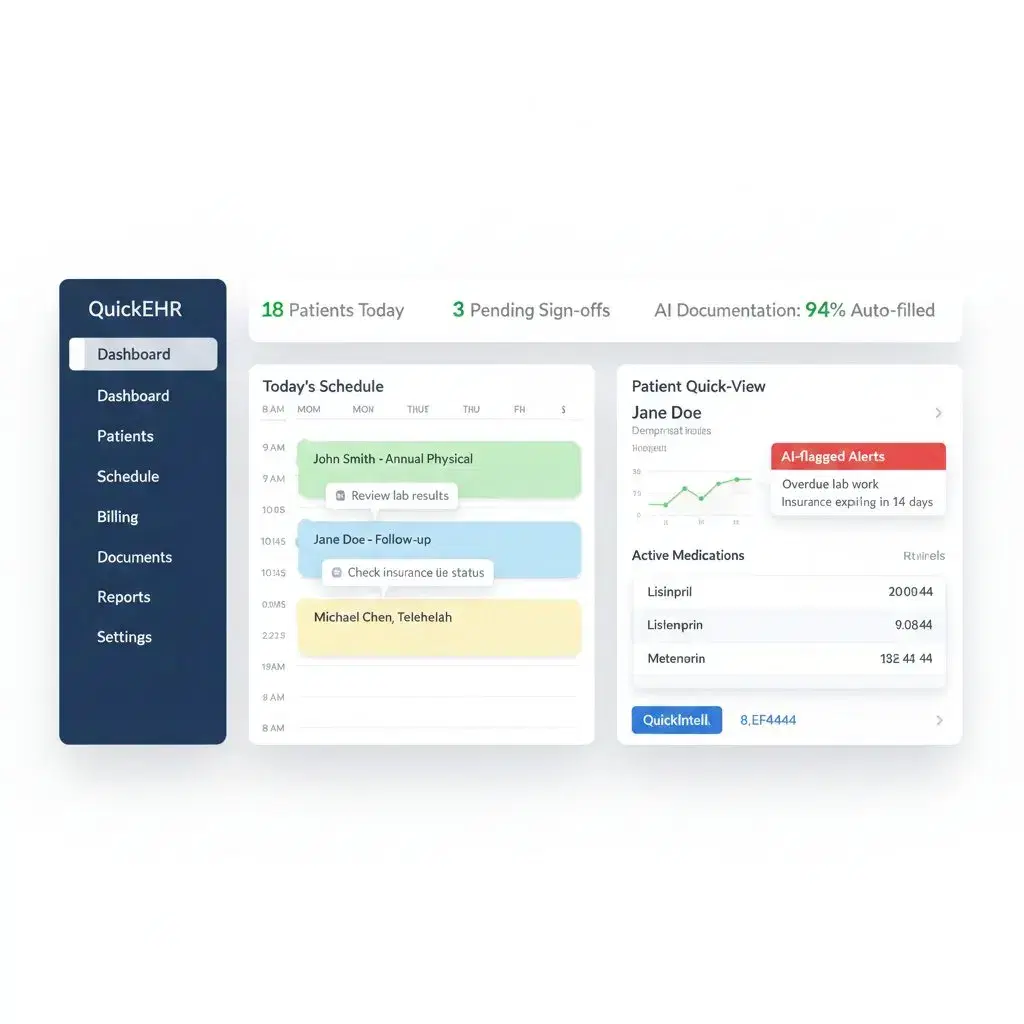
QuickEHR developer solutions dashboard for EHR integration software, OpenEMR context, AI worklists, coding, authorization, and revenue workflows

Build

API and interface

Validate

Sandbox and pilot

Operate

Monitor and review

Build paths

Developer solutions should match the workflow, not just the endpoint.

The right EHR integration software path may be an OpenEMR API call, FHIR resource, HL7 feed, interface-engine event, report, export, or QuickIntell adapter. QuickEHR planning starts with the operational outcome.

EHR API integration

OpenEMR API and FHIR context

QuickEHR is built on the OpenEMR foundation, so developer work can start with approved OpenEMR API, FHIR resource, and tenant-scope review instead of a generic integration checklist.

  • Evaluate patient, appointment, encounter, document, task, medication, observation, and billing context where available.
  • Confirm read, write, and synchronization boundaries before any production workflow depends on them.
  • Route usable EHR API context into QuickIntell review queues with source metadata preserved.
Integration workflow

Interfaces, events, and controlled polling

Some developer solutions need events, HL7 feeds, interface-engine routes, webhooks, or controlled polling rather than direct API calls for every workflow.

  • Use event-driven paths for scheduling, orders, results, charges, claim status, and document arrival when supported.
  • Define retry, duplicate, rejected-message, and exception ownership before go-live.
  • Keep failed delivery and missing mappings visible for implementation and operations teams.
AI EHR developer solutions

AI workflow extensions

QuickIntell developer workflows turn approved clinical and revenue context into assistive automation for documentation, coding, authorization, RCM, and remittance operations.

  • Connect chart context to QuickScribe note drafting without removing clinician review.
  • Move documentation evidence into QuickCode and QuickAuth worklists with clear source traceability.
  • Carry claim, denial, ERA, and EOB context into QuickRCM and QuickERA follow-through.
Data portability

Exports, reports, and migration handoff

Developer work is not always a live integration. QuickEHR planning can also define safe extracts, reports, migration files, archive packages, and reconciliation outputs.

  • Preserve source identifiers, timestamps, manifests, and mapping notes for auditability.
  • Separate one-time migration needs from recurring operational data flows.
  • Review PHI handling, retention, destinations, and support ownership for each extract path.

Developer workflow

Move from request intake to reliable production operations.

QuickEHR developer solutions give engineers, implementation owners, clinicians, coders, authorization teams, and RCM operators a shared plan for scope, testing, and support.

Discover

Start with the clinical or revenue workflow

QuickEHR developer solutions begin by mapping what the practice needs to complete, which system owns the data, and which human role reviews the output.

  • Identify the system of record for patients, providers, locations, encounters, documents, coverage, claims, payments, and tasks.
  • Confirm whether QuickEHR-managed OpenEMR, an existing OpenEMR tenant, or another EHR remains primary.
  • Separate read-only context, assistive AI output, and write-back workflows.

Design

Define access, auth, and data boundaries

A developer-ready EHR integration software plan should make scopes, credentials, roles, environment separation, logs, and support ownership explicit.

  • Document OAuth, service credentials, user roles, tenant scopes, and least-privilege access.
  • Confirm rate limits, retry rules, event ordering, data retention, and monitoring requirements.
  • Keep high-risk writes behind review gates until the clinic approves the workflow.

Build

Normalize data into a shared workflow model

QuickIntell adapters translate approved API, interface, file, event, and export inputs into patient, encounter, document, task, and revenue context.

  • Map source identifiers so each suggestion or worklist item can be traced back to the record.
  • Normalize notes, orders, attachments, payer details, claim events, denials, payments, and task status.
  • Route duplicate patients, ambiguous mappings, unsupported fields, and failed calls to exception queues.

Validate

Test before production teams rely on it

Developer solutions software should prove the full workflow, not just the first successful API call. QuickEHR planning includes sandbox-style validation when available.

  • Test authentication, tenant routing, patient search, document intake, encounter retrieval, and configured write-back rules.
  • Run negative tests for expired tokens, missing scopes, malformed payloads, duplicate patients, and unavailable endpoints.
  • Validate how context reaches documentation, coding, authorization, RCM, ERA, and follow-up workflows.

Operate

Monitor mappings, errors, and release changes

Developer work continues after launch. QuickEHR implementations should define owners for mapping drift, API changes, failed jobs, and operational exceptions.

  • Track latency, retries, rejected writes, unmapped fields, failed deliveries, and stalled worklists.
  • Review version changes before they affect clinical or revenue automation.
  • Keep developers, clinic operations, and QuickIntell implementation owners aligned on support paths.

Sandbox and validation

Prove the integration behavior before production teams depend on it.

Searchers evaluating EHR API integration and OpenEMR API documentation often expect examples, Swagger, and sandbox paths. QuickEHR developer planning treats those as workflow readiness steps: validate auth, mappings, failures, review gates, and support ownership before launch.

For API-specific endpoint planning, review QuickEHR open API. For standards and interface planning, review QuickEHR interoperability.

Developer validation checklist

  • Use synthetic or approved test data when practical; production PHI access should follow the implementation agreement and trust review.
  • Validate OpenEMR API documentation, OpenEMR FHIR API scope, Swagger availability, enabled modules, and deployment version assumptions.
  • Test patient search, appointment context, encounter retrieval, document intake, task routing, coverage context, and configured write-back rules.
  • Confirm OAuth, service credentials, tenant routing, user roles, rate limits, logs, and environment separation.
  • Run negative tests for expired tokens, duplicate patients, missing scopes, endpoint downtime, malformed payloads, and rejected events.
  • Trace how data moves from the EHR integration software path into QuickScribe, QuickCode, QuickAuth, QuickRCM, QuickERA, and QuickEHR worklists.
  • Document what the sandbox proves, what still requires production readiness review, and who owns post-launch support.

OpenEMR and QuickEHR fit

Built around the OpenEMR foundation, scoped for the deployed environment.

QuickEHR is built on the OpenEMR foundation. That makes OpenEMR API integration, OpenEMR FHIR API planning, and QuickIntell AI workflow handoff especially relevant for teams evaluating OpenEMR developer solutions or AI EHR developer solutions.

QuickEHR-managed OpenEMR

For practices adopting QuickEHR, developer scope can be planned around the managed OpenEMR foundation, configured modules, QuickIntell adapters, and production readiness review.

Existing OpenEMR tenants

For practices already running OpenEMR, QuickIntell can evaluate API resources, FHIR availability, custom forms, hosting constraints, interface options, and support ownership.

Connected EHR workflows

For teams keeping another EHR as the system of record, QuickEHR developer solutions can organize approved context around AI worklists and downstream revenue workflows.

Need the dedicated OpenEMR integration page? Start with OpenEMR integration for QuickEHR to review OpenEMR software, QuickEHR-managed OpenEMR, existing OpenEMR tenants, FHIR, APIs, HL7, and QuickIntell automation routes.

Implementation and trust

Keep PHI, write-back, and AI review boundaries explicit.

Developer solutions for clinical and revenue workflows should be reviewed like production software. Teams need a clear record of what data is accessed, who approves it, how errors are handled, and which AI outputs remain assistive work for human review.

Procurement, legal, security, and compliance teams can review current documentation through the QuickIntell Trust Center. This page does not create a new certification, endorsement, or compliance claim for any specific tenant.

Implementation checklist

  • Confirm system-of-record ownership for patient, provider, location, encounter, document, scheduling, coverage, claim, payment, and task data.
  • Define enabled OpenEMR API, FHIR, HL7, interface-engine, event, report, file, and export paths.
  • Document OAuth, service credentials, tenant scopes, role access, environment separation, logs, retention, and support escalation.
  • Map source identifiers, required fields, optional fields, code sets, custom forms, duplicate handling, and rejected-message workflows.
  • Set review gates for AI summaries, draft notes, coding suggestions, authorization packets, claim worklists, and payment exceptions.
  • Validate sandbox and pilot workflows with sample charts, endpoint failures, rate limits, mapping drift, and rollback rules.
  • Review trust documentation, legal terms, data handling, and implementation evidence before production use.

Plan the build

Connect QuickEHR developer work to the workflows your teams actually need to complete.

Bring integration, clinical, coding, authorization, and revenue owners into one scope review. QuickIntell can help map OpenEMR-powered EHR context into practical AI workflows while keeping production controls visible.

FAQs

QuickEHR developer solutions questions

Answers for developers, implementation leads, clinical owners, and revenue teams evaluating QuickEHR, OpenEMR APIs, and AI workflow integrations.

How do QuickEHR developer solutions support EHR integration software?

QuickEHR developer solutions help teams plan EHR integration software around approved OpenEMR API, FHIR, interface, event, file, report, and export paths. The goal is to move usable chart and revenue context into QuickIntell workflows while keeping access, review, and production controls explicit.

Is QuickEHR built for OpenEMR developer solutions?

QuickEHR is built on the OpenEMR foundation, so OpenEMR developer solutions are a natural part of implementation planning. Available API, FHIR, interface, and write-back paths depend on the tenant, version, enabled modules, hosting model, customizations, and approved scope.

Does QuickEHR support EHR API integration?

EHR API integration can be part of a QuickEHR implementation when the deployment supports the required resources and access model. QuickIntell can evaluate OpenEMR API documentation, OpenEMR FHIR API resources, Standard API endpoints, interface feeds, controlled polling, reports, files, and export paths.

Can developers use a QuickEHR sandbox?

QuickEHR implementations can include sandbox-style validation, staging tenants, synthetic payloads, approved test data, or controlled pilot workflows when available for the project. The sandbox plan should document what was tested and what still requires production readiness review.

How do AI EHR developer solutions fit into QuickIntell?

AI EHR developer solutions should turn approved data into reviewable work. QuickIntell can use EHR context to support QuickScribe note drafting, QuickCode coding review, QuickAuth authorization packets, QuickRCM claim workflows, and QuickERA remittance exceptions, with humans retaining final responsibility.

What data can QuickEHR developer workflows connect?

A scoped workflow may connect patient demographics, providers, locations, appointments, encounters, documents, medications, observations, tasks, coverage, charges, claims, denials, payments, ERA, EOB, and operational status events when the implementation path supports them.

What is the difference between developer solutions and the open API page?

This developer-solutions page focuses on the broader build program: workflow discovery, access design, adapter mapping, sandbox validation, AI product handoff, and post-launch operations. The QuickEHR open API page goes deeper on API surfaces, endpoint planning, sandbox behavior, and scoped API access.

Can QuickEHR connect to an existing OpenEMR tenant?

Practices already using OpenEMR can evaluate a QuickIntell integration without replacing the tenant. Available paths depend on the existing OpenEMR environment, approved access, custom forms, hosting model, enabled modules, support policy, and implementation scope.

Does QuickEHR provide unrestricted public API access?

No unrestricted public API access should be assumed from this page. QuickEHR developer access is described as implementation-scoped and should be reviewed for tenant permissions, auth, data handling, PHI boundaries, support ownership, and production readiness.

Does this page make certification, HIPAA, SOC 2, EPCS, or customer claims?

No. This page describes QuickEHR developer workflow planning and avoids new certification, endorsement, HIPAA, SOC 2, EPCS, payer, customer, or nationwide exchange claims. Current trust, legal, procurement, security, and implementation evidence should be reviewed for the specific deployed environment.