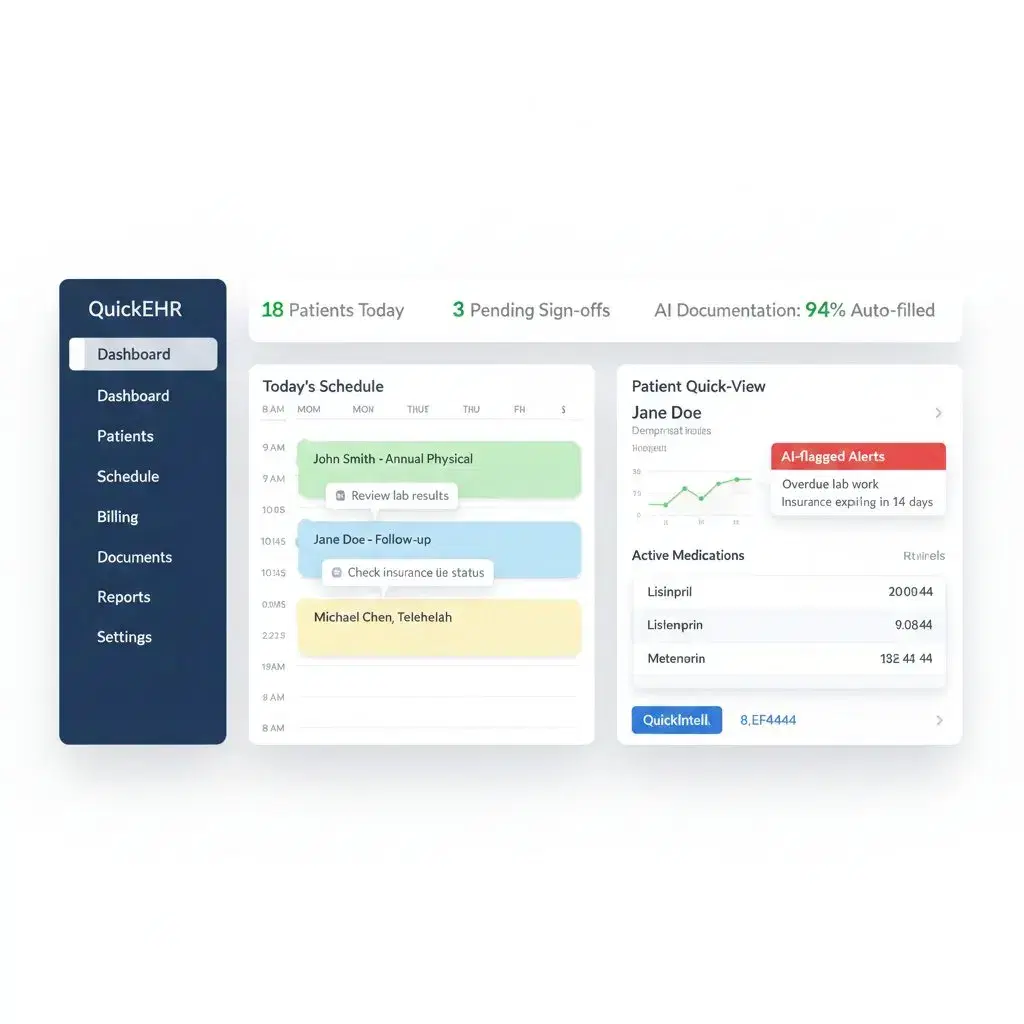
EHR implementation for QuickEHR and OpenEMR workflows
QuickEHR EHR implementation services help ambulatory practices move from planning to go-live with a reviewable operating plan: OpenEMR-powered configuration, migration scope, role-based training, AI workflow automation, testing, hypercare, and support. QuickIntell keeps chart, payer, claim, remittance, and patient context connected so the launch does not stop at software setup.
Launch QuickEHR as a workflow change, not only a system change.
Implementation buyers need clear answers on steps, plans, training, migration, timelines, and challenges. QuickEHR implementation turns those questions into practical scope before go-live.
Migration and readiness
Start the EHR implementation plan with source-system inventory, practice workflows, user roles, data quality, and go-live risk before configuration begins.
Define which records move, which stay read-only, and which need archive access.
Surface data, staffing, training, and revenue-cycle risks early enough to fix them.
QuickEHR configuration
Configure the OpenEMR-powered QuickEHR workspace around the way the practice schedules visits, rooms patients, documents care, codes encounters, bills claims, and follows up.
Align specialty templates and chart workflows with the clinic's first go-live use cases.
Keep unsupported custom fields and ambiguous mappings in named review queues.
AI workflow automation
QuickIntell implementation adds AI workflow design around QuickEHR, so the record can feed documentation, coding, authorization, RCM, ERA, and patient-facing tasks.
Decide where AI drafts, classifies, summarizes, suggests, routes, or waits for review.
Connect chart, payer, claim, and remittance context to the right QuickIntell modules.
Document human approval boundaries before production automation is enabled.
Training and support
EHR implementation services should include role-based training, super-user readiness, go-live coverage, and post-launch optimization instead of ending at software setup.
Train front desk, clinical, billing, coding, authorization, admin, and reporting users by workflow.
Run scenario-based testing for scheduling, charting, claim handoff, and exception queues.
Use hypercare findings to tune templates, worklists, automations, and ownership rules.
EHR implementation workflow
A useful implementation plan is phased, owned, and testable.
QuickEHR implementation covers the work buyers search for: implementation steps, migration planning, staff training, timeline drivers, go-live support, and post-launch optimization.
Discover
Define the current-state workflow and implementation team
QuickEHR implementation starts by naming the people, systems, workflows, and decisions that affect go-live. The team should understand how visits, documents, payer rules, charges, claims, and payments move today.
Map front-desk, clinical, coding, prior authorization, billing, payment, reporting, and support owners.
Confirm whether QuickEHR-managed OpenEMR, an existing OpenEMR tenant, or another source remains the system of record.
List blockers such as custom forms, legacy reports, inactive users, missing payer IDs, or unclear data access.
Migrate
Plan the EHR migration before data moves
EHR migration should not be a blind import. QuickIntell helps teams define source extracts, field maps, document handling, test loads, reconciliation, and cutover rules for QuickEHR.
Decide what becomes active QuickEHR data, what remains historical, and what needs source-system access.
Run test imports and sample-chart validation before the final cutover window.
Configure
Turn QuickEHR into a practice-specific operating workspace
The useful work is not only installing software. QuickEHR configuration should make scheduling, charting, document review, coding, billing, patient communication, and reporting easier to run every day.
Set up users, roles, locations, schedules, templates, forms, document categories, and workflow queues.
Tune specialty-specific charting and practice-management settings for the initial launch scope.
Align QuickEHR billing, claims, eligibility, and payment workflows with connected QuickIntell modules.
Automate
Layer AI only where the workflow is ready
AI EHR implementation should be controlled and reviewable. QuickIntell helps design where AI can prepare work, where a person approves it, and how exceptions move to the right queue.
Use QuickScribe for documentation context, QuickCode for coding review, QuickAuth for authorization packets, QuickRCM for claim worklists, and QuickERA for remittance follow-through.
Route missing data, payer conflicts, failed imports, and uncertain AI suggestions to named owners.
Keep audit-friendly source context visible so teams can understand why a task or suggestion exists.
Train
Practice the real day before go-live
EHR implementation training should use the practice's workflows, not only feature tours. Staff need to know the new clicks, the review boundaries, and what to do when something is missing.
Run role-based training for intake, chart prep, documentation, orders, checkout, coding, claims, and payment exceptions.
Create super-user support paths and quick reference materials for the highest-volume workflows.
Validate end-to-end scenarios with sample patients before production launch.
Launch
Go live with hypercare and optimization already planned
Implementation work continues after the launch date. QuickEHR go-live should include issue triage, data reconciliation, user support, workflow tuning, and a path to expand automation once the baseline is stable.
Define go-live command center owners, escalation paths, and daily review checkpoints.
Use early findings to refine templates, worklists, AI prompts, routing rules, and reporting views.
AI EHR implementation
QuickIntell adds automation where the workflow can be reviewed.
AI should help implementation teams prepare, validate, and route work. It should not silently decide clinical meaning, final billing action, legal scope, or go-live acceptance.
Implementation worklists
Create launch worklists for data exceptions, template decisions, payer mapping, claim readiness, training gaps, and unresolved source-system questions.
Document classification
Classify imported charts, referrals, payer letters, scanned documents, lab packets, and attachments so clinical and billing reviewers can find what matters.
Mapping suggestions
Suggest mappings for common fields, forms, payers, document types, providers, locations, and task categories while implementation owners approve final rules.
Validation summaries
Summarize test-load counts, failed imports, missing fields, duplicate patients, open balances, and unresolved launch risks for team review.
Downstream routing
Route documentation, coding, prior authorization, RCM, ERA, and patient outreach tasks from the same QuickEHR chart and encounter context.
OpenEMR and QuickEHR fit
OpenEMR implementation needs a practical workflow plan.
QuickEHR is built on the OpenEMR foundation. Implementation should therefore define how chart configuration, source data, OpenEMR APIs, FHIR, HL7, documents, templates, user roles, billing settings, and QuickIntell automation will work for the specific practice.
Use QuickEHR when the practice wants a managed OpenEMR-powered EHR workflow with QuickIntell implementation, automation, and operating support around it.
Existing OpenEMR tenants
For clinics already using OpenEMR, implementation can evaluate approved OpenEMR API, FHIR, HL7, file, report, document, and custom-field paths before automation is scoped.
Legacy EHR migration
For practices moving from another EHR or PM system, implementation planning should protect patient history, active schedules, billing continuity, and staff adoption.
Training and go-live readiness
Train the workflows each team will actually run.
EHR implementation training works best when staff practice patient access, documentation, coding, authorization, billing, reporting, and support scenarios before production launch.
Implementation should connect the chart to downstream work.
QuickEHR implementation becomes more useful when documentation, coding, prior authorization, RCM, remittance, and patient workflows launch from the same operating context.
Put risk ownership into the implementation plan before launch.
EHR implementation affects PHI handling, user access, imported documents, source-system extracts, AI review queues, claim handoffs, and support ownership. QuickEHR projects should pair workflow design with a trust review and implementation-specific evidence.
Name the implementation owner, clinical lead, billing lead, IT contact, compliance reviewer, and super users before build work starts.
Confirm QuickEHR, OpenEMR, legacy EHR, PM, clearinghouse, document, payer, and reporting systems in scope.
Document source extracts, field maps, import rules, custom forms, excluded records, archive access, and validation owners.
Define AI boundaries for drafting, classification, coding suggestions, authorization packet prep, RCM routing, and ERA follow-through.
Run role-based training and end-to-end scenario testing before production go-live.
Review Trust Center materials, access controls, PHI handling, support responsibilities, and implementation-specific evidence.
Implementation coverage
EHR and EMR
Covers QuickEHR-specific migration, configuration, and training decisions for EHR and EMR launches.
AI boundary
Assistive
AI prepares classification, mapping, summaries, and workflow routing while people approve scope and launch decisions.
Operating focus
Go-live plus support
Implementation planning includes readiness, test scenarios, hypercare, optimization, and trust review.
Related QuickEHR pages
Implementation sits beside migration, data conversion, interoperability, security, OpenEMR integration, and practice management planning.
EHR implementation plans should reflect specialty templates, order patterns, documentation burden, payer rules, coding needs, and patient-flow differences.
Answers for teams comparing EHR implementation services, OpenEMR implementation, EHR migration, AI EHR implementation, and staff training plans.
What is EHR implementation?
EHR implementation is the planned rollout of an electronic health record workflow, including discovery, migration, configuration, training, testing, go-live, support, and optimization. For QuickEHR, implementation also accounts for the OpenEMR foundation and QuickIntell AI workflows around documentation, coding, authorization, RCM, ERA, and patient operations.
What do QuickEHR EHR implementation services include?
QuickEHR EHR implementation services can include workflow discovery, source-system inventory, OpenEMR and legacy EHR migration planning, QuickEHR configuration, user and role setup, template review, AI workflow design, role-based training, test scenarios, go-live support, and post-launch optimization. The exact scope depends on the practice, systems, data access, specialties, and modules selected.
How does OpenEMR implementation fit QuickEHR?
QuickEHR is built on the OpenEMR foundation. Implementation can support a QuickEHR-managed OpenEMR path or review an existing OpenEMR tenant, depending on the approved API, FHIR, HL7, file, report, hosting, custom form, and support paths available for the deployment.
Can QuickEHR support EHR migration from a legacy system?
QuickEHR can be evaluated for EHR migration when the source system can provide approved exports, reports, files, database extracts, APIs, or other handoff paths. The implementation plan should define what moves into QuickEHR, what remains in legacy read-only access, what is archived, and how unresolved exceptions are reviewed.
How does AI help during EHR implementation?
QuickIntell AI can assist with document classification, data-mapping suggestions, duplicate and gap detection, validation summaries, worklist creation, coding review, prior authorization packet preparation, claim routing, and ERA exception follow-through. These workflows are designed to prepare work for review, not to replace clinical, billing, legal, or implementation sign-off.
What should be in an EHR implementation plan?
An EHR implementation plan should include goals, owners, source systems, data scope, field maps, configuration decisions, training tracks, test scenarios, go-live timing, cutover rules, support roles, trust-review needs, AI boundaries, and post-launch optimization checkpoints.
How does EHR implementation training work?
Training should be role-based and scenario-driven. Front office, clinical, billing, coding, authorization, admin, and reporting users should practice the workflows they will use at launch, including what to do when data is missing, an AI suggestion needs review, or an exception lands in the wrong queue.
How long does a QuickEHR implementation take?
The timeline depends on practice size, specialty mix, number of locations, source data quality, migration scope, integrations, user count, training needs, and selected QuickIntell modules. A reliable estimate should be made after discovery, source-system review, and workflow scoping rather than using a generic timeline.
What happens after go-live?
Post-go-live work should include hypercare, issue triage, data reconciliation, user support, workflow tuning, template adjustments, report review, and phased expansion of automation once the baseline workflow is stable.
Does this page make certification or compliance claims?
No. This page describes QuickEHR implementation workflow planning. QuickEHR is built on the OpenEMR foundation, and any certification, regulatory, security, payer, procurement, or contractual evidence should be verified in the current Trust Center materials, implementation packet, and agreement for the specific deployment.
QuickEHR implementation planning
Build the migration, training, AI workflow, and go-live plan before the launch date.
QuickIntell can help your team scope QuickEHR implementation around OpenEMR-powered workflows, source data, role-based training, trust review, and connected automation across the revenue cycle.