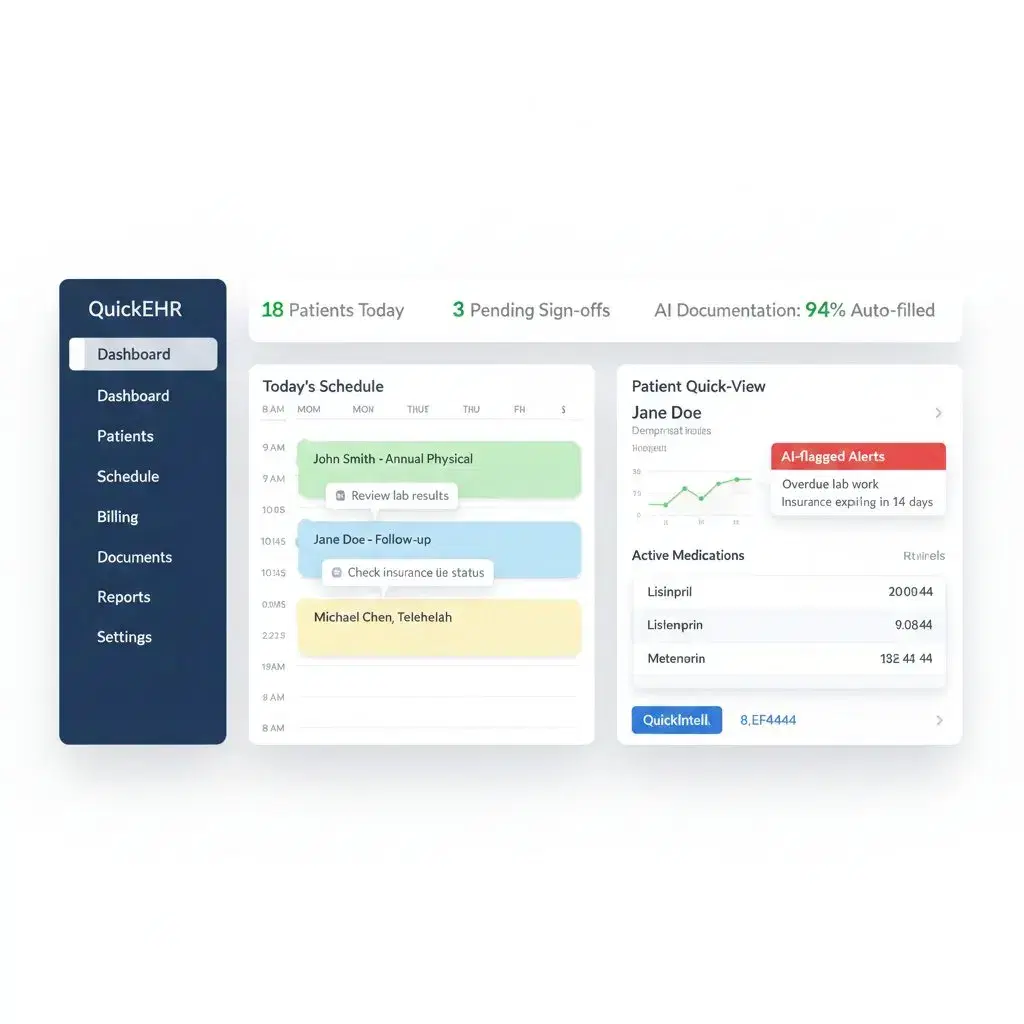
QuickEHR managed RCM software connects OpenEMR-powered billing, AI revenue cycle management, medical billing automation software workflows, claims, denials, AR, payment posting, QuickRCM, and QuickERA so teams can manage the revenue cycle with the chart and payer context in view.
A managed revenue cycle workflow should know what happened in the chart, what the payer needs, and what still requires review.
QuickEHR connects EHR revenue cycle management to the practical billing workflow: intake, eligibility, authorization, documentation, coding, charge review, claims, denials, accounts receivable, ERA, payment posting, and patient balance follow-up.
Managed intake
Scope the revenue cycle around the source visit
Managed RCM software works best when the billing team can see the appointment, chart, coverage, authorization, coding, charge, claim, remittance, and follow-up context without rebuilding the visit story.
Use QuickEHR as the OpenEMR-powered workflow layer for patient, schedule, encounter, payer, provider, location, and billing context.
Define what staff review before release: eligibility, referrals, authorization evidence, documentation, coding, modifiers, units, and charge rules.
Separate clinic-owned work, outsourced billing tasks, and QuickIntell-assisted queues so each revenue cycle item has an owner.
Claim production
Move clean work into claims and payer queues
Revenue cycle management software has to connect the EHR, the practice management workflow, and payer follow-up. QuickEHR keeps claim readiness tied to the underlying clinical and payer evidence.
Prepare claim worklists with QuickCode output, QuickAuth context, eligibility findings, clinical documentation, and payer-specific review notes.
Route claim scrubbing, electronic claims, rejected claims, corrected claims, attachment needs, and payer status into structured work queues.
Keep staff review points explicit so AI can classify, summarize, and prepare work without hiding the final billing decision.
Resolution loop
Close denials, AR, and payment exceptions
Healthcare revenue cycle management software should keep the payment loop connected to the original encounter. QuickEHR routes denials, AR, ERA, EOB, underpayment, and patient balance work back to the claim context.
Use QuickRCM queues for payer denials, claim-not-on-file issues, stalled AR, appeal preparation, and follow-up ownership.
Use QuickERA workflows to connect remittance, adjustments, patient responsibility, posting exceptions, and payment questions to the original claim.
Turn denial and payment patterns into practical feedback for intake, documentation, coding, authorization, and claim release workflows.
Managed operations
Cover the work buyers expect from healthcare revenue cycle management software.
Managed RCM is not one queue. It is a coordinated operating model around eligibility, coding, medical billing revenue cycle management, claim submission, denials, AR, payment posting, patient balances, and reporting.
Use QuickERA to keep remittance, EOB details, contractual adjustments, underpayments, and posting exceptions tied to the claim.
Managed reporting
Review work by payer, provider, location, denial reason, aging bucket, owner, queue status, and operational bottleneck.
AI revenue cycle management
AI can prepare the RCM work while billing teams keep the review gates.
QuickIntell AI can help classify, summarize, prioritize, and route revenue cycle work. The useful goal is not hidden automation. It is cleaner handoff between documentation, coding, authorization, claims, denials, AR, and payment posting.
Revenue cycle worklist classification
AI-assisted routing can group work by missing coverage, documentation gap, coding question, authorization blocker, rejection, denial, AR item, or remittance exception.
Claim readiness summaries
Summarize the chart, payer, authorization, coding, charge, and claim context staff should review before submission or corrected-claim preparation.
Denial root-cause preparation
Connect payer reason codes and notes to the encounter evidence, authorization status, coding context, and appeal next steps for review.
Payment exception routing
Use ERA and EOB context to prepare review queues for partial payments, underpayments, recoupments, adjustment mismatches, and patient responsibility.
OpenEMR and QuickEHR fit
QuickEHR keeps managed RCM close to the EHR source of truth.
OpenEMR billing and OpenEMR revenue cycle management searches often start with practical integration questions. QuickEHR is built on the OpenEMR foundation, so implementation can define which chart, payer, claim, remittance, and billing signals are available for review queues.
QuickEHR is built on the OpenEMR foundation and adds QuickIntell workflow design around documentation, coding, authorization, claims, denials, AR, ERA, and patient balance operations.
Existing OpenEMR tenants
Practices already running OpenEMR can evaluate approved OpenEMR API, FHIR, HL7, clearinghouse, EDI, ERA, batch, or interface-engine paths for revenue cycle context.
QuickEHR Connect for mixed systems
Clinics keeping another EHR or practice management system can evaluate QuickEHR as the workflow layer around the revenue cycle data available through approved interfaces.
Related QuickIntell products
Managed RCM depends on the whole workflow around the claim.
The revenue cycle depends on documentation, coding, authorization, eligibility, claim routing, denials, AR follow-up, remittance, payment posting, patient balances, and reporting. These links keep the QuickIntell workflow connected.
Buyers comparing managed RCM software often need the adjacent QuickEHR billing, claims, AR, ERA, and OpenEMR implementation pages before choosing a workflow.
Managed RCM planning changes by payer mix, specialty, staffing model, and source system. Start with the broader RCM workflow, then review the specialties where claim and documentation context matter most.
Managed RCM should start with data paths, ownership, and review boundaries.
QuickEHR managed RCM planning should define which systems are source of truth, which teams own each queue, what QuickIntell AI may prepare, and what remains in staff, coder, clinician, billing leader, or vendor review.
Choose the operating model: QuickEHR-managed OpenEMR, an existing OpenEMR tenant, QuickEHR Connect, in-house billing, outsourced billing services, or a hybrid RCM team.
Map visit types, charge sources, provider and location rules, payer routing, clearinghouse paths, claim status feeds, ERA/EOB handling, patient balance ownership, and reporting needs.
Define review gates for eligibility, authorization, documentation, coding, claim scrubbing, electronic claims, denials, appeals, AR, payment posting, and patient billing.
Document which AI suggestions may classify, summarize, prioritize, draft, route, or prepare work before staff, coder, clinician, billing manager, or vendor review.
Confirm enabled OpenEMR API, FHIR, HL7, EDI, clearinghouse, payer, remittance, file, or interface-engine paths for the specific deployment.
Review data handling, access controls, audit expectations, support ownership, Trust Center materials, and implementation-specific evidence before production use.
FAQs
Managed RCM software questions for QuickEHR buyers.
Use these answers to frame QuickEHR, OpenEMR billing, AI revenue cycle management, outsourced billing services, and connected QuickIntell product scope before implementation.
What is QuickEHR managed RCM software?
QuickEHR managed RCM software is a QuickIntell workflow for coordinating revenue cycle work around QuickEHR and OpenEMR-powered context. It connects eligibility, authorization, documentation, coding, charges, claims, denials, AR, remittance, payment posting, patient balances, QuickRCM, and QuickERA into reviewable work queues.
How is managed RCM different from standalone revenue cycle management software?
Standalone revenue cycle management software may provide worklists, claims, denial tools, or reports. QuickEHR managed RCM is designed around the EHR workflow, so billers can use patient, encounter, payer, authorization, documentation, coding, claim, and remittance context while QuickIntell AI helps classify, summarize, and route work for review.
How does OpenEMR billing fit with QuickEHR managed RCM?
QuickEHR is built on the OpenEMR foundation. A practice can use QuickEHR-managed OpenEMR workflows or evaluate an existing OpenEMR tenant when approved API, FHIR, HL7, clearinghouse, EDI, remittance, batch, or interface-engine paths are available for the deployment.
Does QuickEHR automate every revenue cycle decision?
No. QuickIntell AI can help classify, summarize, prioritize, route, and prepare revenue cycle work, but billing, coding, clinical, payer, and patient-facing decisions should keep the review points defined in the implementation plan.
Which QuickIntell products support the managed RCM workflow?
QuickScribe supports documentation handoff, QuickCode prepares reviewable coding context, QuickAuth keeps authorization evidence visible, QuickRCM organizes claims, denials, AR, and follow-up queues, and QuickERA connects remittance and EOB context to payment posting and exception review.
Can practices use managed RCM with another EHR?
Practices keeping another EHR or practice management system can evaluate QuickEHR Connect. That path is intended to route documentation, coding, authorization, claim, denial, AR, remittance, and patient balance context around the existing system of record when approved interfaces are available.
Does QuickEHR replace a clearinghouse or billing vendor?
Not by default. QuickEHR is the EHR and workflow layer around managed RCM. A deployment may still use a clearinghouse, payer portal, EDI partner, payment processor, billing vendor, or interface engine based on the practice's payer mix and operating model.
What should a clinic review before launching managed RCM?
Review payer routes, clearinghouse setup, claim edits, status feeds, eligibility workflows, authorization evidence, coding review, denial and appeal ownership, ERA/EOB handling, patient balance rules, user roles, access controls, audit expectations, support ownership, and AI review boundaries.
Does this page make certification or compliance claims?
No. This page describes QuickEHR managed RCM workflow planning. QuickEHR is built on the OpenEMR foundation, and any regulatory, security, certification, payer, or procurement evidence should be verified in the current Trust Center materials, implementation packet, and contract for the specific deployment.
Managed RCM planning
Connect QuickEHR, OpenEMR billing, and AI RCM queues around your real workflow.
Bring the chart, payer, coding, authorization, claim, remittance, and follow-up context into one managed revenue cycle plan before teams commit to new queues.