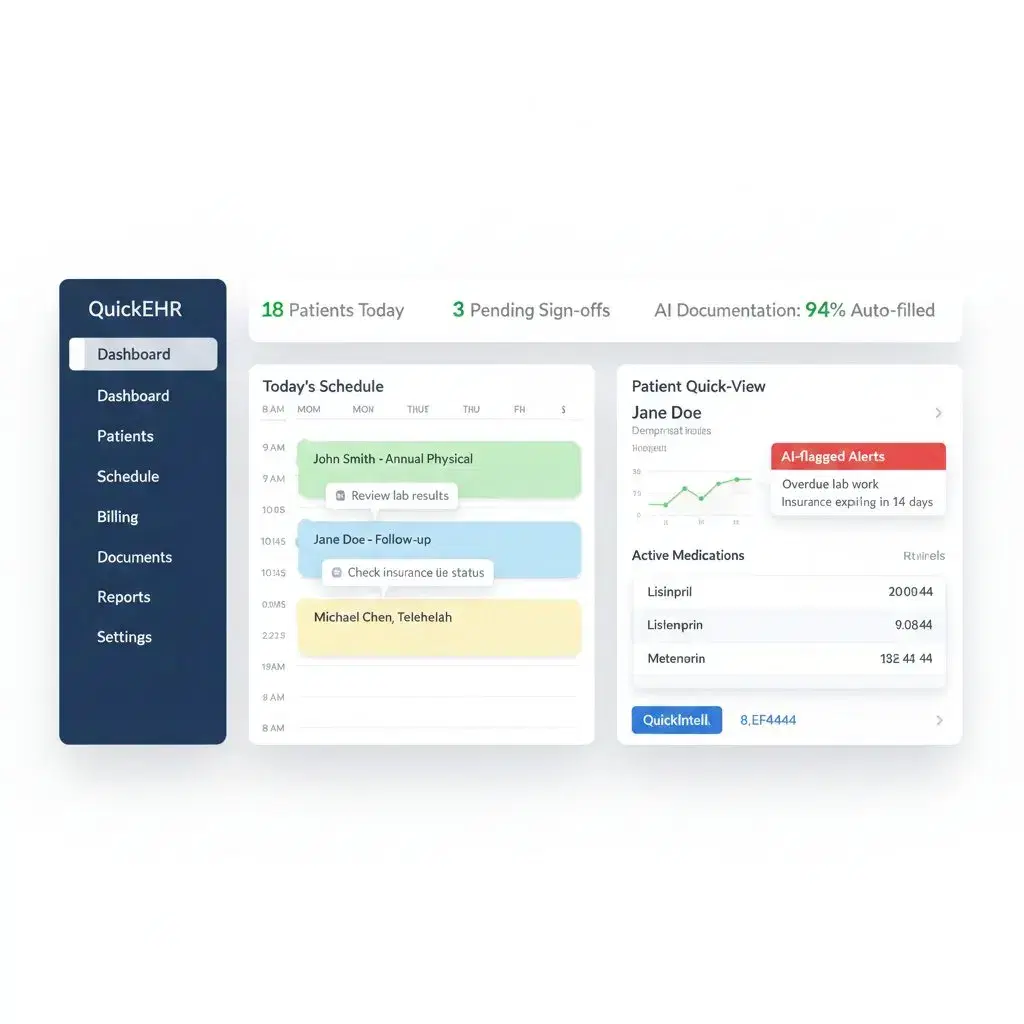
Centralized billing should standardize work without flattening client context.
The SERP blends CBO definitions, billing office software, and commercial medical billing software for billing companies. QuickEHR answers the operational need: a structured way to move many clients through intake, charge review, claims, denials, AR, remittance, and reporting.
CBO intake
Normalize intake across every client
Central billing office software has to make many practices feel operationally consistent without erasing each client's payer rules, provider setup, locations, templates, and billing responsibilities.
Group appointments, demographics, coverage, authorization, chart, charge, and payer context by client, provider, location, and owner.
Surface missing registration, eligibility, documentation, coding, referral, or authorization details before they become claims or AR rework.
Keep billing company staff in one workspace while preserving the client-level separation needed for queue ownership and reporting.
Claim preparation
Move charges into claim-ready queues
Medical billing software for billing companies should connect charge review, coding support, claim scrubbing, payer routing, and corrected-claim preparation without forcing teams to rebuild the encounter story.
Review ICD-10, CPT, HCPCS, modifiers, units, place of service, provider identifiers, payer edits, and supporting documentation.
Use QuickCode and QuickAuth context to make coding questions, authorization evidence, and approved service windows visible before submission.
Track draft, held, scrubbed, submitted, rejected, corrected, and resubmitted claims against the client, patient, encounter, payer, and queue owner.
Resolution loop
Close denials, AR, and payment exceptions
A central billing office does not end at claim submission. QuickEHR connects claim status, denial reasons, remittance details, patient balances, and follow-up tasks back to the source workflow.
Route payer denials, claim-not-on-file issues, attachment requests, payment variances, and underpayment questions into structured QuickRCM queues.
Use QuickERA workflows to connect ERA, EOB, adjustment, patient responsibility, and posting exceptions to the claim and client record.
Turn denial and AR outcomes into feedback for front-desk, documentation, coding, authorization, claim edit, and client training workflows.
CBO operations
Cover the practical jobs buyers expect from centralized billing software.
QuickEHR is built for central billing office operations: multi-client intake, billing management software worklists, charge capture, eligibility, coding, claim scrubbing, denial routing, AR follow-up, payment posting, patient balances, and client reporting.
For the base billing workflow, review QuickEHR billing. For the broader RCM operating model, see QuickRCM.
Multi-client worklists
Queue eligibility issues, charge review, held claims, denials, AR, payment exceptions, and patient balances by client, payer, provider, location, and owner.
Client-specific billing rules
Keep payer routing, provider identifiers, locations, modifiers, visit types, statement policies, and escalation paths visible at the account level.
Eligibility-aware billing
Carry coverage dates, subscriber details, coordination of benefits, plan notes, and verification exceptions into pre-claim review.
Coding and charge review
Use QuickCode context alongside chart documentation, payer requirements, modifiers, units, and charge rules before claims are released.
Claims and rejection repair
Track electronic claims, clearinghouse or payer handoff, claim status, rejected claims, corrected claims, and resubmission ownership.
Denial management
Route CARC, RARC, payer notes, missing evidence, medical-necessity questions, appeal tasks, and root-cause patterns to the right team.
Report work by client, payer, provider, location, aging bucket, denial reason, queue owner, payment exception, and operational bottleneck.
AI CBO automation
AI can prepare central billing work while teams keep review control.
For buyers comparing AI EHR central billing office workflows, AI medical billing software, or medical billing company software, QuickEHR uses QuickIntell automation to classify, summarize, prioritize, and route client work around real account context.
Worklist classification
AI-assisted routing can classify client work by missing coverage, documentation gap, coding question, authorization blocker, rejection, denial, remittance exception, or patient balance need.
Claim readiness summaries
Summarize chart, coverage, authorization, coding, charge, payer, and client-specific details staff should review before a claim leaves the CBO.
Client variance detection
Highlight patterns such as a payer suddenly rejecting a client, a location missing modifiers, a provider creating held charges, or an ERA feed producing posting exceptions.
Denial feedback loops
Turn payer outcomes and AR notes into reviewable changes for front-end intake, documentation, coding, authorization, and claims workflows.
OpenEMR and QuickEHR fit
QuickEHR central billing office workflows can support the EHR path each client chooses.
QuickEHR can be a managed OpenEMR-powered EHR or the connection layer around an existing system. In either model, the CBO should see the chart, schedule, payer, authorization, charge, claim, denial, remittance, and patient balance context needed to resolve work.
QuickEHR is built on the OpenEMR foundation and adds QuickIntell-managed implementation, workflow configuration, and AI-assisted billing operations around the central billing office model.
Existing OpenEMR tenants
Billing organizations supporting OpenEMR clients can evaluate approved API, FHIR, HL7, clearinghouse, EDI, ERA, EOB, batch, or interface-engine paths for billing context.
QuickEHR Connect for mixed portfolios
A CBO with clients on different EHR or practice management systems can evaluate QuickEHR as a workflow layer around documentation, coding, authorization, claims, denials, and remittance context.
Related QuickIntell products
A central billing office depends on the whole revenue cycle.
CBO performance depends on documentation, coding, authorization, eligibility, payer routing, denial management, AR follow-up, remittance, payment posting, patient balances, and client reporting. These links keep the QuickIntell workflow connected.
Buyers comparing software for medical billing companies often need the surrounding claims, denial, payment posting, and end-to-end RCM workflow before choosing a CBO operating model.
Define the central billing operating model before production use.
Central billing office software touches client data, protected health information, payer routing, provider setup, coding decisions, authorization evidence, clearinghouse connections, remittance files, payment posting, patient balances, and audit expectations. QuickEHR implementation should make interfaces, review points, and ownership explicit.
Security and procurement teams can review current materials through the Trust Center. Any implementation-specific evidence should be verified in the current contract and deployment packet.
CBO implementation checklist
Scope these items before go-live.
Decide whether each client will use QuickEHR-managed OpenEMR, an existing OpenEMR tenant, or QuickEHR Connect around another EHR or practice management system.
Map each client's locations, provider identifiers, payer contracts, charge sources, clearinghouse routes, claim status feeds, ERA/EOB files, and patient balance ownership.
Set boundaries for which AI suggestions may classify, summarize, prioritize, draft, route, or prepare work before staff, coder, clinician, or billing manager review.
Document client onboarding, payer cutovers, access controls, PHI handling, audit expectations, support ownership, and rollback steps before production use.
Review Trust Center materials and implementation-specific evidence with procurement, compliance, and revenue cycle leaders before go-live.
QuickEHR navigation
Related QuickEHR pages for CBO buyers.
Central billing office software depends on billing, claims, scrubbing, electronic submission, eligibility, AR, analytics, and OpenEMR context around it.
Answers for teams comparing central billing office software, medical billing software for billing companies, AI medical billing software, OpenEMR billing, EHR billing software, and connected RCM workflows.
What is QuickEHR central billing office software?
QuickEHR central billing office software is the QuickIntell workflow for billing teams that manage multiple practices, providers, locations, payers, and client reporting needs. It connects OpenEMR-powered QuickEHR context with AI-assisted intake, charge review, coding, claims, denials, accounts receivable, payment posting, QuickRCM, and QuickERA workflows.
Who should evaluate central billing office software?
Billing services, RCM companies, MSOs, group practices, and multi-location organizations should evaluate central billing office software when they need standardized worklists across many client or practice entities while still preserving payer rules, provider setup, location rules, reporting, and ownership by account.
How is this different from general medical billing company software?
Medical billing company software often focuses on claim submission, payment posting, and AR. QuickEHR adds EHR billing software context around the chart, schedule, eligibility, authorization, documentation, coding, client-specific rules, and AI-assisted routing so central billing office teams can see why work is blocked.
Does QuickEHR support AI medical billing software workflows?
Yes. QuickIntell AI can help classify, summarize, prioritize, and route billing work for review. It can support claim readiness summaries, client variance detection, denial routing, payment exception review, AR follow-up preparation, and feedback loops without removing human review for billing decisions.
How does OpenEMR central billing office work with QuickEHR?
QuickEHR is built on the OpenEMR foundation. A central billing office can use QuickEHR-managed OpenEMR workflows or evaluate an existing OpenEMR tenant when approved API, FHIR, HL7, clearinghouse, EDI, ERA, EOB, batch, or interface-engine paths are available for the deployment.
Can a CBO use QuickEHR if some clients are not on OpenEMR?
A billing organization with mixed client systems can evaluate QuickEHR Connect. That path is intended to bring documentation, coding, authorization, claim, denial, AR, remittance, and patient balance context around an existing EHR or practice management system when approved interfaces are available.
Does QuickEHR replace a clearinghouse or payer portal?
Not by default. QuickEHR is the EHR and workflow layer around billing management software operations. A central billing office may still use clearinghouses, payer portals, EDI partners, payment processors, patient payment tools, accounting systems, or client-specific interfaces based on the implementation.
How do QuickCode, QuickAuth, QuickRCM, and QuickERA help a CBO?
QuickCode prepares reviewable coding context, QuickAuth keeps authorization evidence visible, QuickRCM organizes claims, denials, AR, and follow-up queues, and QuickERA connects ERA and EOB context to payment posting and exception review across client accounts.
What should billing leaders review before launching centralized billing software?
Review client onboarding, payer routes, clearinghouse setup, provider identifiers, claim edits, status feeds, authorization evidence, coding review, ERA/EOB files, patient balance rules, access controls, audit expectations, AI review boundaries, support ownership, and current Trust Center materials.
Does this page make certification or compliance claims?
No. This page describes QuickEHR central billing office workflow planning. QuickEHR is built on the OpenEMR foundation, and any regulatory, security, certification, payer, or procurement evidence should be verified in the current implementation packet and contract for the specific deployment.
Need a central billing office workflow around QuickEHR?
QuickIntell can walk through QuickEHR, OpenEMR integration, QuickScribe, QuickCode, QuickAuth, QuickRCM, QuickERA, claims, denials, AR, payment posting, client reporting, and trust documentation for the CBO model you are evaluating.