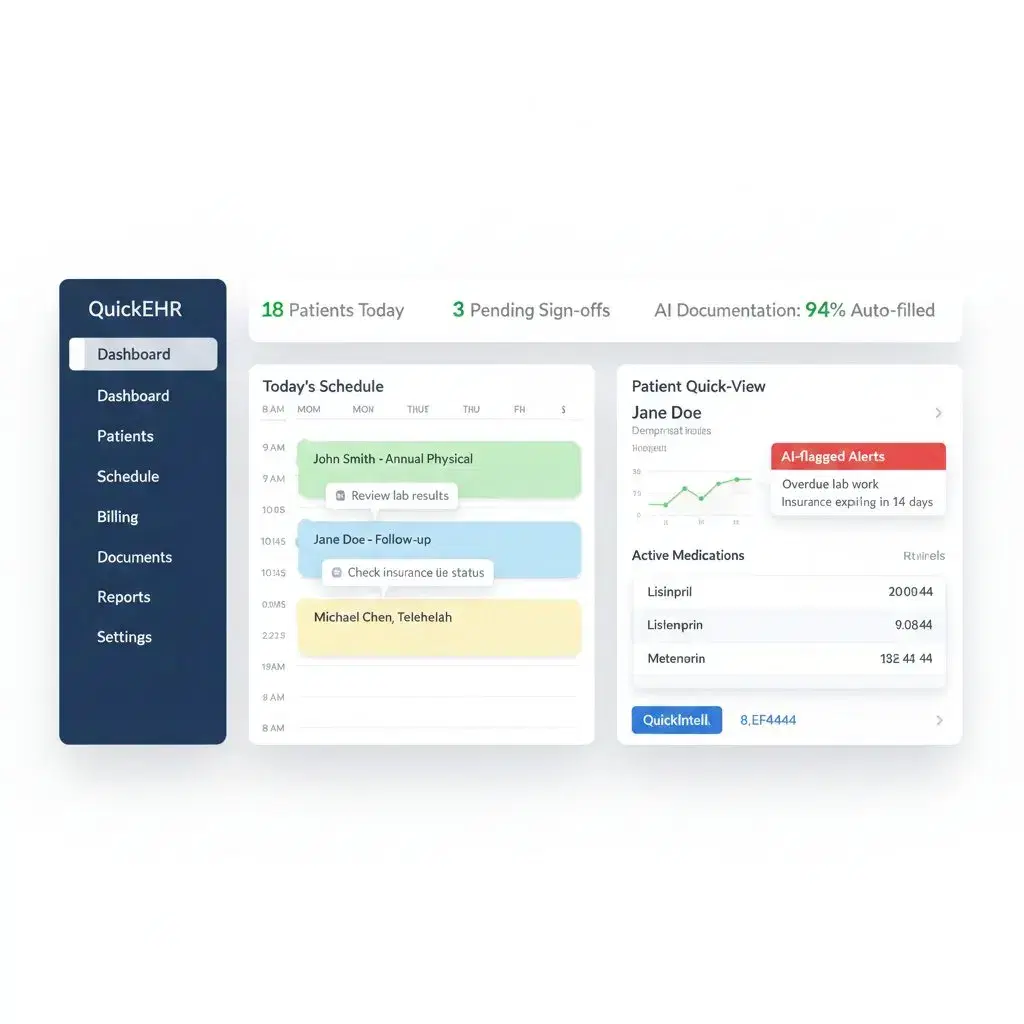
QuickEHR interoperability support for OpenEMR-powered workflows
QuickEHR interoperability support helps practices plan, validate, and operate the data paths that connect OpenEMR, FHIR, HL7, CCD/C-CDA, approved APIs, files, and interface feeds to QuickIntell AI workflows. The value proposition is practical: patient and encounter context should reach the teams handling documentation, coding, authorization, claims, ERA, and follow-up without creating hidden interface risk.
Connections, mappings, AI handoffs, and support queues
Scope
Data and owners
Validate
Test cases
Support
Monitor and tune
Support scope
Interoperability support is useful only when it is tied to the work teams need to finish.
Teams evaluating EHR interoperability, EHR integration services, healthcare interoperability software, and interoperability support software need more than a list of standards. They need a support model that turns connected data into a reliable QuickEHR workflow.
Scope and ownership
EHR integration services
QuickIntell starts interoperability support by naming systems, owners, data boundaries, review roles, and the support path for every connected workflow.
Inventory QuickEHR, OpenEMR, PM, clearinghouse, document, payer, and reporting systems.
Confirm the source of truth for patient, provider, location, schedule, chart, claim, and payment context.
Document who resolves mapping exceptions, access questions, failed messages, and workflow changes.
Standards and handoffs
Interoperability support software planning
The right support plan separates available standards from the actual work staff need to complete in the EHR and revenue-cycle workflow.
Review FHIR, HL7, CCD/C-CDA, OpenEMR APIs, files, reports, and interface-engine feeds where available.
Map approved data paths into clinical, documentation, coding, authorization, RCM, and ERA workflows.
Keep unsupported fields, write-backs, or custom objects out of production until they are validated.
Normalize and monitor
Healthcare interoperability software support
Connected data should become usable patient and encounter context, not another queue of unexplained interface errors.
Surface duplicate candidates, missing values, rejected messages, and stalled worklists for review.
Track mapping drift and release changes after go-live so support stays operational.
Assistive automation
AI EHR interoperability support
QuickIntell uses approved interoperability context to prepare work for review across the QuickEHR operating layer and connected AI products.
Use chart, document, order, payer, claim, and remittance context to reduce record chasing.
Route summaries, draft notes, coding signals, authorization packets, and revenue tasks to named owners.
Keep AI suggestions reviewable by clinicians, coders, authorization teams, billing teams, or staff.
Support workflow
A practical support path from discovery to post-launch monitoring.
The support workflow keeps OpenEMR interoperability support, API planning, interface validation, and AI EHR interoperability support in the same operating plan.
01 / Discover
Confirm the workflow before selecting the interface
Interoperability support starts with the practical workflow: what data is needed, who needs it, where it should appear, and what a person must review before it affects the record.
Map front desk, clinical, coding, prior authorization, billing, payment, and support owners.
Confirm whether QuickEHR-managed OpenEMR, an existing OpenEMR tenant, or another EHR remains the system of record.
Separate read-only context, review-required suggestions, write-back candidates, and support-only alerts.
02 / Connect
Evaluate FHIR, HL7, OpenEMR APIs, documents, and files
QuickIntell reviews the connection paths available for the tenant, then selects the safest route for the workflow instead of assuming every standard or endpoint is enabled.
Assess approved FHIR resources, OpenEMR API scope, HL7 event feeds, CCD/C-CDA documents, and controlled extracts.
Document authentication, roles, tenant permissions, rate limits, test environments, and support contacts.
Decide which workflow needs real-time data and which should use scheduled reports or review queues.
03 / Map
Normalize patient, encounter, document, and revenue context
The support layer translates connected data into a shared QuickIntell workflow model for QuickEHR and adjacent automation products.
Preserve source timestamps, system IDs, and field origins so teams can trace why a task exists.
Send ambiguous matches, missing fields, and rejected transformations into visible exception queues.
04 / Validate
Test the workflow with representative cases
QuickEHR interoperability support should prove the end-to-end workflow before go-live, including negative cases that happen in real operations.
Test patient search, document intake, appointment changes, orders, results, payer context, claim handoffs, and remittance exceptions.
Run duplicate patient, missing scope, expired credential, failed call, malformed payload, and rejected write scenarios.
Confirm how QuickScribe, QuickCode, QuickAuth, QuickRCM, and QuickERA receive context when configured.
05 / Operate
Keep support visible after production launch
Interoperability work continues after the first successful connection. Support should include monitoring, escalation paths, mapping reviews, and workflow tuning.
Review workflow changes before they alter chart, authorization, coding, claim, or payment behavior.
Use support findings to tune templates, mappings, AI prompts, role access, and team ownership.
AI automation
Use interoperability context where AI can prepare work for review.
AI should not become a hidden write path. QuickEHR interoperability support defines where data can help QuickIntell modules draft, summarize, classify, suggest, and route work while teams approve final outputs.
QuickEHR is built on the OpenEMR foundation, so support starts with deployment reality.
OpenEMR interoperability support can look different for a QuickEHR-managed deployment, an existing customer-hosted OpenEMR tenant, or a workflow where another EHR remains in place. QuickIntell scopes available APIs, FHIR resources, HL7 feeds, reports, documents, access paths, and support ownership for the actual environment.
For practices adopting QuickEHR, support can align OpenEMR-powered chart workflows with QuickIntell automation, implementation owners, and operating queues.
Existing OpenEMR tenants
For practices already using OpenEMR, support can evaluate approved API, FHIR, HL7, document, report, hosting, customization, and access paths before automation is scoped.
Adjacent EHR or PM systems
When another system remains in place, interoperability support can define which context QuickIntell receives, which system owns the record, and where exceptions are handled.
Related QuickEHR pages
Move from support questions into implementation details.
Interoperability support sits beside the standards page, the open API page, the testing sandbox, implementation planning, and OpenEMR integration. These links keep the support conversation tied to the technical and operational decisions that follow.
Primary care may prioritize outside history and care gaps. Urgent care often needs recent visits, medications, and results. Specialty groups may need referrals, imaging, procedure notes, authorizations, and payer evidence. QuickEHR interoperability support should route each signal to the team that can act on it.
Define support boundaries before production workflows depend on connected data.
Interoperability support touches source data, patient records, clinical documents, AI outputs, payer context, claims, remittance details, and support ownership. QuickIntell scopes what is accessed, who reviews it, how exceptions are resolved, and what evidence belongs in the implementation packet.
Procurement, IT, security, compliance, and operations teams should review current materials through the QuickIntell Trust Center and deployment-specific documentation. This page does not create a certification or compliance claim for a specific tenant.
Define what can be read, summarized, classified, routed, suggested, written back, or held for review.
Test duplicate patients, missing scopes, expired credentials, failed messages, malformed payloads, rejected writes, and mapping drift.
Connect support workflows to QuickScribe, QuickCode, QuickAuth, QuickRCM, QuickERA, and QuickEHR operating queues where configured.
Review trust, PHI handling, access controls, audit expectations, and implementation-specific evidence before production use.
FAQs
QuickEHR interoperability support questions
Answers for teams evaluating OpenEMR interoperability support, EHR interoperability, healthcare interoperability software, EHR integration services, and AI EHR interoperability support.
What is QuickEHR interoperability support?
QuickEHR interoperability support is the planning, configuration, testing, monitoring, and support work needed to connect OpenEMR-powered QuickEHR workflows with approved EHR, PM, payer, clearinghouse, document, API, interface, or file paths. The goal is usable patient and encounter context for charting, documentation, coding, prior authorization, RCM, ERA, and patient follow-up.
How does QuickEHR interoperability support work with OpenEMR?
QuickEHR is built on the OpenEMR foundation. For a managed QuickEHR deployment or an existing OpenEMR tenant, QuickIntell can evaluate approved OpenEMR APIs, FHIR availability, HL7 feeds, CCD/C-CDA documents, files, reports, and interface-engine routes, then map available context into reviewable workflows.
Is this interoperability support software or EHR integration services?
It is both a support workflow and an implementation service. The software layer normalizes approved interoperability context and routes work into QuickEHR and QuickIntell modules. The service layer helps scope access, data maps, testing, ownership, support queues, trust review, and go-live decisions.
Which interoperability standards can be reviewed?
A support plan can review FHIR resources, OpenEMR APIs, HL7 v2 event feeds, CCD and C-CDA documents, controlled reports, approved file exchange, clearinghouse data, and interface-engine feeds where the tenant and connected systems support them. The final scope depends on available endpoints, permissions, configuration, and workflow needs.
Can interoperable EHR data feed QuickIntell AI workflows?
Yes, when configured and approved. Interoperable chart, document, order, payer, claim, and remittance context can help QuickScribe prepare notes, QuickCode support coding review, QuickAuth prepare authorization packets, QuickRCM route claim work, and QuickERA connect payment exceptions. People remain responsible for final review and decisions.
Can QuickEHR connect to an existing OpenEMR tenant?
Practices already using OpenEMR can evaluate a QuickIntell connection without replacing their tenant. Available read, write, synchronization, reporting, interface, and support paths depend on the OpenEMR environment, hosting model, enabled modules, customizations, approved access, and implementation scope.
Do we have to replace our current EHR to use interoperability support?
No. QuickEHR may be used as the OpenEMR-powered EHR, but interoperability support can also evaluate workflows where another EHR, PM system, clearinghouse, or document repository remains in place. The support plan should define which system owns the record and how QuickIntell receives approved context.
How should testing and go-live support be handled?
Testing should include representative patients, encounters, documents, appointments, orders, payer context, claims, denials, payments, and exception cases. Go-live support should include monitoring, escalation ownership, sample-record checks, mapping review, failed-message triage, and workflow tuning after launch.
Does this page make certification or compliance claims?
No. This page describes QuickEHR interoperability support planning and does not create new certification, EPCS, ONC, HIPAA, SOC 2, customer, payer, or exchange-network claims. Security, regulatory, procurement, and contracting evidence should be reviewed for the specific deployment through current implementation materials and the Trust Center.
Build QuickEHR interoperability support around the workflows your teams actually run.
Bring your EHR, OpenEMR tenant, interface inventory, document exchange paths, payer workflows, and AI automation priorities. QuickIntell can help map the support plan before production workflows depend on connected data.