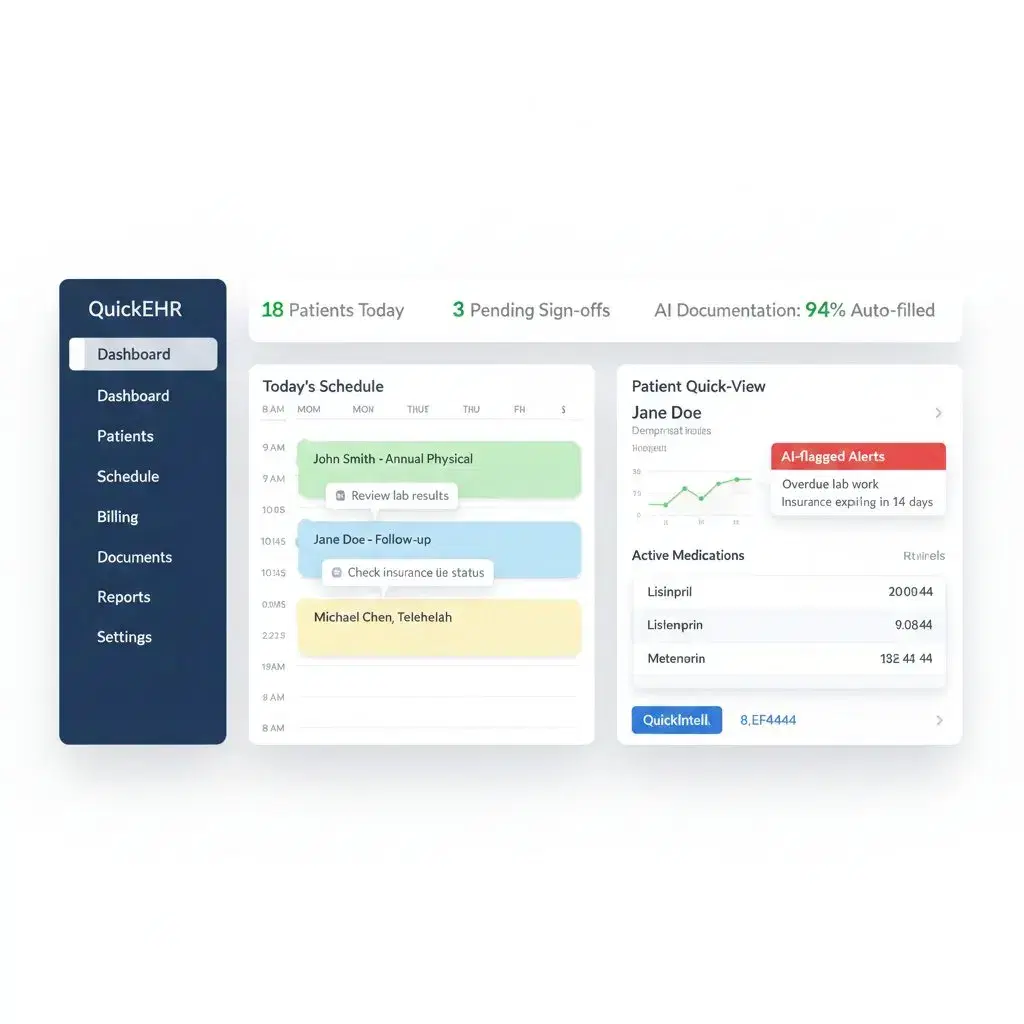
QuickEHR EHR training helps ambulatory practices learn the workflows they will actually run: OpenEMR-powered charting, scheduling, patient access, documentation, coding, prior authorization, RCM, ERA follow-through, AI review queues, go-live support, and ongoing onboarding. The goal is practical adoption, not a generic feature tour.
Searchers looking for EHR training usually need a practical way to learn the system. QuickEHR training is organized around roles, workflows, exceptions, and adoption support.
Front office and patient access
Train the staff who keep the day moving: scheduling, intake, eligibility, registration fixes, reminders, patient messages, and handoff queues.
Practice new-patient scheduling, self-scheduling review, appointment reminders, and same-day changes.
Define when staff use QuickEHR, QuickAuth, QuickRCM, or patient communication workflows for follow-up.
Clinical and provider workflows
Use EHR training to rehearse how providers and care teams move from chart prep to documentation, orders, task review, and encounter completion.
Walk through OpenEMR-powered chart navigation, templates, documents, orders, problems, medications, and visit closure.
Train QuickScribe handoffs for draft notes, chart summaries, imported-document context, and provider review.
Create specialty-specific scenarios so training reflects real visit types instead of generic feature tours.
Billing, coding, and authorization
Connect electronic health record training to the downstream work that determines claim readiness and payer follow-through.
Practice charge handoff, documentation support, diagnosis/procedure review, claim queues, and denial prevention workflows.
Use QuickCode and QuickAuth training to show where AI suggestions help and where coders or authorization owners approve work.
Train exception handling for missing chart evidence, payer conflicts, attachments, and status updates.
Administrators, super users, and support
Prepare the people who answer questions after go-live: administrators, managers, trainers, IT contacts, and operational super users.
Review role access, templates, worklists, reports, dashboards, support tickets, and escalation ownership.
Keep a living training plan for new staff, temporary coverage, workflow changes, and post-launch optimization.
Document unresolved questions, training attendance, scenario results, and configuration updates for the launch packet.
Training workflow
Make the training plan phased, owned, and repeatable.
QuickEHR training covers the questions buyers bring to EHR onboarding training: what staff need to learn, how to practice real scenarios, how long adoption depends on scope, and how support continues after launch.
Assess
Name the roles and workflows that need training
QuickEHR training starts by mapping daily work to real roles instead of handing every user the same generic training software checklist.
Name front office, clinical, billing, coding, authorization, admin, reporting, and support reviewers.
Identify the highest-volume visit, document, payer, claim, payment, and patient-message scenarios.
Confirm whether the team is learning QuickEHR-managed OpenEMR, an existing OpenEMR tenant, or a connected EHR workflow.
Design
Build role-based scenarios before training begins
Useful EHR systems training lets staff practice the exact sequence they will run when patients, charts, payer rules, and AI review queues are live.
Create scenarios for scheduling, intake, chart prep, documentation, coding, authorization, claims, ERA, and support.
Separate must-learn launch workflows from later optimization, custom work, and low-volume edge cases.
Define the owner for each scenario, expected outcome, review boundary, and unresolved-question queue.
Configure
Tune QuickEHR before staff practice it
Training reveals friction quickly. QuickIntell uses those findings to tune roles, templates, worklists, reports, and handoffs before production adoption.
Use OpenEMR-aware configuration notes so training matches the tenant, version, modules, and custom forms in scope.
Keep source-system and migration questions visible for implementation owners instead of teaching around broken paths.
Train
Rehearse the real day, including exceptions
EHR implementation training should include what happens when data is missing, an AI suggestion needs review, or a payer handoff does not match the usual path.
Run short role-based sessions, practice labs, super-user reviews, and end-to-end launch rehearsals.
Teach users how to find the source chart context behind QuickScribe, QuickCode, QuickAuth, QuickRCM, and QuickERA work.
Capture questions that require configuration, policy, support, or leadership decisions before go-live.
Support
Keep adoption support active after go-live
New workflows settle after real patient volume starts. Training should continue through hypercare, support tickets, refresher sessions, and new-staff onboarding.
Monitor chart completion, coding queues, authorization gaps, claim readiness, denials, AR, ERA exceptions, and patient communication issues.
Use support findings to update training guides, quick references, reports, templates, and ownership rules.
Create repeatable onboarding paths for new hires and temporary coverage so knowledge does not sit with one super user.
Optimize
Expand automation only after the baseline is stable
AI EHR training works best when users first understand the baseline workflow, then learn where automation drafts, classifies, suggests, routes, or waits.
Review which AI-assisted workflows staff trust, which need clearer source context, and which need stronger exception handling.
Prioritize optimization around high-volume bottlenecks instead of adding every possible automation at once.
Keep human approval boundaries clear for clinical, billing, launch, and support decisions.
AI EHR training
Teach AI as a reviewable workflow, not a black box.
QuickIntell training shows users where automation prepares work, where source context lives, who approves the next action, and how exceptions route back to a person.
QuickScribe review
Train providers and clinical reviewers to use AI-prepared note context, document summaries, and visit drafts while preserving provider review.
QuickCode suggestions
Show coders and billers where diagnosis, procedure, modifier, and documentation-support suggestions come from before claim release.
QuickAuth packets
Practice payer requirement checks, evidence packets, missing chart data, status updates, and authorization handoff queues.
QuickRCM worklists
Train staff to move eligibility exceptions, claim readiness, denials, AR, payer status, and patient balances through owned queues.
QuickERA follow-through
Teach ERA, EOB, posting, adjustment, underpayment, denial, and patient-responsibility review from the same encounter context.
OpenEMR training fit
OpenEMR training should match the QuickEHR workflow in use.
QuickEHR is built on the OpenEMR foundation. Training should therefore account for the actual OpenEMR path: managed QuickEHR, an existing tenant, approved APIs, FHIR, HL7, files, documents, templates, forms, reports, support ownership, and QuickIntell automation boundaries.
Use QuickEHR training when the practice wants staff to learn an OpenEMR-powered EHR workflow with QuickIntell automation wrapped around it.
Existing OpenEMR tenants
For teams already using OpenEMR, training can focus on tenant-specific templates, forms, documents, roles, reports, APIs, and custom workflow paths.
OpenEMR training plus AI handoffs
Teach where OpenEMR chart context feeds QuickScribe, QuickCode, QuickAuth, QuickRCM, QuickERA, and patient workflows for human review.
Training scope
Scope training by roles, scenarios, AI modules, and adoption risk.
QuickEHR training is part of services and implementation planning. The right scope depends on who needs training, which workflows launch first, and which QuickIntell modules are in use.
Readiness and launch training
For teams preparing for implementation, migration, go-live, or the first QuickEHR production workflow.
Role matrix and scenario plan.
QuickEHR and OpenEMR workflow walkthroughs.
Launch rehearsal and support ownership.
Role-based adoption labs
For practices that want focused sessions by team instead of one broad product overview.
Front office, clinical, billing, coding, authorization, and admin tracks.
Practice data, sample patients, worklists, and exception queues.
Super-user coaching and training artifacts.
AI workflow training
For teams adding QuickIntell automation around the chart, payer requirements, claim lifecycle, remittance, or patient outreach.
QuickScribe, QuickCode, QuickAuth, QuickRCM, and QuickERA handoffs.
Human-review boundaries and source-context review.
Exception handling for uncertain AI suggestions.
Ongoing onboarding support
For teams that need repeatable EHR onboarding training after go-live as staff, templates, and workflows change.
New-staff pathways and refresher sessions.
Issue trends from support tickets and super users.
Updated quick references, reports, and workflow notes.
Final training scope depends on practice size, locations, specialties, existing EHR familiarity, OpenEMR configuration, migration status, selected AI modules, and support expectations. Review QuickEHR pricing and QuickEHR professional services for related implementation context.
Connected QuickIntell products
Train the chart workflow together with downstream work.
QuickEHR training becomes more useful when staff understand how documentation, coding, prior authorization, RCM, remittance, and patient workflows connect to the same chart context.
Make governance part of training before production use.
Training touches PHI handling expectations, access roles, imported documents, support ownership, AI suggestions, billing handoffs, and go-live decisions. The training plan should make those responsibilities explicit before users rely on the workflow.
Define training owners for clinical operations, front office, billing, coding, prior authorization, admin, reporting, IT, and support before sessions begin.
Confirm QuickEHR, OpenEMR, source-system, migration, interface, and data-access assumptions so training matches the actual deployment.
Use role-based scenarios for scheduling, intake, chart prep, documentation, coding, authorization, claims, ERA, patient messaging, and reporting.
Teach AI review boundaries for drafting, classification, coding suggestions, authorization packets, RCM routing, and ERA follow-through.
Capture unresolved questions, configuration changes, policy decisions, and support issues in a shared launch-readiness log.
Review the QuickIntell Trust Center and deployment-specific evidence needs before production training expands.
Primary keyword
EHR training
The page answers practical training, onboarding, role, scenario, and support questions for QuickEHR adoption.
OpenEMR path
Foundation-aware
Training accounts for QuickEHR-managed OpenEMR, existing OpenEMR tenants, templates, reports, and integration paths.
AI boundary
Human review
Users learn where AI prepares work, where source context lives, and where accountable approval remains required.
Related QuickEHR service pages
Training sits beside implementation, professional services, consulting, testing, pricing, and OpenEMR integration planning.
Training should reflect specialty templates, visit cadence, documentation burden, order patterns, payer rules, coding patterns, patient-flow needs, and RCM handoffs.
Answers for teams comparing EHR training, OpenEMR training, AI EHR training, EHR implementation training, onboarding, learning time, and workflow support.
What does EHR training include for QuickEHR?
QuickEHR EHR training can include role-based workflow sessions for front office, providers, clinical staff, billing, coding, prior authorization, administrators, reporting users, support teams, and super users. Training should cover QuickEHR navigation, OpenEMR-powered chart workflows, AI review boundaries, scenario practice, go-live support, and post-launch optimization.
How does OpenEMR training fit QuickEHR?
QuickEHR is built on the OpenEMR foundation, so OpenEMR training can be part of the plan when users need to understand chart navigation, templates, forms, documents, roles, reports, APIs, tenant-specific configuration, and how OpenEMR context feeds QuickIntell automation.
Does QuickEHR training include AI EHR training?
Yes, when AI workflows are in scope. AI EHR training should teach users where QuickScribe, QuickCode, QuickAuth, QuickRCM, and QuickERA draft, classify, suggest, route, or summarize work, and where a person must review source context before final action.
Is this an EHR training certification program?
No. This page describes product and workflow training for QuickEHR, OpenEMR-aware workflows, and connected QuickIntell modules. It is not a third-party credential or certification program. Any credentialing, regulatory, or procurement evidence should be reviewed separately for the specific deployment.
How long does it take staff to learn QuickEHR?
The learning timeline depends on practice size, user roles, specialty mix, current EHR familiarity, OpenEMR configuration, migration scope, selected QuickIntell modules, and how many workflows must be practiced before go-live. A reliable plan should be based on role-based scenarios rather than a generic time estimate.
What should be in an EHR training plan?
An EHR training plan should include roles, workflows, trainers, super users, scenarios, test patients or sample data, AI review boundaries, quick-reference materials, unresolved-question logs, support ownership, go-live rehearsal steps, and post-launch refresher sessions.
Can training help with EHR implementation?
Yes. EHR implementation training helps staff practice the launch workflow before production use. For QuickEHR, that can include scheduling, chart prep, documentation, coding, authorization, claim readiness, ERA follow-through, patient messaging, reporting, and support escalation.
Who should attend QuickEHR training?
Training should include the people who perform or own the workflow: front office, clinical users, providers, billing, coding, prior authorization, RCM managers, administrators, reporting users, IT contacts, support owners, and super users.
Can QuickEHR support ongoing EHR onboarding training?
Yes, ongoing onboarding can be scoped for new hires, role changes, temporary coverage, workflow changes, and post-launch optimization. The strongest programs keep quick references, scenario guides, support findings, and configuration changes current.
Does this page make compliance or certification claims?
No. This page describes training and adoption planning. QuickEHR is built on the OpenEMR foundation, and any certification, regulatory, security, payer, procurement, or contractual evidence should be confirmed in the current Trust Center materials, implementation packet, and agreement for the specific deployment.
QuickEHR training and adoption
Build the training plan around the workflows your staff will run.
QuickIntell can help your team scope QuickEHR training around OpenEMR-powered workflows, AI review boundaries, role-based scenarios, support ownership, and connected automation across the revenue cycle.