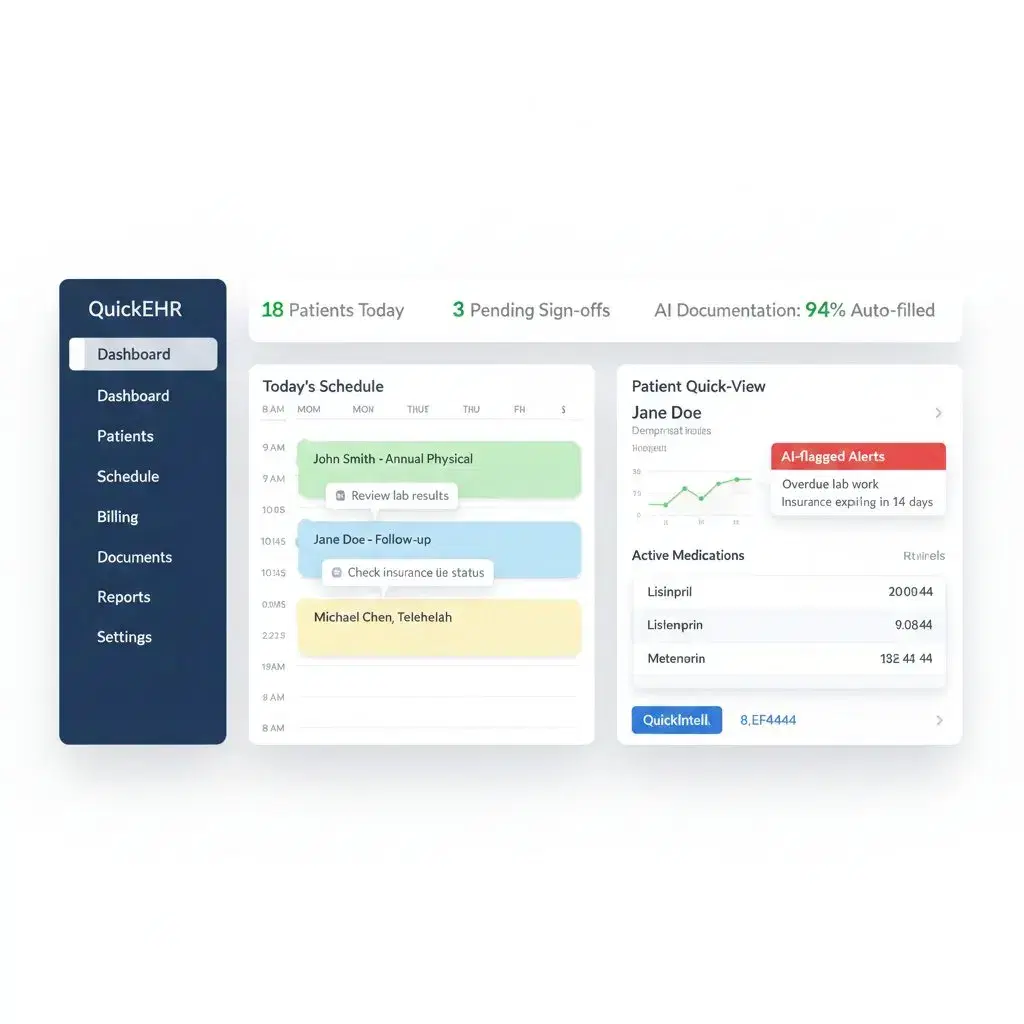
QuickEHR professional services for EHR implementation services and OpenEMR workflows
QuickEHR professional services help ambulatory practices plan, migrate, configure, train, automate, and optimize OpenEMR-powered workflows. QuickIntell connects EHR implementation services with EHR consulting, OpenEMR consulting, custom work, AI automation, RCM handoffs, ERA follow-through, and practical launch support.
A services hub for migration, implementation, training, consulting, and custom work.
Searchers comparing EHR implementation services and EHR consulting services need a clear view of what gets scoped, who approves it, and how QuickEHR, OpenEMR, and AI automation fit together.
Implementation and migration
Plan EHR implementation services around the systems, records, roles, workflows, and launch risks that affect the practice before go-live.
Review existing OpenEMR tenants, approved API paths, FHIR, HL7, files, reports, and custom forms.
Document unsupported items and dependencies before custom work or automation is approved.
Training and adoption
Turn EHR training services into practical role-based workflows instead of generic feature tours.
Train front desk, clinical, billing, coding, prior authorization, admin, reporting, and super-user teams.
Run scenarios for scheduling, chart prep, documentation, claim readiness, ERA review, and patient follow-up.
Use launch feedback to tune templates, worklists, reports, prompts, queues, and ownership rules.
Consulting and custom work
Use professional services to scope the custom work that should be configured, integrated, automated, or held for later review.
Assess EHR consulting needs across workflow design, implementation, RCM, reporting, and optimization.
Define acceptance criteria for custom forms, reports, interfaces, task queues, and AI-assisted workflows.
Keep the first release focused on work that can be tested with representative patients, documents, claims, and payments.
Services workflow
Professional services should be phased, owned, and testable.
QuickEHR professional services connect discovery to delivery: assessment, scope, configuration, AI automation, training, go-live support, and optimization.
Assess
Define the current operating model
QuickEHR professional services start by mapping how care delivery, patient access, coding, authorization, billing, payments, and reporting run today.
Name clinical, front-office, billing, coding, authorization, IT, compliance, and leadership reviewers.
Document source systems, work queues, payer portals, spreadsheets, reports, interfaces, and known bottlenecks.
Clarify whether QuickEHR, an existing OpenEMR tenant, or a connected EHR workflow is the target path.
Plan
Translate the service request into scope
Professional services should produce decisions: what is included, what waits, which owners approve it, and how success is tested.
Separate data migration, implementation, configuration, training, consulting, custom work, and ongoing support.
Connect QuickEHR scope to QuickScribe, QuickCode, QuickAuth, QuickRCM, QuickERA, and OpenEMR integration needs.
Document assumptions, excluded items, third-party dependencies, and review gates before timeline commitments.
Build
Configure QuickEHR and supporting workflows
Build work can include QuickEHR configuration, OpenEMR workflow review, field mapping, template design, integrations, reports, and AI routing.
Set up users, roles, locations, schedules, chart templates, document categories, reports, and workflow queues.
Preserve source identifiers, timestamps, ownership, exception states, and review history where the workflow requires it.
Keep custom rules, prompts, mappings, and task automation visible to implementation owners.
Automate
Add AI only where work can be reviewed
AI EHR professional services should reduce manual work while keeping clinical, billing, legal, and launch decisions with accountable people.
Define where AI drafts, classifies, summarizes, extracts, suggests, validates, routes, or waits for human review.
Use chart, payer, claim, remittance, and document context from QuickEHR in the right QuickIntell module.
Route missing data, uncertain suggestions, and failed handoffs to named queues instead of hiding exceptions.
Train
Practice the real day before launch
Training should use representative patients, encounters, documents, payer rules, claims, remittances, and exception cases.
Run front-office, clinical, coding, authorization, billing, ERA, reporting, and support scenarios before production use.
Create launch issue-triage paths, super-user coverage, and escalation rules for unresolved questions.
Use training feedback to adjust configuration, templates, worklists, and AI review boundaries.
Optimize
Keep support and improvement in the same plan
Professional services should continue into stabilization so the practice can tune workflows after real usage starts.
Monitor patient flow, chart completion, coding queues, authorization status, claims, denials, AR, ERA, and support tickets.
Prioritize fixes that affect patient care workflows, claim readiness, payment follow-through, and staff adoption.
Build the next optimization backlog after the baseline QuickEHR workflow is stable.
AI EHR professional services
Design AI automation around reviewable QuickEHR work.
QuickIntell professional services identify where AI should prepare work, where people approve it, and how exceptions route through QuickEHR and downstream modules.
Documentation assistance
Use QuickScribe context to support note drafting, imported-document summaries, chart prep, and provider adoption with clinician review.
Coding review
Connect documentation to QuickCode so diagnosis, procedure, modifier, HCC, and documentation-support suggestions stay reviewable.
Authorization worklists
Use QuickAuth to organize payer requirements, evidence packets, status tracking, and missing chart data from the QuickEHR workflow.
Revenue-cycle routing
Use QuickRCM to route eligibility, claim readiness, denials, AR, payer status, and patient balance work from the same chart context.
ERA follow-through
Use QuickERA to connect remittance, EOB, posting, adjustment, denial, underpayment, and patient-responsibility review queues.
OpenEMR professional services
OpenEMR consulting needs to connect the foundation to daily operations.
QuickEHR is built on the OpenEMR foundation. Professional services can help decide how OpenEMR configuration, QuickEHR workflows, approved APIs, FHIR, HL7, files, documents, templates, user roles, billing settings, OpenEMR implementation work, OpenEMR customization, OpenEMR support services, and QuickIntell automation fit the specific practice.
Use QuickEHR when the practice wants an OpenEMR-powered workflow with implementation, training, support, and QuickIntell automation around it.
Existing OpenEMR tenant
For teams already using OpenEMR, professional services can review configuration, custom forms, APIs, FHIR, HL7, files, documents, and support paths.
OpenEMR custom work
Scope OpenEMR customization, reports, templates, integrations, and workflow changes with clear acceptance criteria and review boundaries.
Services and pricing scope
Scope professional services by decisions, dependencies, and implementation risk.
Professional services software buyers usually need practical scope before pricing. QuickEHR services are framed by workstreams, systems, source data, selected modules, launch timing, and support expectations.
Readiness sprint
A focused professional-services track for practices that need an implementation, OpenEMR, AI, or RCM roadmap before a larger rollout.
Workflow discovery and system inventory.
OpenEMR and QuickEHR fit assessment.
Prioritized implementation and automation backlog.
Implementation project
A launch-oriented track for EHR implementation services, data migration planning, configuration, training, testing, and go-live support.
Migration and data-conversion scope.
Role-based configuration and training.
Go-live readiness and hypercare planning.
Custom workflow build
A scoped custom-work track for forms, templates, reports, interfaces, data handoffs, and AI-assisted workflow extensions.
Acceptance criteria and feasibility review.
Configuration, integration, or report design.
Validation with representative workflow cases.
Optimization and support
A post-launch track for practices tuning QuickEHR workflows, OpenEMR support paths, AI automation, RCM queues, and reporting.
Operational bottleneck review.
Template, worklist, and report tuning.
Automation expansion planning.
Final scope and pricing depend on the practice, systems, data, interfaces, support model, selected products, and launch timeline. Review QuickEHR pricing for the EHR core, optional modules, and implementation planning context.
Connected QuickIntell products
Professional services should connect the chart to downstream work.
The strongest QuickEHR services plan connects EHR configuration to documentation, coding, authorization, RCM, remittance, patient operations, and OpenEMR integration.
Make governance part of the professional-services plan.
Professional services touch source data, PHI handling, access controls, imported documents, AI suggestions, billing handoffs, and support ownership. The plan should make those decisions explicit before production use.
Confirm source systems, data paths, user roles, access owners, and PHI handling expectations before production work begins.
Review the QuickIntell Trust Center and any deployment-specific evidence needed for the selected QuickEHR workflow.
Document AI boundaries for drafting, classification, coding suggestions, authorization packets, RCM routing, and ERA follow-through.
Keep service scope, workflow maps, configuration decisions, training plans, test scenarios, unresolved exceptions, and sign-off records with the project packet.
Separate QuickIntell professional-services scope from clearinghouse, payment, payer, lab, eRx, hosting, interface, or third-party vendor costs.
Avoid relying on generic certification, security, customer, or regulatory claims without confirming current evidence for the specific deployment.
Primary keyword
EHR implementation services
The hub answers service-buyer questions about implementation, migration, training, go-live, and support.
OpenEMR path
Professional support
Services clarify how OpenEMR configuration, customization, integration, and support paths fit QuickEHR.
AI boundary
Reviewable
AI prepares summaries, suggestions, worklists, and routing while people approve clinical, billing, and launch decisions.
Related QuickEHR service pages
Professional services sit beside implementation, consulting, custom work, data conversion, pricing, and OpenEMR integration planning.
Answers for teams comparing EHR implementation services, OpenEMR professional services, EHR consulting, AI EHR automation, migration, training, and custom work.
Do QuickEHR professional services include EHR implementation services?
Yes. QuickEHR professional services can include EHR implementation services such as workflow discovery, source-system inventory, OpenEMR and legacy EHR migration planning, QuickEHR configuration, role-based training, test scenarios, go-live support, hypercare, and post-launch optimization.
What are QuickEHR professional services?
QuickEHR professional services are scoped implementation, consulting, migration, configuration, training, custom work, OpenEMR support planning, AI automation, and workflow optimization services around the OpenEMR-powered QuickEHR environment and connected QuickIntell products.
Is this OpenEMR professional services or QuickEHR services?
It can be both. QuickEHR is built on the OpenEMR foundation, so the work can include OpenEMR consulting, OpenEMR implementation planning, OpenEMR customization assessment, API or FHIR readiness, HL7/interface planning, OpenEMR support ownership, and QuickEHR workflow design.
Can professional services help with EHR data migration?
Yes. The team can help scope EHR data migration and data conversion by reviewing source extracts, reports, database exports, APIs, files, document stores, custom fields, validation samples, archive access, cutover rules, and exception queues.
How do AI EHR professional services work?
AI EHR professional services define where QuickIntell should draft, classify, summarize, suggest, validate, route, or wait for human review across QuickEHR workflows. The goal is to prepare reviewable work for documentation, coding, authorization, claims, ERA, patient communication, and reporting without skipping accountable approval.
What custom work can be scoped?
Custom work can include templates, forms, document categories, reports, worklists, API/FHIR/HL7/file handoffs, data mappings, dashboard views, task routing, and AI-assisted workflow extensions. Each request should have feasibility review, acceptance criteria, test cases, owners, and known limitations.
Do professional services include training?
Training can be included when it is in scope. Useful EHR training services are role-based and scenario-driven for front office, clinical, billing, coding, prior authorization, admin, reporting, and support teams.
How are QuickEHR professional services priced?
Professional-services pricing depends on practice size, locations, specialties, current systems, source data, interfaces, workflow complexity, selected QuickIntell modules, launch timing, and support needs. A reliable estimate should be made after discovery and scope review rather than using a generic hourly promise.
Which QuickIntell products can be part of the services plan?
The plan can include QuickEHR, QuickScribe, QuickCode, QuickAuth, QuickRCM, QuickERA, and related patient, reporting, billing, interoperability, and OpenEMR integration workflows. The right mix depends on the immediate operational goal.
Does this page make certification or compliance claims?
No. This page describes professional services and workflow planning. QuickEHR is built on the OpenEMR foundation, and any certification, regulatory, security, payer, procurement, or contractual evidence should be confirmed in the current Trust Center materials, implementation packet, and agreement for the specific deployment.
QuickEHR professional services
Build the implementation, training, AI workflow, and support plan before go-live.
QuickIntell can help your team scope QuickEHR professional services around OpenEMR-powered workflows, source data, custom work, role-based training, trust review, and connected automation across the revenue cycle.