Call
OpenEMR-powered report center

QuickEHR report center for medical reporting software

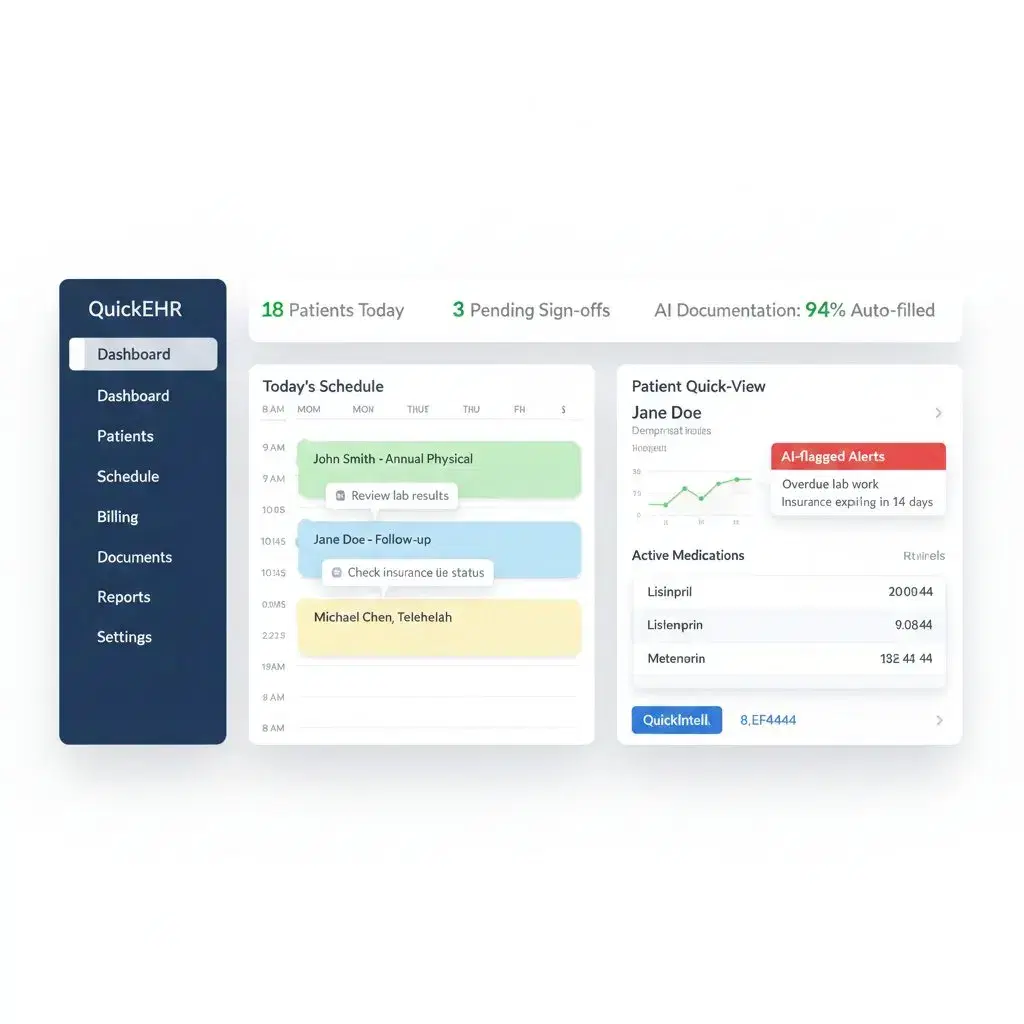
QuickEHR report center gives practices medical reporting software for OpenEMR-powered chart, schedule, patient, payer, billing, claim, denial, remittance, AR, and workflow reports, with QuickIntell AI support for summaries and reviewable work queues.

Primary intent: medical reporting software
Report scope: clinical, PM, billing, RCM
AI role: reviewed summaries and routing

QuickEHR report center workspace

Medical billing reports, EHR reporting, and AI summaries

QuickEHR report center showing medical billing reports, claims, denial, remittance, and workflow analytics

Billing reports

Claims, AR, ERA

PM reporting

Schedules, flow, queues

AI summaries

Patterns and routing

Report center workflow

Make reports useful at the point where work happens.

Search intent for healthcare reporting expects software that can show billing, financial, clinical, and practice performance. QuickEHR report center scopes those reports around the chart, schedule, payer, claim, payment, and team review paths that create the data.

Define

Start with a reporting question the team can act on

A report center should not become a warehouse of disconnected exports. QuickEHR frames each report around the operational question, the responsible team, the trusted source data, and the next review step.

  • Scope reports by patient, provider, location, payer, appointment, encounter, charge, claim, denial, remittance, AR, patient balance, or quality-program context.
  • Define filters, owners, refresh cadence, and data boundaries before teams rely on a report.
  • Separate source-of-truth fields from AI-prepared labels, summaries, and workflow suggestions.

Run

Generate medical billing reports without losing chart context

QuickEHR report center workflows keep billing and revenue reporting connected to the OpenEMR-powered visit story: chart, schedule, payer, code, claim, payment, denial, and follow-up work.

  • Review charge readiness, claim status, rejection trends, denial reasons, AR aging, ERA/EOB exceptions, and patient balance work by owner and aging band.
  • Move from a report row into the related QuickEHR, QuickCode, QuickAuth, QuickRCM, or QuickERA workflow when the deployment supports that context.
  • Keep exports, scheduled reports, and leadership summaries aligned with implementation-approved data paths.

Improve

Turn reports into reviewable work queues

Reporting is most useful when it changes the work. QuickIntell AI can help summarize patterns, classify exceptions, and route report findings for review while staff keep the decision points.

  • Route report exceptions to front desk, clinical, coding, prior authorization, billing, payment posting, denial, or AR owners.
  • Use resolved work as feedback for better report definitions, queue filters, and leadership scorecards.
  • Keep human review in place before report insights affect clinical notes, codes, claims, patient communication, write-offs, or appeals.

Report library

Cover the reports practice leaders ask for every week.

Medical reporting software has to answer financial, operational, and clinical questions without detaching the answer from the patient or payer workflow. QuickEHR report center is designed around reports teams can review and act on.

For KPI modeling and leadership dashboards, review QuickEHR business intelligence. For the live operating view, see the QuickEHR dashboard.

Medical billing reports

Track charges, claim readiness, claim status, rejections, denials, payment posting, adjustments, underpayments, patient balances, and billing-owner queues.

Practice management reporting software

Review scheduling demand, appointment outcomes, provider utilization, location performance, patient flow, no-show patterns, and front-desk exceptions.

Revenue cycle reporting

Use QuickRCM context for eligibility issues, authorization status, claims, CARC/RARC patterns, AR aging, payer follow-up, and appeal workload.

ERA and remittance reports

Use QuickERA context for ERA, EOB, adjustment, takeback, patient responsibility, unapplied cash, payment variance, and posting exception review.

Clinical and documentation reports

Review unsigned notes, draft status, message follow-up, order queues, clinical task aging, and documentation handoff from QuickScribe workflows.

Quality and population views

Plan cohort, care-gap, measure, registry, and patient health reporting around the data available in the QuickEHR deployment and approved workflow.

AI EHR report center

AI can explain report movement while teams keep approvals.

QuickIntell applies AI to reporting as assistive workflow support: summaries, pattern detection, exception classification, and routing for review. The report center should make the next action easier without turning report output into unreviewed clinical, coding, billing, or compliance decisions.

Report summaries

Draft plain-language summaries of what changed in a report: volume, aging, payer movement, denial patterns, posting exceptions, patient balance exposure, or owner workload.

Natural-language report questions

Ask reviewed questions about report data, queue growth, payer behavior, provider variation, claim aging, remittance exceptions, or documentation bottlenecks when the data is available.

Anomaly detection

Flag unusual patterns such as late charges, stale claims, missing authorizations, rejection spikes, unposted payments, payer-specific denials, or location-level volume changes.

Exception routing

Classify report rows by likely owner and next action so billing, coding, authorization, provider review, payment posting, and AR teams can work from one operating model.

OpenEMR and QuickEHR fit

Scope OpenEMR report center workflows around the deployment path.

QuickEHR is built on the OpenEMR foundation. A report center project should define whether the practice is using QuickEHR-managed OpenEMR, connecting an existing OpenEMR tenant, or routing reports around another EHR and practice management system.

QuickEHR-managed OpenEMR reporting

QuickEHR is built on the OpenEMR foundation and adds QuickIntell-managed reporting design, implementation planning, and AI-assisted report workflows around it.

Existing OpenEMR tenants

Practices already using OpenEMR can evaluate approved OpenEMR API, FHIR, HL7, EDI, clearinghouse, remittance, file, or interface-engine paths for report center scope.

QuickEHR Connect for other systems

Clinics keeping another EHR or practice management system can evaluate QuickEHR as a reporting and workflow layer around approved source-system data.

Implementation and trust

Define report governance before teams depend on exports.

Report center software touches patient data, provider productivity, payer workflows, claims, payments, patient balances, AI summaries, and leadership reporting. QuickEHR implementation should make data sources, access, exports, review gates, and accountability explicit.

Security, procurement, and compliance teams can start with the Trust Center, then verify any implementation-specific evidence in the current contract and deployment packet.

Report center launch checklist

Use this before exposing reports to operations teams.

Choose QuickEHR-managed OpenEMR, an existing OpenEMR tenant, or QuickEHR Connect around another EHR or practice management system.

Map report sources, filters, refresh cadence, export permissions, payer feeds, clearinghouse files, ERA/EOB inputs, and interface-engine responsibilities.

Define every KPI before launch: numerator, denominator, trusted source, owner, refresh timing, drill-down path, and exception handling.

Confirm which AI features may summarize, classify, explain, prioritize, or route report findings before human review.

Review role-based access, audit expectations, PHI exposure, user permissions, patient-facing language, and support ownership.

Validate reports with sample patients, visits, charges, claims, denials, payments, and edge cases before production use.

FAQs

QuickEHR report center questions.

These answers cover medical reporting software, report center software, medical billing reports, OpenEMR fit, AI reporting support, and implementation review.

What is QuickEHR report center medical reporting software?+

QuickEHR report center is medical reporting software for QuickEHR workflows. It helps practices organize OpenEMR-powered EHR, practice management, billing, claims, denials, AR, ERA/EOB, patient balance, and clinical workflow reports with reviewed QuickIntell AI support.

For the broader EHR platform, see QuickEHR.

What is report center software in an EHR?+

Report center software in an EHR is a central place to define, run, filter, review, schedule, and act on reports. In QuickEHR, the report center should keep reports tied to patient chart context, scheduling, billing, coding, prior authorization, claims, remittance, and follow-up ownership.

Which medical billing reports can QuickEHR support?+

QuickEHR can support medical billing reports around charge review, claim readiness, claim status, rejections, denials, CARC/RARC patterns, AR aging, payer follow-up, ERA/EOB handling, payment posting exceptions, patient balances, and billing-owner queues when those data paths are configured.

How does OpenEMR report center planning fit with QuickEHR?+

QuickEHR is built on the OpenEMR foundation. Practices can use QuickEHR-managed OpenEMR reporting or evaluate a connection to an existing OpenEMR tenant when approved API, FHIR, HL7, EDI, clearinghouse, remittance, file, or interface-engine paths are available for the deployment.

Is this the same as QuickEHR business intelligence?+

The pages are related but not identical. QuickEHR business intelligence focuses on broader analytics, dashboards, and KPI operating models. QuickEHR report center focuses on the report library, scheduled reports, report filters, exports, and report-to-workflow handoffs.

How does AI EHR report center automation work?+

QuickIntell AI can help summarize report movement, classify exceptions, explain payer or workflow patterns, prioritize report rows, and route items to the right owner for review. It should not replace clinical, coding, billing, compliance, or implementation approval.

Can practices use QuickEHR report center with another EHR?+

Practices keeping another EHR or practice management system can evaluate QuickEHR Connect. That path is intended to route approved reporting and workflow context around the existing source system instead of forcing every clinic to replace its EHR.

Does QuickEHR report center replace enterprise BI tools?+

Not always. QuickEHR report center is focused on EHR, practice management, medical billing, RCM, and QuickIntell workflow reporting. Some organizations may still export governed data to enterprise BI tools based on data policy, interfaces, and reporting scope.

What should teams review before launching report center workflows?+

Teams should review report definitions, source systems, user roles, access controls, export rules, audit expectations, AI review points, interface scope, payer files, remittance handling, data quality validation, support ownership, and current trust or procurement materials.

Need reports that understand the chart and the revenue cycle?

Scope QuickEHR report center around medical reporting software, medical billing reports, OpenEMR workflows, QuickIntell AI summaries, RCM reporting, and implementation review.

Book a demo